Category: Energy Matters

  • Weather extremes: the new normal

    More

    6 of 15
    Why this ad?
    Samsung Smart CameraSamsung.com/au/smart-cameraWB150F with stunning Samsung Features. Only $249 RRP. Info here

    Google Alert – SEVERE WEATHER EVENTS

    Inbox
    x

    Google Alerts googlealerts-noreply@google.com
    6:54 PM (41 minutes ago)

    to me
    News 4 new results for SEVERE WEATHER EVENTS
    Weather extremes: the new normal
    European Voice
    It has been another summer full of reports of extreme weather events of unparalleled scope and severity. Among the highlights: one of the warmest years on record in the US, record-high temperatures in central and eastern Europe, the wettest summer in
    See all stories on this topic »
    TV Forecasters: Connect Climate and Extreme Weather!
    Huffington Post
    When that weather goes off the charts, so to speak, because global warming has increased the chances of extreme events, weather forecasters can play a crucial role in helping the public to understand that connection. But there’s one little hurdle to
    See all stories on this topic »
  • Why business is locked into unsustainable and carbon-heavy cycles

    Why business is locked into unsustainable and carbon-heavy cycles

    Worldwide cynicism about official inaction over sustainability was hardly surprising, but capitalism locks us all into a system that feeds our carbon-hungry lives

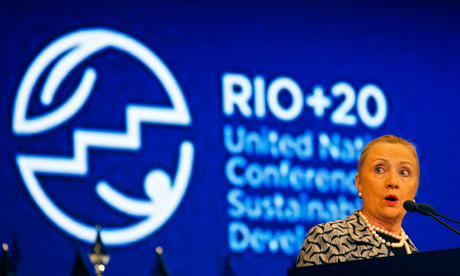
    US Secretary of State Hillary Clinton at Rio+20

    Hillary Clinton at Rio+20. The world has become very cynical about what such conferences can achieve. Photograph: Paulo Whitaker/Reuters

    After disappointing results in Copenhagen (2010) and Durban (2011), the world awaited Rio+20 with far less anticipation than we had for the Euro 2012 semi-finals, the successful crossing of Niagara Falls by Nik Wallenda, or the return of lunch blogger Martha Payne. Sustainable business, like all other business, has been riveted by the electoral politics of Greece and France and the more or less fictional pronouncements of G20 finance ministers. It was never likely that Rio+20 would change anything.

    We know that the international discourse about sustainability will not reverse decades of inaction, that governments will not likely guide us from economic and environmental disaster into a new world order of hope and quality of life. Our deep cynicism is well founded; we have seen too many pronouncements fail.

    Yet there is no human who does not prefer to live in hope. No business wants to discount its calculations of the net present value of future income streams by the absence of a future. No political leader wants to see the local impact of economic and environmental decline.

    How is it that time and again we are unable to achieve what so many of us want? Why can we not achieve an agenda which is likely the only way forward into prosperity?

    At the recent conference of the International Society of New Institutional Economists, Shi-Ling Hsu presented a paper looking at why we cannot get the answer right. In Physical, Human, and Social Capital as Barriers to Environmental Policy Change, he theorises that “environmentally harmful products and practices persist because firms and people have so much invested in their persistence”. We lock in unsustainable technologies and ways of life because capital is too expensive to write off without threatening the viability of a firm or a consumer. Oil companies and coal mine operators cannot afford to lose the value of their investments. State-owned enterprises are no less dependent on the value of carbon deposits than are for-profit companies.

    Fishing villages and logging towns around the world want to maintain their livelihoods which depend on the extraction of decreasingly available stocks. Families who are making large mortgage and loan payments on suburban homes and cars are not easily convinced to leave their commitments and reinvest in housing and transport with a smaller carbon footprint.

    Hsu suggests that we are locked into our carbon-hungry lives and our extractive livelihoods by specific and pervasive public policies which favour the creation and stability of capital. Grandfathering the use of old technology allows firms and their customers to get by with processes and equipment which are far worse than their replacements. Tax credits for extractive industries slow the movement of our economies into more sustainable industries. Capital gains taxes provide incentives to retain capital long past its “best before date” to avoid triggering tax penalties.

    Too often firms must retain their holdings in assets that unnecessarily deplete natural resources or burn carbon in order to maintain healthy balance sheets. They cannot easily invest in new capital when governments allow them generous tax concessions on outdated technology.

    We can better align incentives so that business will move out of the status quo and into more sustainable methods. Governments need not continue to support and subsidise outdated industries and processes. Instead, they might identify “environmentally-stranded capital” and let it be written down to zero over a relatively short period of time – if it is taken out of operation forever. If we really want companies to change, we must demand accelerated write-off schedules for investments in coal mines and trawlers.

    One way forward is through better accounting standards. GDP+, the UK environment minister’s proposal to enter natural resources into a national chart of accounts, had the potential to resolve some of the tension between the desire of business to innovate and capital policies which lock us into old technology. When a nation assigns a value to its natural resources, it may be more likely to drop incentives which encourage resource depletion. Nick Clegg took the proposal to Rio. After appeals by Clegg and Joseph Stiglitz, the final text of the conference recognised the need for “broader measures of progress to complement GDP”. It referred the problem to the UN Statistical Commission.

    Until our various legislators and regulators reconsider their capital-related policies, we will have fewer financial incentives than we need. Until we stop being rewarded for maintaining old equipment, investments and industries, we have little reason to reinvest or to favour the substantive change which Rio+20 might have brought. Without fixing financial regulations and accounting schemes, we cannot easily fix the earth.

    Alison Kemper teaches management at York University and has worked with the Michael Lee-Chin Institute for Corporate Citizenship at the Rotman School since 2005. Her professional background is in advocacy and NGO management.

    Roger Martin is dean of the University of Toronto’s Rotman School of Management and is academic director of the school’s Michael Lee-Chin Family Institute for Corporate Citizenship. His research work is in integrative thinking, business design, corporate social responsibility and country competitiveness. His most recent book is Fixing the Game.

    This content is brought to you by Guardian Professional. Become a GSB member to get more stories like this direct to your inbox

  • Energy White Paper Submission

    Energy White Paper Submission
    Comments on the inadequate coverage of the risk of future oil shortages in the draft Energy White Paper The coverage of the real risks of future global oil shortages in the Energy White Paper is very seriously inadequate and displays a common but unfortunate tendency in Government and business to overlook or discount crucial risk factors. “Predictable Surprises” is the title of an essay published in the Harvard Business Review and a subsequent book. “Why do leaders consistently ignore looming signs of crises even when they know the consequences could be devastating? Most events that catch us by surprise are both predictable and preventable, but we consistently miss (or ignore) the warning signs Another analogy is “The Optimism Bias”, where only the most positive and favourable outcomes are considered in planning. This is an unconscious bias. However, the associated “Strategic Misrepresentation” is a related deliberate deception towards an unrealistically optimistic outcome. A number of documents were included as appendices Predictable Surprises, Optimism Bias, Peak Oil Summary, Economic explanation of Peak Oil, Megaprojects approach , Nature-Peak Oil , Aleklett-IEA-review and BITRE 117

  • The Secret to Solar Power NEW YORK TIMES


    Alert Name: CLIMATE CHANGE NEWS
    August 12, 2012 Compiled: 1:26 AM

    By JEFF HIMMELMAN (NYT)

    The future of solar belongs to whoever can convince consumers that it’s not just for tree-huggers and rich people.


  • Fukushima disaster paves way for new geothermal plants

    Fukushima disaster paves way for new geothermal plants

    Drive to find alternatives to nuclear power overrides fears that natural hot springs will be damaged by energy development

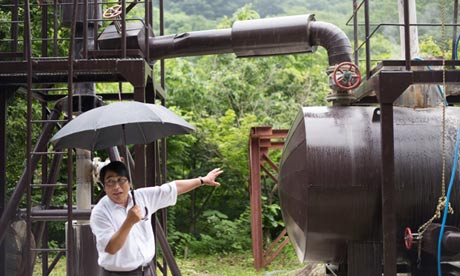
    Kazuya Ikeda explains the future location and logistics of a geothermal plant in Fukushima, Japan

    Kazuya Ikeda explains the future location and logistics of a geothermal plant in Fukushima prefecture, Japan. Photograph: Jeremy Sutton-Hibbert for the Guardian

    Before last year’s triple disaster in north-east Japan, Tsuchiyu Onsen drew tens of thousands of tourists in search of the recuperative qualities of its piping hot spring water.

    Almost 18 months after the nuclear accident at nearby Fukushima Daiichi power plant, that same natural resource is about to turn this spa resort into a trailblazer for the country’s push towards renewable energy.

    By spring 2014, Tsuchiyu, 9 miles (15km) from Fukushima, will be generating 250 kilowatts of electricity – about a quarter of the city’s total needs – at a geothermal plant hidden away in the surrounding mountains.

    The plant will be the first to be built inside a national park, a controversial move that only became possible after the environment ministry recently relaxed regulations on developing protected areas.

    If all goes to plan, the project could not only help the town become self-sufficient in power generation, but revive its role as a tourist destination after visitor numbers plummeted amid lingering fears over radiation. In the past, hot-spring operators have been among the fiercest opponents of geothermal energy, an obvious source of energy given Japan’s huge subterranean reserves of volcanic water.

    Many fear the plants would affect the flow and quality of the water, which is pumped up from the depths and then cooled for the benefit of Japan’s enthusiastic bathers.

    In Tsuchiyu, however, where half a dozen hotels remain closed with earthquake damage, spa owners are among the new geothermal generator’s keenest backers. “The plant won’t affect the water quality or the temperature,” said Kazuya Ikeda, general manager of the Tsuchiyu Onsen Tourist Association. “We have surveyed opinion in the town, and no one has raised any objections.”

    The move also makes economic sense. Under a new feed-in tariff system introduced last month, utilities are required to pay premium prices for renewable energy – 42 yen (34p) per kilowatt for geothermal power.

    “The structure itself will be quite small and unobtrusive,” Ikeda added. “And with the feed-in tariff, we should be able to cover our initial costs in about seven years.”

    The 300m-yen (£2.5m) facility will use water pumped from below ground and combine it with an ammonia-like substance with a lower boiling point than water to propel a turbine.

    Resistance to geothermal power, coupled with the pre-Fukushima faith in nuclear, means that until now Japan has failed to tap into a resource that energy experts believe has huge potential. Its 18 geothermal plants account for 0.2% of electricity output, according to the trade and industry ministry, and no new plants have been built for a decade.

    Scientists believe the sector’s share could rise enormously thanks to the feed-in tariff, new subsidies to fund feasibility studies and test-drilling, and official recognition that nuclear’s heyday has passed.

    According to one estimate, Japan’s gGeothermal capacity could reach 24m kilowatts – the third biggest in the world after the US and Indonesia – compared with less than 550,000 kilowatts now. Tsuchiyu has other compelling reasons to embrace geothermal power. Visitor numbers dropped dramatically after the Fukushima nuclear disaster, and while a recovery is under way, fears of radiation persist, even though recorded levels here pose no health threat.

    Profits from the venture will be used to repair three damaged hotels and rebuild three others that were destroyed in the earthquake.

    In the long term, Ikeda believes Tsuchiyu will become a model for other small towns struggling to find clean and stable sources of energy, while experts debate if nuclear has any role to play in Japan’s future energy mix.

    If the experiment works, it should allay anxiety among other Onsen operators about potential damage to hot-spring water flows – the financial lifeblood of countless similar resorts around Japan.

    Eventually, the geothermal plant will be capable of generating 1,000 kilowatts, according to Ikeda. That is a tiny fraction of the capacity of just one of Fukushima Daiichi’s now crippled reactors. But with opposition to nuclear restarts unlikely to waver, towns such as Tsuchiyu have no choice but to turn to alternatives, he said.

    “If it hadn’t been for the nuclear disaster, we would never have given this project a second thought.”

  • Oil Companies Still Hiding the True Risks of Deepwater Drilling from Investors

    Oil Companies Still Hiding the True Risks of Deepwater Drilling from Investors

    Posted: 03 Aug 2012 04:38 PM PDT

    Oil and gas companies are doing a terrible job of disclosing climate and deepwater drilling risks, even in light of the tragic Gulf of Mexico oil spill, according to a new report.While companies are making extensive capital investments related to climate change and deepwater drilling, they are generally failing to adequately disclose the associated risks in a manner consistent with US Securities and Exchange Commission’s (SEC) rules and growing investor expectations, according to a report co-authored by Boston-based investor coalition Ceres…

    Read more…

    Iraq’s Kurdish Region Pulling Away from Baghdad Control

    Posted: 03 Aug 2012 04:34 PM PDT

    To paraphrase Apollo 13, “Baghdad, we have a problem.” Iraq’s Kurdistan Regional Government’s (KRG) is increasingly signing unilateral oil deals with international oil giants, bypassing Baghdad. Iraq’s central government is insisting that all such regional deals first be cleared by the Iraqi government, but the oil majors have apparently concluded that such diplomatic niceties are largely irrelevant in their search for profits, and are now cutting deals directly with the KRG in Iraqi Kurdistan’s capital Erbil. The…

    Read more…

    India’s Future in the Dark Following the Latest Blackouts

    Posted: 03 Aug 2012 04:28 PM PDT

    Electric power was restored across northern India on Wednesday after an electric grid failure on July 30 and 31 resulted in the world’s largest blackout. More than 600 million people, or nearly one tenth of the global population, were affected.As the country’s economy and population continues to rapidly expand, the energy crisis has sharpened fears about India’s ability to invest in the infrastructure needed to support it.“As one of the emerging economies of the world, which is home to almost a sixth of the world population, it is imperative…

    Read more…

    Tax Breaks – Big Oil Makes Massive Profits whilst the Federal Budget Struggles

    Posted: 03 Aug 2012 04:26 PM PDT

    Second-Quarter Earnings Race Ahead, Boosted by Tax BreaksMiddle-class families may have gotten some relief in the second quarter of 2012 due to slightly lower gasoline prices compared to the first quarter of the year, but billions of dollars in big profits continue to pile up at the Big Oil companies. In the first half of 2012, the five biggest oil companies—BP plc, Chevron Corp., ConocoPhillips, ExxonMobil Corp., and Royal Dutch Shell Group—earned a combined $62.2 billion, or $341 million per day. This compares to an average dip in…

    Read more…

    Panasonic’s New Process for Artificial Photosynthesis Looks Promising

    Posted: 03 Aug 2012 04:08 PM PDT

    Tuesday the web started noticing that Panasonic has developed an artificial photosynthesis system, which converts carbon dioxide (CO2) to organic materials.  A quick review of the web site commentary revealed how far the assumptions got before Panasonic got the press release open and out in English on the corporate site in Japan.What Panasonic has developed is three major improvements in one process.The first part is Panasonic has taken CO2 directly to formic acid, a valuable precursor to numerous petroleum like compounds including fuels. …

    Read more…

    Sanctions Cost Iran $133 Million a Day in Lost Revenue

    Posted: 03 Aug 2012 04:01 PM PDT

    According to a recent report by Bloomberg, the US and EU sanctions have already caused a 52% fall in shipments exporting oil from Iran, equating to 1.2 million barrels per day, about $133 million worth of crude.US Congress has now passed a new set of sanctions aimed at punishing banks, insurance companies, and shipping companies which deal with Tehran in oil trades.Republican Representative Ileana Ros-Lehtinen, chair of the House Foreign Affairs Committee, said that the new sanctions seek “to tighten the chokehold on the regime beyond anything…

    Read more…