Category: Energy Matters

  • IMF chief Christine Lagarde fears oil spike poses serious threat to global recovery

    IMF chief Christine Lagarde fears oil spike poses serious threat to global
    Telegraph.co.uk
    “The rising price of oil is a new threat that could derail the recovery. I think it is a major threat. “Optimism must not lull us into a false sense of security. The global economy may be on a path to recovery, but there is not a great deal of room for
    See all stories on this topic »

    Telegraph.co.uk
  • Tullow Oil confirms major find off coast of Ghana

    Tullow Oil confirms major find off coast of Ghana

    London-based oil exploration company confirms strike two days after reporting soaring profits

    • guardian.co.uk, Friday 16 March 2012 11.30 GMT
    • Article history
    • Oil. Photograph: Remi Benali/Corbis

      Tullow Oil said the Ghana find was a ‘significant achievement’. Photograph: Corbis

      Tullow Oil, the London-based explorer, has had a good week: two days after reporting soaring profits it confirmed that an oil strike off the coast of Ghana was a major find.

      The Africa-focused company, which has been built from scratch by Irishman Aidan Heavey, has been ramping up a new field in Ghana, where a well has discovered oil in “very good quality sandstone reservoirs”. The latest discovery “confirms the significant extent of the Enyenra light oil field”.

      Tullow was the second biggest riser on the FTSE 100 on Friday morning, with its shares rising 3.67% to £15.25.

      Further work will now be undertaken to refine estimates of oil in place.

      “This bold step out is an excellent result which is further enhanced by the quality and thickness of the reservoirs found,” said Angus McCoss, exploration director. He said the find was “a significant achievement which was only possible through the use of highly refined geophysical techniques”.

      Rob Mundy at Liberum Capital said: “Whilst this is an encouraging announcement we already have this field in our net asset value and won’t be changing our numbers at this stage.”

      On Wednesday, Tullow doubled its dividend to 8p a share after net income jumped to $665.9m (£422m) last year from $49.2m in 2010. Oil and gas production climbed 35% to an average of 78,200 barrels of oil equivalent a day.

      Even so, production at the FTSE 100 company’s Jubilee field in Ghana was lower than expected and the company said it planned work on the field to improve output this year. It also hopes to start up its Ugandan fields in 2016.

  • IEA Recognises Potential of Renewable Energy Sector

    Oil Price Daily News Update


    IEA Recognizes Potential of Renewable Energy Sector

    Posted: 17 Mar 2012 06:35 AM PDT

    For many investors, renewable energy remains a somewhat forbidding topic.What seems to be the best sure-fire bet? Solar? Wind? Geothermal? Tidal? Biomass?Now the redoubtable International Energy Agency is to publish in July an invaluable guidebook for the perplexed, “Deploying Renewables — Best and Future Policy Practice,” 182 pages, ISBN 978-92-64-12490-5, paper €100, PDF €80 (2011)According to the IEA’s bookshop, “Growth is focused on a few of the available technologies, and rapid deployment is confined to a…

    Read more…

    East Africa’s Rapid Rise to the Top of the Energy World

    Posted: 16 Mar 2012 05:06 PM PDT

    Soon America won’t be alone with a glut of natural gas. Statoil, the Norwegian oil company, made big oil industry news late last month announcing it had found huge volumes of natural gas off the coast of Tanzania thus confirming east Africa’s reputation as one of the energy world’s most promising new frontiers. The area off east Africa has yielded a series of huge discoveries over the past couple of years.  Simon Ashby-Rudd, an oil investment banker at Standard Bank in the UK puts it this way, “With gas exploration…

    Read more…

    Israel to Destroy “illegal” Solar Panels in Palestinian Villages

    Posted: 16 Mar 2012 04:55 PM PDT

    The Israeli Occupation authorities are planning to demolish renewable energy installations in Palestinian villages in the Occupied West Bank. The projects were installed by an Israeli NGO, ME Comet, and paid for by German aid. Although the Israeli government of PM Binyamin Netanyahu says the projects must be torn down because they have no permit, one shouldn’t have to have a permit to have electricity. Moreover, the government deliberately does not give Palestinians building permits, because it wants them to emigrate. The Guardian writes: “According…

    Read more…

    An Eulogy for the Industrial Revolution’s Power Source

    Posted: 16 Mar 2012 03:59 PM PDT

    The capitalist world has little time for nostalgia, as its primary mission is making money, but a recent pronouncement out of Britain is sounding the incipient death knell for a power source that fuelled Britain’s Industrial Revolution, and, by extension, the modern capitalist world. INING group UK Coal is currently in discussions to shutter Britain’s biggest remaining coal mining pit. Nothing personal – INING group UK Coal wants to restructure its business. The potential cost, for those on the coal face is hundreds of jobs. The balance…

    Read more…

    Power Struggles at the Persian Gulf – is Another Gulf War Imminent?

    Posted: 16 Mar 2012 03:58 PM PDT

    Iran is currently the fifth-largest oil producer in the world, the second-largest producer in the OPEC, and the third-largest oil exporter worldwide. Of the total production of almost 3.5mn barrels/day, 2.285mn barrels/day were exported last year. 0.8mn barrels/day are shipped to the OECD countries in Europe, 0.6mn barrels/day of those to the EU and 200,000 barrels/day to Turkey (50% of the Turkish demand). But Asia is the most important export market at 1.5mn barrels/day, with China alone accounting for 550,000 barrels. Japan, India, and South…

    Read more…

    You are subscribed to email updates from OilPrice.com Daily News Update
    To stop receiving these emails, you may unsubscribe now.
    Email delivery powered by Google
    Google Inc., 20 West Kinzie, Chicago IL USA 60610
  • Peak Oil Alerts

    News 2 new results for PEAK-OIL
    Why The Huge Spike in Oil Prices? “Peak Oil” or Wall Street Speculation?
    Center for Research on Globalization
    Another camp argues that the price is rising unavoidably because the world has passed what they call “Peak Oil”—the point on an imaginary Gaussian Bell Curve (see graph above) at which half of all world known oil reserves have been depleted and the
    See all stories on this topic »

    Center for Research on Globalization
    Gingrich: Left doesn’t believe the Wright Brothers invented flying
    AMERICAblog (blog)
    By Myrddin on 3/16/2012 08:00:00 AM “The Left has believed for at least forty years now in a concept called Peak Oil that says ‘gee, we’re about to run out.’ Well, it turns out that our reserves in the US, because of new technology, which is something
    See all stories on this topic »


    Tip: Use site restrict in your query to search within a site (site:nytimes.com or site:.edu). Learn more.

    Delete this alert.
    Create another alert.

  • Why I am urging David Cameron to act against Friends of the Earth (MONBIOT) s

    Why I am urging David Cameron to act against Friends of the Earth

    Former directors of the group have written to the prime minister suggesting he abandons new nuclear plants. This demands a response

    British Energy's Sizewell B nuclear reactor

    Four former Friends of the Earth directors have sent a letter to David Cameron with the support of the current director, suggesting he abandons new nuclear power plants. Photograph: Graham Turner

    Had I wondered, 10 years ago, what I would be doing in 2012, signing a letter to the prime minister urging him not to heed four former directors of Friends of the Earth would not have appeared on the list.

    I still see Friends of the Earth as a force for good. I will remain a member, as I have been for 20 years or more. But the letter that Jonathon Porritt, Tom Burke, Charles Secrett and Tony Juniper have sent to David Cameron with the support of the current director, suggesting he abandons new nuclear power plants, demands a response.

    If Cameron were to act on it, he would set back the UK’s efforts to meet its international commitments on climate change, and help to make runaway global warming a more likely prospect. The four former directors’ narrowness of vision, and their readiness to appeal to jingoistic and xenophobic sentiments, appal me.

    Writing to Cameron this week, they asserted that the UK government is “handing over the control of Britain’s future energy and climate security to the government of France.” This, a grotesque exaggeration, is a theme they repeated and embellished in the media. Environmentalism has long been internationalist in outlook, recognising the common interests of humankind and emphasising the fact that pollution and environmental destruction does not stop at national boundaries. It often argues that governments should put aside narrow national interests in favour of global concerns. To see this going into reverse is disturbing.

    But much more alarming is their apparent willingness to downgrade the effort to tackle man-made climate change. In writing to Cameron they suggested that the UK follow the example of Germany, Japan and Italy. These countries, they pointed out, are making extra investments in both energy efficiency and renewables to fill the gap left by their abandonment of nuclear power. But the four signatories forgot to add that these nations are also making extra investments in fossil fuels. In all three cases, dropping atomic energy will raise greenhouse gas emissions and make the global target of preventing more than two degrees of global warming harder to achieve.

    The signatories of both letters to Cameron – against and for nuclear power – want to see more investment in both energy efficiency and renewables. What divides us is the aim of this investment. Those who wrote the first letter want this investment deployed to replace nuclear generation, which is by far the greatest current source of low-carbon electricity. The signatories to the second letter (Mark Lynas, Fred Pearce, Stephen Tindale, Michael Hanlon and myself) want it used to replace fossil fuels.

    It is plain that we cannot do both. Reducing carbon emissions to 10% or less of current levels in the rich nations, which is the minimum required to prevent two degrees of warming, is hard enough already. To do so while also abandoning our most reliable and widespread low-carbon technology is even harder. It’s like putting on a pair of handcuffs before stepping into the boxing ring.

    To suggest phasing out nuclear power when the world is faced with a climate change crisis is utter madness. It shows that some people have lost sight of which goal is more important.

    If there were quick, cheap, easy and effective means of reducing the UK’s carbon emissions to 5 or 10% of current levels, I too would continue to oppose nuclear power. But every one of our options entails great difficulty. We do not possess an abundance of good choices, and cannot afford to start throwing options away.

    It is not a question of nuclear or renewables or efficiency. To prevent very dangerous levels of climate change, we will need all three. This was made clear by the Committee on Climate Change, which showed that the maximum likely contribution to our electricity supply from renewables by 2030 is 45%, and the maximum likely contribution from carbon capture and storage is 15%. If nuclear power does not make up most of the remainder, the gap will be filled by fossil fuel.

    Some of the concerns the four signatories raise about financing and delivering new nuclear plants in the UK are valid. There is no primrose path to a low-carbon future, and a new generation of nuclear power plants will require compromise on the issue of energy market liberalisation and, probably, subsidies.

    But take a look at the alternative they propose: gas with carbon capture and storage (CCS). Every issue concerning the financing and delivery of nuclear power is doubled, tripled or quintupled in this case. Unlike atomic energy, gas CCS has not even been proven at scale. If they think nuclear power has problems with investor confidence, the availability of capital, the absence of subsidies and the need for government involvement, they should try talking to financiers about their own preferred option.

    The likelihood is that if we press for gas with CCS, we’ll get gas without CCS. As the difficulties with carbon capture and storage mount up, investors will flee. But the gas plants will still be built and the public won’t perceive a great deal of difference between gas with or without abatement. It could scarcely be a better formula for ensuring the abandonment of the UK’s carbon targets.

    The environment movement has a choice. It has to decide whether it wants no new fossil fuels or no new nuclear power. It cannot have both. I know which side I’m on, and I know why. Anyone who believes that the safety, financing and delivery of nuclear power are bigger problems than the threats posed by climate change has lost all sense of proportion.

    monbiot.com

  • ‘Dash for gas’ plans anger campaigners

    ‘Dash for gas’ plans anger campaigners

    New government rules for building gas-fired power stations leads to fears over carbon-cutting targets and energy price hikes

    • guardian.co.uk, Saturday 17 March 2012 07.00 GMT
    • Article history
    • Power Companies Urged To Pass On Energy Savings To Consumers

      Ministers’ proposals could lead to many more gas-fired power stations being built across the UK. Photograph: Matt Cardy/Getty Images

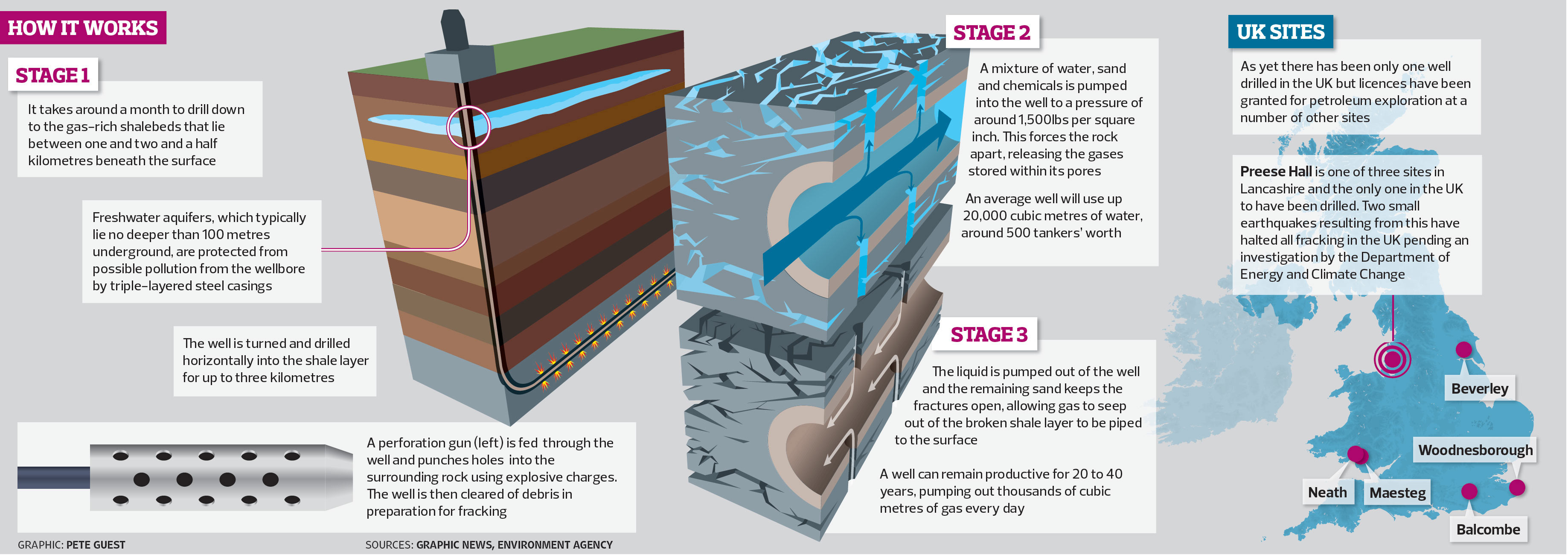
      The government set out proposals for a new “dash for gas” on Saturday, as campaigners prepared for the biggest meeting on fracking for shale gas to be held in the UK.

      The chancellor, George Osborne, and the energy secretary, Ed Davey, announced plans to clear the way for a new generation of gas-fired power stations across the UK. They said this would not hamper the fight against climate change.

      Green groups, however, fear that supporting an expansion of fossil fuel would put carbon-cutting targets at risk and lead to higher energy prices. They argue that this, in turn, would push thousands more people into fuel poverty. Most of the recent rises in electricity prices have been down to the soaring wholesale cost of gas, according to the government’s own analysis.

      Osborne said: “The government is providing certainty to businesses that want to invest in gas. Gas is a reliable, affordable source of energy. We need to recognise that gas will be a vital part of the mix in delivering affordable and secure low-carbon energy.”

      As part of the push for gas, ministers set new rules – emissions performance standards (EPS) – that would prevent new coal-fired power stations being built but would provide a go-ahead for gas-fired power until 2045. As the Committee on Climate Change has advised that the electricity industry should be decarbonised by 2030, many of those future plants would have to be fitted with untried carbon capture and storage technology if the UK’s carbon-cutting targets are to be met.

      The move by Osborne and Davey was seen as a fillip to the right wing of the Tory party ahead of next week’s budget. Osborne has repeatedly criticised environmental regulations as a burden on businesses, and secured a review of key climate change targets that could result in them being watered down.

      But green groups have warned that an over-reliance on imported gas would be bad for consumers.

      Paul Steedman, energy campaigner at Friends of the Earth, said: “The big six and other energy companies are planning to keep us hooked on dirty and expensive gas we don’t need. Gas dependency is a costly, polluting dead-end – to guarantee affordable energy in the long run we must switch to clean British power and slash energy waste.

      “People in the UK are fed up of the energy rip-off – an overwhelming majority want the government to force the big energy firms to invest in power from our wind, waves and sun.”

      Joss Garman, a Greenpeace campaigner, said: “By stripping away the simple requirement that our power stations need to become more efficient and less polluting, Clegg and Davey are undoing whatever good work their party has done on the environment since entering government. Indeed, this announcement is such a fundamental betrayal of their commitment to tackle climate change that one wonders if green-minded voters will, in all good conscience, struggle to support them again.”

      Garman said the emissions performance standards (EPS) had been championed by the Conservative party in opposition, as part of its policies to address climate change. The EPS establish the level of carbon that an electricity generating plant is allowed to emit for a given unit of power.

      The government intends to set the EPS for new power plants at 450g of CO2 per kilowatt hour. To comply with the recommendations of the Committee on Climate Change, that level would need to fall to 50g per kwh at 2030. Instead, the government has announced that any gas plant consented under the current level of the EPS could still be polluting at that level 30 years later, in 2045.

      One of the arguments put forward by gas supporters is that the UK could be made less dependent on imports by fracking for shale gas. The fracking industry’s own estimates suggest that if all the UK’s shale gas reserves are widely exploited, the UK could become nearly self-sufficient, though the British Geological Survey puts the probable amounts much lower.

      At Saturday’s meeting in Manchester, anti-fracking campaigners want to step up the pace of their protest, partly in response to the rapidly growing political support for gas.

      The concerns over fracking follow its widespread use in the US in the last few years, which environmentalists say has caused contamination of water supplies, gas leaks and the despoliation of the countryside over wide areas there. They want to ensure that similarly destructive practices do not take hold in the UK. Green groups also fear that an over-emphasis on gas will put carbon-cutting targets far out of reach – some research suggests shale gas from fracking produces more greenhouse gas emissions than coal when burned – and will crowd out investment in renewable forms of energy.

      But the only UK company currently engaged in fracking, Cuadrilla, argues that the bad examples of the US would not apply in the UK, where the industry is more tightly regulated. The company has invited local people to its site and says its equipment and methods are of a higher standard than those that have caused problems in the US.

      All fracking operations for shale gas in the UK are currently suspended, pending scientific evaluation of two small earthquakes in the Blackpool area last year that an investigation found were directly linked to Cuadrilla’s fracking operations in the area.

      Several large companies that had been linked with an interest in fracking in the UK, or are involved in fracking in other countries, said they had no plans to look at using the technology in the UK. These included Shell, BP, EDF Energy and Centrica.