There are groups working on these Technologies for the future,
UltraLight Rail for Santa Cruz
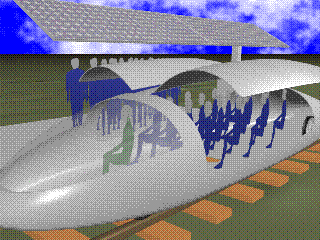
Check out these New developments related to solar powered transit on fixed guideways [2006 November] and another website about Ultra Light Rail.
Santa Cruz has urgent need for better transportation, and needs to decide between more rail or more road usage. We are working to use the existing rails, by starting with an ultra-lite demonstration prototype. Join us in creating a unique form of sustainable transportation for Santa Cruz.
Since this page was last updated in 1997, the developer of this website has become involved in other transportation projects. New activities include the Kiteship Project and the Umunum Chapter of Citizens for Personal Rapid Transit. To learn what others are doing in this field, see the innovative transportation technologies website.
Background

 Solar-electric rail is a smokeless, noiseless rail transit system based on recent advances in solar racing car technology. The Santa Cruz County Regional Transportation Commission (SCCRTC) is finishing up a major study on transportation options which includes expanding Highway 1 or using the existing rail corridor for transit. While the Ultra Light Rail is not “officially” being considered by the county, strong public support for the ULR could make it a viable contender. Meanwhile, the Commission has signed a resolution supporting the development of an Ultra Light Rail (ULR) prototype. We are building a core development group to create, design and build the world’s first prototype. The public has been invited to participate on many levels.
Over the past year, two alternatives have been presented by the SCCRTC to the public — the SunTan Special (a Danish IC3 Flexliner) and the First Night Trolley (Siemen’s RegioSprinter).
Since the late 1890’s, the weight of a train has not improved much from about 2,500 pounds per passenger. In the 1930’s, it was recognized that stronger materials could dramatically improve performance of rail cars. Going from more than 300 horsepower to only 90 horsepower, the 13,500 pound Budd-Micheline light-weight stainless steel car was a precursor to the use of composites now becoming familiar in advanced transportation systems.
Description
The ULR vehicle will be built low to the ground (4 feet) and will seat passengers from the sides in a manner similar to an amusement ride (roller coaster).. Each car will be shaped like a tear-drop for maximum aerodynamics. The cars will hold 20-40 passengers, ride on rubber motorcycle-type tires and use very light carbon fiber and composite materials. It will weigh about 100 lbs per passenger. The electric power will be provided by a utility grid/solar photovoltaic (PV) mix, with the mix changing as PV costs come down. PV (solar cells) on both the solar train and at each rail station will re-charge battery packs.
Industry
The solar electric racing industry is well established. Beginning in 1987, when GM’s “SunRaycer” won Australia’s World Solar Challenge, auto-makers, universities and private groups from around the world have competed in developing the technology which will support the transportation industry of tomorrow.
Benefits
The goal of our Ultralite is to reach 100 lbs/passenger, to lower energy consumption. It will be virtually silent, autonomous, with opportunity charging at stations. With electric propulsion, it will have low maintenance. It will be aerodynamic, low profile, unlike a bus or train, but like an oversized sports car. The rail itself is easy to install (feasibly on existing streets for automobiles) and removable if requirements change. Priority will be given to local development and fabrication.
Technical Aspects
On-Board Solar Panel
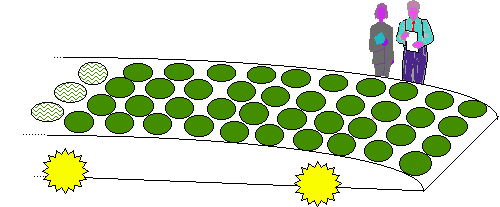
An 8’x20′ (160 sq ft) panel area can provide 2 kw solar power (3 HP peak). For a very light, aerodynamic vehicle, this is a substantial portion of the power required. It will have light weight, low power electric motors. The novelty of using solar on-board will create appeal for ridership.
Seating
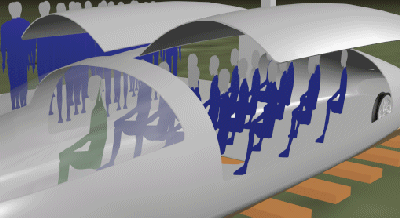
We are planning to incorporate low profile seating, with gull wing doors (roof lifts for access). There will possibly be open air seating for summer days. It will accommodate 10-20 passengers, seated 4 abreast, with access from both sides (i.e., loading 2 per side, with space for luggage and groceries in the center. (The first prototype will not handle bikes/handicapped but the production model will.)
Structure
The prototype will employ a very simple box structure. It will be made of composite materials (fiberglas, honeycomb, kevlar, carbon fiber). Batteries will be inserted in a channel down the center. Furthermore, the prototype will offer an opportunity to serve as a research platform to develop new battery types, ultracapacitors, etc.
Solar Charging Station
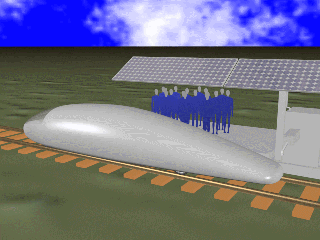
Solar charging will consist of 10 KW of solar panels per station (about 1,000 sq ft of rooftop area that will shelter riders from elements while embarking/disembarking). A flywheel or similar electrical storage at each station will facilitate rapid opportunity charging while in the station. The message for sustainability will create future benefits and build extraordinary public relations for the community.
Program Development Schedule
A video is currently being produced, and is anticipated to be ready by the end of December, 1995. The present schedule is to do preliminary engineering in Winter 1996, and prototype construction Spring/Summer 1996. A new video will be produced to document the prototyping and testing.
Take a look at the mockup which has been contructed for community events to give our future riders a chance to appreciate the scale of the vehicle and (if they have a lot of imagination) an idea what it might look like.
Marketing Plan
We will coordinate a series of core group meetings to be held in Nov-Feb to promote the ULR concept. The meetings will be promoted by a series of press releases in local Santa Cruz and SF Bay area media. A 30-minute docudrama is being produced about the ULR project and will be shown on local television stations in January 1996. Newspaper and magazine articles will also be sought. While the prototype is being approved, a national press campaign will be created to promote, manufacture and license the ULR for both urban and rural rail corridors.
A detailed marketing plan will evolve over the course of these meetings, reflecting the input received from public, business, and technical sources.
Budget
| Item |
Estimate |
| Preliminary engineering, component development |
|
| Engineering |
$10,000 |
| Suspension/drive train design |
5,000 |
| Prototype construction |
|
| Chassis |
10,000 |
| Body |
10,000 |
| Suspension/drive train |
5,000 |
| Electrical — motor/controller |
5,000 |
| “Batteries included” (lead acid) |
5,000 |
| On-board solar panel & electronics |
20,000 |
| Contingency |
10,000 |
| Video documentation |
20,000
|
| TOTAL |
$100,000 |
We have received feedback that this budget is excessively optimistic. Some comments:
- This budget does not include organizational expenses, testing costs, or other items needed to jump from the prototype into a viable business. This is merely the budget for the prototype itself. Other such costs are being factored into our business plan.
- It is not our intention in the first iteration to build a production prototype. It will not have elaborate automated controls or fare collections boxes, etc. — things which might be quite necessary when in production. This is to be a rudimentary prototype that will prove the viability of the concept and enable us to refine the specifications for a more advanced prototype, which will be built after we have done initial testing and market research. By using our money carefully at the outset, we will avoid going off on costly tangents.
- No charging station facilities (solar cells, storage devices, etc.) are planned for this prototype.
- We are not counting costs that may be incurred in producing specialized components for testing. For example, we will gladly accept loans or donations of advanced components such as unproven batteries or electronics, and we will put them through the paces for the benefit of our sponsors in order to improve the quality and demonstrate the feasibility of their products.
Additional comments are welcomed.
Ecosystems Qualifications
Renewable Energy and Conservation Specialists since 1970
- Constructed 15 homes of molded fiberglas and urethane foam, 1971, 1972
- Electric Vehicle Restoration, 1979
- Prototype Solar/Electric Vehicle, 1981
- Installed wind generator for California Energy Commission, 1981
- Exhibits of Solar Cars, 1991
- EV Market Research for GM/Hughes, 1992-1994
- Converted Volkswagen Bug to Electric in Mexico, 1994
- Co-Founder, Tonatiuh, Mexican Solar Race Car Team, 1992-present, with sponsorship budget of $200,000. In SunRayce 1995, Tonatiuh won the coveted $5,000 DuPont Prize for best use of composite materials in solar race car design.
- References: from industry, professionals, sponsors on request
Conclusions
UltraLight Rail is one potential key element in creating a transportation system using sustainable energy sources. A group is developing a prototype for use on the existing rail line in Santa Cruz County, California.
| Contact
updated 2007 January 6
updated 2001 Mar 28
|
|


 “The solar train could travel from Tucson to Phoenix in 30 minutes and might someday run from Nogales to the Grand Canyon.” Image credit: excerpted from image provided by
  Back to EcoSystems’ Home Page


