Category: Energy Matters

  • Inspections reveal 24 pc of solar jobs are substandard

    Inspections reveal 24 pc of solar jobs are substandard

    FOUR per cent of roof-top solar-panel installations have been found to be unsafe by inspections conducted by the official regulator and 20 per cent have been discovered to be substandard.

    The Office of the Renewable Energy Regulator has told a Senate estimates committee hearing that of 1841 inspections of roof-top solar panels to the end of January, 4 per cent were deemed unsafe and immediately shut down.

    The information came as the Climate Change Department conceded, in the same hearing, that the budget revenues projected by the government carbon pricing package could be lower if the floating carbon price traded around the $15-a-tonne floor price in the package.

    But the compensation under the scheme would also be lower if the carbon price was lower.

    The questioning by South Australian Liberal senator Simon Birmingham was sparked by continued weakness in the price of emissions units in the EU scheme. After trading around $20 in the middle of last year, the market has been hit by the European economic slump and is now around $9.


    But when the Australian carbon price floats it will be prevented from falling lower than a floor price of $15 with international permits subject to a top-up payment if their price is lower.

    Senator Birmingham asked whether a carbon price trading around a floor price of $15 when the scheme moved to a floating price in 2015-16 would produce significantly lower revenues than the $9.2 billion projected at the fixed price of $25.40 a tonne in 2014-16.

    But Climate Change Department secretary Blair Comley cautioned that “costings are never quite as simple as they appear” and that Treasury was responsible for economic forecasting. Department officials are set to fly to Europe for meetings with EU officials before a vote next month that will debate raising the EU’s emissions reductions targets in a move that would in part be designed to restore the carbon price.

    Asked if international and domestic prices were likely to be lower than $15 in 2015, Mr Comley said: “I don’t think that’s true.”

    In later evidence on solar-panel inspections, Andrew Livingston, from the office of the Renewable Energy Regulator, said a further 1368 inspections were planned for this year and state authorities had been notified of faults. He said some states had suspended installers over the results but most installers and electricians had been “very prompt” in rectifying faults.

    Where a solar installation was found to be faulty it was immediately disconnected, he said.

    The move came as the hearing was told that the government was chasing more than $21 million from installers who had wrongly claimed money in the government’s home installation scheme.

    The department had collected $844,000 of this amount and written off $9200. It was in negotiations with a debt collector about the outstanding funds.

  • Oil Price Daily News Update

    V

    Oil Price Daily News Update


    Natural Gas Analysis for the Week of February 13, 2012

    Posted: 13 Feb 2012 10:33 AM PST

    Last week, April Natural Gas traded in an inside range, indicating that it may be going through a transition period. This should come as no surprise to chart watchers because two weeks ago when the market formed a closing price reversal bottom, I warned that there may be a 2 to 3 week rally equal to at least 50 percent of the previous swing down. After bottoming at 2.438 on January 23, the market proceeded to confirm a weekly reversal bottom, but its subsequent follow-through rally fell well short of its first upside target at 3.102. The inside…

    Read more…

    Many Fear New Government Reforms will Destroy the UK Solar Industry

    Posted: 13 Feb 2012 08:23 AM PST

    Young industries such as the renewable energy sectors rely heavily on government funding and incentives to help them achieve a level of competition with the well-established industries out there. The incentives are only needed for a few years to give the young industry time to find its feet and develop the necessary technologies and scale of production to fully support itself. UK government ministers have recently angered the solar industry with proposals that will see incentives cut by 35 percent; significantly lower than other renewable energies…

    Read more…

    Canadian PM Shills Alberta Oil Sands in China

    Posted: 12 Feb 2012 06:01 PM PST

    Canadian Conservative Prime Minister Stephen Harper is in the midst of an official visit to China. His mission? To convince Beijing’s mandarins to buy Canada’s Alberta oil sands hydrocarbon production, now that Republican Congressional overreach has effectively sidelined the Keystone XL pipeline, designed to transit the oil to U.S. Gulf of Mexico refineries, for the foreseeable future. Harper faces an uphill struggle, as China is questioning the delays in implementing the Northern Gateway pipeline, to transit Alberta’s…

    Read more…

    Solar Insanity: Why is Obama Obsessed with Solar Energy?

    Posted: 12 Feb 2012 05:59 PM PST

    The U.S. Energy Department is throwing a lot of money at solar power recently, with California seemingly getting the bulk of the federal money. President Obama last year set some pretty ambitious renewable energy targets, by American standards, and this year called for an “all-of-the above” strategy for domestic energy. But why put so much political energy into solar? Should there be a bulk renewable energy initiative? Energy Secretary Chu last week said he was putting $12 million behind a so-called incubator program that would fund start-up…

    Read more…

    Physicists Meet at CERN to Discuss Progress Made on Cold Fusion

    Posted: 12 Feb 2012 04:58 PM PST

    Francesco Celani and Yogendra Srivastava will be leading a kind of informal meeting called a colloquium at Europe’s fundamental physics facility, CERN.  The topic, “Overview of Theoretical and Experimental Progress in Low Energy Nuclear Reactions (LENR)” will be discussed March 22, 2012 in the CERN Council Chamber.  Of note is the event will be viewable – live – on the CERN Webcast Service.  Hopefully someone will save it to YouTube. Celani is a prominent Italian physicist at the Italian National Institute…

    Read more…

    Tunisia – A Possible Electrical Savior of Southern Europe?

    Posted: 12 Feb 2012 04:51 PM PST

    Europe, battered by a perfect storm of recession and rising energy requirements, is looking for additional electrical power reserves anywhere it can. Surcease may come from North Africa, and the leading potential state to supply that need might be… Tunisia. Tunisia is endowed with a reliable source of solar power in its southern Saharan region, where the sunshine generates 20 percent stronger solar radiation than even the best locations in Europe. Given its proximity to Italy, Tunisia is in an ideal position to transfer such renewable energy…

    Read more…

    What Does the Future hold for the World Oil Markets

    Posted: 12 Feb 2012 04:49 PM PST

    Never, it would seem, has the oil market been in such a state of disarray. Brent crude, the global benchmark, hit US$117 per barrel this week for the first time since August. The spot price has been rising on concerns over where the showdown with Iran is leading. European consumers have begun to cut back on purchases ahead of an outright ban when sanctions are introduced. Meanwhile the Chinese, usually buyers of some 20 percent of Iran’s output (or about 550,000 barrels a day) are said to have cut back by 285,000 barrels in January and February,…

    Read more…

    Crude Oil Analysis for the Week of February 13, 2012

    Posted: 12 Feb 2012 04:46 PM PST

    The lack of follow-through to the downside led to a fast turnaround in April Crude Oil last week. Although the market closed higher for the week, it remained inside of the previous week’s range and therefore posted an inside week. This pattern often indicates impending volatility with a slight bias to the upside. Besides the limited range week, the market also ping-ponged inside of a retracement zone created by the main range of $114.87 to $75.92. These levels are $95.40 and $99.99.  The longer the market stays hemmed inside of the 50…

    Read more…

    You are subscribed to email updates from OilPrice.com Daily News Update
    To stop receiving these emails, you may unsubscribe now.
    Email delivery powered by Google
    Google Inc., 20 West Kinzie, Chicago IL USA 60610
  • Three Major Journals Publish Articles On Limited World Oil Supply

    Three Major Journals Publish Articles On Limited World Oil Supply

    By Gail Tverberg

    13 February, 2012
    Our Finite World

    In the past month, three major peer-reviewed journals have published articles relating to limited world oil supply:

    1. In Science, Technology is Turning U. S. Oil Around But Not the World’s, by Richard A. Kerr;

    2. In Nature, Climate Policy: Oil’s Tipping Point has Passed, by James Murray and David King; and

    3. In Energy, Oil Supply Limits and the Continuing Financial Crisis, by Gail Tverberg.

    The fact that these articles have been published is significant, because articles in the mainstream press, such as Bloomberg’s recent article, Peak Oil Scare Fades as Shale Deepwater Wells Gush Crude, seem to suggest that our oil problems are past. While the US oil supply situation may be a little better, the world supply situation is still very bad, and oil prices are still very high around the world.

    Furthermore, high oil prices tend to have a recessionary effect, and can lead to debt defaults. These issues are described in both the second and third articles above. Thus, there is a substantial chance that high oil prices are contributing to the debt default problem in Europe, and to forecast low world economic growth.

    In this post, I briefly describe these articles.

    In Science, Technology is Turning U. S. Oil Around But Not the World’s, by Richard A. Kerr

    This article points out that even the optimistic estimates, such as BP’s recent Energy Outlook to 2030, see little growth in non-OPEC conventional oil production between now and 2030 (Figure 1).
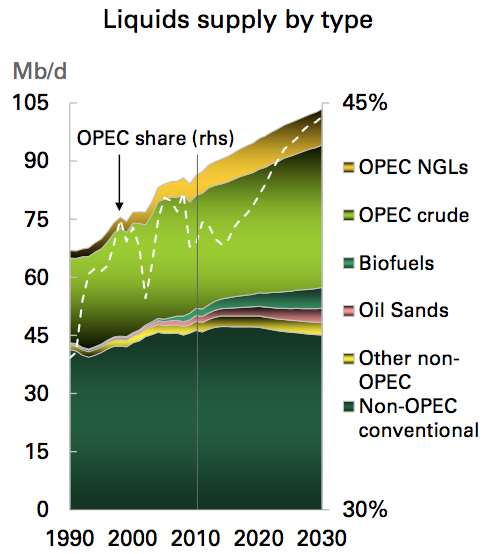
    Figure 1. BP oil forecast to 2030, from BP Energy Outlook to 2030

    We are thus dependent on growth in OPEC crude oil and in OPEC natural gas liquids, neither of which is assured, given political uncertainties in the Middle East. While technology advances are making possible some new US oil production, this growth is needed to offset declines in existing fields around the world. There is a great temptation by those using new technology to make forecasts using an “overabundance of optimism.” History shows that US oil production has mostly fallen since 1970 (Figure 2).
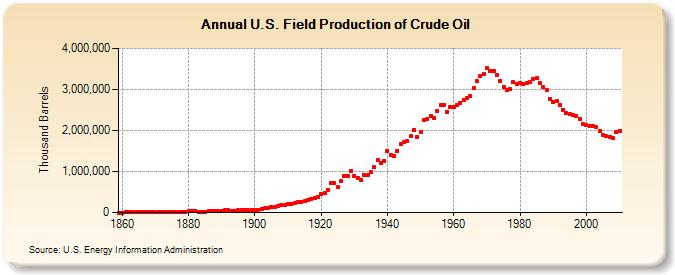
    Figure 2. History of US production of crude oil, in figure created by EIA (similar to, but not the same as, figure shown Science article).

    In Nature, Climate Policy: Oil’s Tipping Point has Passed, by James Murray and David King

    According to the authors:

    There is less fossil-fuel production available to us than many people believe. From 2005 onwards, conventional crude-oil production has not risen to match increasing demand. We argue that the oil market has tipped into a new state, similar to a phase transition in physics: production is now ‘inelastic’, unable to respond to rising demand, and this is leading to wild price swings. Other fossil-fuel resources don’t seem capable of making up the difference.

    Such major spikes in fuel price can cause economic crises, and contributed to the one the world is recovering from now. The future economy is unlikely to be able to bear what oil prices have in store. Only by moving away from fossil fuels can we both ensure a more robust economic outlook and address the challenges of climate change. This will be a decades-long transformation that needs to start immediately.

    The article talks about how high oil prices erode family budgets, and points out that it seems likely that it wasn’t just the ‘credit crunch’ that triggered the 2008 recession. The oil price crunch was also involved.

    A call-out from the article summarizes a current problem:

    The price of oil is likely to have been a contributor to the euro crisis in southern Europe.

    In Energy, Oil Supply Limits and the Continuing Financial Crisis, by Gail Tverberg

    This is an article I wrote in early 2011, that wasn’t officially published until January 2012. The article can temporarily be downloaded free, as the fifth item down on this list of articles from the January issue.

    In this article, I explain why one would expect high oil prices to cause economic disruptions of many types. If consumers are spending more on high-priced oil (and high-priced food, because both costs tend to rise together), they will cut back on discretionary expenditures, such as going out to restaurants and taking vacations and buying new cars. Workers in affected industries will be laid off.

    There will also be indirect impacts. People who have been laid off from work will tend to default on their loans, as will people who are living paycheck to paycheck and find that the cost of commuting has rising, and the cost of food has also risen. Holders of sub-prime mortgages will be disproportionately represented in the group of those with defaults, since they were among the least qualified loan applicants.

    High oil prices can also be expect to affect housing prices. In part, this occurs because people who spend more on necessities (commuting and food) are less likely to want to buy a move-up home. As a result, there will be a cut-back in demand for homes, and thus in resale prices. Also, at the time that oil prices rose in the 2004-2006 period, the Federal Reserve raised interest rates in an attempt to try to bring oil prices back down. These higher interest rates also tended to reduce demand for move-up homes. I also show that the timing in the drop in US home values matches with what a person would expect, if it were high oil prices, and actions taken by the Federal Reserve in response to high oil prices, that were really behind the drop in home prices.

    Gail E. Tverberg graduated from St. Olaf College in Northfield, Minnesota in 1968 with a B.S. in Mathematics. She received a M.S. in Mathematics from the University of Illinois, Chicago in 1970. Ms. Tverberg is a Fellow of the Casualty Actuarial Society and a Member of the American Academy of Actuaries. Ms. Tverberg began writing articles on finite world issues in early 2006. Since March 1, 2007, Ms. Tverberg has been working for Tverberg Actuarial Services on finite world issues. She is also a frequent contributor to the TheOilDrum.com website, under the name “Gail the Actuary”.


  • Peak Oil unable to avert energy crunch

    News 2 new results for PEAK-OIL
    Peak oil unable to avert energy crunch
    gulfnews.com
    By Saadallah Al Fathi, Special to Gulf News Last week I discussed peak oil which happens when the maximum rate of world oil production is reached and the production rate enters terminal decline. Conventional oil production seems to have reached a
    See all stories on this topic »
    Don’t overlook Aussie Gas Stocks
    TheBull.com.au
    No discussion of the outlook for the petroleum contribution to the Australian Oil and Gas Sector would be complete without considering the issue of Peak Oil. For Australia, Peak Oil is the date oil production begins to decline until all reserves are
    See all stories on this topic »
  • Google Oil news

    IEA: Future Sanctions Already Severely Effect Iranian Oil Exports

    Posted: 12 Feb 2012 02:37 PM PST

    In the IEA’s monthly Oil Market Report they have said that the European and US trade sanctions designed to impede Iran’s nuclear program could affect far more than the 600,000 barrels per day (bpd) that the EU normally imports.

    The sanctions are not set to come into effect for another 5 months, but already European customers are avoiding Iranian oil and many other countries such as China and India have been sourcing their oil imports from other nations such as Russia, Saudi Arabia and Africa. “Although there are five months…

    Read more…

    You are subscribed to email updates from OilPrice.com Daily News Update
    To stop receiving these emails, you may unsubscribe now.
    Email delivery powered by Google
    Google Inc., 20 West Kinzie, Chicago IL USA 60610
    Reply
    Forward
  • Danger to Nuclear Plants

    News 3 new results for DANGER TO US NUCLEAR PLANTS
    Study: Nuclear plant threatens drinking water
    Republican Eagle
    A small tritium leak of 27 gallons from the Prairie Island nuclear plant Feb. 3 resulted in opportune timing for two study groups already scheduled to discuss the effects of tritium on drinking water at a press conference Wednesday.
    See all stories on this topic »
    Japan’s Fukushima reactor may be reheating, operator says
    Herald Sun
    TEMPERATURE readings at one of the crippled Fukushima nuclear reactors rose above Japan’s stringent new safety standard but there was no immediate danger, its operator said today. Tokyo Electric Power said one of three thermometers on the No.2 reactor
    See all stories on this topic »
    America’s Green Enemies – OpEd
    Eurasia Review
    It was good news that the Nuclear Regulatory Commission approved the nation’s first nuclear power plants on February 9th, clearing the way for the construction of two reactors by Southern Company at its Plant Vogtle site near Atlanta, Georgia.
    See all stories on this topic »


    Tip: Use quotes (“like this”) around a set of words in your query to match them exactly. Learn more.

    Delete this alert.
    Create another alert.