Category: Energy Matters

  • Peak oil and the lost message of the carbon tax

    Peak oil and the lost message of the carbon tax
    On Line opinion
    Whether or not one believes in human-induced climate change, with the Carbon Tax’s introduction on Sunday, it is worth remembering the fundamental reasons for its conception. The Carbon Tax debate, which has been memorable for its hyperbole, but not
    See all stories on this topic »

  • Fracking: where’s the debate about its climate change risks?

    Fracking: where’s the debate about its climate change risks?

    Fracking looks set to be given the green light in the UK, but there is a worrying lack of discussion about its climate implications

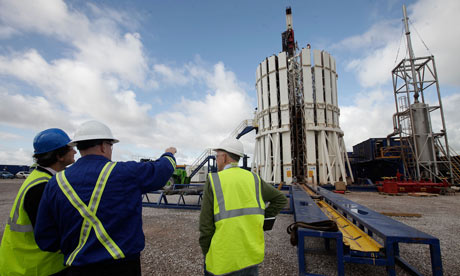
    Engineers look at the Cuadrilla shale fracking facility in Preston, Lancashire

    Engineers look at the Cuadrilla shale fracking facility in Preston, Lancashire. Photograph: Matthew Lloyd/Getty Images

    Rarely a day goes by, it seems, when “fracking” isn’t in the news. It’s either being hailed as a miracle energy source, or it is being condemned as yet another polluting fossil fuel.

    Today’s headlines largely focus on the findings of a joint report (pdf) by the Royal Society and the Royal Academy of Engineering which concludes that hydraulic fracturing of shale gas – “fracking” – should be allowed to proceed in the UK, but only with tight regulation and monitoring. Published ahead of the government’s anticipated “green light” for fracking later this summer, the report calls for a long parade of checks and balances, as you might expect it to:

    Monitoring should be carried out before, during and after shale gas operations to inform risk assessments. Methane and other contaminants in groundwater should be monitored, as well as potential leakages of methane and other gases into the atmosphere. The geology of sites should be characterised and faults identified. Monitoring data should be submitted to the UK’s regulators to manage potential hazards, inform local planning processes and address wider concerns. Monitoring of any potential leaks of methane would provide data to assess the carbon footprint of shale gas extraction.

    But what is missing from much of today’s media coverage is mention of – for me at least – the most important paragraph in the whole report:

    This report has analysed the technical aspects of the environmental, health and safety risks associated with shale gas extraction to inform decision making. Neither risks associated with the subsequent use of shale gas nor climate risks have been analysed. Decision making would benefit from research into the climate risks associated with both the extraction and use of shale gas. Further benefit would also be derived from research into the public acceptability of all these risks in the context of the UK’s energy, climate and economic policies.

    Yes, there are plenty of concerns about the possible localised environmental impacts of fracking, such as earth tremors, aquifer contamination, and surface leaks. As the report concludes, these need constant and tightly-regulated assessment if extraction is to get under way on a commercial scale. But this is a side salad compared to the picnic hamper of unanswered questions that still hang over fracking when it comes to its possible contribution to climate change.

    With nice timing – but largely ignored by the media – is a report out today by the Committee on Climate Change, a statutory body set up to advise the UK government on greenhouse gas emissions. It urges the government to give up on its “dash for gas” in order to help avoid dangerous levels of greenhouse gas emissions. Its chief executive, David Kennedy, said:

    [Ministers] must rule out the dash for gas, and set clear carbon objectives in the context of draft energy legislation and the forthcoming gas generation strategy. Our analysis shows that power sector decarbonisation is economically sensible, even in a shale gas world.

    To frack, or not to frack, is arguably the most pressing environmental decision facing the “greenest government ever” at present. There are clearly huge temptations to proceed: its advocates say it is an abundant and cheap source of energy that could help to re-ignite our flailing economy. And voices such as James Lovelock say that fracked gas is a lesser evil than coal so we should use it as a bridging technology to “buy us some time”.

    But there are plenty of legitimate environmental concerns, too, not least that the climate risks have yet to be fully analysed or face democratic scrutiny. And there are worries that fracking will likely hinder or damage the fledgling renewables sector.

    Visit the Department for Energy and Climate Change’s webpage on shale gas and there is no mention of climate risks. The only direct reference I can find is an archived article by the former energy secretary Chris Huhne from last November:

    Every national scientific academy in the world agrees: climate change is a real and growing threat. We face ambitious, legally binding carbon emissions and renewable energy targets. Yes, gas will help us meet them. But we should not bet the farm on shale.

    He didn’t say, though, how this was to be achieved, other than earlier stating: “With carbon capture and storage technology, [shale gas] can provide a significant amount of low-carbon electricity in the long term.” And we all know how well CCS is coming along, don’t we?

    Is the UK government really going to breezily “green light” fracking, as seems highly likely, given what the Committee on Climate Change has said today? Is it really going to push ahead, without having fully investigated and discussed the possible climate implications of fracking?

    I, for one, don’t feel we have even begun having this important national debate.

  • NREL Say 80% of US Electricity can be Created from Renewable Sources by 2050

    NREL Say 80% of US Electricity can be Created from Renewable Sources by 2050

    Posted: 28 Jun 2012 03:03 PM PDT

    Americans have always prided themselves on thinking big. When it comes to energy, the National Renewable Energy Lab (NREL) has given big-thinkers everywhere a shot in the arm with a new study that concludes:“Renewable energy sources, accessed with commercially available technologies, could adequately supply 80% of total U.S. electricity generation in 2050 while balancing supply and demand at the hourly level.”This is a very big finding from one of the world’s most credible experts on advanced energy technologies. This detailed…

    Read more…

  • Has Peak Oil Peaked?

    It is being assumed that Shale Oil will supplement or surplant
    Sweet crude oil. This remains to become a reality, with extraction and refining costs, and environmental damage in
    the process.

    Has Peak Oil Peaked?
    Wall Street Journal
    Peak oil, the Malthusian scenario whereby global oil-supply growth has reached its limit, appears to have peaked.
    See all stories on this topic »


    Wall Street Journal
    Has peak oil paranoia peaked?
    The Australian
    REMEMBER the days when a threatened hurricane and news of Syria downing a Turkish jet would send oil prices spiking?
    See all stories on this topic »
    Has Peak Oil Actually Peaked?
    Wall Street Journal (India)
    WSJ’s Liam Denning takes a seat on Mean Street to attempt to answer the question, has peak oil actually peaked? Photo: Getty Images.
    See all stories on this topic »
    No Peak Oil In Sight: We’ve Got An Unprecedented Upsurge In
    Daily Markets (blog)
    From a purely physical point of view, there are huge volumes of conventional and unconventional oils still to be developed, with no “peak-oil” in sight. The full
    See all stories on this topic »
    Werewolf Edition #32 Out Now! – Has Peak Oil Peaked?
    Scoop.co.nz
    Hi and welcome to the 32nd issue of Werewolf. With some anxiety and trepidation, our cover story this month analyses the current state of the peak oil concept
    See all stories on this topic »


    Tip: Use site restrict in your query to search within a site (site:nytimes.com or site:.edu). Learn more.

    Delete this alert.
    Create another alert.
    Manage your alerts.

    Click here to Reply or Forward
  • Breaking the rules. 350org

    Breaking the rules. 350org

    Inbox
    x

    Bill McKibben – 350.org organizers@350.org
    4:21 AM (5 hours ago)

    to me

    Dear friends,

    Lately, our 350 network has been breaking a lot of rules.

    Last Sunday, here in the US, we marched right into the place where the fossil fuel industry didn’t want us — into the Ohio state capitol, for a “people’s assembly” in the middle of the state-house, to protest the dangerous practice of fracking. It was a beautiful sight to behold: 1000 passionate activists bravely standing up for their rights to free assembly, clean water, and a future worth fighting for.

    And on Thursday we marched right out of the place that we were supposed to be: the Rio Earth Summit in Brazil. World leaders had gathered yet again to forge a plan to address our planetary challenges  — but they ended up failing us by producing another weak, non-binding agreement. So when youth leaders asked us to join a walk-out in protest of the summit’s disappointing outcomes, we were proud to join them — even if that meant breaking the UN’s rules.

    The point is, if we play by the rules that corporations have set for our political life, we’re going to lose. Corporate polluters channelled $350,000 to Ohio’s governor to make sure he was pushing fracking, and they made sure that the official text in Rio was a mush of weasel words and toothless promises.

    So we’re going to have to find the places we can have a people-powered edge. Some of those places will be in the streets, of course — but we’ll also be ramping up our work on the web, where hundreds of thousands of people around the world launched a “Twitter Storm” on fossil fuel subsidies last week. Those subsidies ended up being one of the issues that drew the most attention at Rio — meaning that hundreds of thousands of people around the world managed to take this arcane topic and thrust it into the global spotlight. In the weeks ahead, we’ll continue to ramp up the pressure on fossil fuel subsidies with a sustained, strategic campaign in key areas around the world.

    Governments failed us in Rio — and if we don’t shake things up, there’s no reason to think that they are likely to change. Fortunately for the planet, this movement already has some big plans under way.

    In India and in South Africa, 350 leaders and allies are developing plans for national level mobilization to shift development plans more towards low carbon solutions. In the US state of Texas, some of our friends are preparing a bold action called the Tar Sands Blockade. They’re planning a very direct action that will literally stand in the way of the southern leg of the Keystone XL pipeline.

    And all around the world local groups continue to pop up in new places — 350 Tehran is the newest group up on the map! — and climate leadership workshops continue to train and strengthen our network of activists and organizers building this movement. In fact, just now we’re starting to talk with youth allies around the world about possibly organizing a mass workshop — a global series of movement trainings in the months ahead. Our movement is already achieving great things, but we know we need to step it up even further.

    It’s not always easy to be doing such hard work in trying times. But if we have a hope to beat this crisis, it’s in our collective bravery and strength. 

    Onwards,

    Bill McKibben for the 350.org Team


    350.org is building a global movement to solve the climate crisis. Connect with us on Facebook and Twitter, and sign up for email alerts. You can help power our work by getting involved locally, sharing your story, and donating here.