Category: Articles

  • A brown-coal export hub? Tell them they’re dreaming!

    24 April 2012, 6.36am AEST

    A brown-coal export hub? Tell them they’re dreaming!

    If wishes were horses, then beggars would ride. And if wishes were new technology, then Victoria’s Latrobe Valley would be a mining export hub to rival the Pilbara. But wishes are neither horses nor new technology and Victoria’s Latrobe Valley is not going to be exporting brown coal any time soon. Last…

    Author


    Disclosure Statement

    Stephen King does not work for, consult to, own shares in or receive funding from any company or organisation that would benefit from this article, and has no relevant affiliations.

    Monash University is a Founding Partner of The Conversation.

    The Conversation

    The Conversation is an independent source of information, analysis and commentary from the university and research sector—written by acknowledged experts, curated by professional editors and delivered direct to the public. read more

    Articles by This Author

    4 April 2012 Who suffers when retailers exercise their market muscle? 13 December 2011 Impressions count when it comes to misleading consumers 13 July 2011 After coal: what’s the future of Victoria’s Latrobe Valley? 29 April 2011 Undergraduate education and the Melbourne Model

    Ppz3g5gm-1335163505 Plans to transform Victoria’s Latrobe Valley into a mining export hub are misguided. AAP

    If wishes were horses, then beggars would ride. And if wishes were new technology, then Victoria’s Latrobe Valley would be a mining export hub to rival the Pilbara. But wishes are neither horses nor new technology and Victoria’s Latrobe Valley is not going to be exporting brown coal any time soon.

    Last week’s announcements about the potential for brown coal exports from Victoria, fail on both technological and economic grounds. There are good reasons why Victoria’s brown coal from the Latrobe Valley is used just for electricity generation in the Latrobe Valley. Brown coal has a high moisture content and must be dried before it can be used. If it is transported before drying, then transport costs are high. Effectively, you are transporting as much water as coal. Once dried, however, brown coal is volatile and difficult to handle.

    New technology may make it viable to treat brown coal and make it like black coal, in terms of moisture content and handling. However, Australia already has large supplies of black coal. While brown coal is easy to mine, the technology needed to make it exportable would have to be extremely cheap before brown coal exports could compete with black coal.

    What, then, explains last week’s political statements? Beyond wishful thinking, both federal and eastern-state politicians face significant problems. As CommSec’s April State of the States’ report notes, Australia has a three-speed economy, with Western Australia well out in front. This imbalance makes economic management difficult.

    To make matters worse, the federal government appears to have painted itself into an economic corner. It is insisting on returning the federal budget to surplus in the next financial year. While this sort of fiscal tightening makes sense for the boom regions of Western Australia and parts of Queensland, it makes no economic sense for the rest of Australia.

    At the same time, the federal government appears to be lobbying the Reserve Bank of Australia to ease monetary policy. However, monetary policy is a poor tool to deal with economic imbalance. Fiscal policy can use selective subsidies and taxes to target particular regions that are economically distressed. In contrast, monetary policy cannot be targeted at particular regions. Lax monetary policy and lower interest rates have an Australia-wide impact. It may help manufacturing in the eastern states but it may also lead to a property bubble in Perth.

    Government belt-tightening means that any substantial investment that could transform the Latrobe valley into a coal export hub is unlikely to be forthcoming. Private industry is unlikely to fund such a scheme by itself in the absence of proven technology and without export contracts in hand. And with the fiscal brakes being applied at the federal level, there is unlikely to be any government investment in a coal export hub. So the conclusion is simple – there will be no coal-based export hub in eastern Victoria.

    However, this does not spell doom and gloom for the region for two reasons. First, the Latrobe Valley is located in the heart of Australia’s dairy industry. Growth in Asia has not simply pushed up prices for iron ore and coal, it has also increased demand for high-quality food, including dairy products. There has been a significant world-wide increase in the demand for dairy products in recent years. This is leading to investment and expansion of output in New Zealand and in south-east Australia. This investment is likely to continue. So while a coal export hub seems unlikely, a dairy export industry is already flourishing both in the Latrobe Valley and throughout Victoria.

    Second, the Latrobe Valley supplies Melbourne’s electricity, and Melbourne’s population is growing. With or without a carbon tax, Melbourne needs power and most of that power will come from the Latrobe Valley. The carbon tax means that there will be new investment in cleaner sources of power and much of this investment will occur in and around the Latrobe Valley. The simple reason for this is that the transmission infrastructure that is needed to get electricity from the generators to Melbourne is already based in the Latrobe Valley. This gives the Valley an economic advantage for anyone considering new generation investment.

    Electricity investment may involve new gas-fired plant rather than traditional brown-coal electricity generation. But with gas reserves offshore in the Bass Strait, the region around the Latrobe Valley is well placed to benefit from this investment. So while the carbon tax may cause some dislocation in the Latrobe Valley, it is also likely to be accompanied by new investment projects.

    The Latrobe Valley will not be Victoria’s Pilbara any time soon. And politicians who claim otherwise are simply blowing hot air. While the valley may not be heading for a boom, however, it does have natural advantages that will assist its economic performance.


     

  • Murray-Darling plan ‘deceptive and misleading’

    Murray-Darling plan ‘deceptive and misleading’

    Posted April 23, 2012 21:01:37

    A group of scientists has told a Senate inquiry the draft plan for the Murray-Darling Basin is deceptive and misleading.

    The Wentworth Group of Concerned Scientists has told the inquiry that the draft plan proposed by the Murray-Darling Basin Authority must be withdrawn, arguing it will not prevent a return to drought

    The plan was released in November and an extensive public consultation period ended this month.

    A member of the Wentworth Group, John Williams, has told the inquiry there is not enough information in the draft for Parliament to make an informed decision.

    “To me it’s misleading scientifically, it’s deceptive and I think we are being sold a pup, quite frankly,” he said.

    “It doesn’t deal with climate change and it doesn’t establish what the sustainable limit for a healthy river is over the long term.”

    Meanwhile, the Authority has told the Senate inquiry that climate change science is too uncertain to be used to underpin the initial plan for the river system.

    The draft is based on 114 years of historical weather data and the Authority has left the possibility open for climate change projections to be included in the plan after it is in place for a decade.

    The Authority has closed the 20-week public submission period on the contentious draft basin plan and is now writing a final report for the Federal Government.

    Chief executive Rhonnda Dickson says at this stage the forward figures are too variable.

    Topics: murray-darling-basin, drought, rivers, australia, nsw, act, vic, sa

  • Planet at risk of famine

    News 2 new results for DANGER TO US NUCLEAR PLANTS
    The Fukushima Nuclear Disaster Is Far From Over
    Huffington Post
    After repeated warnings by former senior Japanese officials, nuclear experts, and now a US Senator, it’s sinking in that the irradiated nuclear fuel stored in spent fuel pools amidst the reactor ruins pose far greater dangers than the molten cores.
    See all stories on this topic »
    Planet at risk of famine
    Deccan Chronicle
    This is the first major report on the consequences of a regional nuclear war on agricultural production, global climate and environment, and the health of human beings, animals and plants. Both the USA and China could be hit by a famine,
    See all stories on this topic »
  • The Most Important ‘Unknown’ Story in the World: India’s Economic Slowdown

    Oil Price Daily News Update


    The Most Important ‘Unknown’ Story in the World: India’s Economic Slowdown

    Posted: 20 Apr 2012 03:26 PM PDT

    Could the Indian slowdown be the most important (but still somewhat neglected) story in the world right now?  Vikas Bajaj reports: …the country cannot get enough fuel — principally coal — to run the plants. Clumsy policies, poor management and environmental concerns have hampered the country’s efforts to dig up fuel fast enough to keep up with its growing need for power. A complex system of subsidies and price controls has limited investment, particularly in resources like coal and natural gas. It has also…

    Read more…

    You are subscribed to email updates from OilPrice.com Daily News Update
    To stop receiving these emails, you may unsubscribe now.
    Email delivery powered by Google
    Google Inc., 20 West Kinzie, Chicago IL USA 60610
  • On fracking and wind we are having the wrong debates

    On fracking and wind we are having the wrong debates

    Discussion of climate change and the wider public interest has been jettisoned in the rush to lobby against alternatives

    • Matt Kenyon 1904

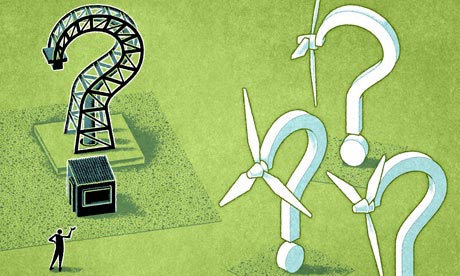
      Illustration by Matt Kenyon

      It’s been a big week for alternative energy sources. On Tuesday, the British Geological Survey effectively greenlit fracking, with its conclusion that the earthquake risk was low. Tomorrow National Opposition to Windfarms launches its campaign in the House of Lords. My instincts are pro-wind and anti-fracking, from a straight climate change perspective: wind is renewable and not harmful, while shale gas is not renewable and contributes as much or more – much more, according to a study by Cornell University – to the greenhouse effect than either oil or coal.

      The anti-fracking lobby should just stick with this argument – that if you’re serious about halting global warming you have to concentrate on energy sources that don’t contribute to it. However they don’t want to – believing, possibly correctly, that the political will to prevent irreparable climate change just isn’t there.

      Instead, the anti-frackers range freely around in their opposition; some of it’s grounded and some isn’t. What strikes me is the similarity in approach from the anti-wind camp and the anti-frackers.

      First, they talk about the aesthetics of these energy sources – National Opposition to Windfarms talks about windfarms destroying tourism, and their opening gambit is that the area becomes so unspeakably unattractive that people will simply stop going there. In the Ribble Valley and across the areas affected by fracking, the sheer ugliness of industry is emphasised.

      There’s a counter-argument in both cases. The aesthetics of windfarms are pretty subjective – some people like them. National Opposition to Windfarms quotes a survey from the Welsh Tourist Board in which 71% of respondents said turbines spoilt the environment; Renewables UK quotes a survey in which an almost identical proportion, 75%, finds the effect of turbines either positive or neutral.

      Fracking occurs predominantly underground, so while heavy machinery is rarely attractive, it’s nothing like as ugly as a coal mine or a nuclear power station. But, more important, unless you’re prepared to stop using energy or you have an alternative, “I don’t like the look of it” isn’t enough. “It’s too expensive to produce” isn’t enough, either – it will look a lot less expensive when the existing energy sources run out.

      Windfarms are ahead of frackers in the way they comprehend their obligations. They pay rent to landowners but also £1,000 per megawatt a year to the community – and this sector is also creating a new model for small-scale finance. You can, from Saturday, invest in a wind turbine in the Forest of Dean for as little as £5, with the expectation of a return. More on that another day; there are so far no small-scale investment plans for fracking the Bowland Basin in Lancashire.

      But there is a huge swath of shale gas in the north of England; the mineral rights are owned by the crown. That money could be sucked into the centre, or it could be kept in Lancashire, dispersed to local authorities. What would the north-south divide look like then? Is there any requirement to privilege local companies in the granting of contracts, either for wind energy or shale gas? Where there isn’t, why isn’t there?

      What would society look like if the shareholders in its major energy companies were regular people on median incomes? What would it look like if the people living above the gas supplies were its beneficiaries? These questions will affect the wealth distribution of this country for the next 200 years. And yet what does the debate concentrate on? How many jobs are created building a road to the well site? How much a unit of wind energy costs to produce? It’s so narrow as to be a distraction.

      Finally, both the anti-winds and the anti-frackers are guilty of such overstatement as to collapse their arguments. Respectable anti-windfarmers generally don’t make the case for adverse health effects, but on the ground protesters are still talking about infrasound and flicker, and how they cause suicide. National Opposition to Windfarms claims losses to bird life that are disputed by crowning bird fanciers the RSPB. Anti-frackers claim that France has a moratorium on fracking because it has learned and understood the lessons of the film Gasland.

      If this is true, it is remarkable: not just because France’s geology is different to that of the film’s US location, but also because the scientific arguments lodged in that film are nothing like a done deal. There’s a scene in which someone turns on a tap, and gas comes out that you can light with a match. Scientists contest that this was localised methane in the aquifer and nothing to do with the fracking process. Thermogenic methane is associated with gas production, while biogenic methane isn’t, and it’s apparently easy to tell the difference.

      People counter with “well, they would say that, wouldn’t they?” – that point was made by the Oil and Gas Conservation Commission of Colorado – but you can’t cherrypick the science that suits you and reject that which doesn’t. Frackers, incidentally, believe France’s moratorium is linked to lobbying by the nuclear industry. As enjoyable as it is to see big businesses eat each other for a change, it’s not exactly the sight of everything working in the public interest.

      I remain pro-wind and anti-fracking; but my main worry is that both will go ahead, and the real concerns of energy users – proximal or not – won’t be resolved or even discussed, just swamped under anxious misinformation.

      Twitter: @zoesqwilliams

      • This article was amended on 20 April. The original referred to the British Geological Society. This has been amended

  • Should Obama be Trusted to Stop Iran’s Nukes?

    News 2 new results for DANGER TO US NUCLEAR PLANTS
    Morning letters: Unwise to pull the nuclear-power plug
    OCRegister
    I compliment Sforza for pointing out the power blackout danger if the only two power plants capable of supplying us with affordable energy in southern California are shut down. After the hydroelectric power supplied by Hoover Dam, the most affordable
    See all stories on this topic »
    Should Obama be Trusted to Stop Iran’s Nukes?
    Arutz Sheva
    Citing unnamed diplomatic sources, the New York Times reported that the western allies plan to demand the immediate closing and ultimate dismantling of Iran’s underground nuclear reactors, a halt in the production of uranium fuel and the shipment of
    See all stories on this topic »


    Tip: Use a minus sign (-) in front of terms in your query that you want to exclude. Learn more.

    Delete this alert.
    Create another alert.
    Manage your alerts.

    Reply
    Forward
    Click here to Reply or Forward