Category: Climate chaos

The atmosphere is to the earth as a layer of varnish is to a desktop globe. It is thin, fragile and essential for preserving the items on the surface.150 years of burning fossil fuel have overloaded the atmosphere to the point where the earth is ill. It now has a fever. Read the detailed article, Soothing Gaia’s Fever for an evocative account of that analogy. The items listed here detail progress on coordinating 6.5 billion people in the most critical project undertaken by humanity. 

  • Climate change deniers claim they’re censored. What hypocrites.

    Climate change deniers claim they’re censored. What hypocrites


    Anthony Watts, sceptic and scourge of climate change science, has used copyright laws to censor an opponent


     One of the allegations made repeatedly by climate change deniers is that they are being censored. There’s just one problem with this claim: they have yet to produce a single valid example. On the other hand, there are hundreds of examples of direct attempts to censor climate scientists.

    Most were the work of the Bush administration. In 2007 the Union of Concerned Scientists collated 435 instances of political interference in the work of climate researchers in the US.


    Scientists working for the government were pressured by officials to remove the words “climate change” and “global warming” from their publications; their reports were edited to change the meaning of their findings, others never saw the light of day. Scientists at the National Oceanographic and Atmospheric Administration and the US Fish and Wildlife Service were forbidden to speak to the media; James Hansen at Nasa was told by public relations officials that there would be “dire consequences” if he continued to call for big cuts in greenhouse gases.


    Philip Cooney, a senior White House aide who previously worked at the American Petroleum Institute, admitted to Congress that he had made hundreds of changes to government reports about climate change on behalf of the Bush government.


    Among other changes, he had struck out evidence that glaciers were retreating and inserted phrases suggesting that there was serious scientific doubt about global warming. In the UK, both Viscount Monckton and Martin Durkin, the director of Channel 4’s The Great Global Warming Swindle, have threatened to sue people who have criticised the claims they’ve made about the science.


    Where, on the other hand, is a single verifiable instance of a climate denier being silenced by the authorities? They have yet to produce one. But it suits them to cry wolf. They love to imagine that they are important enough to censor. The claim chimes with their paranoid invocation of a great conspiracy – involving most of the world’s scientists, most of the world’s governments, most of the world’s media and a few hundred million others – to suppress the truth about global warming.


    Now we have another marvellous instance of this hypocrisy. Anthony Watts spends much of his time maligning climate scientists and environmentalists on his blog Wattsupwiththat. But while he can dole it out, he can’t take it. As Kevin Grandia of desmogblog shows, Watts has just used US copyright laws to take down a YouTube video which exposes his claims. Grandia has since reposted the video (see above) so you can see for yourself what all the fuss is about.


    It is not clear how his copyright was infringed by the video, but the US laws have been widely used by other people to block material that they don’t like. Websites are obliged to remove any video which is subject to a takedown request, and they can put it back up only if they win an appeal. I charge Watts with the accusation he unjustly levels at other people: this looks to me like an attempt to silence his critics.
    monbiot.com


  • Global poll finds 73% want higher priority for climate change

    Global poll finds 73% want higher priority for climate change


    Britons among the most enthusiastic about action to stop global warming, while Americans among least willing to put environment first, according to global public opinion poll


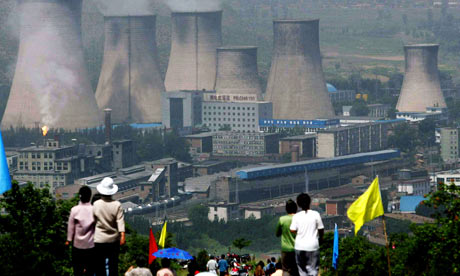
     county's power plant in Zhangjiakou, northeast China's Hebei province

    Residents walk down a road that leads to the county’s power plant in Zhangjiakou, north-east China’s Hebei province. Photograph: STR/AFP


    A majority of peoples around the world want their governments to put action on climate change at the top of the political agenda, a new global public opinion poll suggests.


    Unfortunately for Barack Obama though, who has put energy reform at the top of his White House to-do list, Americans are not necessarily among them.


    Only 44% of Americans thought climate change should be a major preoccupation for the Obama administration, the survey co-ordinated by the University of Maryland’s Programme on International Policy Attitudes said. The only other two countries unwilling to see their governments make climate change a top focus were Iraq and the Palestinian territories. In 15 other countries though there was strong support for governments to do more to deal with climate change.


    Britons were among the most enthusiastic supporters for greater government intervention, with 77% urging officials to do more. Germans, however, think their government has already done enough. Some 83% think their government has already adopted climate change action as a top priority; 27% would like the government to turn its attention elsewhere.


    “The public is pulling for more — a lot more, no, but a bit more, yes. There is definitely political capital there to move the ball forward and that is pretty much universal,” said Steven Kull, the director of the survey which drew on data gathered by academic and marketing polling organisations in the respective countries. Overall about 73% of those polled believe governments should make climate change a top priority.


    The poll, which sampled the opinions of 18,578 people in 19 countries, found broad popular support for making climate change a top priority extended even to those countries whose governments have yet to commit to global action. In China there was overwhelming support — 94% — for the government to keep climate change on the front burner. And in India, which is also rapidly emerging as one of the world’s leading producers of global warming pollution, 59% of the public wanted their government to make climate change a top priority.


    That defies the hard line taken by the country’s environment minister, Jairam Ramesh, earlier this month against putting any cap on its greenhouse gas emissions.


    Around the globe, the public was unconvinced their governments were assigning high enough priority to climate change. The disconnect suggests that there is greater public support for action on public change than elected officials realise, Kull said. “There is a tendency among policy makers to underestimate people’s readiness for action.”


    Only four countries — Germany, Britain, China, and Indonesia — considered that their governments were focused on climate change. But, that did not necessarily satisfy the demand for even greater action.


    Although the majority of Britons, 58%, credit the government with making climate change a major priority, even greater numbers, 89%, believe there is room for the government to do even more.

  • Human activity is driving Earth’s ‘sixth great extinction event’

    Human activity is driving Earth’s ‘sixth great extinction event’


    Population growth, pollution and invasive species are having a disastrous effect on species in the southern hemisphere, a major review by conservationists warns


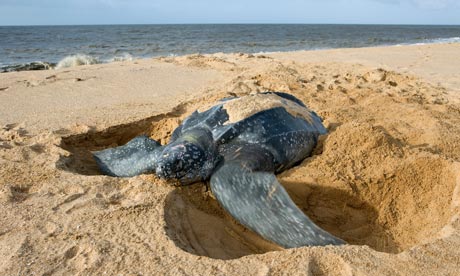
    A leatherback turtle in Surinam

    The leatherback turtle is endangered – but scientific reports expose worrying signs of mass extinctions among other wildlife species. Photograph: Frans Lemmens/Getty Images


    Earth is experiencing its “sixth great extinction event” with disease and human activity taking a devastating toll on vulnerable species, according to a major review by conservationists.


    Much of the southern hemisphere is suffering particularly badly, and Australia, New Zealand and neighbouring Pacific islands may become the extinction hot spots of the world, the report warns.


    Ecosystems in Polynesia, Micronesia and Melanesia need urgent and effective conservation policies, or the region’s already poor record on extinctions will worsen significantly.


    Researchers trawled 24,000 published reports to compile information on the native flora and fauna of Australasia and the Pacific islands, which have six of the most biodiverse regions on the planet. Their report identifies six causes driving species to extinction, almost all linked in some way to human activity.


    “Our region has the notorious distinction of having possibly the worst extinction record on Earth,” said Richard Kingsford, an environmental scientist at the University of New South Wales in Sydney and lead author of the report. “We have an amazing natural environment, but so much of it is being destroyed before our eyes. Species are being threatened by habitat loss and degradation, invasive species, climate change, over-exploitation, pollution and wildlife disease.”


    The review, published in the journal Conservation Biology, highlights destruction and degradation of ecosystems as the main threat. In Australia, agriculture has altered or destroyed half of all woodland and forests. Around 70% of the remaining forest has been damaged by logging. Loss of habitats is behind 80% of threatened species, the report claims.


    Invasive animals and plants have devastated native species on many Pacific islands. The Guam Micronesian kingfisher is thought to be extinct in the wild following the introduction of the brown tree snake. The impact of invasive species is often compounded by pollution and burgeoning human populations on the islands, which have outstripped their capacity to deal with waste. Plastics and fishing gear are an ongoing danger.


    The impact of humans on wildlife is likely to increase in Australasia and the Pacific islands. By 2050, the population of Australia is expected to have risen by 35%, and New Zealand by 25%, while Papua New Guinea faces a 76% increase and New Caledonia 49%.


    More than 2,500 invasive plant species have colonised Australia and New Zealand, competing for sunlight and nutrients. Many have been introduced by governments, horticulturists and hunters. In addition, the report says, average temperatures in Australia have increased, in line with climate change predictions, forcing some species towards Antarctica and others to higher, cooler ground.


    The report highlights several studies that point to serious threats from diseases such as avian malaria and the chytrid fungus, linked to declines in frog populations. An infectious facial cancer is spreading rapidly among Tasmanian devils and populations of the world’s largest marsupial predator are believed to have fallen by more than 60% as a result.


    Plants have also fared badly: a root fungus deliberately introduced into Australia has destroyed several species.


    The report sets out a raft of recommendations to slow the decline by introducing laws to limit land clearing, logging and mining; restricting deliberate introduction of invasive species; reducing carbon emissions and pollution; and limiting fisheries. It raises particular concerns about bottom trawling, and the use of cyanide and dynamite, and calls for early-warning systems to pick up diseases in the wild.


    “The burden on the environment is going to get worse unless we are a lot smarter about reducing our footprint,” said Kingsford. “Unless we get this right, future generations will surely be paying more in quality of life and the environment. And our region will continue its terrible reputation of leading the world in the extinction of plants and animals.”


    Dead and buried


    Cretaceous-Tertiary 65m years ago, the dinosaurs were wiped out in a mass extinction that killed nearly a fifth of land vertebrate families, 16% of marine families and nearly half of all marine animals. Thought to have been caused by asteroid impact that created Chicxulub crater in the Yucatan.


    End of Triassic About 200m years ago, lava floods erupting from the central Atlantic are thought to have created lethal global warming, killing off more than a fifth of all marine families and half of marine genera.


    Permian-Triassic The worst mass extinction took place 250m years ago, killing 95% of all species. Experts disagree on the cause.


    Late Devonian About 360m years ago, a fifth of marine families were wiped out, alongside more than half of all marine genera. Cause unknown.


    Ordovician-Silurian About 440m years ago, a quarter of all marine families were wiped out by fluctuating sea levels as glaciers formed and melted. again.

  • Climate change clouds fate of ancient Polish woods

    Climate change clouds fate of ancient Polish woods


    Reuters July 29, 2009, 10:16 am


    BIALOWIEZA, Poland (Reuters) – Europe’s last ancient forest, home to its largest herd of bison, faces an uncertain future because of climate change, but residents worry that tougher conservation efforts will damage the local economy.


    The 150,000-hectare (380,000-acre) Bialowieza Primeval Forest, which straddles the border between Poland and Belarus, is one of the largest unpopulated woodlands remaining in Europe. It has been a UNESCO World Heritage Site since 1979.


    On the Polish side of the border, residents oppose plans to extend the protected zone of this unique habitat, which is under threat from rising temperatures and declining rainfall.


    Encouraged by international conservation agencies, Warsaw wants to enlarge the area’s national park, which occupies less than a fifth of the Polish part of the forest.


    It has offered up to 100 million zlotys (20.6 million pounds) to be shared among the nine communities that would be affected by broader regulations protecting wildlife.


    However, the region is among the poorest in Poland and residents of Bialowieza district (population 2,400) are sceptical, fearing it would discourage investment, cause job losses and reduce the community’s tax revenues.


    “You may think we are fools not willing to take the money,” Mayor Albert Litwinowicz told Reuters. “But it will only go for green investments, while we need roads.”


    Forests occupy more than 80 percent of the Bialowieza administrative district and provide a significant part of the its income, thanks to government cash.


    Revenues come mostly from woodland and other subsidies from the central government, plus grants and other state aid, Litwinowicz said.


    Income would be halved if the whole area were incorporated into the national park and most of about 50 forestry workers, responsible for maintaining the woodland as well as for cutting the timber, could be laid off, he added.


    Bialowieza district would be fully incorporated into the national park under the current proposal.


    “Building anything in the middle of a national park with strict conservation rules would be almost impossible and we want to develop better transport … and other infrastructure,” Litwinowicz said.


    SIGNS OF CLIMATE CHANGE


    There are no major industrial centres nearby. Every year 150,000 people visit Bialowieza but tourism accounts for only a 10th of the district’s revenue.


    However, unemployment in Bialowieza is almost non-existent, partly because a quarter of the population has left since 1990, moving to cities or, like many other people from eastern Poland, seeking better jobs in wealthier Western Europe.


    Signs of climate change that could threaten the forest have become more evident.


    “The average annual temperature has risen by 0.8 degrees Celsius over past 50 years. This is a lot for a primeval forest,” Elzbieta Malzahn of the Forest Research Institute told Reuters. “That’s enough time to call it a change to climate.


    “There is less rain in the summer, winters are milder and end sooner, prompting vegetation to start earlier.”


    National park officials say the level of ground water has fallen by 50 cm (20 inches) in the past three decades.


    “Spruce roots are very shallow and they just run out of water. We are observing falling number of spruce,” said park employee Mateusz Szymura.


    Bialowieza is home to 800 wild European bison, the continent’s heaviest land animals weighing up to 1 tonne each and standing up to two metres (more than six feet) high.


    So far, the changes have not endangered the bison because mammals adapt easily to a changing environment, scientists say.


    They say Bialowieza had undergone many changes over the centuries and the forest had adjusted to new conditions.


    “The problem, is, however, if the changes we are now causing are too fast and too unpredictable and leave nature little chance to catch up,” Malzahn said.


    BORDER FENCE


    Political arguments between Belarus and Poland have stifled joint efforts to safeguard the forest. Since Poland joined the European Union in 2004, the bloc’s eastern border runs through the forest, marked by a fence built by Belarus years ago.


    The barrier prevents bison from each side from intermingling.


    However, they remain genetically similar since the species was regenerated using just a few animals — and only two males — that survived in a Polish zoo after they had vanished from the wild in the 1920s as a result of hunting and poaching.


    To extend the protected area on the Polish side, the government needs the approval of local authorities and says the scheme would cost between 1.5 million and 3 million zlotys.


    “For years local people have opposed plans to enlarge the park and we are now presenting a programme that shows they can go on operating with an enlarged park,” Deputy Environment Minister, Janusz Zaleski, told Reuters.


    “We also hope this money would create jobs in the region and help improve it.”


    Mayor Litwinowicz did not seem convinced. He said he was considering holding a referendum among residents on the enlargement scheme.


    “If where we live is so unique for the whole of Europe, why shouldn’t the residents benefit rather than suffer?,” he said. “Personally, I am against it, but the people will decide.”


    (Editing by Andrew Dobbie)

  • A force of nature: our influential Anthropocene period.


    A force of nature: our influential Anthropocene period


    What humanity does has important consequences, so we must manage our global life-support system


    We live in epoch-making times. I mean this literally, rather than as a tool to dramatise the global economic crisis or latest political scandal. An epoch describes a geological time period. The end of the last glaciation, some 11,000 years ago, saw the transition from the cool Pleistocene to the warmer Holocene. This relatively stable epoch saw humans turn to agriculture and our population rise considerably. Now geologists, ecologists and climate scientists, myself included, are reporting we have entered a new and much less stable geological epoch: the Anthropocene.


    Just as changes to the Earth’s orbit, volcanic eruptions and asteroid impacts in the distant past have set the world on radically new courses, humanity itself has now become a collective force of nature, with far-reaching consequences. But what does this startling discovery – that humanity has become a globally significant geophysical force – mean for society, solving environmental problems, and perhaps more profoundly, how we see ourselves?


    People have always had an impact on the environment. The difference now is that rather than influencing only local environments in limited ways, humanity is having planet-wide impacts on the Earth’s workings. The best known global change is the rise in atmospheric carbon dioxide and resulting climatic changes. Some of the CO2 in the atmosphere dissolves into the oceans, making them more acid, which is degrading marine ecosystems. To put this in context, the oceans are more acidic today that they have been for at least 800 millenia. The atmospheric CO2 increase has also boosted plant growth in some places, changing the world’s forests and grasslands. In short, the global cycling of carbon has been significantly altered.


    The impacts of human activity on the other great global chemical cycles are similarly profound. To increase crop yields, more nitrogen is added to ecosystems through fertiliser use, than is added by all natural processes combined. But fertiliser run-off leads to ‘dead-zones’ of low-oxygen water that currently affect 245,000 sq km of the world’s ocean.


    Furthermore, scientists estimate that each year humans move more rock, sediment and soil than all natural processes , that at least three times as much fresh water is held in reservoirs than in rivers, and at least a third of all land has been appropriated for human use.


    The heavy hand of humanity reaches into the living world too. Each year, we extract 7m tonnes of bushmeat from tropical forests, 95m tonnes of fish from the oceans, and raze 80,000 sq km of forest. The result: we are at the leading edge of the sixth mass extinction in Earth’s history. Extinction rates today are at least 100 times higher than ‘background’ rates. Previous extinctions, such as that which wiped out the dinosaurs 65m years ago, are joined by a human-induced loss of life.


    Many of these trends look set to continue or accelerate, with potentially dire consequences. Recent events may provide a taste of what’s to come: in 2007 and 2008 food protests erupted across three continents, in part because of the switch of some land from food to biofuel production. In the same period, about 1% of humanity had their homes damaged or destroyed by extreme weather events. Interlinked feedback loops amongst political, economic and environmental spheres could lead to grave problems without foresight and planning.


    The big question in the Anthropocene is: can we learn to manage our own global life-support system and avoid crossing dangerous thresholds? The answer so far, if progress in 14 years of UN climate change talks is a measure, is probably no.


    But perhaps there are grounds for cautious optimism. The word “Anthropocene”, coined by Nobel prize winner Paul Crutzen, has greatly assisted researchers in understanding how the Earth and human society function together. Perhaps pushing the concept into wider usage would enable politicians, business leaders, social movements and NGO’s to similarly benefit from thinking along integrated, quantitative and evidence-based lines.


    Of course, scientific knowledge itself cannot set goals for society. Choosing how to manage our life support system is within the realm of politics. Scientists can identify the likely (and unlikely) outcomes of choices we face. For instance, humanity’s impact on the environment has been greatest over the last 50 years. In this time human numbers have doubled and the global economy increased more than fifteen-fold. Our socio-economic system and the fossil fuels that power it lie at the heart of understanding how humans have become a force of nature, and therefore how to alter our future impacts.


    Big ideas from science are often discomfiting. The Anthropocene is no exception. There is a temptation to see humanity as “bad” for despoiling the environment, or to deny the evidence through fear of acknowledging the need for profound changes. I see it as an update on how we view our place in the universe. First, Copernicus discovered that the Earth revolves around the sun, and humanity is not at the centre of the universe. Then, Darwin established that we are not even at the heart of life on Earth. Now Crutzen has reversed this trend by naming a new human-dominated geological epoch. . The future direction of the only place in the universe where we know life exists is in our hands. Suddenly, after almost 500 years, humanity is centre stage again. Let’s not blow it.


  • China’s three biggest power firms emit more carbon than Britain, says report

    China’s three biggest power firms emit more carbon than Britain, says report


    Greenpeace report names top three polluters and calls for tax on coal to improve efficiency and encourage switch to renewables 


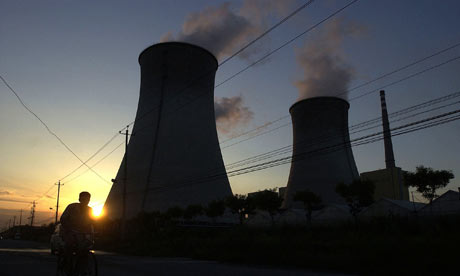
    A cyclist rides past a China Huaneng Group power plant in Beijing

    A cyclist rides past a China Huaneng Group power plant in Beijing Photograph: China Newsphoto/Reuters


    China‘s three biggest power firms produced more greenhouse gas emissions last year than the whole of Britain, according to a Greenpeace report published today.


    The group warned that inefficient plants and the country’s heavy reliance on coal are hindering efforts to tackle climate change. While China’s emissions per capita remain far below those of developed countries, the country as a whole has surpassed the United States to become the world’s largest emitter.


    Greenpeace said the top 10 companies, which provided almost 60% of China’s total electricity last year, burned 20% of China’s coal — 590m tonnes — and emitted the equivalent of 1.44 billion tonnes of carbon dioxide.


    The efficiency of Chinese power generation compares unfavourably with other countries. In Japan, 418 grams of carbon dioxide are emitted per kilowatt hour and in the US, the equivalent figure is 625 grams. But most of the top 10 firms in China produce 752 grams of CO2.


    “China is suffering the pains of extreme weather events such as droughts, heat waves, typhoons and floods, worsened by climate change. These power companies can and must help China to prevent climate disaster by rapidly increasing efficiency and the share of renewable energy such as wind and solar,” said Yang Ailun, Greenpeace’s climate campaign manager, at the launch in Beijing of the Greenpeace report, Polluting Power: Ranking China’s Biggest Power Companies.


    The report says that in 2008, Huaneng, Datang and Guodian — the top three firms — emitted more greenhouse gases than the whole of the United Kingdom.


    But Yang added: “China is ideally placed to…[become] the world’s superpower in terms of smart energy and renewable energy.”


    The group said China closed down 54.07 gigawatt of the least efficient coal-fired plants over the last three and a half years — more than the total electricity installed capacity of Australia.


    It urged power firms to phase out all inefficient coal-fired plants under 100 megawatt by 2012, saving 90m tonnes of coal consumption and 220m tonnes of carbon dioxide annually.


    Firms are already turning to renewable energy and by the end of last year Guodian had installed 2.88 gigawatt of wind power; almost 24% of China’s total and enough to make it the biggest wind energy firm in Asia.


    But Greenpeace said only three of the top 10 produced 10% or more of their energy from renewable sources. The vast majority relied heavily on hydropower — with eight of the firms not even halfway to their legal obligation to produce 3% of energy from other renewable sources by 2010.


    Greenpeace urged the Chinese government to impose energy and environment taxes on coal, encouraging increased efficiency and a move to renewable sources.


    It also called for a doubling of the national renewable energy target to 30% by 2020 and for stricter efficiency standards for coal-fired power stations.


    The State Council, China’s cabinet, is currently drawing up plans for a massive “new energy” programme to cut emissions and ensure energy security. Reports in the domestic media and from foreign diplomats suggest the next decade could see between 1.4 trillion (US$200 bn) and 4.5 trillion yuan (US$600bn) investment in projects ranging from nuclear power, low carbon transport and clean coal technology to super-efficient electric grids.


    This huge expansion is already causing problems. Manufacturing capacity is outstripping supply and the country’s under-invested power grid networks were not ready for large-scale wind power input. Some wind farms have been unable to start operating because of a lack of grid connection or were operating at levels lower than planned.


    But experts warn that de-carbonising the energy supply must happen fast, given the massive toll on China’s environment. State news agency Xinhua reported yesterday that the country’s largest desert lake could vanish in decades due to climate change and human activities.


    “Just 10 years ago, one couldn’t see the other bank of the Hongjiannao even through a telescope. Today, it’s visible with the naked eye,” said He Fenqi, a researcher with the Chinese Academy of Sciences.


    The Hongjiannao, sandwiched between the Muus Desert in Shaanxi Province and the Erdos Plateau in Inner Mongolia, has shrunk by at least 30% in the past two decades, Xinhua reported. It now covers 4,600 hectares and its water level is declining by 20 centimetres annually