Category: Climate chaos

The atmosphere is to the earth as a layer of varnish is to a desktop globe. It is thin, fragile and essential for preserving the items on the surface.150 years of burning fossil fuel have overloaded the atmosphere to the point where the earth is ill. It now has a fever. Read the detailed article, Soothing Gaia’s Fever for an evocative account of that analogy. The items listed here detail progress on coordinating 6.5 billion people in the most critical project undertaken by humanity. 

  • World will warm faster than predicted in next five years, study warns


    World will warm faster than predicted in next five years, study warns


    New estimate based on the forthcoming upturn in solar activity and El Niño southern oscillation cycles is expected to silence global warming sceptics


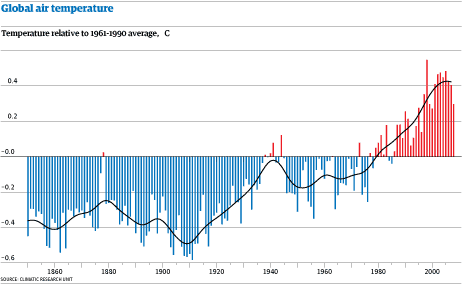
    Air temp

    The world faces record-breaking temperatures as the sun’s activity increases, leading the planet to heat up significantly faster than scientists had predicted for the next five years, according to a study.


    The hottest year on record was 1998, and the relatively cool years since have led to some global warming sceptics claiming that temperatures have levelled off or started to decline. But new research firmly rejects that argument.


    The research, to be published in Geophysical Research Letters, was carried out by Judith Lean, of the US Naval Research Laboratory, and David Rind, of Nasa’s Goddard Institute for Space Studies.


    The work is the first to assess the combined impact on global temperature of four factors: human influences such as CO2 and aerosol emissions; heating from the sun; volcanic activity and the El Niño southern oscillation, the phenomenon by which the Pacific Ocean flips between warmer and cooler states every few years.


    The analysis shows the relative stability in global temperatures in the last seven years is explained primarily by the decline in incoming sunlight associated with the downward phase of the 11-year solar cycle, together with a lack of strong El Niño events. These trends have masked the warming caused by CO2 and other greenhouse gases.


    As solar activity picks up again in the coming years, the research suggests, temperatures will shoot up at 150% of the rate predicted by the UN’s Intergovernmental Panel on Climate Change. Lean and Rind’s research also sheds light on the extreme average temperature in 1998. The paper confirms that the temperature spike that year was caused primarily by a very strong El Niño episode. A future episode could be expected to create a spike of equivalent magnitude on top of an even higher baseline, thus shattering the 1998 record.


    The study comes within days of announcements from climatologists that the world is entering a new El Niño warm spell. This suggests that temperature rises in the next year could be even more marked than Lean and Rind’s paper suggests. A particularly hot autumn and winter could add to the pressure on policy makers to reach a meaningful deal at December’s climate-change negotiations in Copenhagen.


    Bob Henson, of the National Centre for Atmospheric Research in Colorado, said: “To claim that global temperatures have cooled since 1998 and therefore that man-made climate change isn’t happening is a bit like saying spring has gone away when you have a mild week after a scorching Easter.” Temperature highs and lows


    1998

    Hottest year of the millennium


    Caused by a major El Niño event. The climate phenomenon results from warming of the tropical Pacific and causes heatwaves, droughts and flooding around the world. The 1998 event caused 16% of the world’s coral reefs to die.


    1957

    Most sunspots in a year since 1778


    The sun’s activity waxes and wanes on an 11-year cycle. The late 1950s saw a peak in activity and were relatively warm years for the period.


    1601

    Coldest year of the millennium


    Ash from the huge eruption the previous year of a Peruvian volcano called Huaynaputina blocked out the sun. The volcanic winter caused Russia’s worst famine, with a third of the population dying, and disrupted agriculture from China to France.

  • Community will pay so polluters keep polluting

    Community will pay so polluters keep polluting

    Tuesday 28 July 2009

    The proposed doubling of handouts to the coal sector under the Continue
    Polluting Regardless Scheme will see householders and small businesses
    face higher costs and a worse climate crisis so that polluters can keep
    polluting, the Australian Greens said today.

    “Mr Rudd’s climate plans are already a polluter’s paradise, but this
    change would put the coal sector in seventh heaven,” Australian Greens
    Deputy Leader, Senator Christine Milne, said.


    “Australians have clearly said they are happy to pay more if emissions
    will be reduced, but under Mr Rudd’s Continue Polluting Regardless
    Scheme, householders and small business owners will be paying more so
    that the polluters can keep polluting.

    “Every dollar to polluters is a dollar less for the community.

    “Every dollar to dirty coal is a dollar less to the sunrise industries
    that will provide pollution-free power that will never run out.

    “Handing out billions of dollars to polluters under the CPRS makes as
    much sense as paying cigarette companies the takings of a tobacco tax
    designed to discourage people from smoking.

    “The Rudd Government has long ago lost sight of what emissions trading
    is supposed to do.

    “Polluters should be paying for the damage they do so that the community
    can afford to fix it.

    “We need to be retraining workers in the sunset industries for the jobs
    boom in the sunrise industries that smart policies will generate.”

    Senator Milne also commented on the Australian Coal Association’s
    national ad campaign starting today.

    “Instead of wasting hundreds of thousands of dollars on lobbying and
    advertising campaigns, the coal sector should be putting up money for
    its own research so that taxpayers’ money can go into the intelligent
    technologies of the future.”


    Tim Hollo
    Media Adviser
    Senator Christine Milne | Australian Greens Deputy Leader and Climate
    Change Spokesperson
    Suite SG-112 Parliament House, Canberra ACT | P: 02 6277 3588 | M: 0437
    587 562
    http://www.christinemilne.org.au/| www.GreensMPs.org.au
    <http://www.greensmps.org.au/>

  • Act now on climate change or pay later: expert.

    Act now on climate change or pay later: expert


    Posted 7 hours 48 minutes ago


    The Climate Change Institute in Canberra has warned that Australia must think beyond the emissions trading scheme, if it wants to have an impact on global warming.


    Climate change experts are meeting at a summit at the Australian National University to discuss Australia’s response to the threat of global warming.


    As the Federal Government and Opposition battle it out over the detail of an ETS, Climate Change Institute director Will Steffen is advising Australians to embrace the renewable energy technologies that are available now, rather than wait for advances in the field.


    “What we need to do is start getting the emissions trajectory down as soon as we can, the longer we wait to do this, the more we run the risk, the science says, of crossing some of these tipping elements of triggering some abrupt changes,” he said.


    “Even if we don’t the cost of adapting becomes far greater the longer we wait to cut emissions, so there may be some very promising technologies decades in the future but that’s leaving it rather late.”


    Mr Steffen says an ETS is just one aspect of the approach needed to avert a climate crisis.


    “I think the emissions trading scheme is obviously very important but one of the issues that came out of the meeting in Copenhagen earlier this year, the research meeting, is that you need a number of tools and a number of approaches to get on top of the issue,” he said.


    “The other issue of course that came out quite strongly particularly from the economics community is that the longer we delay on the issue the costlier it’ll actually become.”


    Tags: environment, climate-change, australia, act, canberra-2600

  • Rudd won’t assist Pacific climate issue

    Rudd won’t assist Pacific climate issue

    Updated: 09:55, Monday July 27, 2009


    The Rudd government has been accused of running incoherent policy by refusing to assist Pacific nations in dealing with the dire consequences of climate change.


    Two reports are scathing about Australia’s attitude towards neighbours who face the dislocation of millions of people by 2050 as global warming causes sea levels to rise.


    Aid organisation Oxfam Australia says Australia and New Zealand need to contribute more money – up to $668 million – to help island nations adapt to climate change.


    And it agrees with The Australia Institute that Australia needs to develop immigration policies which support those Pacific island communities forced from their homes.


    The institute was especially critical of Labor’s record since 2007, saying the failure to match pre-election rhetoric and early promises in government had failed to secure a more hopeful outlook for Pacific islanders.


    Adaptation assistance had been inadequate and the government was refusing to discuss climate-induced migration, the think-tank said.


    ‘The Rudd government cannot continue to drag the chain on migration and simultaneously refuse to openly and honestly engage with the Pacific,’ its report said.


    ‘It is an entirely incoherent policy position which cannot be sustained.’


    Oxfam says Pacific communities urgently need support to adapt to the impacts of climate change.


    ‘In a region where half the population (of about eight million) lives within 1.5 kilometres of the sea, few people will be untouched by the consequences of climate change,’ it says in a briefing paper.


    Unless wealthy nations, such as Australia and New Zealand, took urgent action to curb emissions some island nations in the Pacific faced the ‘very real threat of becoming uninhabitable’, it said.


    It said wealthy nations must reduce their carbon emissions by at least 40 per cent by 2020, and at least 95 per cent by 2050.


    Australia is committed to reducing its emissions by a minimum five per cent by 2020 and up to 25 per cent if a global agreement can be reached at Copenhagen in December.


    Oxfam wants Australia and New Zealand to address the most urgent adaptation needs of Pacific communities by doubling present funding.


    Both organisations believe Australia needs to engage its Pacific neighbours about displacement of their local communities.


    The institute says Prime Minister Kevin Rudd should use a leaders meeting of the Pacific Islands Forum in Cairns next week to capitalise on a climate change declaration agreed to at last year’s gathering in Niue.


    ‘Concrete action on these issues is imperative, not only for the well being of Pacific communities, but also for the legitimacy of the Australian claim to regional leadership,’ it said.

  • Meltdown is a warning the world can’t afford to ignore

    Meltdown is a warning the world can’t afford to ignore


    The release of America’s spy satellite images of Arctic sea ice provides unexpected, dramatic new evidence about the dangers of global warming.


    These visions of dwindling ice cover confirm that changes in climate in the planet’s high latitudes are progressing much faster than originally expected. And what happens there is bound to have an impact elsewhere on our overheating world, in particular to its rising sea levels.


    It is not the actual loss of Arctic sea ice that is the danger, of course. Its melting will add nothing, directly, to rises in sea levels. But its dwindling will almost certainly have a profound knock-on effect – mainly on the great ice sheets that cover Greenland and Antarctica. Without sea ice to prop them up at their edges, these sheets will break apart at faster and faster rates and tip more and more ice into the oceans. And once changes have been triggered at their edges, these will be transmitted into the hearts of these great glaciers at remarkably fast rates, scientists predict.


    And here lies the threat to Earth. The destruction of the ice sheets of Antarctica and Greenland will feed vast amounts of meltwater into the oceans, far more than has been calculated until very recently. For example, the last report of the Intergovernmental Panel on Climate Change contained little input from melting ice sheets in its estimates and concluded, instead, that sea-level rises would be constrained to around 20 to 60 centimetres by the end of the century.


    That figure now looks uncomfortably optimistic and current estimates put the likely rise at one metre or more by 2100 – a figure backed by the US Geological Survey, which this year warned that rises could reach as much as 1.5 metres. As a result, low-lying areas, including Bangladesh, Florida, the Maldives and the Netherlands, will undergo catastrophic flooding, while in Britain large areas of the Norfolk Broads and the Thames estuary could disappear. In addition, cities including London, Hull and Portsmouth will need new flood defences.


    And that is just the beginning. No matter what we do about carbon dioxide emissions – the key cause of this heating and melting – the world will continue to warm and its sea levels to rise beyond 2100. Reversing global warming will be a very long process. However, we have, if nothing else, been warned.

  • Carribbean Reefs Face Severe Summer Threat

    July 22, 2009, 5:03 pm

    Caribbean Reefs Face Severe Summer Threat


    Coral reefs in a broad swath of the Caribbean face a substantial risk of severe bleaching and die-offs through October, the National Oceanic and Atmospheric Administration said on Wednesday in its latest  Coral Reef Watch report.


    Similar conditions may develop in the southern Gulf of Mexico and central Pacific, the agency said. But the report said the widest area of high risk was in the southern Caribbean, from Nicaragua’s east coast across the south coasts of Haiti and the Dominican Republic and from Puerto Rico south along the Lesser Antilles. Rising ocean temperatures are contributing to the risk, the report said, noting that the National Climatic Data Center reported that in June the world’s  ocean surface temperature was the warmest on record.


    From the report:


    Scientists are concerned that bleaching may reach the same levels or exceed those recorded in 2005, the worst coral bleaching and disease year in Caribbean history. In parts of the eastern Caribbean, as much as 90 percent of corals bleached and over half of those died during that event.


    The forecast said there was substantial risk of bleaching in parts of the Pacific Ocean, as well, and noted that this did not include the extra heat anticipated from a developing El Niño warming of the tropical Pacific.