Category: Climate chaos

The atmosphere is to the earth as a layer of varnish is to a desktop globe. It is thin, fragile and essential for preserving the items on the surface.150 years of burning fossil fuel have overloaded the atmosphere to the point where the earth is ill. It now has a fever. Read the detailed article, Soothing Gaia’s Fever for an evocative account of that analogy. The items listed here detail progress on coordinating 6.5 billion people in the most critical project undertaken by humanity. 

  • Wild weather in the year ahead, scientists predict

    Wild weather in the year ahead, scientists predict


    Climate scientists have warned of wild weather in the year ahead as the start of the global “El Niño” phenomenon exacerbates the impact of global warming. As well as droughts, floods and other extreme events, the next few years are also likely to be the hottest on record, scientists say.


    In the UK, a Met Office spokesman said yesterday that the El Niño event was likely to cause a hot, dry summer following a warm June, but said it could have other unpredictable effects on weather in Britain and north-west Europe. “Much depends on how much the El Niño deepens in the next few months.”


    El Niño – “the child” in Spanish – was named by fishermen in Peru and Ecuador because the phenomenon arrives there at Christmas. It is part of a natural meteorological cycle that happens every 3-7 years and affects weather worldwide for a year or more. It is caused by changes in ocean temperatures, with the first sign being abnormal warming in the Pacific.


    Sea surface temperatures across an area of the Pacific almost the size of Europe have been increasing for six months and will trigger worldwide weather turbulence for the next year, said a spokesman for the US National Oceanic and Atmospheric Administration (Noaa).


    At this stage, both US and Australian climate scientists say this may be a medium-strength El Niño, but they have warned it could develop further.


    “Temperatures in the Pacific are around 1C above average, and sub-surface temperatures up to 4C warmer than normal, ” said a spokesman for Australia’s Bureau of Meteorology.


    The last major El Niño in 1998 killed more than 2,000 people and caused billions of dollars worth of damage to crops and infrastructure in Australia and Asia. It led to forest fires in south-east Asia, a collapse of fish stocks in South America and a drought threatening 700,000 people in Papua New Guinea.


    Strong El Niños often have long-lasting effects. The 1991-92 event led to droughts in Africa and food shortages that left 30 million people at risk of malnutrition and set back development for a decade.


    Oxfam has alerted teams globally. “This could be the hottest year in known history. Poverty and climate change is enough of a challenge: an El Niño will only make things harder,” said Steve Jennings, Oxfam’s disaster risk reduction manager.
  • Developing countries urge G8 to impose 40% emissions cut by 2020

    Developing countries urge G8 to impose 40% emissions cut by 2020


    Diplomat says developing nations ‘will commit once they have certainty that developed countries are commiting themselves’


    Developing nations are prepared to make concessions on climate change targets if the G8 fulfils its side of the bargain in the run-up to the climate change talks in Copenhagen in December, a key negotiator told the Guardian today.


    The developing countries want the G8 nations to sign up to a 40% cut by 2020, but that figure is off the radar of the EU and, given the unwieldy legislation laboriously passing through the senate, not a possibility for the US.


    In important forward steps this week, the G8 agreed to cut its emissions by 80% by 2050 and said worldwide emissions should fall 50% by the same date.


    However, the value of this pledge has been reduced by the lack of an agreed start date from which the emission cuts should be measured, making it a distant promise.


    Luis Alfonso de Alba, the lead co-ordinator on climate change for the developing countries at the G8, told the Guardian that their call for a 25-40%cut in developed nations’ emissions by 2020 was based on what UN climate change scientists had recommended.


    The Mexican diplomat gave some ground, saying: “It does not have to be a specific target of 40%.


    “That is what we hope to achieve, but this is a process of negotiation.”


    He said a G8 commitment to a 2020 target was “fundamental”, adding: “It is logical that developing countries will commit once they have certainty that developed countries are commiting themselves.


    “We need to see the mid-term targets go much higher, and we want to see all the developed countries, including the US, move at the same pace.


    “We still need to see numbers. We respect the internal debate in the US, but it is important for the US to understand that this is a global issue and a multilateral negotiation.”


    He said developing nations could not “just sit and wait to see what the internal debate in the US resolves”. He insisted the meeting chaired by Barack Obama under the aegis of the Major Economies Forum this week had made progress in accepting common responsibility for the crisis and for the need for carbon emissions to peak.


    “Climate change is no longer seen as a north-south issue,” he said. “It is no longer a donor recipient relationship.


    “The most important message is that assuming individual responsibilities to fight climate change can start immediately, and by doing it immediately it will be easier to reach an ambitious agreement at Copenhagen.”


    De Alba said Mexico had already come up with its own carbon reduction programme, and he expected other developing nations to do the same over the coming months.


    It was acknowledged at the summit that science dictates world temperatures must not rise more than 2C degrees above pre-industrial levels.


    The negotiators hope this acknowledgement will drive the coming negotiations in the run-up to Copenhagen.


    The talks include three UN sponsored meetings in Bonn, Bangkok and Barcelona as well as another meeting of the G20 in September.

  • G8 summit: Barack Obama says world can close the carbon emissions

    G8 summit: Barack Obama says world can close the carbon emissions


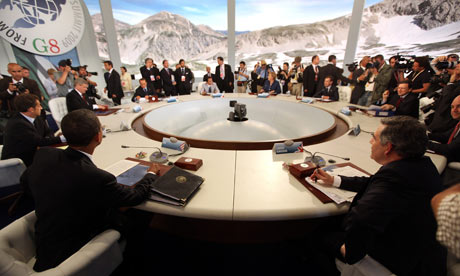
    World leaders from the G8 group of nations attend a round-table discussion in L'Aquila, Italy.

    World leaders from the G8 group of nations attend a round-table discussion during their summit in L’Aquila, Italy. Photograph: Oli Scarff/Getty Images


    Barack Obama said today there was still time to overcome cynicism and close the gap with developing powers on climate change, after slow progress towards an agreement on how to cut carbon emissions across the planet.


    World leaders are racing to meet a deadline of December when the UN climate talks in Copenhagen are due to conclude a crucial deal designed to set a carbon cutting framework to cover 2012-2050. At a meeting in L’Aquila, the G5 group of emerging economies – Brazil, India, China, Mexico and South Africa – refused to back a specific target for developing countries to cut emissions.


    In a small step forward yesterday 17 industrialised and developing countries, which account for about 80% of global emissions, agreed to set an aspiration that world temperatures should not rise by more than 2C on pre-industrial levels. It is the first time India, China and the US have agreed to such a goal.


    Obama said: “We have made a good start, but I am the first to admit that progress is not going to be easy … every nation in this planet is at risk, but just as more than one nation is responsible for climate change no one nation can solve it alone.


    “Developing nations want to make sure they do not have to sacrifice their aspirations for development and higher living standards, yet with most of the projected growth in emissions coming from these countries their active participation is a prerequisite to a solution.


    “Developed countries like mine have a historic responsibility to take the lead with our much larger carbon footprint per capita. I know that in the past the US has sometimes failed to meet its responsibilities so let me make it clear those days are over.”


    Ed Miliband, the climate change secretary, said: “Now we have the 2C goal, that can act as a yardstick to drive up ambition, which is what we need to do over the next six months.”


    But Ban Ki-moon, the UN secretary general, criticised all sides for not being more ambitious. The world had to agree a long-term target, a cut of at least 50% by 2050, he said. “But more importantly, the leaders of industrialised countries should agree on a mid-term target.”


    On Wednesday the G8 industrialised nations committed to cutting emissions by 80% by 2050, the first time the US, Canada and Russia had agreed to such an ambitious target. But the G8 balked at setting interim targets for 2020, partly because of Obama’s belief that he would undermine support in the US Congress for his climate change bill if he went for tough short term targets.


    Obama hit another obstacle yesterday when Democratic leaders in the Senate, under criticism from Republicans for trying to rush through sweeping reforms, abandoned plans to produce a first draft of the bill before the summer recess in August.

  • Why it would be naive to abandon emissions negotiations at Copenhagen

    Why it would be naive to abandon emissions negotiation at Copenhagen


    A new report advocates exclusive emphasis on clean technology – but rejecting emissions caps is simplistic and will not work


    A new breed of climate sceptic is becoming more common. This new breed is not sceptical of the science, but of the policy response. The latest example is a new report by a group of leading academics: How to get climate policy back on course. It questions the approach to climate change action within the United Nations negotiations. Rather than the current approach that emphasises targets for emissions reductions, the report advocates support for low-carbon and energy-efficient technologies (PDF).


    The frustration of the report’s authors is understandable. The negotiations since the UN Framework Convention on Climate Change entered into force in 1994 have been painfully slow. For too long some industrialised economies – particularly the US – were either lukewarm or hostile to the negotiating process. The emissions reductions targets announced for 2020 by leading developed countries such as the US and Japan are not sufficient – this is despite Japan’s commitment to exclusively domestic action. Furthermore, long promised finance and technological assistance for developing countries has yet to materialise.


    However, we shouldn’t take this frustration too far and make an idealised climate change policy the enemy of the good. As the authors of the report emphasise, there is considerable economic, political and psychological capital invested in the current policy approach. This means that the negotiations in Copenhagen are the only game in town. But none of the measures advocated in the report will add up unless they are implemented within an overall limit on emissions. Caps on emissions are required as part of what Anthony Giddens has recently called the “ensuring State”. We need to know that the actions of individuals, businesses and communities are sufficient to limit emissions in line with climate science.


    Caps on emissions are more effective where they are implemented alongside policies to price carbon emissions. The EU emissions trading scheme does this, and there are provisions in the US climate change bill for a similar scheme. There is huge room for improvement in the EU, for example, by tightening caps and reducing the number of get out clauses for industries with large lobbying budgets. But again this is no excuse to dismiss the whole idea. Pricing carbon is necessary (though not sufficient) to move economies towards a more low-carbon pathway.


    The report’s authors recognise the value of pricing carbon to some extent. They advocate a “low ring-fenced carbon tax” to fund low-carbon technologies. But a low tax is unlikely to make any real difference. Furthermore, their emphasis on funding for low-carbon technologies and energy efficiency is only a partial solution – and sets up a false dichotomy between emissions caps and support for technology and efficiency. It echoes the view of President Bush who rejected the Kyoto treaty. Having done so, he used his 2007 State of the Union address to offer the alternative view that “the way forward is through technology”.


    Simply supporting cleaner, low-carbon technologies is not enough and is naive. Experience shows that pushing technologies with funding is just one part of a complex picture. There also needs to be a market for these technologies so that businesses and individuals adopt them. Markets for low-carbon technologies need to be created through a combination of carbon prices and regulations. Without them, a lot of good technology investment will go to waste.


    The emphasis on energy efficiency in the report is welcome, but not thought through. Almost all assessments of climate mitigation pathways conclude that energy efficiency should be done first because it saves us money. However, making energy production and use more efficient is not as easy as it seems, and can have unintended consequences. The “rebound effect” happens because the savings are used for other energy-consuming activities. This seldom makes energy efficiency a waste of time, but emissions caps are needed to limit such rebounds.


    Caps on emissions are therefore a vital component of a successful deal at Copenhagen. Without this and action on other crucial issues such as finance and technology, leading developing countries will not sign up – and will refuse to make commitments of their own. There are some positive signs. Good progress is being made in bilateral talks between the US and China about the conditions under which China could be brought into a new deal. Gordon Brown’s recent proposals on finance and technology have been widely welcomed in the developing world. We should support these initiatives while being critical when progress is too slow or lacks ambition. Rejecting emissions caps in favour of an exclusive emphasis on cleaner technologies is simplistic and will not work.


    • Jim Watson is director of the Sussex Energy Group at the University of Sussex

  • PM Kevin Rudd warns world on climate change

    PM Kevin Rudd warns world on climate change


    Lenore Taylor, National correspondent | July 10, 2009


    Article from:  The Australian


    KEVIN Rudd has warned world leaders they have 150 days to bite the bullet on climate change, after talks between environment ministers failed to break deadlocks threatening a global agreement at Copenhagen in December and G8 leaders managed only the vaguest consensus.


    Speaking as he prepared for critical climate change talks with leaders of 17 wealthy and developing countries on the sidelines of the G8 meeting in the Italian town of L’Aquila, the Prime Minister was blunt about the stalled negotiations and the urgent need for a breakthrough.


    On Wednesday, the G8 agreed to a long-term “goal” of reducing global emissions by 50 per cent by 2050, but Mr Rudd said that, if the Copenhagen negotiations were to succeed, there would have to be tough talk about the nearer term 2020 targets crucial to emissions trading schemes being developed around the world, including in Australia.


    “The key challenge is what can developed and developing nations do in terms of medium-term targets by 2020 and how can we reach agreement on that by the time we reach Copenhagen,” Mr Rudd said before attending the major economies forum meeting, to be chaired by US President Barack Obama.


    “That is the real challenge and when we get to L’Aquila later today I would hope to be having that level of discussion with our friends from around the world.


    “The clock is ticking on climate change and we can’t just shuffle around and hope that something falls out of trees. We have to actually land an outcome, our negotiators need fresh impetus, a fresh commissioning from their political leaders to try to forge an agreement.”


    The G8 leaders were putting a positive spin on their climate change communique, claiming it represented an agreement to stop global warming at 2C.


    In fact the communique said only that the leaders “recognised the broad scientific view” that global temperatures should not be allowed to climb more than 2C over pre-industrial levels and that rich countries could collectively reduce emissions by 80 per cent by 2050 as part of the global effort to achieve the 50 per cent cuts.


    A draft of the communique set to be issued by the major economies leaders – obtained by The Australian – contains even vaguer language. “We recognise the scientific view that the increase in global average temperature above pre-industrial levels ought not to exceed 2C. We will work between now and Copenhagen to identify a global goal for substantially reducing global emissions by 2050.”


    British Prime Minister Gordon Brown hailed the deal as historic and claimed it laid the foundations for a successful Copenhagen deal. American officials called it a “step forward”.


    But G8 member Russia quickly undermined it when President Dmitry Medvedev’s economic adviser said the 80 per cent emissions reductions would be impossible for Russia to achieve.


    “For us, the 80 per cent figure is unacceptable and likely unattainable,” Arkady Dvorkovich said. “We won’t sacrifice economic growth for the sake of emission reduction.”


    And both China and India have insisted the developed countries need to put medium-term cuts on the table before the developing countries commit to anything. “There have to be credible mid-term goals in the range of 25-40 per cent,” said Dinesh Patnaik, an Indian negotiator.


    Both the Rudd government and the opposition have promised cuts of between 5 and 25 per cent by 2020, the higher targets conditional on the ambition of any global deal.


    Mr Rudd said distant 2050 targets should not be the main game for the major economies forum, which includes the G8 and other countries, including China, India, Brazil and Australia.


    Conservation groups said the aspiration to limit global warming was weakened by the absence of medium-term targets.

  • Study suggests dry spells here to stay

    Study suggests dry spells here to stay 


    The author of a new climate study commissioned by the Federal Government says people in southern parts of Australia can expect the dry weather in many areas to continue indefinitely.


    The study by Australian National University (ANU) professor Will Steffen looked at scientific papers published since the Inter-Governmental Panel on Climate Change’s last major report in 2007.


    He found there is growing evidence that prolonged dry spells in certain parts of Australia are linked to climate change rather than nature.


    “The situation is becoming clear: I think we can say with some degree of confidence now that the drying in south-west Western Australia, the one in which Perth is suffering from, has a strong climate change signal so it’s going to be with us for some time,” he said.


    He says the situation is similar in south-east Australia.


    “We are also now starting to see a signal we think in the southern part of south-east Australia, that is the southern half of South Australia and Victoria,” he said.


    “The pronounced drying we have seen over the last decades appears to have a climate change signal in it as well, so there is a risk that that will continue for some time.”


    Tags: drought, environment, climate-change, science-and-technology, research, weather, australia, sa, vic, wa