Category: Climate chaos

The atmosphere is to the earth as a layer of varnish is to a desktop globe. It is thin, fragile and essential for preserving the items on the surface.150 years of burning fossil fuel have overloaded the atmosphere to the point where the earth is ill. It now has a fever. Read the detailed article, Soothing Gaia’s Fever for an evocative account of that analogy. The items listed here detail progress on coordinating 6.5 billion people in the most critical project undertaken by humanity. 

  • 250.000 jobs and 70 Bn revenue- the forecast for a thriving renewables sector.

    250,000 jobs and £70bn revenue – the forecast for a thriving UK renewables sector


    Study from the Carbon Trust warns that potential of renewables sector will only be realised if government invests in research and removes regulatory barriers


    Rain And High Winds Battering The UK

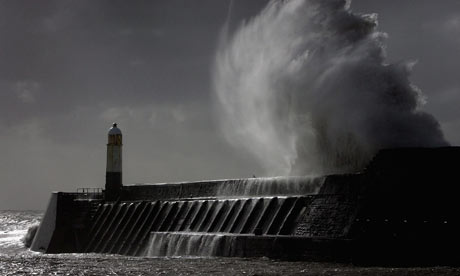
    Waves crash over the harbour wall on the seafront at Porthcawl in Wales. Photograph: Matt Cardy/Getty Images


    The UK could benefit from 250,000 jobs and up to £70bn in revenue from offshore wind and wave technologies by 2050, according to a study by the Carbon Trust. This potential will only be realised, however, if the government gives clear signals to industry, so that investors know where to put their money, rather than leaving new technologies to face the market alone.


    The Carbon Trust, a government-backed agency that studies ways to promote low-carbon technologies, carried out economic analyses in six areas of low-carbon industry including offshore wind, wave, solid-state lighting and micro combined heat and power.


    The studies, published today, looked at the current status and costs of the technology, how these would develop and what research and development costs there might be in the coming decades.


    The studies for offshore wind and wave power showed these technologies could provide at least 15% of the total carbon savings required to meet the UK’s 2050 CO2 reduction targets. “The UK’s greenhouse gas targets mean that by 2050 We must reduce our emissions to just one-10th of today’s levels, per unit of output,” said John Beddington, the government’s chief scientific adviser.


    “This is a formidable challenge, requiring step changes in the rate at which we improve our energy efficiency and in low-carbon innovation.The Carbon Trust’s proposals recognise the need for us to be smarter in focusing our investments, including to help businesses seize the economic opportunities of the transition.”


    According to the new analysis, published just a few weeks ahead of the forthcoming government white paper on energy, the UK could attract 45% of the global offshore wind market by 2020, delivering £65bn of net economic value and 225,000 total jobs by 2050.


    This would only happen with an investment of up to £600m into research, the removal of regulatory barriers and incentives to increase the deployment of the turbines. In the UK this means installing around 29GW of wind by 2020 and upwards of 40GW by 2050. A large part of the economic benefit would come from exporting technology developed here.


    For wave, the outlook is more modest. Around a quarter of the world’s wave technologies are being developed in the UK and the Carbon Trust said Britain should be the “natural owner” of the global market in this area. It could generate revenues worth £2bn per year by 2050 and up to 16,000 direct jobs.


    “These technologies are not green ‘nice to haves’ but are critical to the economic recovery of the UK,” said Tom Delay, the chief executive of the Carbon Trust. “To reap the significant rewards from their successful development we must prioritise and comprehensively back the technologies that offer the best chance of securing long-term carbon savings, jobs and revenue for Britain. Rather than following in the footsteps of others, this new analysis shows it is an economic no-brainer to be leading from the front.”


    In addition to the direct jobs in these in industries, there would be further benefits to the economy. “The UK’s also very good at the secondary service industries – things like the financing of wind farms, the legal documents, environmental assessments,” said Paul Arwas, a consultant who wrote the new Carbon Trust report. “Those jobs would be in addition – for offshore wind, it would be another 70,000 by 2050.”


    None of this will happen, though, without government support. Arwas said that when encouraging new industries, authorities tended to swing between two poles – either direct state funding or allowing markets to decide. “Either the governments didn’t intervene at all or, if they did they did it by market mechanisms which are totally undifferentiated by technology. There you end up with a situation where, to take a footballing analogy, you’ve got the under 21s playing the under 12s.”


    Instead the Carbon Trust has proposed a new, semi-interventionist, model where the government chooses a family of technologies to invest in, for example wave power, and tells developers there will be subsidies or long-term help available to develop the sector as a whole but without backing individual technologies.


    John Sauven, Greenpeace’s executive director, welcomed the Carbon Trust’s proposed approach. “Every country now needs a decarbonisation plan to help solve three of our greatest challenges – climate stability, energy security and economic prosperity. The UK has an enormous untapped supply of clean, green renewable energy and a world class engineering industry well placed to develop it.”


    Martin Rees, the president of the Royal Society, said the UK had little choice but to develop these new technologies, given the dwindling supplies of fossil fuels: “In the past we have let opportunities to capitalise on our scientific leadership slip through our fingers. The US and others are investing heavily in low carbon technologies; we must not fall behind and waste the scientific expertise that we have in the UK.”
  • ExxonMobil continuing to fund climate sceptic groups, records show

    ExxonMobil continuing to fund climate sceptic groups, records show


    Records show ExxonMobil gave hundreds of thousands of pounds to lobby groups that have published ‘misleading and inaccurate information’ about climate change


    Exxon

    Exxon. Photograph: Donna Williams/AP


    The world’s largest oil company is continuing to fund lobby groups that question the reality of global warming, despite a public pledge to cut support for such climate change denial, a new analysis shows.


    Company records show that ExxonMobil handed over hundreds of thousands of pounds to such lobby groups in 2008. These include the National Center for Policy Analysis (NCPA) in Dallas, Texas, which received $75,000 (£45,500), and the Heritage Foundation in Washington DC, which received $50,000.


    According to Bob Ward, policy and communications director at the Grantham Research Institute on Climate Change and the Environment, at the London School of Economics, both the NCPA and the Heritage Foundation have published “misleading and inaccurate information about climate change.”


    On its website, the NCPA says: “NCPA scholars believe that while the causes and consequences of the earth’s current warming trend is [sic] still unknown, the cost of actions to substantially reduce CO2 emissions would be quite high and result in economic decline, accelerated environmental destruction, and do little or nothing to prevent global warming regardless of its cause.”


    The Heritage Foundation published a “web memo” in December that said: “Growing scientific evidence casts doubt on whether global warming constitutes a threat, including the fact that 2008 is about to go into the books as a cooler year than 2007”. Scientists, including those at the UK Met Office say that the apparent cooling is down to natural changes and does not alter the long-term warming trend.


    In its 2008 corporate citizenship report, published last year, ExxonMobil said it would cut funds to several groups that “divert attention” from the need to find new sources of clean energy.


    The NCPA and Heritage Foundation are included among groups funded by ExxonMobil, according to details of its “2008 Worldwide Contributions and Community Investments” published recently.


    Ward said: “ExxonMobil has been briefing journalists for three years that they were going to stop funding these groups. The reality is that they are still doing it. If the world’s largest oil company wants to fund climate change denial then it should be upfront about it, and not tell people it has stopped.”


    In 2006, Ward, then at the Royal Society, wrote to ExxonMobil to challenge the company’s funding of such lobby groups. The move, revealed in the Guardian, prompted accusations of censorship and debate about whether experts should “police” the distribution of scientific information.


    In an article on the Guardian website, Ward writes: “I have now written again to ExxonMobil to point out that these organisations publish misleading information about climate change on their websites, and to seek guidance on how to reconcile this fact with the pledge made by the company. I believe that the company should keep its promise by ending its financial support for lobby groups that mislead the public about climate change.”


    ExxonMobil said it annually reviews and adjusts its contributions to policy research groups. A spokesman said: “Only ExxonMobil speaks for ExxonMobil and our position on climate change is clear. We have the same concerns as people everywhere, and that is how to provide the world with the energy it needs while reducing greenhouse gas emissions. We take the issue of climate change seriously and the risks warrant action.”

  • Sweden takes EU helm and vows action on climate change

    Sweden takes EU helm and vows action on climate change


    July 01, 2009


    Article from:  Agence France-Presse


    SWEDEN has taken over the six-month rotating presidency of the European Union, vowing to tackle climate change and combat soaring unemployment in Europe following the global economic crisis.

    “The financial crisis and climate change, with the preparation of the Copenhagen conference, will be our main priorities,” Prime Minister Fredrik Reinfeldt told reporters on the eve of the Swedish presidency.

    Stockholm wants to get the EU to sign up to a new UN global warming treaty to be negotiated in Copenhagen in December and which would replace the Kyoto Protocol on cutting carbon emissions that expires in 2012.


    “We need a global answer to this global problem,” Reinfeldt said.

    But Reinfeldt and his centre-right government, which took over the reins on Wednesday after a turbulent Czech presidency, have their work cut out for them for the next six months as the 27-member bloc finds itself in a period of limbo.

    A new European parliament has just been elected and is in the process of settling in, a new Commission will be installed – and it is not yet certain who the next president will be – and the bloc’s institutional framework may be altered depending on the outcome of a referendum in Ireland on the Lisbon Treaty in October.

    The Scandinavian country, which like the Czech Republic is not a member of the eurozone, nonetheless aims to restore confidence in the financial markets by establishing “a European body to supervise stability”.

    “We need to work in a more coordinated and cross-border way for supervision,” Reinfeldt said.

    Sweden also plans to “lay the foundations for a new growth and employment strategy” to help the millions of unemployed Europeans, according to its work program.

    Other priorities include EU enlargement, of which Sweden is a fierce advocate, improving European judicial co-operation, and developing a strategy to improve the Baltic Sea’s marine environment and the region’s growth potential.

    Reinfeldt’s government will host the European Commission for a meeting in Stockholm on Wednesday that will formally open the Swedish presidency.

  • Major Economies Zero in on Climate Goals

    June 25, 2009, 1:21 pm

    Major Economies Zero In on Climate Goals


    Reuters has a useful update on the latest meeting of the  Major Economies Forum on Energy and Climate, which concluded yesterday in  Cuernavaca, Mexico. The article cites a draft two-page text circulated at the meeting, which appears to indicate movement toward long-term (2050) and near-term (2020) steps to curb emissions of greenhouse gases — although with all of the soft language required to get both developing and rich countries on board.


    According to Reuters, the text says, “We support an aspirational global goal of reducing global emissions by 50 percent by 2050, with developed countries reducing emissions by at least 80 percent by 2050.”


    Developed countries would take “robust aggregate and individual mid-term reductions in the 2020 time frame.” In that same span, developing countries would make a “significant deviation from business as usual” to slow a rise in their emissions while still pursuing an end to poverty, according to Reuters.


    The next stop for the forum, which was assembled by the Obama administration in a process created under President George W. Bush, comes on July 9 in Italy when leaders of participating countries gather at a meeting on the sidelines of the Group of Eight summit of industrial powers.


    President Obama has pledged repeatedly to make the  United States a leader in efforts to craft a new climate treaty this year. Look for a strong final push from his climate team to get some meaningful language adopted in July.

  • A weather forecast we daren’t ignore

    A weather forecast we daren’t ignore


    It is an old axiom of politics that people do not necessarily engage with an issue until they feel it has some personal impact on their lives. Thanks to the UK Climate Projections 2009 report released by environment secretary Hilary Benn last week, that impact is now clearly laid out.


    The result of 12 years research by Met Office scientists, the report suggests that summer temperatures in London could regularly reach 40C by 2080 and that wildfires, blistering summers, storm surges and crop failures could become common events across southern Britain. In the North, meanwhile, there is a serious risk that winter rainfall could increase dramatically, with devastating consequences.


    There are caveats, naturally, about the uncertainties involved in any long-term weather forecasts. But it would be a mistake not to try to get the most accurate possible picture of our meteorological fate. Without that, we will be exposed to major loss of life from heatwaves, flooding and fire. The report is a welcome source of potential guidance over the siting of new flood defences, changes in farming practices and the need for the health service to prepare for the impact of soaring temperatures.


    But there is another factor involved. The report provides a range of scenarios and stresses that the worst can be prevented if carbon emissions are minimised. We still have a chance to control our destinies.


    The key here lies with the development of ways to generate energy cleanly. And of these, the technology with the most promise is the one that will allow us to continue to burn coal, the world’s most abundant fossil fuel, without generating carbon dioxide. That point was stressed by E.On chief Paul Golby last week. He argued that carbon capture and storage (CCS) schemes, in which carbon is removed from coal and buried below ground, may prove to be the most important of all forms of clean energy generation. He is right and the government apparently agrees, hence its recent praiseworthy decision to support CCS development.


    Coal is a filthy fuel. But the world needs to balance economic vitality and environmental security. To understand what will happen should we fail with CCS, we need look no further than last week’s projections report.

  • Have the climate change deniers abandoned us during the heatwave ?

    Have the climate change deniers abandoned us during the heatwave?


    If a UK cold snap persuades climate sceptics that global warming isn’t happening, then a heatwave must convince them that it is


    We’re still waiting. During the cold weather last winter, Gerald Warner, Peter Mullen and a host of other climate change deniers lined up to suggest that there must be something wrong with global warming theory, because some snow had fallen in Britain. Clearly they possessed the mystical ability to divine a long-running global climate trend from a single regional weather event. This clairvoyance could be very useful to climate researchers, so I hoped they would continue to favour us with their insights.


    But, to general wailing and gnashing of teeth, they appear suddenly to have abandoned us. Where are these oracles, now that we need to consult them about the current weather event? If a single cold snap in the UK persuades them that global warming isn’t happening, then a single heatwave in the same place must surely convince them that it is. Logic would dictate that the world must now be destined for a century of heating – until the next cold snap, whereupon it is obviously destined once more for a century of cooling.

    It would be sacrilege to accuse these seers of inconsistency, so it can be only a matter of time before they issue their revised assessment of global climate trends. I understand that, pending their pronouncement, Nasa and the Met Office have put their research programmes on hold. Please don’t keep us waiting too long.


    monbiot.com