Category: Climate chaos

The atmosphere is to the earth as a layer of varnish is to a desktop globe. It is thin, fragile and essential for preserving the items on the surface.150 years of burning fossil fuel have overloaded the atmosphere to the point where the earth is ill. It now has a fever. Read the detailed article, Soothing Gaia’s Fever for an evocative account of that analogy. The items listed here detail progress on coordinating 6.5 billion people in the most critical project undertaken by humanity. 

  • T4 campaign update – October 2012

    T4 campaign update – October 2012

    Inbox
    x

    Coal Terminal Action Group via email.nationbuilder.com
    7:46 PM (1 hour ago)

    to me
    Images are not displayed. Display images below – Always display images from hcec@hcec.org.au

    Dear Nevile,

    A few weeks ago scientists announced that Arctic sea ice was at its lowest level since records began. At the rate the planet is warming (due to greenhouse pollution from fossil fuels like coal) the Arctic may be completely free of summer sea ice as early as 2015. That’s the same year that mining companies were planning to start shipping coal from T4 – their proposed massive new coal terminal in Newcastle. But they didn’t count on the strong community campaign against it. We’ve already delayed T4 by two years!

    But we don’t want T4 delayed. We want it stopped. For the health of people living with the Hunter coal industry, already breathing unsafe levels of particle pollution, T4 needs to be stopped. For the vast areas of land and water in the Hunter and Gunnedah regions threatened by coal mining; for the globally significant wetlands of the Hunter Estuary, and the wildlife that depend on them; and for the millions of people around the world whose lives are threatened by climate change, T4 needs to be stopped.

    Together, we can stop T4. Take action now: http://www.stopT4.org.au

    Here’s how the campaign is going:

    • On Monday, University of Sydney researchers released a report on ‘Health and Social Harms of Mining in Local Communities: Spotlight on the Hunter’. The report documents the risk of cancer, heart, lung and cancer disease and birth defects.
    • There have been 36 air quality alerts for the Hunter Valley in the last month – an average of one a day. A recently installed air quality monitor in Stockton has revealed particle pollution exceeding the national standard. And this is now. What will the air in the Hunter Valley be like if coal companies get their wish, and the industry triples in size?
    • We’ve just launched a new online action page. With a couple of clicks you can send a message direct to Premier Barry O’Farrell and Planning Minister Tim Owen, asking them to take a stand against T4. Please take action, then spread the word throughout your networks. Let’s swamp their in-boxes.
    • We’ve also been working on a new T4 ad, targeting Barry O’Farrell and Tim Owen. If we can raise enough money, we’re going to put it in the Newcastle Herald. We’re also about to embark on a letterbox leafleting drive with the ad. Do you have some time to letterbox your area? Drop us a line if you do. To see the ad or donate money to get it in the paper, please click here.
    • Planning Minister, Brad Hazzard, has sent the T4 Proposal to the NSW Planning Assessment Commission (PAC) for review. The Terms of Reference for the PAC can be downloaded here. The PAC will be holding public hearings in Newcastle in early 2013 (probably February), to assess the merits or otherwise of the T4 Proposal. They will be calling for both written and oral submissions. Now, we are not naive here at CTAG. We have seen how corrupt the NSW planning process is when coal companies are involved. So we’re fairly certain that the PAC will recommend approval of T4. Nonetheless it’s an important process to engage with, to further delay the T4 approval process, and to give the PAC all the ammunition they need to make the right call. We will be calling on you to make your voice heard to the PAC over the next couple of months, so keep an eye out.
    • We fundraised $5000 for our air monitoring program! Thanks for your generous donation! We will be hiring equipment soon, to begin making independent measurements of the air quality along the coal rail line. Industry recently did their own air quality monitoring. You might have seen our criticism of that study in local media.

    That’s all for now. We’ll be in touch soon. Don’t forget to do the online action and tell your friends about it.

    Thanks again for your support!

    Annika (Hunter Community Environment Centre)

    On behalf of theCoal Terminal Action Group
    http://coalterminalactiongroup.nationbuilder.com/

    -=-=-
    coalterminalactiongroup · Australia
    This email was sent to nevilleg729@gmail.com. To stop receiving emails, click here.
    -=-=-

    Created with NationBuilder, the essential toolkit for leaders.

  • David Attenborough: US politicians duck climate change because of cost

    David Attenborough: US politicians duck climate change because of cost

    The naturalist warned it would take a terrible example of extreme weather to wake people up to global warming

    The broadcaster and naturalist Sir David Attenborough says scientists and environmentalists have been cautious of overstating the dangers of global warming Link to this video

    One of the world’s leading naturalists has accused US politicians of ducking the issue of climate change because of the economic cost of tackling it and warned that it would take a terrible example of extreme weather to wake people up to the dangers of global warming.

    Speaking just days after the subject of climate change failed to get a mention in the US presidential debates for the first time in 24 years, Sir David Attenborough told the Guardian: “[It] does worry me that most powerful nation in the world, North America, denies what the rest of us can see very clearly [on climate change]. I don’t know what you do about that. It’s easier to deny.”

    Asked what was needed to wake people up, the veteran broadcaster famous for series such as Life and Planet Earth said: “Disaster. It’s a terrible thing to say, isn’t it? Even disaster doesn’t do it. There have been disasters in North America, with hurricanes and floods, yet still people deny and say ‘oh, it has nothing to do with climate change.’ It visibly has got [something] to do with climate change.”

    But some US politicians found it easier to deny the science on climate change than take action, he said, because the consequence of recognising the science on man-made climate change “means a huge section from the national budget will be spent in order to deal with it, plenty of politicians will be happy to say ‘don’t worry about that, we’re not going to increase your taxes.’”

    Neither Barack Obama or Mitt Romney mentioned climate change in three TV debates, despite a summer of record temperatures and historic drought in the US.

    Romney used Obama’s commitment to taking action on climate change as a joke in his convention speech. The president later hit back by saying “and yes, my plan will continue to reduce the carbon pollution that is heating our planet because climate change is not a hoax. More droughts and floods and wildfires are not a joke.” However, environmentalists have been critical of Obama’s silence on the subject and the Green party presidential candidate, Jill Stein, went as far as saying it meant he was, in effect, “another climate denier”.

    Attenborough said he thought the US’s attitude towards climate change and the environment was not just because of politics, but because of the country’s history. “[It’s] because they’re a pioneer country. There has been the wild west, the western frontier… that’s still there, you see it in the arms business, the right for everyone to bear arms. It’s part of the pioneer stuff that you’ve [Americans] grown up with.”

    By contrast, he said, people in the UK had “grown up with a mythology of black industry and wrecking the countryside.”

    The current financial crisis has made it problematic for politicians to show leadership on climate change, Attenborough acknowledged. “Well it’s a very difficult time to do it [show leadership]. In times of recession, it’s a very difficult time to advance these arguments [on the urgency of tackling climate change] that mean you have to spend even more money and take money from taxes to do things,” he said.

    Yet he also warned that it was becoming clear the impacts of climate change were worst than had been expected. Talking about the record Arctic sea ice melt this summer, he said: “The situation is worse than we thought [in the Arctic]. The processes of melting are more volatile than we thought. More complicated. The ice cap is really melting faster than we thought.”

    The 86-year-old naturalist, who is also a patron of the charity Population Matters, said many of the environmental problems the world faced could be helped by addressing human population, which is believed to have reached the 7 billion mark last year, and is forecast to reach 10 billion by the middle of the century.

    The solution, he said, was to raise living standards and increase democracy in developing countries. “The only way I can think of it [tackling population] is by giving women the rights to control their own bodies and control how many children they have. In every circumstance where women have that right, where they have the vote, where they are proper medical facilities, where they are literate, where they are given the choice, the birth rate falls,” he said. “That is a good start, if that could be spread.”

    • You can read more of Sir David Attenborough‘s views on climate change and animals in this Sunday’s Observer magazine

  • A Massive Field Of Frozen Greenhouse Gas Is Thawing Out

    A Massive Field Of Frozen Greenhouse Gas Is Thawing Out
    Smithsonian (blog)
    The cause of this sharp spike in greenhouse gas concentrations, some researchers say, was a sudden release of methane from rocky stores deep below the ocean waves. And though other researchers call this idea into question, the presumed threat of stored
    See all stories on this topic »

  • Green news roundup: The Guardian

    Green news roundup: Whales, weather and wildlife

    The week’s top environment news stories and green events

    If you’re not already receiving this roundup, sign up here to get the briefing delivered to your inbox

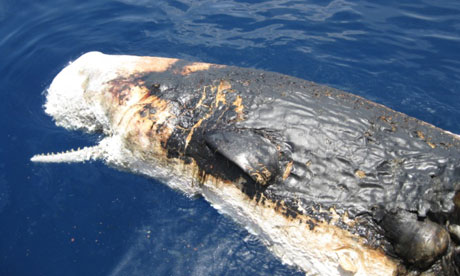
    A dead Sperm Whale floating in the Gulf of Mexico seen from the deck of NOAA Ship Pisces

    A dead Sperm Whale floating in the Gulf of Mexico. Photograph: NOAA

    Environment news

    US downplayed effect of Deepwater oil spill on whales, emails reveal
    • Badger cull postponed until 2013
    UK makes biggest emissions cuts in Europe
    Ash dieback disease discovered in mature woodland in East Anglia
    China to approve new nuclear plants, ending moratorium after Fukushima
    •  UK public favours wind turbines over shale gas wells, poll finds
    Future of UK nuclear power hangs in the balance, says EDF boss

    On the blogs

    Prix Pictet 2012 :  Carl De Keyzer

    The strength of the Prix Pictet is in danger of becoming watered down
    • Evidence of pesticide harm to bees is now swarming
    Extreme high-vis: when you really want to be seen on a bike
    Noc the talking whale has told us to get out of the water
    Red laser beams enable cyclists to create their own bike lane
    Lotus Evora 414E: behind the wheel of an electric sports car

    Multimedia

    A young deer hides amongst the autumnal bracken at Dunham Massey park in Knutsford

    Autumn colours around the world – in pictures
    Oil-affected wildlife in the Gulf of Mexico – in pictures
    Badger cull postponed until 2013 – video
    Talking whale named Noc mimics human speech – video

    Features and comment

    A badger

    Brian May: Badgers win reprieve but we need a complete abandonment of cull plans
    Talking beluga whale named Noc is revealed
    • Anti-aviation sentiment shared across Europe, say UK campaigners

    Green jobs

    Environmental Health Technician, RAF Careers, UK, Salary £18,340
    Deputy Campaigns Director: Corruption, Global Witness, London, £50,000 – £60,000
    Senior Community Engagement Officer, Environment Agency, York, Leeds, Newcastle, £30,720 – £34,280

    … And finally

    Can the Isle of Wight start a power revolution?
    The island has taken its first steps towards a smart grid that will reduce electricity consumption and manage renewables

    • SKY_MEDIA_NETWORK_30812
    • Button_Sustainable_Business_Shorts
    • Email Services


    You are receiving this email because you are a Green Light subscriber.

    Click here if you do not wish to receive Green Light emails from the Guardian News and Media.
    Click here to find out about other Email Services from the Guardian.

    Guardian News & Media Limited – a member of Guardian Media Group PLC. Registered Office: Kings Place, 90 York Way, London, N1 9GU. Registered in England No. 908396

  • 24 hours that shifted the world. 350 org

    24 hours that shifted the world.

    Inbox
    x

    Will Bates – 350.org organizers@350.org
    7:11 AM (2 hours ago)

    to me

    Dear friends,

    It’s not often you get to feel the world shift a little bit — but three years ago, that’s exactly what happened.

    On October 24 2009, 350.org’s first ever day of action took the world by storm, with over 5,000 events in 181 countries. The International Day of Climate Action helped put the 350 movement on the map in every corner of the globe.

    It’s hard to describe it in words, so take two minutes to watch this video — and consider chipping in to support our work moving forward:

    Screenshot of 350 Video

    www.350.org/three-years

    CNN called the event “the most widespread day of political action in our planet’s history.” Foreign Policy magazine called it “the largest ever global coordinated rally of any kind.” For 24 hours, the global climate movement was the top story on Google News.

    But it isn’t the media attention that inspires me most — it’s everything that has happened since.

    In the last three years, a truly global movement has risen up to fight the climate crisis. Millions of people have participated in 350 campaigns, trainings, and mass mobilizations. We’ve launched and won critical climate battles all over the world — and we’re just getting started.

    Our most important work is ahead of us — we’re planning a landmark global convergence, embarking upon an educational road-tour, and launching hard-hitting campaigns in countries all around the world.

    We’re working with local groups and partners in India, the Philippines, and Australia to scale up campaigns to move beyond coal and shift to renewable energy. Our friends in France and Indonesia are carrying on the fight to #EndFossilFuelSubsidies and cut off corporate polluters from public handouts. And so it goes around the world — everywhere we’re able, we’re working with incredible grassroots activists to push for the solutions that the planet and its people so desperately need.

    Whether you joined us three years ago, or just found out about 350.org yesterday, thank you for all that you do to build this movement.

    Let’s keep shifting the world. Together.

    Onwards,

    Will Bates for the 350.org team

    P.S. If you think this work is important, please do chip in to support it. You can donate (and watch the video) right here: www.350.org/three-years


    350.org is building a global movement to solve the climate crisis. Connect with us on Facebook and Twitter, and sign up for email alerts. You can help power our work by getting involved locally, sharing your story, and donating here.

    To stop receiving emails from 350.org, click here.

  • Reclaiming rare earths: Improving process to recycle rare-earth materials

    Reclaiming rare earths: Improving process to recycle rare-earth materials

    Posted: 24 Oct 2012 02:55 PM PDT

    Recycling keeps paper, plastics, and even jeans out of landfills. Could recycling rare-earth magnets do the same? Perhaps, if the recycling process can be improved. Scientists are working to more effectively remove the neodymium, a rare earth element, from the mix of other materials in a magnet. Initial results show recycled materials maintain the properties that make rare-earth magnets useful.

    2012 Antarctic ozone hole second smallest in 20 years

    Posted: 24 Oct 2012 01:47 PM PDT

    The average area covered by the Antarctic ozone hole this year was the second smallest in the last 20 years. Scientists attribute the change to warmer temperatures in the Antarctic lower stratosphere.

    Speed limits on cargo ships could reduce their pollutants by more than half

    Posted: 24 Oct 2012 09:48 AM PDT

    Putting a speed limit on cargo ships as they sail near ports and coastlines could cut their emission of air pollutants by up to 70 percent, reducing the impact of marine shipping on Earth’s climate and human health, scientists have found.