Category: Climate chaos

The atmosphere is to the earth as a layer of varnish is to a desktop globe. It is thin, fragile and essential for preserving the items on the surface.150 years of burning fossil fuel have overloaded the atmosphere to the point where the earth is ill. It now has a fever. Read the detailed article, Soothing Gaia’s Fever for an evocative account of that analogy. The items listed here detail progress on coordinating 6.5 billion people in the most critical project undertaken by humanity. 

  • Canada’s PM Stephen Harper faces revolt by scientists

    Canada’s PM Stephen Harper faces revolt by scientists

    Scientists to march through Ottawa in white lab coats in protest at cuts to research and environmental damage

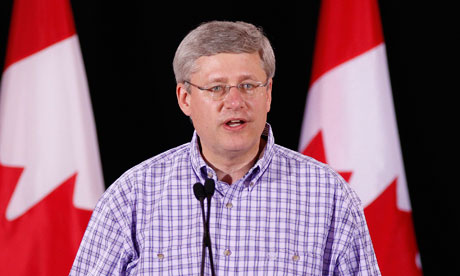
    Canada's prime minister Stephen Harper

    Canada’s prime minister Stephen Harper: his government is accused of jeopardising Canada’s scientific reputation. Photograph: Todd Korol/Reuters

    Canada‘s prime minister, Stephen Harper, faces a widening revolt by the country’s leading scientists against sweeping cuts to government research labs and broadly pro-industry policies.

    The scientists plan to march through Ottawa in white lab coats on Tuesday in the second big protest in a month against the Harper government’s science and environmental agenda.

    Harper is accused of pushing through a slew of policies weakening or abolishing environmental protections – with an aim of expanding development of natural resources such as the Alberta tar sands.

    His government is also accused of jeopardising Canada’s scientific reputation by shutting down the Experimental Lakes Area (ELA), a research station that produced critical evidence to help stop acid rain.

    “In my view there are a lot of attempts in this country, and other countries too, to push through resource-based economies,” said Prof John Smol, a freshwater lake biologist at Queen’s University in Kingston, Ontario. “People working at ELA are constantly finding reasons why you can’t just put a pipeline here, or an industry there, because there are going to be environmental costs.”

    Andrew Weaver, a climate scientist at the University of Victoria in British Columbia, was even more pointed. “It’s not about saving money. It’s about imposing ideology,” he said. “What’s happening here is that the government has an ideological agenda to develop the Canadian economy based on the extraction of oil out of the Alberta tar sands as quickly as possible and sell it as fast as it can, come hell and high water, and eliminate any barriers that stand in their way.”

    However, a spokeswoman for Gary Goodyear, the minister of state for science and technology, said the government remained committed to funding science. “Our government has made historic investments in science, technology and research to create jobs, grow our economy, and improve the quality of life for Canadians,” she said.

    But Canadian government officials also indirectly confirmed scientists’ charges that Harper was far more interested in funding research with direct industry applications, than in funding pure science or environmental research.

    “As a country we have been lagging behind our peer nations on applied research and commercialisation and our government is taking steps to correct that,” the official said.

    The official provided a list of new projects supported by the government. Among the largest was $105m for marketing forest products.

    The showdown between the government and scientists was set late last month by the passage of a budget bill that weakened or abolished scores of environmental laws.

    The government claims the cuts are intended to shift more resources towards monitoring development of the Alberta tar sands, the core of Harper’s economic strategy.

    Critics say the changes gut the country’s strongest environmental law, the Canadian Fisheries Act, by easing earlier requirements on mining and other industries to protect fish habitat.

    In addition, the C-38 budget bill cut dozens of jobs for government scientists, scrapped research projects, and pollution control programmes. It abolished the unit in charge of monitoring emissions from power plants, furnaces, boilers and other sources, for a net saving of about $600,000.

    It cut funding entirely for two-well established bodies: the National Round Table on the Environment and the Economy, an advisory panel, and the Canadian Foundation for Climate and Atmospheric Science, which awards research grants. It also cut other research grant programmes.

    The Harper government has clashed regularly with environmental groups over its strategy of developing the tar sands and shipping the oil to America and China.

    Earlier this year, the natural resources minister, Joe Oliver, accused foreign radicals and “jet-setting celebrities” of trying to hijack the country, by opposing development of the tar sands.

    The government has also directed the tax authorities to investigate the funding of environmental groups.

    There were protests, too, when government scientists were banned from speaking to media without an official “minder”, and when news of the cost-cutting proposals first trickled out.

    More than 500 groups took their websites down for 24 hours last month in protest at the budget cuts, which they claim were an excuse to weaken environmental protections.

    But the cuts that seem to have galvanised the protests on Tuesday was the government’s decision to shut down the Experimental Lakes Area in March 2013.

    “It’s a culmination of all of the cuts to government science and environment,” said Diane Orihel, a PhD candidate at the University of Alberta, leading the campaign to save the labs. “The ELA is one small little morsel in a much broader problem.” But she added: “We are starting to see momentum.”

    Since the decision first trickled out – as a government leak – the Harper government has faced widening criticism in Canadian media.

    Scientists say the closure, due in March 2013, would rob researchers of a rare chance to conduct science on a real-life scale – not just in a laboratory flask, said Smol.

    Over the years, it has provided critical evidence on the causes of acid rain, and the effects on fish and their habitats of dumping fertilisers, detergents, or mercury.

    “Any water quality problem we have on the planet, the research started out there,” Smol said. “I think we need that information to get solid policy to deal with our environmental problems.”

    The government argues it can no longer afford the research station, which costs about $2m a year to run.

    Critics dismiss that argument, pointing to the Harper government’s promotion of the Alberta tar sands and its opposition to the Kyoto protocol agreements on climate change.

    “The Harper government is the most environmentally hostile one we have ever had in Canada. Harper pulled Canada out of the Kyoto protocol, gutted the Fisheries Act (our strongest freshwater protection law), and hollowed out our environmental assessment legislation, making it easier for extractive industries to get licences to exploit,” said Maude Barlow, a former UN advisor on water and chair of the Council of Canadians. “It is heartlessly shutting down a programme that costs very little to run given the incredible benefits it brings, in order to silence the voices who speak for water.”
  • Torrential rain wreaks havoc across Britain

    MORE SEVERE GLOBAL WEATHER EVENTS. CLIMATE CHANGE!!!!!

    Torrential rain wreaks havoc across Britain

    Homes flooded, road chaos and sports events at risk as 200 flood warnings are issued

    floods

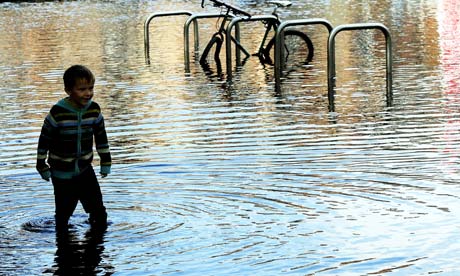
    Flood water covers the streets in the centre of York after the river Ouse burst its banks. Photograph: John Giles/PA

    More than 200 flood warnings and alerts were issued by the Environment Agency on Saturday as torrential rain swept the country, causing havoc in many areas.

    In East Tynedale, Northumberland, a man in his early 20s was killed after his car plunged off the A68 between Broomley Grange and Healy in heavy rain.

    In Yealmpton, Devon, the Yealm burst its banks, flooding more than 40 homes, including some that had six feet of water inside, police said.

    The rain led to flooded homes, road closures and havoc on public transport across parts of the country as the latest downpours continued to fall on ground already saturated after three months of record-breaking rainfall.

    The RSPCA urged farmers to move livestock from low-lying fields and ensure that animals had access to food and shelter, and told pet owners to keep their animals safe at all times.

    Thousands of motor-racing fans heading to the F1 British Grand Prix were warned not to attend the Silverstone race track in Northamptonshire for race qualifying on Saturday after the deluge left car parks unusable and caused long traffic jams near the circuit.

    Officials said that they would have the car parks ready for use on Sundayand be able to accommodate all ticket holders.

    Craig Woolhouse, the Environment Agency’s head of flood incident management, urged people to remain on alert for flooding, especially in Devon, Cornwall and Somerset.

    “It has been raining heavily and the situation could escalate quite quickly. We would also ask people to remember to stay away from flood water, and do not walk or drive through it, as it is often fast-moving and can contain sewage and other debris.”

    Many parts of the country received more than half the average rainfall for July in one day, and the Met Office warned that heavy rain was expected to move east overnight, reaching Sussex and Kent on Sunday.

    In Yealmpton, Tony Stearn, whose house backs on to the Yealm river, said that he had been telephoned by a neighbour warning him of danger. “He said you better have a look out your window. Our garden was completely under water.”

    A spokesman for the Dorset Fire and Rescue Service said that it been called to incidents – mainly flooding of houses and cars stuck in flood water – in more than a dozen places, including Bridport, Maiden Newton and Bradpole.

    Monday’s horse racing meeting at Newton Abbot in Devon has been cancelled due to a waterlogged track, while Dorset police have warned people to stay away from the base of cliffs in Lyme Regis, as mud slides are making them unstable.

    Several residents in the Leicestershire village of Sheepy Magna were evacuated from their homes. According to a Red Cross official, a total of 13 houses were involved in the rescue.

    In Scotland, 13 flood warnings were issued in Edinburgh, the Lothians and in the Borders.

    The A720 Edinburgh city bypass was closed between Hermiston Gait and Straiton and the Taste of Edinburgh festival was cancelled after its site at The Meadows was flooded. Emergency teams have been sent from Moscow.

  • Projections of global warming by 2100 doubled to 5.1C.

    Projections of global warming by 2100 doubled to 5.1C.

    For the no policy scenario, the researchers concluded that there is now a nine percent chance (about one in 11 odds) that the global average surface temperature would increase by more than 7°C (12.6°F) by the end of this century, compared with only a less than one percent chance (one in 100 odds) that warming would be limited to below 3°C (5.4°F).

    mit-wheels.gif

    On our current emissions path, we have a 9% chance of an incomprehensibly catastrophic warming of 7°C by century’s end, but less than a 1% chance of under 3°C warming.

    “The take home message from the new greenhouse gamble wheels is that if we do little or nothing about lowering greenhouse gas emissions that the dangers are much greater than we thought three or four years ago,” said Ronald G. Prinn, professor of atmospheric chemistry at MIT. “It is making the impetus for serious policy much more urgent than we previously thought.”

    The Massachusetts Institute of Technology Joint Program on the Science and Policy of Climate Change has joined the climate realists. The realists are the growing group of scientists who understand that the business as usual emissions path leads to unmitigated catastrophe (see, for instance, “Hadley Center: “Catastrophic” 5-7°C warming by 2100 on current emissions path” and below).

    The Program issued a remarkable, though little-remarked-on, report in January, “Probabilistic Forecast for 21st Century Climate Based on Uncertainties in Emissions (without Policy) and Climate Parameters,” by over a dozen leading experts.

    For whole text click here

  • US bakes under heatwave as fears grow over rising death toll among elderly

    US bakes under heatwave as fears grow over rising death toll among elderly

    The mercury is set to top 100 degrees in America’s midwest and some eastern states, where power outages add to concern

    US-WEATHER-HEATWAVE

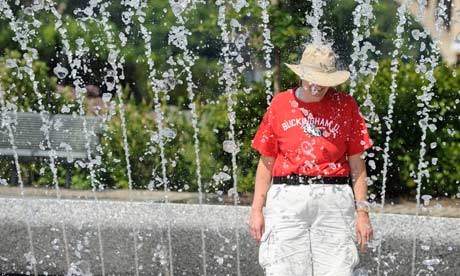
    A woman stands near a fountain to cool off in Washington DC. Photograph: Zhang Jun/Xinhua Press/Corbis

    Highways buckled in Wisconsin, water use was cut back in Indiana and those who had power in the mid-Atlantic were urged to conserve it, but the heat gripping much of the country was only expected to worsen Saturday.

    Temperatures of more than 100 degrees were forecast in Philadelphia, authorities warned of excessive heat in the Midwest and the power outages surpassed a week in the mid-Atlantic, where extreme heat was expected into the weekend.

    A major storm in the area last week left behind damage, which combined with the high demand for power to stress the electrical system’s capabilities, a Washington-area utility said.

    Hundreds of thousands remained without power Friday night in the Appalachians and mid-Atlantic.

    Tens of thousands were still without power in the Midwest as well after storms there this week.

    Utilities hoped to restore service over the weekend in Michigan, where temperatures were forecast in the 90s.

    The heat wave has so far been blamed for at least eight deaths.

    In Ohio, a man in his 70s and two women – one in her late 60s, the other in her 80s – were found dead this week inside stifling hot houses.

    Doctor Jeff Lee, deputy coroner in Licking County in central Ohio, said all three were suffering from heart disease but died from stress caused by high temperatures.

    In two cases, temperatures inside the homes – with windows shut and no ventilation – were in the 90s. The houses lacked electricity because of recent power outages.

    “If they had gotten cooling, we would have expected them to survive,” he said.

    Three deaths in Wisconsin and two in Tennessee were also reported to be heat-related.

    Record temperatures were set Friday in the Indiana cities of Indianapolis, South Bend and Fort Wayne, where temperatures could reach 106 degrees but feel more like 114.

    In central Arkansas, Russellville reached 106 degrees, breaking a record set in 1964.

    Relief was on the way in the form of a cold front as the weekend ends, but forecasters expected it to bring severe weather, too.

    The rain should help dry spells in many places.

    Much of Arkansas is enduring brown grass and seeing trees lose their green, and farmers in Ohio are growing concerned about the dry conditions, considered among the worst of the past decade.

  • Record floods kill 134 in southern Russia

    Record floods kill 134 in southern Russia

    Updated July 08, 2012 09:36:27

    Flash floods in Russia’s southern Krasnodar region have killed at least 134 people and affected nearly 13,000 in the area’s worst natural disaster in decades, officials said Saturday.

    Authorities discovered 67 bodies including that of a 10-year-old child in the district of Krymsk.

    Nine more people died in the Black Sea resort town of Gelendzhik and another two in the port of Novorossiisk over the past two days, he said.

    Gelendzhik alone received five months’ worth of rain in 24 hours, a major blow to the resort town at the height of the tourist season, the regional administration said.

    Novorossiisk, Russia’s largest port on the Black Sea, received two month’s worth of rain in 24 hours, disrupting the work of the port and forcing pipeline operator Transneft to halt crude shipments.

    Krasnodar governor Alexander Tkachev said he spoke by phone to both president Vladimir Putin and prime minister Dmitry Medvedev and pledged everything would be done to help those affected by the crisis.

    “Of course, it came as a shock to us,” he said, adding that the towns of Krymsk and Gelendzhik might have not seen a disaster on such a scale for at least 70 years.

    “We’ve never had this before.”

    Speaking on television, Mr Tkachev also expressed hope that residents would not resort to looting.

    “You can see from the air that the water in Gelendzhik nearly died down but something unimaginable is happening in Krymsk,” Mr Tkachev said on Twitter as he toured the flood-hit areas.

    Mr Medvedev has set up a commission to help the victims, his office said.

    “A rescue operation is ongoing. More bodies are being discovered,” police spokesman Zhelyabin said, adding that he expected the death toll to rise as the day went on.

    The administration of the Krasnodar region, frequently battered by seasonal rains, said earlier it was the worst flooding to hit the region in a decade.

    “Non-stop rain has turned several districts of the region into an emergency zone,” it said in a statement, adding that floods affected the homes of nearly 13,000 people.

    “The floods were very strong. Even traffic lights were ripped out,” regional police spokesman Igor Zhelyabin said.

    “Evacuations are under way,” he added.

    Authorities were now working to identify the bodies, Mr Zhelyabin said, adding: “It is hard to establish where they came from.”

    The Novorossiisk port has been partially flooded and a team has worked through the night to bring the situation under control, port spokesman Mikhail Sidorov said.

    “In some places the water level reached 1.5 metres,” he said.

    Mr Sidoriv said that floods and a landslide had affected the port’s operations and state-controlled oil company Transneft had informed it that it would halt crude shipments.

    AFP

    Topics:floods, russian-federation

    First posted July 07, 2012 22:57:32

  • Smaller volcanoes could cool climate

    Extreme heat raises climate change questions, concerns

    Posted: 05 Jul 2012 05:49 PM PDT

    The recent heat wave baking much of the country has prompted many people to ask: Is this due to climate change?

    Drought monitor shows record-breaking expanse of drought across United States

    Posted: 05 Jul 2012 04:41 PM PDT

    More of the United States is in moderate drought or worse than at any other time in the 12-year history of the U.S. Drought Monitor, officials have said.

    Smaller volcanoes could cool climate

    Posted: 05 Jul 2012 04:41 PM PDT

    Scientists have discovered that aerosols from relatively small volcanic eruptions can be boosted into the high atmosphere by weather systems such as monsoons, where they can affect global temperatures. The massive eruption of Mount Pinatubo in the Philippines in 1991 temporarily dropped temperatures by half a degree Celsius world-wide.

    Eddies, not sunlight, spur annual phytoplankton bloom in North Atlantic

    Posted: 05 Jul 2012 03:09 PM PDT

    Researchers have long believed that the longer days and calmer seas of spring set off an annual bloom of plants in the North Atlantic, but scientists have now discovered that warm eddies fuel the growth three weeks before the sun does.