Category: Climate chaos

The atmosphere is to the earth as a layer of varnish is to a desktop globe. It is thin, fragile and essential for preserving the items on the surface.150 years of burning fossil fuel have overloaded the atmosphere to the point where the earth is ill. It now has a fever. Read the detailed article, Soothing Gaia’s Fever for an evocative account of that analogy. The items listed here detail progress on coordinating 6.5 billion people in the most critical project undertaken by humanity. 

  • Northeast India flood toll rises to 79

    More severe weather events on a global scale.

    Northeast India flood toll rises to 79

    Updated: 19:05, Monday July 2, 2012

    Monsoon rains in northeastern India have left at least than 79 people dead and forced 2.2 million to leave their homes.

    Assam state, which borders Bhutan and Bangladesh, has been worst hit with the massive Brahmaputra river breaching its banks, while extensive flooding has also hit the states of Arunachal Pradesh and Manipur.

    The Assam state government said 26 of 27 districts had endured flash floods as heavy rains destroyed thousands of flimsy homes, blocked roads and swamped fields.

    ‘So far 79 people have died in separate incidents of boat capsize or have drowned while trying to escape the gushing waters and also in landslides,’ state authorities said in a statement on Monday.

    The statement added that an estimated 2.2 million people had been displaced, with thousands of homes wrecked and more than 500,000 people being sheltered in relief camps.

    ‘We have opened makeshift relief camps for the displaced, while many more were forced to take shelter on raised platforms and in tarpaulin tents,’ Assam’s health minister Himanta Biswa Sarma told AFP.

    Officials said more than 70 per cent of the Kaziranga National Park, famous for its tigers, one-horned rhinos and elephants, was underwater.

    ‘The animals are trying to move to safer areas,’ park warden Sanjib Bora said.

    Prime Minister Manmohan Singh and the Congress party president Sonia Gandhi visited Assam on Monday to take an aerial survey and inspect relief work.

    In the adjoining states of Arunachal Pradesh and Manipur, monsoon rains caused widespread flooding but there were no reported deaths.

    The monsoon, which sweeps across the sub-continent from June to September, is crucial for the region’s farmers but also claims casualties from flooding every year.

  • While Colorado burns, Washington fiddles

    While Colorado burns, Washington fiddles

    Drought, wildfires, storms, floods – climate change is happening, but the real disaster is our Big Energy-owned politicians’ inaction

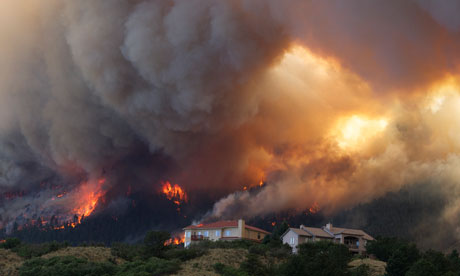
    The Waldo Canyon wildfire burns near Colorado Springs

    The Waldo Canyon wildfire burns as it moved into subdivisions and destroyed homes in Colorado Springs. Photograph: Galon Wampler/AP

    In the political world, this was the week of the healthcare ruling: reporters hovered around the supreme court, pundits pundited, politicians “braced” for the ruling, “reeled” in its aftermath. It provoked a “firestorm” of interest, according to one magazine; it was, said another, a “category 10 hurricane”.

    But in the world world, there was news at least as big, but without the cliched metaphors. News that can be boiled down to a sentence or two:

    You ever wonder what global warming is going to look like? In its early stages, exactly like this.

    Global warming is underway. Are we waiting for someone to hold up a sign that says “Here’s climate change“? Because, this week, we got everything but that:

    • In the Gulf, tropical storm Debby dropped what one meteorologist described as “unthinkable amounts” of rain on Florida. Debby marked the first time in history that we’d reached the fourth-named storm of the year in June; normally it takes till August to reach that mark.

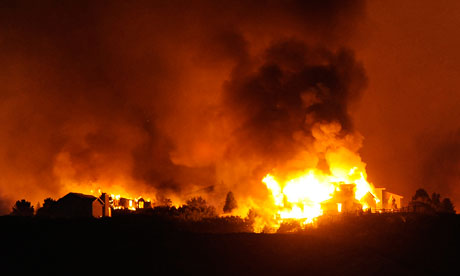
    • In the west, of course, firestorms raged: the biggest fire in New Mexico history, and the most destructive in Colorado’s annals. (That would be the Colorado Springs blaze: the old record had been set the week before, in Fort Collins.) One resident described escaping across suburban soccer fields in his car, with “hell in the rearview mirror”.

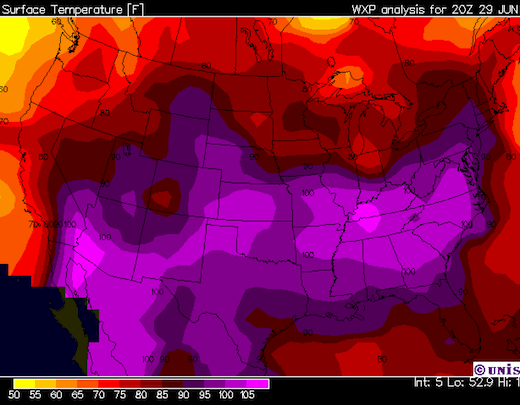
    • The record-setting temperatures (it had never been warmer in Colorado) that fueled those blazes drifted east across the continent as the week wore on: across the Plains, there were places where the mercury reached levels it hadn’t touched even in the Dust Bowl years, America’s previous all-time highs.

    • That heatwave was coming at just the wrong time, as farmers were watching their corn crops get ready to pollinate, a task that gets much harder at temperatures outside the norms with which those crops evolved. “You only get one chance to pollinate over 1 quadrillion kernels,” said Bill Lapp, president of Advanced Economic Solutions, a Omaha-based commodity consulting firm:

    “There’s always some level of angst at this time of year, but it’s significantly greater now and with good reason. We’ve had extended periods of drought.”

    In the markets, all this news was taking its toll: prices for corn and wheat were spiking upwards, rising almost a third on global markets as forecasters suggested grain stockpiles could shrink by as much as 50% as the summer wears on. But in the political world, there wasn’t much reaction at all.

    The Obama administration said it would grant Shell leases to drill for more oil in the Arctic, and they auctioned off a vast new tract of federal coal land at giveaway prices – even though it’s the carbon in that coal and oil that drives the droughts and fires. Even that didn’t satisfy the GOP, as Mitt Romney demanded yet more pipelines and wells.

    Amid it all, the CEO of the biggest oil company in the world, Exxon, gave what may go down in the annals as the most poorly timed – not to mention, arrogant – speech in the firm’s history: Rex Tillerson, speaking to the Council on Foreign Relations, admitted what his company spent many years denying, that humans were heating the planet. But then he added:

    “We have spent our entire existence adapting, OK? So we will adapt to this. Changes to weather patterns that move crop production areas around – we’ll adapt to that. It’s an engineering problem, and it has engineering solutions. And so I don’t … the fear factor that people want to throw out there and say, ‘We just have to stop this,’ I do not accept.”

    Against the backdrop of the burning Rockies, it’s pretty clear this is not an engineering problem. Engineers, in fact, have performed admirably. One day last month, Germany generated more than half its electricity from solar panels. We’ve got the technical chops to solve our troubles.

    No, this is a greed problem. In the last five years, Exxon has made more money than any company in history. For the moment, Exxon and other’s desire to keep minting money – and our politicians’ desire for a share of that cash – has conspired to keep our government, and most others, from doing anything to head off the crisis.

    And unlike the healthcare predicament, this crisis comes with a time limit. If we play politics for a generation, then weeks like the one we’ve just come through will be normal, and all we’ll be doing as a nation is responding to emergencies. As one scientist put it at week’s end, the current heatwave is “bad by our current definition of bad, but our definition of bad changes.”

    Another way of saying that is: there are disaster areas declared across the country right now, but the biggest one is in DC.

  • VIDEO: proud to be tackling climate change (GET UP)

    VIDEO: proud to be tackling climate change (GET UP)

    Inbox
    x

    GetUp! info@getup.org.au
    7:30 PM (1 hour ago)

    to me
    What do a former liberal leader; a Wallabies star and a world-renowned conservationist have in common? Watch this video to find out.

    Dear NEVILLE,

    From today, Australia finally has a price on pollution, and we reckon that’s something to be proud of.

    Well-loved Australian leaders have come together in this new video to mark the milestone. It’s a great antidote to the negativity we’ll hear so much of this week, and a reminder of why we’re tackling climate change in the first place.

    Let’s share it with friends, family and colleagues this week.

    You’ll recognise many of the faces in this video, but Wallabies star David Pocock really stands out. David is the kind of articulate, thoughtful young climate champion the whole country should hear more from. Let’s get behind him.

    We’ve pencilled in advertising spots for this video during next weekend’s Rugby Union fixtures. If 1,500 of us can each chip $30, we’ll be able to ensure hundreds of thousands of rugby fans see David’s leadership off the pitch as well as on it.

    Thanks, and congratulations to all who have campaigned for climate action,
    the GetUp! team.

    This video was made with our good friends at the Australian Youth Climate Coalition; WWF-Australia; and Australian Conservation Foundation. They all have been campaigning long and hard for a safer climate and deserve congratulations for being part of the movement that has achieved this price on pollution.


    GetUp is an independent, not-for-profit community campaigning group. We use new technology to empower Australians to have their say on important national issues. We receive no political party or government funding, and every campaign we run is entirely supported by voluntary donations. If you’d like to contribute to help fund GetUp’s work, please donate now! If you have trouble with any links in this email, please go directly to www.getup.org.au. To unsubscribe from GetUp, please click here. Authorised by Simon Sheikh, Level 2, 104 Commonwealth Street, Surry Hills NSW 2010

    Click here to Reply or Forward
    Ads – Why this ad?
    See How The Household Assistance Package Will Help Australians.
  • climate code red UPDATES

    climate code red UPDATES


    Climate News

    Posted: 30 Jun 2012 11:38 PM PDT

    Week ending 1 July 2012

    The U.S. surface temperature map from Unisys at 4 pm, June 29, 2012, shows 100° temperatures stretching almost continuously from California eastward to the Carolinas
    PICKS OF THE WEEK

    While Colorado burns, Washington fiddles
    http://www.guardian.co.uk/commentisfree/2012/jun/29/while-colorado-burns-washington-fiddles
    Bill McKibben, Guardian, 29 June 2012
    Drought, wildfires, storms, floods – climate change is happening, but the real disaster is our Big Energy-owned politicians’ inaction
    AND
    US wildfires are what global warming really looks like, scientists warn
    http://www.guardian.co.uk/environment/2012/jun/29/us-wildfires-global-warming-scientists
    Reuters/Guardian, 29 June 2012
    The Colorado fires are being driven by extreme temperatures, which are consistent with IPCC projections
    AND
    Massive ‘Debilitating’ Heat Wave Expands Eastward
    http://www.climatecentral.org/news/debilitating-heat-wave-expands-eastward
    AND
    NBC Meteorologist On Record Heat Wave: “If We Did Not Have Global Warming, We Wouldn’t See This.”
    http://thinkprogress.org/climate/2012/06/30/509246/nbc-meteorologist-on-record-heat-wave-if-we-didnt-have-global-warming-we-wouldnt-see-this

    Greenland Ice Sheet Melt Nearing Critical ‘Tipping Point’
    http://www.climatecentral.org/news/greenland-ice-sheet-reflectivity-near-record-low-research-shows/
    Andrew Freedman, Climate Central, 29 June 2012
    The Greenland ice sheet is poised for another record melt this year, and is approaching a “tipping point” into a new and more dangerous melt regime in which the summer melt area covers the entire land mass,  according to new findings from polar researchers.

    AEMO slashes energy demand forecasts by nearly 10 per cent
    http://reneweconomy.com.au/2012/aemo-slashes-energy-demand-forecasts-by-nearly-10-per-cent-56289
    Giles Parkinson, ReNewEconomy, 29 June 2012
    The energy market game-changer, falling demand: Developers and network operators can tear up their business plans. And so can some renewable hopefuls too – the era of solar PV and price-conscious consumers is here.
    AND
    Why residential electricity demand is not growing
    http://www.climatespectator.com.au/commentary/why-residential-electricity-demand-not-growing

    What can our protected places teach us about saving the Arctic?
    http://grist.org/article/what-can-our-protected-places-teach-us-about-saving-the-arctic-3/
    Joe Smyth, Grist, 28 June 2012
    Our national parks have been called “America’s best idea,” and Americans are proud of the special places we have protected for the inspiration and enjoyment of current and future generations. But protected areas from Florida to Alaska face new challenges on a warming planet, and melting sea ice means that a newly vulnerable area – the Arctic – is increasingly threatened by offshore oil drilling and industrial fishing.

    Adapting to climate change: Necessary but difficult and expensive
    http://grist.org/climate-change/adapting-to-climate-change-necessary-but-difficult-and-expensive/
    David Roberts, Grist, 22 June 2012
    So: it’s mitigation, adaptation, and/or suffering. Some of the latter two are unavoidable, but if we care about the health and well-being of our descendents, we’ll maximize the first, starting today.

    AUSTRALIA’S CARBON PRICE COMMENCES

    Climate Spectator Carbon Tax Special
    http://www.climatespectator.com.au/commentary/carbon-tax-special

    Another day, another carbon price beat-up
    http://reneweconomy.com.au/2012/another-day-another-carbon-price-beat-up-19146
    Giles Parkinson, ReNewEconomy, 26 June 2012
    The front page stories in today’s mainstream media about bailouts for Australia’s biggest brown coal generators are not quite what they seem.

    To a morning sunrise of raised expectation and lowered fear
    http://www.smh.com.au/opinion/politics/to-a-morning-sunrise-of-raised-expectation-and-lowered-fear-20120629-21869.html
    Ross Garnaut, SMH, June 30, 2012
    When we wake up tomorrow, Australia will have carbon pricing. How will its effects compare with those expected a year ago, when I produced my Climate Change Review for the Federal Parliament’s multiparty committee?

    Carbon tax a job half done
    http://www.theage.com.au/opinion/politics/carbon-tax-a-job-half-done-20120626-210cr.html
    David Day, The Age, June 27, 2012
    Coal is the great contradiction in government policy on climate change. There are good reasons for slowing and halting coal mining.

    Rich, polluters, miners brace for July 1
    http://news.smh.com.au/breaking-news-national/rich-polluters-miners-brace-for-july-1-20120629-216ak.html
    Colin Brinsden, AAP/SMH, 29 June 2012
    The well-off, polluters and the mining industry will be the targets of three hard-fought federal tax initiatives due to start from July 1

    Australia’s carbon price
    http://www.nature.com/nclimate/journal/v2/n7/full/nclimate1607.html
    Frank Jotzo, Nature Climate Change, 17 June 2012
    Australia’s carbon pricing mechanism leads the way with innovative design in price management and revenue recycling but could fall victim to partisan politics.

    Shift minds on a tax? Unlikely
    http://www.nationaltimes.com.au/opinion/politics/shift-minds-on-a-tax-unlikely-20120626-210ct.html
    Ross Gittins, SMH, June 27, 2012
    People who feel carbon tax is terrible will continue to think this way, whatever the reality.

    AFTER RIO20+

    After Rio, we know. Governments have given up on the planet
    http://www.guardian.co.uk/commentisfree/2012/jun/25/rio-governments-will-not-save-planet
    George Monbiot, Guardian, 25 June 2012
    The post-summit pledge was an admission of defeat against consumer capitalism. But we can still salvage the natural world

    End of an era, So now what do we do to defend life on Earth?
    http://www.monbiot.com/2012/06/25/end-of-an-era/
    George Monbiot, Guardian, 25 June 2012
    It is, perhaps, the greatest failure of collective leadership since the first world war. The Earth’s living systems are collapsing, and the leaders of some of the most powerful nations – the US, the UK, Germany, Russia – could not even be bothered to turn up and discuss it. Those who did attend the Earth summit last week solemnly agreed to keep stoking the destructive fires: sixteen times in their text they pledged to pursue “sustained growth”, the primary cause of the biosphere’s losses.

    Rio+20 Draft Text Is 283 Paragraphs Of Fluff
    http://www.countercurrents.org/monbiot240612.htm
    George Monbiot, 24 June, 2012
    In 1992, world leaders signed up to something called “sustainability”. Few of them were clear about what it meant; I suspect that many of them had no idea. Perhaps as a result, it did not take long for this concept to mutate into something subtly different: “sustainable development”. Then it made a short jump to another term: “sustainable growth”. And now, in the 2012 Rio+20 text that world leaders are about to adopt, it has subtly mutated once more: into “sustained growth”

    ENERGY AND INNOVATION

    Coal plants: Filthy, dangerous, and now a terrible investment!
    http://grist.org/climate-energy/the-days-of-cheap-coal-are-over/
    Justin Guay, Grist, 28 June 2012
    Despite what the coal industry would have you believe, the days of affordable coal-fired power are over. That’s the conclusion of the Sierra Club’s recent ”Locked In,” a report that analyzes the wide array of financial risks coal plant investments face.

    AEMO: Electricity prices depressed for years
    http://www.climatespectator.com.au/commentary/aemo-electricity-prices-depressed-years
    Tristan Edis, Climate Spectator, 29 June 2012
    AEMO has massively downgraded its forecasts of electricity demand, which suggest consumers will win, but coal power stations will be badly squeezed through carbon costs combined with depressed prices caused by renewables and energy efficiency.

    How to power a continent with wind and solar
    http://reneweconomy.com.au/2012/how-to-power-a-continent-with-wind-and-solar-97566
    Giles Parkinson, ReNew Economy, 27 June 2012
    Of all the most ambitious renewable energy projects around the world, the European Desertec Industrial Initiative ranks right at the top – some would say it’s fantastic in both the true and the modern sense of the word.

    Victoria’s Brown Coal Boondoggle
    http://newmatilda.com/2012/06/28/hrls-brown-coal-boondoggle
    Julien Vincent, New Matilda, 28 June 2012
    Looking for signs of the Carbon Tax apocalypse? How about taxpayer dollars being used to both shut down and keep open the same brown coal power station? Julien Vincent on the latest in the HRL saga

    “Millenium Challenge 13: Smart energy demand and renewable supply”
    http://theconversation.edu.au/challenge-13-smart-energy-demand-and-renewable-supply-6994
    Mark Diesendorf, The Conversation, 26 June 2013
    In part 13 of our multi-disciplinary Millennium Project series, Mark Diesendorf argues that it is high time we got smart about power: how we generate it and how we deliver it.

    NSW announces end to CSG ‘royalty holiday’
    http://www.abc.net.au/news/2012-06-24/nsw-ends-coal-mining-royalty-holiday/4088706
    ABC News, 24 June 2012
    The New South Wales Government will end its so-called “royalty holiday” for CSG miners and start collecting royalties from day one of production.

    Solar Insights: How to build utility-scale solar with no subsidies
    http://reneweconomy.com.au/2012/solar-insights-how-to-build-utility-scale-solar-with-no-subsidies-23773
    Giles Parkinson, ReNew Economy,  25 June 2012
    German firm Solaria has released more details about how it plans to build a subsidy-free, 60MW solar PV facility in Spain – one of the first of almost 1800MW of such projects in a country that cut all subsidies earlier this year.

    How we can pursue 100% renewables
    http://www.climatespectator.com.au/commentary/how-we-can-pursue-100-renewables
    Mark Diesendorf, The Conversation, 26 Jun 2012
    In part 13 of the multi-disciplinary Millennium Project series, Mark Diesendorf argues that it is high time we got smart about power: how we generate it and how we deliver it.

    Game Over: Hoffert On Unconventional Gas & Oil And Unconventional Self-Destruction Of Civilization
    http://thinkprogress.org/climate/2012/06/28/508563/game-over-hoffert-on-unconventional-gas-oil-and-unconventional-self-destruction-of-civilization/
    Joe Romm, Climate Progress, June 28, 2012
    Can we preserve a livable climate if we exploit any significant fraction of unconventional oil & gas resources? The CEO of ExxonMobil, which has been a major funder of climate disinformers, says it will be “manageable” through adaptation.  Actual climate scientists disagree, as does the recent scientific literature.

    POLITICS AND POLICY

    Exxon CEO Thinks You’re All Overreacting to Climate Change
    http://www.motherjones.com/blue-marble/2012/06/rex-tillerson-thinks-youre-all-overreacting-climate-change
    Kate Sheppard, Mother Jones, 28 June 2012
    ExxonMobil has never been a big fan of climate science. The largest oil company in the world has been caught funding bad science on climate, and CEO Rex Tillerson has claimed previously that there are “too many complexities around climate science for anybody to fully understand all of the causes and effects.”

    What The World’s Richest Woman Gina Rinehart Thinks About Climate Change
    http://www.desmogblog.com/what-world-s-richest-woman-gina-rinehart-thinks-about-climate-change
    Graham Readfearn, DeSmogBlog, 27 June 2012
    She is the richest woman on the planet with a personal fortune approaching $30 billion thanks to her coal and iron ore businesses.

    Future of polluting power stations remains unclear
    http://www.abc.net.au/news/2012-06-29/future-of-polluting-power-stations-remains-unclear/4101192
    ABCNews, 29 June 2012
    The future of two of Victoria’s biggest power plants continues to hang in the balance.

    Libs to take axe to climate agencies
    http://www.theaustralian.com.au/national-affairs/climate/libs-to-take-axe-to-climate-agencies/story-e6frg6xf-1226407087085
    Sid Maher, The Australian, June 25, 2012
    The  opposition has unveiled plans to scrap at least five major climate change agencies and dozens of programs as part of its removal of the carbon tax if Tony Abbott wins the next election.

    Palace protest arrests
    http://www.smh.com.au/world/palace-protest-arrests-20120624-20wco.html
    SMH, June 25, 2012
    Four climate change activists have been arrested after scaling the gates of Buckingham Palace and chaining themselves to the railings. Three men and one woman who said they represented the Climate Siren group locked themselves to the centre gate and south centre gate, wearing T-shirts bearing the words ”climate emergency. 10% annual emission cuts,” and wielding megaphones.

    SCIENCE AND IMPACTS

    Cities as Hot as Death Valley
    http://www.weather.com/news/weather-forecast/plains-hotter-death-valley-20120627
    Jon Erdman, weather.com, Jun 28, 2012
    You may have heard of Death Valley, Calif.  This is typically the nation’s hottest location in the spring and early summer.  The valley’s  “Badwater Basin” sits 282 feet below sea-level, the lowest elevation in the U.S.  That lack of elevation and its location in the Desert Southwest allows it to heat into the 120s at least several times each summer.

    Global carbon emissions rise is far bigger than previous estimates
    http://www.guardian.co.uk/environment/2012/jun/21/global-carbon-emissions-record
    Simon Rogers and Fiona Harvey, Guardian, 21 June 2012
    New analysis by the Guardian shows the world emitted a record 31.8bn tonnes of carbon from energy consumption in 2010

    Gleckler et al Confirm the Human Fingerprint in Global Ocean Warming
    http://skepticalscience.com/gleckler-human-fingerprint-ocean-warming.html
    Dana Nuccitelli, Skeptical Science, 27 June 2012
    Although over 90% of overall global warming goes into heating the oceans, it is often overlooked, particularly by those who try to deny that global warming is still happening.  Nature Climate Change has a new paper by some big names in the field of oceanography, including Domingues, Church, Ishii, and also Santer (Gleckler et al. 2012).

    Arctic find could cause major shift in climate debate
    http://www.smh.com.au/opinion/arctic-find-could-cause-major-shift-in-climate-debate-20120624-20w6t.html
    Michael Richardson, SMH, June 25, 2012
    Two years ago, a Canadian research team alarmed climate scientists when it published the results of a survey of the oceans. The researchers reported that the world’s phytoplankton – tiny, plant-like organisms that grow in seawater – seemed to have been disappearing at a rate of about 1 per cent a year for the past century.

    Arctic ice turns to the dark side
    http://www.nature.com/nclimate/journal/v2/n7/full/nclimate1603.html
    Nicola Jones, Nature Climate Change, 26 June 2012
    Subject terms:
    It is well known that the minimum summer Arctic sea-ice cover has shrunk by about a third since 1979, at an average rate of more than 10% per decade. Less well appreciated is the fact that the proportion of thick, old ice that lasts from one year to the next is shrinking even faster, at about 15% per decade

    You are subscribed to email updates from climate code red
    To stop receiving these emails, you may unsubscribe now.
    Email delivery powered by Google
    Google Inc., 20 West Kinzie, Chicago IL USA 60610
  • US wildfires are what global warming really looks like, scientists warn

    US wildfires are what global warming really looks like, scientists warn

    The Colorado fires are being driven by extreme temperatures, which are consistent with IPCC projections

    Colorado Springs wildfire

    Homes are destroyed by the Waldo Canyon fire in the Mountain Shadows area of Colorado Springs. Scientists say the fires offer a preview into the kind of disaters that climate change could bring. Photograph: Jerilee Bennett/AP

    Scorching heat, high winds and bone-dry conditions are fueling catastrophic wildfires in the US west that offer a preview of the kind of disasters that human-caused climate change could bring, a trio of scientists said on Thursday.

    “What we’re seeing is a window into what global warming really looks like,” said Princeton University’s Michael Oppenheimer, a lead author for the UN’s climate science panel. “It looks like heat, it looks like fires, it looks like this kind of environmental disaster … This provides vivid images of what we can expect to see more of in the future.”

    In Colorado, wildfires that have raged for weeks have killed four people, displaced thousands and destroyed hundreds of homes. Because winter snowpack was lighter than usual and melted sooner, fire season started earlier in the US west, with wildfires out of control in Colorado, Montana and Utah.

    The high temperatures that are helping drive these fires are consistent with projections by the UN Intergovernmental Panel on Climate Change (IPCC), which said this kind of extreme heat, with little cooling overnight, is one kind of damaging impact of global warming.

    Others include more severe storms, floods and droughts, Oppenheimer said.

    The stage was set for these fires when winter snowpack was lighter than usual, said Steven Running, a forest ecologist at the University of Montana.

    Mountain snows melted an average of two weeks earlier than normal this year, Running said. “That just sets us up for a longer, drier summer. Then all you need is an ignition source and wind.”

    Warmer-than-usual winters also allow tree-killing mountain pine beetles to survive the winter and attack western forests, leaving behind dry wood to fuel wildfires earlier in the season, Running said.

    “Now we have a lot of dead trees to burn … it’s not even July yet,” he said. Trying to stop such blazes driven by high winds is a bit like to trying to stop a hurricane, Running said.

    Fires cost about $1bn or more a year, and exact a toll on human health, ranging from increased risk of heart, lung and kidney ailments to post-traumatic stress disorder, said Howard Frumkin, a public health expert at the University of Washington.

    “Wildfire smoke is like intense air pollution,” Frumkin said. “Pollution levels can reach many times higher than a bad day in Mexico City or Beijing.”

    Older people, the very young and the ill are most vulnerable to the heat that adds to wildfire risk, he said. The strain of fleeing homes and living in communities in the path of a wildfire can trigger ailments like post-traumatic stress disorder, depression and anxiety.

    The briefing was convened by the science organisation Climate Communications, with logistical support by Climate Nexus, an advocacy and communications group. An accompanying report on heat waves and climate change was released simultaneously.

  • Barack Obama visits Colorado Springs neighbourhood destroyed by wildfires

    Barack Obama visits Colorado Springs neighbourhood destroyed by wildfires

    President praises firefighters and announces federal disaster relief to devastated region as blaze continues to burn

    obama colorado wildfires

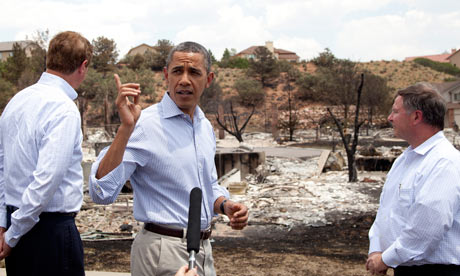
    President Barack Obama tours the Mountain Shadow neighborhood devastated by raging wildfires Colorado Springs. Photograph: Carolyn Kaster/AP

    Barack Obama toured smouldering districts of Colorado Springs on Friday, offering federal disaster funds to the “heartbroken community” as it struggles to contain wildfires that have already claimed at least two lives and destroyed hundreds of homes.

    As the Waldo Canyon fire continued to rage on the edge of the city, the president praised the firefighters battling to bring it under control and said Americans would come together to support the tens of thousands forced to flee.

    During a tour of the Mountain Shadows neighbourhood, where houses were left blackened and ruined when the blaze reached it three days ago, Obama appeared stunned by the random nature of the devastation.

    “You have a house that’s cinders, next to it, it’s untouched,” he said.

    Later, in a brief statement outside the city’s fire station number nine, he described the devastation from the fires as enormous but said officials were “starting to see progress”.

    “When natural disasters hit, all of America comes together,” he said. “We all realise: ‘there but for the grace of God, go I.’”

    Paying tribute to the firefighters, Obama added: “We can provide all the resources … what we can’t do is provide them with the courage and the determination and professionalism” to fight the fires.

    Mountain Shadows is one of the worst hit districts, and the scene of the first confirmed fatality. On Thursday night, human remains were discovered in one of the homes, and it was confirmed that remains of a second person had been found on Friday.

    The deaths cast a sombre shadow over a day in which the news was more positive on efforts to contain the wildfire.

    Ahead of Obama’s arrival, fire officials said they were now making “great strides” in controlling the wildfire, which exploded out of the foothills earlier this week destroying nearly 350 homes and forcing more than 30,000 to flee.

    Evacuation orders were lifted on a number of areas, and normal operations resumed at the air force academy, a portion of which had been evacuated because of the wildfire.

    Fire officials said they hoped to lift more evacuation orders later on Friday though residents would not be able to return permanently to neighbourhoods until electricity and other services was restored.

    “We made great strides yesterday. We were able to up our containment to at least 15%, and 15% is a lot,” said Jerri Marr of the US forest service. “We feel with a lot of confidence, based on the weather, that we are going to be able to up that number by the end of the day. We are going to make a lot of progress.”

    Later on Friday, it was confirmed that firefighters had contained 25% of the fire.

    Some 1,100 firefighters were now working to beat back the wildfire behind containment lines. The effort got additional aerial support on Friday in the form of four more US air force C-130s. The planes have been dropping thousands of gallons of bright orange flame retardant on the containment lines.

    Some fire officials were so hopeful as to suggest the wildfire could be entirely contained within a few days. For others, however, the ordeal is just beginning.

    Hundreds of residents got their first definitive confirmation on Thursday night that they had lost their homes in the wildfire. “We had seen some pictures, but the meeting, and seeing so many others in the same situation, just made it all seem real,” said Rebekah Largent.

    Her family was renting their apartment in the Mountain Shadows neighbourhood. But she said she lost her wedding dress and the rocking chair she used to put her baby to sleep.

    One reporter who accompanied the president on his visit described the scene which greeted him in Mountain Shadows. “Homes were burned to their foundation with water still spewing out of pipes, an orange Saab was half burned in one driveway and a Toyota was melted down to the frame and shelling at another house,” he wrote in a pooled dispatch.

    The White House said Obama’s visit was intended to offer some support to families in a similar predicament, as well as to thank firefighters who are struggling against record wildfires.

    The funds announced on Friday will be used to help the state cope with the aftermath of the fire, and also include job and psychological counselling, the White House said.

    But the visit to a battleground state just months before the elections was politically sensitive. Local television is already running blanket campaign ads. Colorado Springs, because of the air force base, is seen as a Republican stronghold.

    Local officials were insistent that the security preparations for Obama’s visit, which was to include a tour of affected areas and visits with firefighters, would not distract from that progress.

    “Colorado Springs does not have the assets to help with the presidential visit,” Steve Cox, an adviser to the city’s mayor told reporters.

    He said there would be limited road blocks and no interruption in airborne fire operations because of the visit.