Category: Climate chaos

The atmosphere is to the earth as a layer of varnish is to a desktop globe. It is thin, fragile and essential for preserving the items on the surface.150 years of burning fossil fuel have overloaded the atmosphere to the point where the earth is ill. It now has a fever. Read the detailed article, Soothing Gaia’s Fever for an evocative account of that analogy. The items listed here detail progress on coordinating 6.5 billion people in the most critical project undertaken by humanity. 

  • ‘Cheap’ solar geoengineering plans may have unintended consequences

    However, an analysis of the most discussed technique – solar radiation management (SRM), which involves changing the amount of incoming energy from the sun by using aerosols to create clouds or deflecting solar rays with mirrors – says it could create a conflict of interest between countries.

    The study, published in Nature Geoscience by researchers from Carnegie Mellon and Oxford Universities, says it may not possible to simultaneously control both temperature and precipitation levels with SRM. As such, attempts to reduce solar radiation in one region are likely to have knock-on effects in others.

    A report by MPs from the Science and Technology Committee earlier this year contained similar warnings, saying SRM could produce ‘droughts with severe implications for regional and global food production’.

    ‘Cheap’ solutions

    The authors of this most recent study said as climate change impacts worsened individual countries might start unilaterally jumping on ‘cheap’ geoengineering solutions.

    ‘Doing SRM is likely to be cheap,’ said Professor Granger Morgan, head of Carnegie Mellon’s Department of Engineering and Public Policy, ‘so there is risk that a single nation or region might start doing it to solve a local or regional climate problem, and impose the impacts on all of us.’

    The Met Office, which has recently created a new advice page on geoengineering, said it was too early to rule out the use of SRM and that it may still be possible to find a technique that concentrated the negative precipitation impacts over oceans and not land, where it can impact on food production.

    ‘The [study] shows that it “may not be possible” to stabilise the climate in all regions simultaneously. I agree with their conclusions. But because they haven’t tested all possible SRM scenarios, and because the results remain model-dependent to some extent, they can’t say that it is definitely not possible,’ said Dr Olivier Boucher, head of climate chemistry and ecosystems at the Met Office.

    Focus on emission cuts

    Study co-author Morgan said policymakers should focus more on reducing carbon dioxide emissions rather than geoengineering solutions.

    ‘If the world doesn’t get serious about achieving a dramatic reduction in emissions of carbon dioxide, the planet will have lost most of its coral reefs by the end of this century along with the fish and other marine life that they depend on,’ said Morgan.

    ‘We need to understand SRM but it is no substitute for finding ways to reduce carbon emissions by 80 percent as soon as possible.’

    Useful links

    Nature Geoscience study in full
    Met Office guide to geoengine
  • NSW climate plan a farce if new coal fired power stations built

    NSW climate plan a farce if new coal fired power stations built
     
    Media release: 9 August 2010
     
    Any plan to cut the state’s greenhouse gas emission will be meaningless if two new coal-fired power stations are built, according to Greens NSW MP John Kaye. (‘Ambitious targets in greenhouse proposal’, Sydney Morning Herald, 9 August page 3, http://bit.ly/smh100809)
     
    Dr Kaye said: “Premier Keneally is using the bureaucracy to disguise the environmental disaster that building new baseload power stations would be.
     
    “Emissions of more than 22 million tonnes of CO2 each year from coal fired power stations being planned for Lithgow and the Upper Hunter would swamp any savings that the new plan might make.
     
    “The NSW government cannot have it both ways. On the one hand, Treasurer Eric Roozendaal is peddling the myth that new baseload power plants are needed to keep the lights on.
     
    “Now the Deputy Director of the Climate Change Department, Simon Smith, says the new generators would replace older plant and bring down emissions.
     
    “Both statements cannot be true. If the new generators are needed to maintain a reliable supply, then shutting down older plant would cause blackouts.
     
    “In fact, neither statement is true. New baseload capacity is not needed and if they are built they will massively increase the state’s emissions.
     
    “This is further evidence that energy policy in NSW is still being driven by the mindless push to privatise the industry and build new plant whether they are needed or not.
     
    “Neither Mr Smith nor Treasurer Roozendaal is prepared to admit the awful truth.
     
    “If these plant are built, the state’s emissions will climb by more than 17 percent and energy efficiency programs will be devastated.
     
    “If the Premier were serious about achieving ambitious greenhouse gas targets, she would dump Treasurer Roozendaal’s electricity privatisation scheme and the new fossil-fuel power stations it is designed to produce,” Dr Kaye said.
     
    For more information: John Kaye 0407 195 455
     
     
    ———————————-
    John Kaye
    Greens member of the NSW Parliament
    phone: (02) 9230 2668
    fax: (02) 9230 2586
    mobile: 0407 195 455
    email: john.kaye@parliament.nsw.gov.au
    web: www.johnkaye.org.au
     

  • Biggest ice island for 48 years breaks off Greenland glacier


    Andreas Muenchow, professor of ocean science and engineering at the University of Delaware, said satellite images have revealed that the glacier has lost about a quarter of its 43-mile-long floating ice shelf.

    The last time such a large ice island formed was in 1962 when the Canadian Ward Hunt Ice Shelf calved an island. Smaller pieces of that chunk became lodged between real islands inside the Nares Strait.

    Muenchow said he had expected an ice chunk to break off from Petermann, one of the two largest remaining glaciers in Greenland, because it had been growing in size for seven or eight years. But he said he did not expect it to be so large.

    “The freshwater stored in this ice island could keep the Delaware or Hudson Rivers flowing for more than two years,” said Muenchow, whose research in the area is supported by the National Science Foundation.

    “It could also keep all US public tap water flowing for 120 days.”

    He said it was hard to judge whether the event occurred due to global warming because records on the sea water around the glacier have only been kept since 2003.

    “Nobody can claim this was caused by global warming. On the other hand nobody can claim that it wasn’t,” Muenchow said, adding that the flow of sea water below the glaciers is one of the main causes of ice calvings off Greenland.

    Regine Hock, a glacial geophysicist at the University of Alaska Fairbanks, told the National Geographic that the breakup of ice shelves is “a normal process that happens all the time”.

    But she said that such a “huge, huge piece of ice … is very unusual”.

    Scientists have said the first six months of 2010 were the hottest globally on record. The El Niño weather pattern has contributed to higher temperatures, but many scientists say elevated levels of man-made greenhouse gases are pushing temperatures higher.

    The initial discovery of the breakaway island was made by Trudy Wohlleben of the Canadian Ice Service.

    Experts believe the island could fuse to land, break up into smaller pieces, or slowly move south where it could block shipping.

    Petermann Glacier spawned smaller ice islands in 2001 (34 square miles) and 2008 (10 square miles).

  • Climate talks losing ground, say negotiators.


    “Unfortunately, what we have seen over and over this week is that some countries are walking back from the progress made in Copenhagen,” he told journalists, referring to the 11th-hour accord hammered out at the climate summit in December.

    That agreement enshrined the goal of capping the increase of global temperatures at 2.0 degrees, but did not muster the commitments needed to attain it.

    It also pledged long-term financing to help poor countries green their economies and cope with consequences of climate change, without specifying where the money would come from.

    Dessima Williams of Grenada, speaking for the 43-nation Association of Small Island States, said she was “greatly concerned” by the slow pace of the talks.

    “The situation on the ground for all our countries is worsening,” she said at a press conference.

    AFP

    Tags: climate-change, germany

  • Climate deal loopholes ‘Make farce’ of rich nations’ pledges


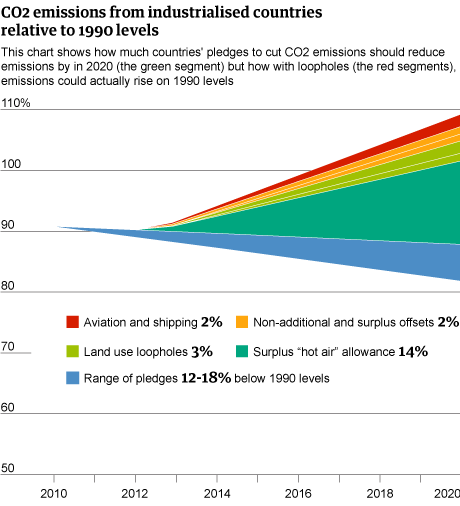
    The research factored in four separate loopholes that are known to exist, but which countries have so far failed to address in the negotiations. These include land use and forestry credits, carbon offset credits gained from UN Clean Development Mechanism schemes, surplus carbon allowances accumulated by former Soviet countries and international aviation and shipping emissions, which are not currently included in emission reduction schemes proposed by countries.

    “Industrialised countries pledged a modest reduction in their emissions at the Copenhagen talks last year, but the these loopholes would actually allow them to grow them substantially well into the future,” said Sivan Kartha, senior scientist at the Stockholm Institute.

    “This means they [rich nations] need not do anything to hold emissions. They could accumulate huge amounts of credits to continue business as usual,” he said.

    “The more we look into the loopholes the worse it gets. The whole thing begins to look like a farce”, said Lim Li Lin, a legal specialist with TWN.

    In a separate submission to governments, Pablo Solon, Bolivia’s ambassador to the UN, claimed that industrialised countries were filling all the available atmosphere with carbon pollution, and preventing poor countries from developing. Solon quoted peer-reviewed research by leading Nasa scientist Jim Hansen and the German government’s Advisory Council on Global Change which, he said, showed that the world had a “budget” of 750 gigatonnes of CO2 over the next 40 years if it sought a 66% chance of holding temperature rises to under 2C. The world had a smaller budget of just 420GT of CO2 if it wanted to stay below 1.5C, as more than 100 countries have so far demanded.

    “With the current pledges on the table, we have calculated that the Annex 1 (industrialised) nations are going to spend the whole [carbon] budget of the next 40 years in the next 10 years,” Solon said. “What is on the table has no relation to any target that [rich countries] have established. It is like a salary. If you spend it all in the first week then you have nothing left for the rest of the month.”

    “Copenhagen demonstrated disastrously low levels of ambition and rich countries are trying shamelessly to wriggle out of even the weak commitments they have made,” said Asad Rehman, international climate change campaigner at Friends of the Earth. “The science is clear. Developed countries must stop trying to hide behind technicalities hidden in the negotiations,” he said.

    CO2CHART.gif


  • Global warming pushes 2010 temperature to record highs


    “That’s a very remarkable result, that all those data sets agree,” he added. “It’s the clearest evidence in one place from a range of different indices.”

    Currently 1998 is the hottest year on record. Two combined land and sea surface temperature records from Nasa’s Goddard Institute for Space Studies (GISS) and the US National Climatic Data Centre (NCDC) both calculate that the first six months of 2010 were the hottest on record. According to GISS, four of the six months also individually showed record highs.

    A third leading monitoring programme, by the Met Office, shows this period was the second hottest on record, after 1998, with two months this year – January and March – being hotter than their equivalents 12 years ago.


    The Met Office said the variations between the figures published by the different organisations are because the Met Office uses only temperature observations, Nasa makes estimates for gaps in recorded data such as the polar regions, and the NCDC uses a mixture of the two approaches. The latest figures will give weight to predictions that this year could become the hottest on record.

    Despite annual fluctuations, the figures also highlight the clear trend for the 2000s to be hotter than the 1990s, which in turn were clearly warmer than the previous decade, said Stott.

    “These numbers are not theory, but fact, indicating that the Earth’s climate is moving into uncharted territory,” said Rafe Pomerance, a senior fellow at Clean Air Cool Planet, a US group dedicated to helping find solutions to global warming.


    The Met Office published its full list of global warming indicators, compiled by Hadley Centre researcher John Kennedy. It formed part of the State of the Climate 2009 report published as a special bulletin of the American Meteorological Society by the US National Oceanic and Atmospheric Administration, which runs the NCDC temperature series.

    Seven of the indicators rose over the last few decades, indicating “clear warming trends”, although these all included annual fluctuations up and down. One of these was air temperature over land – including data from the Climatic Research Unit at the UEA, whose figures were under scrutiny after hacked emails were posted online in November 2009, but the graphic also included figures from six other research groups all showing the same overall trends despite annual differences.

    The other six rising indicators were sea surface temperatures, collected by six groups; ocean heat to 700m depth from seven groups; air temperatures over oceans (five data sets); the tropospheric temperature in the atmosphere up to 1km up (seven); humidity caused by warmer air absorbing more moisture (three); and sea level rise as hotter oceans expand and ice melts (six).

    Another four indicators showed declining figures over time, again consistent with global warming: northern hemisphere snow cover (two data sets), Arctic sea ice extent (three); glacier mass loss (four); and the temperature of the stratosphere. This last cooling effect is caused by a decline in ozone in the stratosphere which prevents it absorbing as much ultraviolet radiation from the sun above.

    One key data set omitted was sea ice in the Antarctic, because it was increasing in some areas and decreasing in others, due to reduced ozone causing changes in wind patterns and sea-surface circulation. This data set showed no clear trend, said Stott. These figures were also in the last report from the UN’s Intergovernmental Panel on Climate Change (IPCC) in 2007.

    “It’s not that the IPCC didn’t look at this data, of course they did, but they didn’t put it all together in one place,” he added.

    The cause of the warming was “dominated” by greenhouse gases emitted by human activity, said Stott. “It’s possible there’s some [other] process which can amplify other effects, such as radiation from the sun, [but] the evidence is so clear the chance there’s something we haven’t thought of seems to be getting smaller and smaller,” he said