Category: General news

Managing director of Ebono Institute and major sponsor of The Generator, Geoff Ebbs, is running against Kevin Rudd in the seat of Griffith at the next Federal election. By the expression on their faces in this candid shot it looks like a pretty dull campaign. Read on

  • The extreme weather and climate events of 2014 in 13 photos

    The extreme weather and climate events of 2014 in 13 photos

    Pakistan-flood

    Pakistani villagers wade through water to find safe shelters in Pindi Bhatian, 105 kilometers (65 miles) northeast of Lahore, Pakistan, Monday, Sept. 8, 2014.
    Image: K.M. Chaudary/Associated Press
    It’s been a rough year, meteorologically speaking, on the Blue Marble.

    We’ve seen record heat, record snow, record flooding, record drought, rising sea levels and super typhoons — and extreme climate events are expected to continue unless humans taks action to reduce emissions and lower the planet’s temperature.

    Take a look at the photos below to see the extreme weather and climate events that plagued 2014.

    Record warm year

    It is virtually certain that 2014 will go down in history as the globe’s warmest year on record since instrumental records began in 1880. In a telling sign of global warming, 14 out of the 15 warmest years have all occurred since the year 2000.

    australiaheat

    Image: AP Images/Associated Press

    The warmth in 2014 has largely been driven by the oceans, which again were record-breakingly warm for November, continuing a streak of records that have been toppled during the past several months.

    The January-to-November period surpassed the previous record warm years of 1998 and 2010 in NOAA’s database, the agency said.

    This is unique because both of those previous years featured El Niño events, which raise global ocean temperatures and give the planet’s overall temperature a boost. So far this year, an El Niño event has failed to materialize in the Pacific Ocean, despite being forecast to do so, yet records have been set for the highest global ocean temperatures on record during several months this year.

    While instrument data only goes back as far as 1880, other climate records, from tree rings to coral reef samples, have shown that it is likely that the Earth has not been this warm in at least 4,000 years, with global levels of greenhouse gases at the highest level in human history.

    Not every climate data center is guaranteed to rank 2014 as the warmest year, due to the different data analysis method each group uses. Satellite-derived temperature data for the lower atmosphere does not show as sharp a spike in 2014 temperatures for example.

    Buffalo snowfall

    Derek Buffalo Photos Snow

    Derek Gee, chief photographer at ‘The Buffalo News,’ tweeted a photo of snow-covered houses in West Seneca, New York, on Nov. 19, 2014.

    Image: DerekGeePhoto

    The Buffalo, New York area was subjected to a virtual firehose of heavy snow in November when an extremely active lake effect snow pattern developed and stalled out over the same area for days at a time. Snowfall amounts reached 88 inches in Cowlesville, New York, which is a new record for the Buffalo area.

    Twin tornadoes

    Tornadoes Approach Pilger

    Two tornadoes approach Pilger, Nebraska, Monday June 16, 2014.

    Image: Eric Anderson/Associated Press

    Two EF-4 tornadoes, spaced about a mile apart, tore through the small town of Pilger,, Nebraska on June 16, killing 2, while damaging the vast majority of structures in the town.

    As strong and photogenic as they were, however, the tornadoes were not anywhere close to unprecedented, based on an examination of tornado research and interviews with severe weather experts. However, the intensity and longevity of both funnels did strike some experts as unique.

    Overall, the 2014 tornado season was one of the least active in U.S. history, with less than 1,000 tornadoes touching down. This is below the average of 1,260 tornadoes that have occurred each year since the early 1950s. Interestingly, 2012 and 2013 were also unusually quiet tornado years, following deadly tornado outbreaks in 2011 that killed more than 500.

    Emerging scientific research shows that the frequency of tornadoes may be decreasing as the climate warms, while the timing of tornado season shifts, and big tornado outbreaks become more common. This is due to the overall increase in water vapor — a key fuel for severe thunderstorms — as a result of global warming, while another prime ingredient known as wind shear becomes a more limited resource.

    This transition to a “boom or bust” tornado regime is consistent with some climate studies showing that even if wind shear declines, it will still be present on some days, leading to potentially larger, but less frequent, outbreaks.

    Polar vortex

    Polar Vortex Weather System Brings Artic Temperatures Across Wide Swath Of U.S.

    Repeated bouts of extremely cold air affected the lower 48 states last winter, particularly during the month of January. Some of the cold waves were related to a weakening of the polar vortex, which is circulation that typically rings the poles during the winter. When the polar vortex winds weaken and the shape of the vortex becomes elongated, the odds of Arctic outbreaks in the U.S. and Europe increase.

    This NOAA graphic illustrates the temperature departures from average during early January 2014.

    Arctic Outbreak

    Temperature departures from average for Jan. 5-7, 2014, showing the unusually cold weather across much of the U.S.

    Image: NOAA

    The polar vortex is a meteorological term that has been in use since the middle of the 20th century, but it wasn’t until the winter of 2013-2014 that it seeped into pop culture and took on multiple new meanings, much to the chagrin of many meteorologists.

    Super Typhoons

    Super Typhoon Neoguri Threatens Japan

    In this handout provided by the National Oceanic and Atmospheric Administration (NOAA), Super Typhoon Neoguri approaches Okinawa island on July 7, 2014 in Japan.

    Image: NOAA via Getty Images

    The tropical Pacific Ocean gave rise to some incredibly intense typhoons this year, including Super Typhoon Hagupit and Super Typhoon Neoguri. Both of these storms were strong category 5 storms at one point, but fortunately they each struck land in a weakened state.

    Typhoon Hagupit

    Satellite image of Super Typhoon Hagupit.

    Image: University of Wisconsin

    Brazil drought

    Brazil Drought

    The frame of a car sits on the cracked earth at the bottom of the Atibainha dam, part of the Cantareira System responsible for providing water to the Sao Paulo metropolitan area, in Nazare Paulista, Brazil, Friday, Oct. 10, 2014.

    Image: Andre Penner/Associated Press

    An intense drought has been affecting southeastern Brazil during the past year or more, leading to water shortages in the country’s capital of Sao Paulo. Water services to homes and businesses has been sporadic at times, as officials grapple with what to do if rain does not arrive soon to refill rapidly depleting reservoirs. At times, Sao Paolo has been just weeks away from completely running out of water.

    California drought

    Pictured here is the dry bed of the Stevens Creek Reservoir seen on Thursday, March 13, 2014, in Cupertino, Calif.

    The dry bed of the Stevens Creek Reservoir is seen on Thursday, March 13, 2014, in Cupertino, Calif.

    Image: Marcio Jose Sanchez/Associated Press

    The California drought is one of the state’s worst short-term drought events on record. It is an example of what climate scientists project will occur more often — while conditions dried out, California set high temperature records and is likely going to set a record for the state’s warmest year.

    Because of the lack of surface water, farmers and other water users have drawn from aquifers deep underneath the soil to access groundwater. So much groundwater has been depleted that it would take 11 trillion gallons of water to replenish this crucial resource again, NASA scientists announced last week.

    Surface water is easier to replenish via precipitation compared to groundwater, which can take years to decades to recover.

    Deadly blizzard in the Himalayas

    Nepal Avalanche

    In this handout photo provided by the Nepalese army, rescue team members carry avalanche victims to safety at Thorong La pass area in Nepal, Friday, Oct. 17, 2014. Rescuers widened their search Friday for trekkers stranded since a series of blizzards and avalanches battered the Himalayas in northern Nepal early this week, leaving at least 29 foreigners and locals dead, officials said.

    Image: (AP Photo/Nepalese Army)/Associated Press

    In mid-October, Tropical Cyclone Hudhud came ashore in east-central India. The storm funneled moisture northwestward, toward the Himalayas. There, hundreds of climbers were tackling some of the world’s highest peaks in what is typically the least snowy month of the year. The blizzard and series of avalanches that resulted killed at least 40 people and injured dozens more, as the Nepalese Army had to mobilize a helicopter airlift to rescue those stranded by the severe weather.

    Coral bleaching

    Coral Bleaching Hawaii

    This 2014 photo provided by the National Oceanic and Atmospheric Administration and the Hawaii Institute of Marine Biology shows bleached coral at Lisianski Island in the Papahanaumokuakea Marine National Monument. The pale coral is bleached due to thermal stress, while the lavender-colored coral is healthy.

    Image: AP Photo/NOAA and the Hawaii Institute of Marine Biology, Courtney Couch

    With the highest ocean temperatures on record this year, coral reefs have been suffering a greater toll than they have in many other years. In fact, some scientists think we are beginning to see what will eventually become a global coral bleaching and die-off event, the likes of which has not been observed since 1998.

    Corals are invertebrates that often grow in colonies in symbiosis with algae, known as zooxanthellae, which live in their tissues. It is these algae that give the corals their vibrant colors, and healthy coral reef ecosystems in turn provide food and shelter for a plethora of marine species. When ocean temperatures get too warm for too long a period of time, corals will expel the algae — giving them a sudden eviction notice. Once they do this, the corals turn a ghostly white color, which is where the term “bleaching” comes from.

    Corals are the tropical rain forests of the ocean — they house an incredibly diverse array of species, and when the corals suffer from severe stress, these delicate ecosystems can be permanently damaged.

    Carbon dioxide seen from space

    Carbon Dioxide

    Global atmospheric carbon dioxide concentrations from Oct. 1 through Nov. 11, as recorded by NASA’s Orbiting Carbon Observatory-2.

    Image: NASA JPL

    NASA launched a new satellite in 2014 that is known as the Orbiting Carbon Observatory-2. This spacecraft is aimed at obtaining close-up views of the sources and sinks of carbon dioxide throughout the world.

    Kashmir floods

    Kashmir Floods

    In this Thursday, Sept. 4, 2014 photo, Kashmiri residents struggle to withstand sudden and strong water currents while wading through floodwaters in their efforts to move to safer places in Srinagar, India.

    Extreme rainfall associated with the seasonal South Asian Monsoon caused rivers to overflow their banks in mid-October in northwest India and parts of Pakistan, killing more than 320 people and displacing tens of thousands from the Himalayan region of Kashmir and eastern Pakistan. The floods were not as deadly as 2010 floods in a similar area, but the rainfall amounts were comparable, according to scientists.

    The 2010 floods, which killed about 2,000 and displaced nearly 20 million, were focused on the Indus River. The flooding this year was is in that river’s tributaries, including the Chenab and Jhelum Rivers. They became so swollen that their expansion was visible from satellites orbiting the Earth.

    The flooding in the Indian-controlled portion of Kashmir was said to be the worst in at least 60 years, with communication lines cut along with electricity and strategic bridge crossings.

    Above average sea surface temperatures in the Indian Ocean, to the south of Kashmir, may have played a role in the unusually heavy rainfall.

  • The John James Newsletter No 38

    2 of 27


    Web Clip

    Dictionary.com Word of the Day – consanguinity: close relationship or connection. – 3 days ago

    The John James Newsletter 38

    Inbox x

    John James

    4:48 AM (4 hours ago)
    to John

    The John James Newsletter 38
    27 December 2014.

    Men occasionally stumble over the truth, but most of them pick themselves up and hurry off as if nothing had ever happened –  Winston Churchill

    TO OPEN A LINK ON THIS EMAIL USE CONTROL-CLICK

    Arms Trade Treaty Enters Into Force Offering Fresh Hope for the Protection of Civilians in 2015
    Campaigners hailed a “huge victory” as after more than a decade of campaigning, the Arms Trade Treaty has become international law at last. The treaty aims to set the highest standards for controlling the $85 billion international trade of arms and ammunition and to cut the supply of weapons to dictators and human rights abusers.
    www.commondreams.org/newswire/2014/12/23/arms-trade-treaty-enters-force-offering-fresh-hope-protection-civilians-2015

    From Bad to Worse: Notes for Understanding Lima
    Emissions were not reduced during COP20. This makes it impossible to catch up with a 2ºC pathway in the next decade, since the global peak year should happen before 2020. This situation is even worse because of a laissez-faire attitude of “do what you want” when it comes to emission cuts, so “pledges” will be replaced by “contributions”.
    www.commondreams.org/views/2014/12/22/bad-worse-roadmap-global-burning

    Critical Glaciers Melting Under ‘Continuous Warming’
    Chinese researchers warn drinking sources may dry up in much of Asia along with vital water to India,
    www.commondreams.org/news/2014/12/24/critical-glaciers-melting-under-continuous-warming-study

    NASA’s Spaceborne Carbon Counter Maps New Details
    The first global maps of atmospheric carbon dioxide from NASA’s new Orbiting Carbon Observatory-2 mission show concentrations across the Southern Hemisphere from springtime biomass burning.
    You can see this as a time-scale video on this site.
    www.nasa.gov/jpl/oco2/nasas-spaceborne-carbon-counter-maps-new-details/index.html#.VJXC9ANAKU


    The Stuxnet Attack On Iran’s Nuclear Plant Was ‘Far More Dangerous’ Than Previously Thought
    The sober reality is that globally nearly every industrial or military facility that uses industrial control systems is dependent on its network of contractors, many of which are very good at narrowly defined engineering tasks, but lousy at cybersecurity.  Given that the next attackers may be nation-states, they may be likely to go after civilian critical infrastructure.
    http://www.businessinsider.com.au/stuxnet-was-far-more-dangerous-than-previous-thought-2013-11

    THE RED LINES ARE BEING DRAWN
    Russia Will Be Able To Overcome Economic Problems – Chinese Foreign Minister
    “If the Russian side needs it, we shall offer all possible support we may have,”
    http://www.informationclearinghouse.info/article40534.htm
    China has a stake in Russia’s strength as part of China’s protection from US aggression, whether economic or military.
    http://www.informationclearinghouse.info/article40509.htm
    The Bear Squeezes Back: Ruble Rises Against Dollar
    www.informationclearinghouse.info/article40558.htm

    John Pilger: Ukraine Crisis Could Start World War 3
    He says he has never known the truth ‘so inverted’ over any one issue. He believes we are in the midst of a cold war more dangerous than the one he grew up with, with a ‘real possibility’ of a nuclear war. He compares it to Iraq, because both involved ‘fiction,’ now the idea that Russia is attacking the West. He says oil prices were driven down by agreement between the US and Saudis, to wreck the Russian economy. He says it was NATO and the US that took over Ukraine, to the point that Joe Biden’s son is on the board of Ukraine’s biggest private gas provider. At a meeting in Yalta in September 2013, the ‘takeover of Ukraine was planned’ by prominent politicians and multinationals. There was a ‘coup stage-managed by the Obama administration,’ and blame shifted to Russia, who acted purely defensively.
    http://www.informationclearinghouse.info/article40537.htm

    Possible Russian responses to sanctions
    The coming perfect storm is evolving on two fronts; an overt economic war by sanctions and a concerted, covert attack on the heart of the Russian economy. If Russia decides to impose capital controls and/or imposes a “holiday” on repayment of larger debt tranches coming due in early 2015, the European financial system will be bombed, as it will if Russia decides to cut off natural gas and oil from the West. Russian intel may wreak non-stop havoc in pumping stations from the Maghreb to the Middle East. Russia may block all the oil and natural gas pumped in the Central Asian ‘stans’. The result would be the greatest financial collapse in history.
    www.informationclearinghouse.info/article40512.htm
    and
    kingworldnews.com/paul-craig-roberts-russia-unleash-ultimate-black-swan-west/
    and
    http://www.informationclearinghouse.info/article40508.htm
    and
    http://www.informationclearinghouse.info/article40514.htm

    EU asks Russia to go ahead with South Stream
    I bet this is now too late as Russia is linked with Turkey, and Turkey is the doorway to Syria, a Russian client state.
    Bulgaria is obliged to stand by its obligations to prepare for construction work and issue the required permissions, after talks with the EU leaders
    http://itar-tass.com/en/economy/768044

    Dick Cheney’s Song of America
    The Plan is for the US to rule the world. The overt theme is unilateralism, but it is ultimately a story of domination. It calls for the US to maintain its overwhelming military superiority and prevent new rivals from rising to challenge it. It calls for dominion over friends and enemies alike. It says not that the US must be more powerful, or most powerful, but that it must be absolutely powerful.
    www.informationclearinghouse.info/article1544.htm

    Head Of Stratfor – a Private CIA – says Overthrow Of Yanukovych Was ‘The Most Blatant Coup In History’
    The Russian authorities can not tolerate a situation in which western armed forces will be [in Ukraine] a hundred kilometers from Kursk or Voronezh. The US considers the most dangerous potential alliance to be between German technology and capital with Russian natural and human resources. So the US is trying to antagonize Germans against Russia. This will weaken both of them in favour of the US.
    www.countercurrents.org/zuesse201214.htm

    US seeks to overthrow Venezuela government
    THIS SAME SCENARIO WAS USED IN THE UKRAINE
    Tighter US sanctions against Venezuela are aimed to foment violent unrest to try to overthrow President Nicolas Maduro, his defense minister said Saturday. “This US interference is aimed at promoting violence…against our institutions” to oust staunch US critic Maduro. Obama signed a law on Thursday to allow sanctions against senior Venezuelan officials accused of violating the rights of protesters during [CIA-fomented] anti-government demonstrations that rocked the country earlier this year.
    http://news.yahoo.com/us-seeks-overthrow-venezuela-government-official-234048242.html>

    Cemetery with One Million Mummies Unearthed in Egypt
    A cemetery containing perhaps a million mummified bodies has been unearthed in central Egypt. Scientists have already excavated more than 1,700 mummies … It is thought that the mummies were buried around 1,500 years ago, between the 1st and 7th Century AD, when Egypt was controlled by the Roman and Byzantine Empire. Unlike many famous mummified remains these were found in mass graves and appear to be ordinary citizens rather than royalty or other important figures … The mummies appear to be clustered together by hair colour, with those with blond hair in one area and all of those with red hair in another.
    http://www.dailymail.co.uk/sciencetech/article-2877855/Cemetery-one-MILLION-mummies-unearthed-Egypt-1-500-year-old-desert-necropolis-largest-found.html

    Plants are good parents too
    ‘Mother’ plants ‘teach’ seeds when to grow by passing on their memory of seasons. Warm temperatures cause plants to produce proteins to regulate flowering and these proteins also ‘teach’ seeds when the best time to germinate. Finding could help prepare us to improve crop yields that are threatened by climate change
    www.dailymail.co.uk/sciencetech/article-2879074/Plants-good-parents-Mother-plants-teach-seeds-grow-passing-memory-seasons-study-claims.html

  • Let’s Move to the Country! – Rurally Challenged Ascending City Slickers Take the Plunge –

    Let’s Move to the Country!
    – Rurally Challenged Ascending City Slickers Take the Plunge –

    by Linda Johnson
    10th March 2003The Dream…

    Most people like the ‘country’. Or, the ‘idea’ of the country – such as the TV ads showing green fields of contented cows, romping lambs and fields of golden wheat. Country style furniture and decorations remain ever popular as people try to re-create a feeling of warmth, cosiness and a time when life was less complicated, less stressful and more nurturing. I confess that I have a lot of cow things and folk art in my house too!

    Many people from the city go away to the beach or country for a weekend or holiday and think it would be great to live there permanently. Sensitive and ascending people can feel the vibrational difference in these places compared to the city and the longer one stays, the harder it is to go back to the city where the vibe is lower, the attachments stronger and you are surrounded by people and institutions that suck your chi, bringing you back down to their level. I urge people reading this article to make a conscious effort to take breaks away from the cities and feel the difference in the vibration in the country, mountains or sea.

    However, bear in mind that visiting a place and living there permanently are two different things. Much of the country dream is pure fantasy, and those who can separate the fantasy from the reality and plan accordingly will be better prepared for life in the country, or anywhere you are unfamiliar with.

    We are by no means experts on life changes yet, but have seen examples of what happens when people follow a fantasy without any sort of planning and we do not want to fall into that trap. They end up miserable and unfulfilled because they have not been realistic about what they are doing and why. Many see moving out of the city as a chance to ‘escape’ pressures and responsibilities, but if they are not complete with the old life the dramas will follow.


    Preparing to Leave…

    1. Complete Karma: As an ascending person the most important thing before you go anywhere is to complete all karma. Endeavour to complete your karma with the place you are living, the company you work for, and the people you associate with – especially people you are unlikely to see after you move – or you don’t want to see again. You don’t want to leave any loose end attachments as you will have to complete later with a similar place, person or company [see Attachments article for more details].

    2. Lighten the Physical Load: Take the opportunity of a move to sort and sell anything you no longer use or need (start sorting now). If in doubt ask your guidance if you are likely to need the item where you are going. The lighter you travel, the freer you will be. Storage facilities can be expensive. We found the most effective (if you have somewhere to leave it) is to purchase a shipping container. These are much stronger and more secure than a shed and can be used later for storing machinery or as a secure garden shed. If you buy an A-Grade container (these cost a little extra) it can also be re-sold for a good price as it is still roadworthy. Older containers can’t be re-trucked later if they are rusty and these tend to be the ones sold off for storage… which is fine if you want to keep it in the same place permanently.

    3. Research the Area: By all means be guided by your own higher self as to where you are to go, but do some research on the area and the facilities so you can plan accordingly. Will you need a car? How far to town? Will you need to work/deliver/sell/post? Will you need specialist facilities/banks? Start preparing now. We have tried as much as possible to receive payments and do our banking and bill paying online so we don’t have to physically go to a bank when we move – as it will be a 60km round trip to town.

    4. Research the Property: If possible get some independent advice on the properties you are attracted to – do you have your own road access, water, phone access, how much will a power pole cost? How much will building cost? It seems a drag to think about these things when you just want to be a free spirit, set up your tipi and live off the land, but a little planning first will save a lot of headaches later. Many rural properties have noxious weeds that just look like nice green plants to us city slickers. You may find out you’re up for a lot of money to get rid of them – with poisons you don’t want to use. Sometimes these properties are sold off cheaply to unsuspecting folk who find out too late the hidden costs.

    5. Plan the Menu: We once went to a gathering of farmers in the area we are moving to and discovered that we (from the city) were the only people who grew our own vegetables – all the farmers went to the supermarket. It is faster and simpler to buy the food that is shipped up frozen from the city than the labour involved in growing when you don’t have to. Part of our plan is to grow our food for the organic quality and self sufficiency, but we know we can’t leave the gardens uncovered like in the city. If you want to grow your own food put some research in and make sure you have water available and fencing organised before you sew the first seed or the local birds and animals will eat it long before you do.

    If you are not moving to the country yet, I advise you to start a veggie patch in the city. This will not only give you some nice fresh food, but valuable experience on growing food and saving seed. Potatoes are a good first crop as they will break up hard ground for the next crop – this way your carrots won’t grow at right angles like our first crop. Growing a veggie patch in your back yard will also give you an idea of the scale of growing you’ll need to live off. Your entire tomato crop may give you one cup of spaghetti sauce. All your peas (after two hours of picking and shelling) will give you one meal. You will learn how to stagger your crops so you don’t get ten lettuces in one week… all valuable experience. You will also have lots of fun playing in the dirt and communing with nature.

    6. Necessary Evil: Moving to the country means you have an opportunity to use the equity from your city house to buy or build something cheaper and have no mortgage. This also means no ongoing karma with the lending institution. If you put your money into setting yourself up with water tanks and pumps you have no water bills. Although solar panels are expensive once they are up you can have no electricity bills. If you don’t want to live totally off solar batteries, your panels can feed back into the grid. If you generate more power than you use, you may even make some money. Council rates may be less, and car registration and insurance are likely to be less. If you plan for self reliance as much as possible you can minimise the ongoing bills, meaning you don’t need to generate the sort of income to live that you did in the city.

    7. Work: You may be fortunate enough to have enough money to live on already, but if you need to earn an income, you’ll need to put some thought into this too. Jobs are hard to come by in country areas. Try and get the local papers sent to you regularly so you can see what work is available. Take into consideration the travelling time from where you live, the petrol you’ll use, and how work time will eat into the time you wanted to spend in the country. You don’t want to take the city job stress to another location. Think about what you’d really like to do and see if there’s a call for it in the area you are moving to, whether for locals or tourists. Take the opportunity of moving to do something different that gives you pleasure.

    Depending where you go, country areas contain mixtures of the original settler families, farmers, town folk, new age newcomers, retiring city people and holiday visitors. Many of the people who’ve come from the city are used to new age people and therapies, but it can take a while for the locals and old-timers to accept it so if you are offering new age goods or services, you may need to adjust the literature to attract different clients than you did in the city.

    8. Disappearing: Over the years we have been added to many mailing lists and our post office box is always full of junk. For the past few months we have been sending back the junkmail to the senders with ‘Moved from this address’ on the envelope. This means we’ve been disappearing off the lists and the junk mail is diminishing. It also means we’ve been able to keep a list of the mail we still want so we can notify them of the address change. Make yourself a list from all the mail you receive. You’d be surprised how many places you’ll need to notify – but it also gives you the chance to vanish from those you no longer need.


    The Reality…

    While your soul and higher self are guiding you to move to the country, the physical reality of preparing for a major move is daunting – especially when you have little or no practical experience outside the city. City people are used to keeping to themselves. In the country you will be called upon to help your neighbours and they will do the same for you. City people are used to a disposable life. In the country everything is recycled – it’s a long way to town to buy something. City people have everything they need at their doorsteps – restaurants, theatres, shopping centres. In the country there may be one video store, a local club and the shops shut at 12 on Saturday. Don’t go to the country expecting a city lifestyle and facilities… go to the country to get away from it.

    As I write this piece I have spent the weekend visting the land in the country we are moving to for the first time in many months. It has rained and everything is green and has grown – including weeds. I see the work we will need to do to keep the creek clear. I see the work that will need to be done before we can build a house and set up the gardens. But I also sat on the ground, connected to the earth and listed to the hundreds of birds singing in the trees, smelled the fresh air, listened to the creek bubbling along and imagined waking up every day to this instead of rushing off to work.

    I was originally hoping I would just move to the country, build a house and put my feet up. But that was when I was still in a fantasy about what living in the country entailed. I know there will still be plenty of work to do in the country, but it will not be a chore. Each day there will be new challenges, new adventures and something to learn. We will have time to be outdoors in the bush, by the creek, in the garden…. with nature.

    I came back next day to work in the city and felt all the chi for my dream being drained from me yet again and have to consciously pull it back – it is a daily battle. Despite the daunting feeling of leaving all we know and stepping off into a whole new life we know that we cannot stay here in the city. We are complete and the only way is forward. It is both frightening and exhilarating. As soon as our house is sold we are out of here.

    The bottom line is, you cannot continue to ascend past a certain point while living in the city. Due to our earlier ascension work we have been vibrating at a rate higher than the land around us for quite some time, and feel the drain and pressure on our fields constantly. We stayed to complete in the city and to hold the space for other awakening people through our courses and healing, but cannot stay any longer. Once we are set up in the country will will again offer these services – but in a much more beautiful space.

    We are sure there are plenty of other ascending people who are feeling as we do – ready to go now – any many others who have taken the plunge. We hope the tips in this article will help you to plan your own life changes. We will write more of our adventures as they happen and bring you stories from others who have taken the plunge to inspire you… in the meantime take a weekend away and feel the difference!

  • Tipping Point Nears for ‘Emerging Flooding Crisis’

    Tipping Point Nears for ‘Emerging Flooding Crisis’

    SAN FRANCISCO — Soggy times are coming for cities along both U.S. coasts and they’ll be here much quicker than previously thought. By mid-century, sea level rise is set to make floods a monthly occurrence in more than two dozen major cities, and in some of those cities, it could become a daily occurrence by the 2070s.

    The watery findings come from a new study published Thursday and presented at the American Geophysical Union meeting. It builds on findings earlier this year from National Oceanic and Atmospheric Administration (NOAA) scientists that show sea level rise tipping points are just a few decades away for the majority of the cities they looked at.

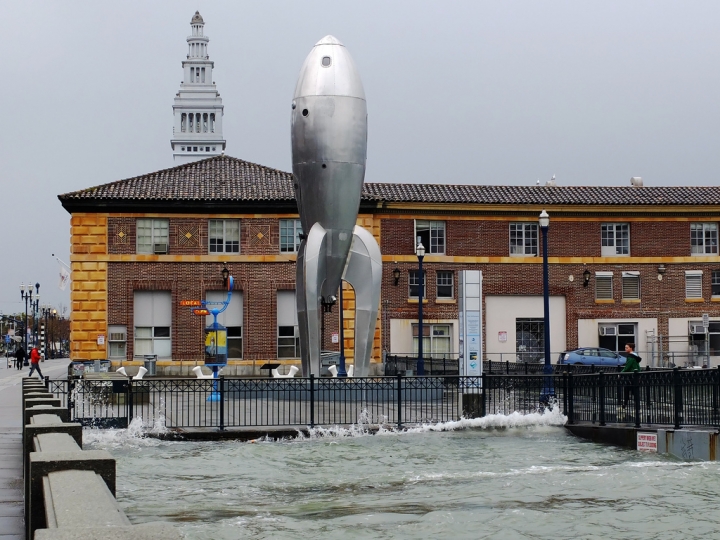
    Flooding on San Francisco’s Embarcadero during the 2012 King Tide.
    Credit: Sergio Ruiz/Flickr

    Flooding has already become 10 times more likely in Baltimore and Honolulu and five times more likely in Philadelphia, Norfolk, Va., and Charleston, S.C., since 1930. That’s in large part because since the start of the 20th century, sea levels have risen by about 8 inches globally due to human greenhouse gas emissions that have caused oceans to warm and land ice to melt, swelling the seas.

    “It’s an emerging flooding crisis,” William Sweet, an oceanographer with NOAA who led the new report, said.

    And while the onset of the crisis has been gradual, it’s likely to reach a tipping point in the 2050s for all 26 cities that Sweet examined, after which point the risk of flooding increases dramatically. Sweet defined a tipping point as the time when a city would experience 30 days of nuisance flooding — floods roughly up to 20 inches above the high-tide mark — per year.

    While most cities will reach that tipping point around 2050 unless greenhouse gas emissions are slowed, a number of locations will cross that line much sooner. Boston has nearly crossed that mark already and New York and Philadelphia are likely to reach the 30-day flood threshold at some point in the 2020s.

    Reaching those levels is a near guarantee due to the sea level rise already locked in. After that, the world’s choice on when or if to reduce greenhouse emissions will determine just how regular future flooding will be. In cities such as Norfolk and San Francisco, it will become a daily problem by the 2070s on the current emissions pathway, at which points seas could be up to 4 feet higher, according to recent climate projections.

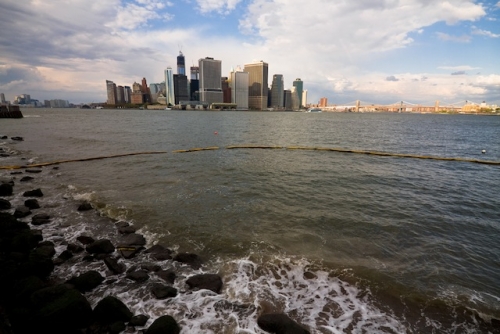
    Downtown Manhattan.
    Credit: Brian Kahn

    Sweet’s analysis is one of three major studies to look at nuisance flooding in the U.S. this year. Researchers from the Union of Concerned Scientists and Old Dominion also examined flooding and found similar results while using slightly different methodology to reach their conclusions.

    While nuisance flooding doesn’t have quite the same “wow” factor of storm surge flooding like Sandy and Haiyan, the financial ramifications are huge. Coastal flooding could cost the world trillions of dollars over the 21st century unless adaptation measures are taken. And it has very real implications for people living in low-level floodplains.

    “Nuisance floods have an important role in driving adaptation because that’s the flooding most people have to deal with every year. Nuisance flood damage isn’t going to reimbursed by the National Flood Insurance Program and I don’t think your insurance company will reimburse you for a flood that happens 30 days a year,” said Bob Kopp, a sea level rise researcher at Rutgers University whose sea level rise estimates were used in the new study.

    Kopp said the findings provide a nice complement to other studies looking at larger-scale floods. The findings provide information that municipalities, individuals and insurers could use to consider the impacts of sea level rise just as research looking at 100-year floods can inform national flood planning.

    Sweet also sees the utility of these projections in planning because they cover a range of possible sea level rise scenarios.

    “(Communities) can actively participate and see on a year-to-year basis how impacts are playing out and make the right (adaptation) decision based on the trajectory they’re experiencing,” he said.

    You May Also Like:
    Rain a ‘Start’ for Calif., But Drought Entrenched
    NASA Satellite Sends Back Most Detailed View of CO2
    Persistent Warming Driving Big Arctic Changes
    NYC Tops List for Seeing Increased Storm Outages

  • Merry Christmas From Bill Shorten

    1 of 19

    Merry Christmas

    Inbox
    x

    Bill Shorten via sendgrid.info 

    10:26 AM (3 minutes ago)

    to me
    .
    .

    G’day Neville,At the end of a big year, I want to wish you all a Merry Christmas.

    I hope you get the chance to celebrate with your friends and loved ones over a delicious meal.

    Personally, I’m looking forward to some relaxing time with my family – and a whole new supply of jokes from the Christmas crackers.

    At this time of year, we think of all those Australians who won’t get the chance to spend Christmas with the people they love.

    billthumbnail.png

    The men and women in our defence force, stationed around the world.

    Our emergency services personnel, our ambos, fireys, nurses and police, working through the day and night to keep us safe.

    And the heroes who don’t wear a uniform – Australians working unsociable hours to make ends meet and make our community a better place.

    And finally, as we give thanks for how lucky we are, let’s think of everyone who will go without this Christmas. Let’s think of the people who are doing it tough – here in Australia and around the world.

    And let’s all try and do something to bring a little bit of Christmas cheer into their lives, to make their 2015 better than 2014.

    Merry Christmas everyone and a Happy New Year,

    Bill

  • Assuring Real Progress on Climate HANSEN

    1 of 2
    Web Clip
    The Sydney Morning Herald Sport HeadlinesStalwarts help restore Dragons’ pride12/16

    Assuring Real Progress on Climate

    Inbox
    x

    James Hansen via mail93.atl51.rsgsv.net 

    8:55 AM (21 minutes ago)

    to me
    Email not displaying correctly? View it in your browser.
    Assuring Real Progress on Climate
    Assuring Real Progress on Climate is available here in pdf format, on my web site, and on our blog.

    ~Jim
    23 December 2014

    Like my Facebook page
    Like https://www.facebook.com/jimehansen on Facebook
    Share on social media
    Facebook Twitter
    Visit our program webpage
    csas.ei.columbia.edu