Category: General news

Managing director of Ebono Institute and major sponsor of The Generator, Geoff Ebbs, is running against Kevin Rudd in the seat of Griffith at the next Federal election. By the expression on their faces in this candid shot it looks like a pretty dull campaign. Read on

  • Register now for the fifth annual Ride for Life Challenge

    Brisbane’s sizeable cycling community is being challenged to hop on their bikes and support the fifth annual Ride for Life Challenge on Sunday 12 October 2014.

    Riders will also get the chance to rub shoulders with Tour de France great and Ride for Life ambassador, Robbie McEwen, who will be whizzing through the packs offering invaluable tips and tricks.

    The Ride for Life Challenge this year will support Guide Dogs Queensland and the Children’s Hospital Foundation.

    Registrations are open and limited to 1000, visit rideforlifechallenge.com.au for more information.

    The $99 registration fee includes a charitable donation and a free 2014 Ride for Life jersey.

    The ride includes full support – a police escort, a rest stop with refreshments, course Cycle Guides, first aid, mechanical support and support vehicles, a post-ride breakfast and an exclusive after-party at Byblos Bar + Restaurant.

    Corporate groups, local teams and individuals are encouraged to register for the non- competitive social ride around Brisbane, and spectators are encouraged to attend to cheer on the riders.

    Where: Starting and finishing at Hamilton’s Northshore Riverside Park
    When: Sunday 12 October 2014

  • It’s All About Fresh Water — Rapid Sea Level Rise Points To Massive Glacial Melt in Antarctica

    It’s All About Fresh Water — Rapid Sea Level Rise Points To Massive Glacial Melt in Antarctica

    It’s all about fresh water. In this case, massive freshwater outflows from the vast glaciers covering Antarctica.

    This week, a new scientific report published in the Journal Nature found that from 1992 through 2012 freshwater outflow from Antarctica’s massive glaciers exceeded 400 gigatons each year. An immense flood of cold, fresh water. One that helped push sea levels rapidly higher around the Antarctic continent.

    But with glacial melt on the rise and with mountains of ice now inexorably sliding seaward, these freshwater flows may just be the start of even more powerful outbursts to come. And such prospective future events have far-ranging implications for sea level rise, global weather, sea ice, human-caused climate change, and world ocean health.

    Flood of Fresh Water Drives More Sea Level Rise Than Expected

    The researchers discovered the tell-tale signature of this vast freshwater flood through chemical analysis of the seas surrounding Antarctica. The analysis pointed to a broad and expanding fresh water layer over-riding a warmer, saltier current issuing in from the Southern Ocean.

    Since fresh water is less dense than salt water, the freshwater layer expands at the ocean surface causing sea levels to rise more rapidly. Meanwhile, the heating of the deep ocean surrounding Antarctica is thought to result in additional thermal expansion of the water column.

    The researchers note:

    On the basis of the model simulations, we conclude that this sea-level rise is almost entirely related to steric adjustment [changes that effect atomic spacing], rather than changes in local ocean mass, with a halosteric [salt based] rise in the upper ocean and thermosteric [heat based] contributions at depth. We estimate that an excess freshwater input of 430 ± 230 Gt yr−1 is required to explain the observed sea-level rise. We conclude that accelerating discharge from the Antarctic Ice Sheet has had a pronounced and widespread impact on the adjacent subpolar seas over the past two decades.
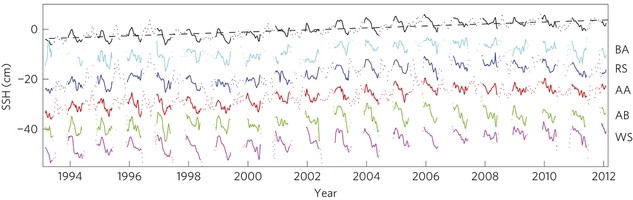
    Antarctic Sea level Trend

    (Rate of sea level rise in the seas surrounding Antarctica since 1992. Aggregate sea level rise is indicated in black. Individual seas data is broken out by color. Image source: Nature.)

    Previously, increased rates of sea level rise surrounding Antarctica were thought to have been set off by increasing winds around the continent. The winds were thought to push more water up against the ice faces forming a kind of perpetual, low-grade storm surge. But the current finding provides strong evidence that the source of the sea level rise is due to less dense fresh water over-topping saltier waters flowing in from the Southern Ocean combined with increasing heat along the Antarctic sea bed. And, notably, this is not the first study to find increasing freshwater flows spilling into the Southern Ocean. Last year, a KNMI expedition uncovered similar results.

    More Evidence of Large-Scale Melt

    The study comes on the back of other recent findings showing that warm water invasion at Antarctic glacier bases had led to more rapid than expected melt and destabilization. In May, two NASA studies showed that a broad section of West Antarctica had destabilized and was sliding at an ever more rapid pace toward the ocean (see reports here and here). These findings held stark implications for global sea level rise as large ice regions of Greenland and West Antarctica, containing enough water to raise seas at least 15 feet, are likely already in a state of irreversible collapse.


    Regional Anomaly Sea level Antarctic

    (Sea level rise anomaly of the region surrounding Antarctica compared with the rest of the Southern Ocean. Red indicates faster than normal sea level rise. Blue indicates slower than normal sea level rise. Image source: Nature.)

    This intensifying glacial melt and associated freshwater cap expanding out from the pole has implications — not just for sea level rise, but for sea ice, weather, and world ocean system health.

    Impacts For Sea Ice

    Large outflows of glacial fresh water may well be involved in the recent observed expansion of sea ice in the zone surrounding Antarctica (see recent related study). Fresh water serves as an insulative cap on the ocean surface preventing warm water from entering the top layer from below. The warm, salty water, in the Antarctic instead pools near the bottom or at the base of the great ice sheets.

    Fresh water also freezes at a higher temperature than salt water. So sea ice in an expanding freshwater zone around Antarctica would have naturally higher resiliency even to the rising temperatures now occurring due to human-caused warming. Eventually, however, human heat forcing would overwhelm the ice, but not before a period of related, localized negative feedbacks.

    The Iceberg Cooling Effect

    The fresh water is a haven for sunlight-reflecting sea ice. It is interspersed with ice bergs from the glacial discharge and the large ice bergs cool the surrounding air. The fresh water layer prevents warm water upwelling from the warm, deep waters surrounding Antarctica. And the leading edge of the fresh water would drive salt-water down-welling along its advancing front. This would push warmer waters toward the ocean bottom, resulting in a kind of heat sink. And this is exactly the kind of dynamic that appears to be ongoing in the Southern Ocean now. These combined impacts are what is known as the ice berg cooling effect associated with large-scale glacial outbursts known as Heinrich Events. And we may well be in the process of setting off one of these geological scale nightmares.

    20121230_iceberg_cooling_effect_Hansen_Sato

    (Iceberg cooling effect under a mid-range warming scenario when global climate models were set to include the effects of large freshwater outflows from polar glaciers at a fast enough rate to raise seas by 60 cm through 2060 and 144 cm through 2080 [left frames]. Note the cooler zones in the Southern Ocean and North Atlantic adjacent to Greenland. Right frames include mid range emissions/warming scenarios and IPCC projected rates of sea level rise. It is worth noting that the amplifying effects of potential additional ghg release from the global climate system, particularly from Arctic and world ocean carbon stores, are not included in these simulations. Image source: Hansen and Sato.)

    For global weather, such events have major implications. Regional cooling in the zone of freshwater outflow would juxtapose regional warming in the southern hemisphere meridional zones. This temperature differential would increase with the strength of the fresh water outflow and the rising intensity of the human-driven warming. The result would be a powerfully intensified storm track. Both the intensified storm track and increased atmospheric moisture loading due to human warming would result in much more powerful weather events than we are currently used to and the potential for catastrophic storms would drastically increase.

    Amplifying Feedbacks and a Blow to World Ocean Health

    Lastly, the expanding flood of fresh water would result in an increasing stratification of the world ocean system. This stratification would drive warm, salty water toward the ocean bottom and deplete already low oxygen reserves in that region. In addition, the extra heat is more likely to destabilize deep-sea clathrates — releasing methane which will speed in the oxygen depletion of the abyssal waters even as it tips the world ocean system to stop storing carbon and to begin releasing it. A combined feedback that is both an ocean killer and an amplifier to the already extraordinarily powerful human heat forcing mechanism.

    Links:

    Rapid Sea Level Rise Along Antarctic Margins Due to Increasing Glacial Discharge

    Important Role For Ocean Warming and Enhanced Ice Shelf Melt in Sea Ice Expansion

    Update on Greenland Ice Sheet Mass Loss: Exponential?

    Grim News From NASA: West Antarctica’s Entire Flank is Collapsing

    Nature: Human-Destabilized Antarctica Capable of Glacial Outbursts Contributing to Up to 14 Feet of Sea Level Rise Per Century

  • Bardarbunga webcams / live data

    nd > Bárdarbunga > News

    Check out our destinations and tours!
    Follow us:
    FacebookTwitterGoogle PlusYouTube

    Current activity of Bardarbunga volcano, Iceland: An intense seismic crisis started at Bárdarbunga volcano on 16 August 2014 and is continuing at the time of writing (23 Aug). It may or may not lead to a volcanic eruption, possibly under the Vatnajökull ice cap.
    Follow updates as news come in!

    Bardarbunga volcano

    Stratovolcano approx. 2000 m / ca. 6,560 ft
    Iceland, 64.63°N / -17.53°W

    Bardarbunga webcams / live data
    Bardarbunga volcano eruptions:
    1080(?), 1159(?), ca. 1210, ca. 1270, ca. 1350, ca. 1410(?), 1477 (very large effusive-explosive eruption), 1697, 1702, 1706, 1712, 1716, 1717, 1720, 1726, 1729, 1739, 1750, 1766, 1769, 1797, 1807(?), 1862-64, 1872(?), 1902-03, 1910, 2014
    Typical eruption style:
    Large effusive eruptions, some explosive activity.
    Last earthquakes nearby

    Bardarbunga volcano update: Fissure eruption decreases, but earthquakes pick up again – what’s next?

    Wednesday Sep 03, 2014 07:05 AM | BY: T
    View of the eruption this morning (Mila webcam)

    View of the eruption this morning (Mila webcam)
    Earthquakes near Vatnajökull during the past days (IMO)

    Earthquakes near Vatnajökull during the past days (IMO)
    Depth vs time of the recent earthquakes

    Depth vs time of the recent earthquakes
    Satellite image of the eruption yesterday (NASA)

    Satellite image of the eruption yesterday (NASA)

    Important changes seem to be under way. The fissure eruption with its spectacular lava emission at the surface still continues, but has decreased a lot since the first two days.
    At the same time, earthquake and deformation activity that had decreased yesterday have picked up again. This is likely because the internal pressure is no longer efficiently released and intruding magma no longer erupted at the same rate as added underground.
    The scenario of a new eruption along new fissures, possibly under the ice, or even at Bárdarbunga or Asjka volcanoes, is considered a possible scenario.

    Small explosions
    Small explosions were reported to have occurred in an area north of the glacier, but it is unclear what they were caused by. A possibility includes phreatic (purely steam-driven) or phreatomagmatic (magma directly in contact with water) explosions as magma (or surface lava flows) meets and heats up wet sediments.
    As lava from the ongoing Holuhraun eruption continues to flow towards the nearby glacial river Jökulsá á Fjöllum, Iceland’s second largest river from Vatnajökull, and only approx. 6 km away yesterday, the interaction of lava flows with the river water will likely generate powerful steam explosions that can release dangerous gases.

    Earthquakes
    A magnitude 5.5 earthquake occurred at 03:09 this night at the northern caldera of Bárdarbunga. GPS data indicate that since the beginning of the crisis, the caldera is slowly subsiding as magma flows away from underneath. This increases the risk of an explosive eruption at the volcano itself.
    Earthquakes along the dyke (magma intrusion at depth) NE of the volcano have continued in two clusters: one is in the area of the current eruption,along a 20-25 km long NNE-oriented stretch under the glacier edge, the latest eruptive fissure and north of it. The second cluster is NE of Askja to the north, suggesting that some of the intrusion has even progressed into Askja’s volcanic zone.

    Status as of yesterday
    The eruptive fissure was 1.5 km in length, positioned about 4.5 km from the ice margin of Dyngjujökull. At 14:00 UTC yesterday, the lava flow was 4.2 km2 in area. At 08:00 UTC the edge had extended 1.5 km to the east-south-east.

  • Daily update: Australian fossil fuel subsidies undermine case for wind, solar

    re to enable desktop notifications for Gmail.   Learn more  Hide

    1 of 4
    AdPerth Solar Installswww.brightonsolar.com.au – Reduce your energy costs now WA’s most affordable packages

    Daily update: Australian fossil fuel subsidies undermine case for wind, solar

    Inbox
    x

    Renew Economy editor@reneweconomy.com.au via mail62.atl51.rsgsv.net

    2:57 PM (42 minutes ago)

    to me
    Australian fossil fuel subsidies undermine case for wind, solar; Solar industry & voters rally to save RET; Electricity emissions jump as carbon price dumped; Big US utility hoses micro grid over centralised generation; GreenPower scheme to collapse under proposed RET change; Australia’s first fossil fuel free super fund launched; Aged care facility goes solar in Victoria; Usyd the thin end of the wedge in coal invested campaign; Gas ain’t so green says BP; On the verge of an EV battery breakthrough; Euro Council lifts 2030 renewables target to 30%; Tricking E.coli bacteria into making renewable propane; and 99.999% certainty humans a driving global warming says new study.
    Is this email not displaying correctly?
    View it in your browser.
    RenewEconomy Daily News
    The Parkinson Report
    Residents on Tasmania’s Bass Strait islands will see their electricity bills fall this year, even as the cost of diesel rises. They pay less than one third of the true cost of electricity – just one example of the extraordinary subsidies that are crowing out solar, wind and storage in Australia.
    A Save Solar meeting packed out in Queanbeyan, a signed letter from 500 solar businesses – pressure increases on Abbott govt to leave RET untouched.
    Australian electricity emissions have quickly reversed course following the dumping of the carbon price, less hydro and more coal.
    NRG Energy – the biggest generation company in US – joins Vermont utility to shift from centralised power grid to localised production and storage.
    RET Review recommendation to include voluntary renewable power purchases within mandated annual RET targets would kill GreenPower scheme, says ATA.
    Former GetUp director Simon Sheikh launches Australia’s first fossil fuel free super fund as coal and oil divestment campaigns gain momentum.
    Aged care facility says it expects 20% annual return from 100kW rooftop solar investment.
    Greenpeace’s campaign to get USYD to divest from Whitehaven Coal could be the thin end of a campaign that could embarrass coal investors and analysts alike.
    Judging by the hype surrounding the US shale-gas revolution, you might guess natural gas was a sure-fire solution. It’s not.
    Tesla could have found a battery cheap enough to make electric vehicles cost-competitive with conventional cars.
    The new target, an increase on the previous 27% goal, is welcomed by solar industry, but draws criticism for failing to introduce binding commitments.
    The vast majority of global energy demand is for fuel, and a renewable source could help us heat our houses and travel efficiently long into the future.
    Less than 1 chance in 100,000 that global average temperature over the past 60 years would have been as high without human-caused greenhouse gas emissions.
  • Meg Mac heading to Brisbane Festival

    Meg Mac
    Meg Mac plays the Spiegeltent for the Brisbane Festival

    Brisbane Festival today announced soul-pop sensation Meg Mac will play at The Telstra Spiegeltent on Sunday 21 September, following the cancellation of Seattle singer-songwriter Damien Jurado’s Australian tour.

    The sultry Sydney-sider will take to the beautiful Belgian venue to play tracks from her new EP, MEGMAC, in Brisbane for the first time.

    Turning heads with her much-hyped singles Known Better, Every Lie and Roll up Your Sleeves after winning triple j’s Unearthed Falls Festival competition in 2013, Meg Mac has had a whirlwind year.

    If her latest sold-out gigs in Adelaide, Brisbane, Melbourne and Sydney are anything to go by, festivalgoers are advised to get in quick-smart before this gig sell out too.

    Brisbane Festival is an initiative of the Queensland Government and Brisbane City Council and runs from 6 to 27 September 2014. For more information visit brisbanefestival.com.au.

  • Four 1000k oldies celebrate ten Brisbane to Goldies

    Brisbane to Gold Coast launch
    Four original Brisbane to Goldie riders have clocked up 1000k each

    They’re known as the 1000k Club, a nickname to honour the achievement of each riding the 100km Santos GLNG Brisbane to the Gold Coast Cycle Challenge ten times.

    There was celebration aplenty as four of the challenge’s original participants, Bernard Milford, Shane Osmond, Phil Forshaw and Garry Kuhn accepted the honour of cutting a specially crafted bicycle-shaped birthday cake to mark a decade of Queensland’s biggest and best bike ride.

    For Mr Milford, a 64-year-old grandfather of eight, the opportunity to achieve the perfect ten ensured he was one of the first people to enter Bicycle Queensland’s annual ride from Brisbane to the Goldie.

    “I took part in the inaugural ride in 2005 and knew there was something special about the Brisbane to Gold Coast Challenge right from the start,” Mr Milford said.

    “Your bike can be a lonely place but on that one day the cycling community comes together and the thrill of riding with such a huge group of people has kept me coming back ever since.

    “I’ve made lifelong friends as the years and the kilometres of the Challenge have rolled past and I’ve helped raise a bit of money for a number of good causes through it too.”

    Bicycle Queensland CEO Ben Wilson said Bernard would be one of an expected 10,000 participants to tackle the 100 kilometre ride which, over the years, has raised almost $1.4 million for various charities.

    To celebrate a decade of pedalling to the glitter strip, the entire field will receive a stylish commemorative jersey.

    “Over the last ten years the Santos GLNG Brisbane to the Gold Coast Challenge has grown to be Queensland’s biggest and best bike ride,” Ben said.

    “No other ride brings together so many like-minded people in a safe and structured environment or offers once-a-year experiences like riding the South East Busway and taking part in a fun, healthy and rewarding activity.”

    In 2014 the Santos GLNG Brisbane to the Gold Coast Cycle Challenge is supporting the Heart Foundation and riders are being encouraged to help raise funds for research, prevention strategies and advocating positive, healthy choices to combat Australia’s number one killer.

    Santos Vice President Queensland Trevor Brown said Santos GLNG was proud to support the ride for the third year in a row

    “Over the years, more than 61,000 cyclists have participated in the ride – including hundreds of Santos GLNG’s very own cycling enthusiasts – and the fact that so many people are keen to take up this challenge is a great indicator of the increasing popularity of bike riding,” Mr Brown said “It’s a great fit for our business, given our strong focus on health, safety and fitness, and I’m pleased that more than 100 Santos GLNG employees have already signed up for this year’s ride.”

    General registrations close on Tuesday 14 October. Full details are available at the Brisbane to Gold Coast website

    If you want to know more about Westender’s forthcoming feature on cycling – contact us now