Managing director of Ebono Institute and major sponsor of The Generator, Geoff Ebbs, is running against Kevin Rudd in the seat of Griffith at the next Federal election. By the expression on their faces in this candid shot it looks like a pretty dull campaign. Read on
Strong advocate for coal seam gas … Liberal Scot MacDonald. Photo: Supplied
NSW Liberal MP Scot MacDonald will be referred by the NSW Greens to the Independent Commission Against Corruption for allegedly accepting gifts from gas company Santos, after praising coal seam gas drilling in NSW.
Mr MacDonald had been a member of a state government inquiry into the industry, and made many statements about the benefits of the industry during the inquiry hearings.
His statement on a dissenting report in the inquiry concluded: “It is difficult to reach any other conclusion than the coal seam gas industry should be developed as quickly as possible.”
Days after the inquiry delivered its findings in May, he accepted flights and accommodation in Tasmania from Santos to speak at a forum alongside Santos officials on the topic of coal seam gas and agriculture.
Advertisement
Mr MacDonald, a member of the legislative council from the NSW Northern Tablelands, declared the flights and accommodation on the pecuniary interests register.
The NSW Greens said they will now refer Mr MacDonald to ICAC over the free flights and accommodation.
Mr MacDonald has released a statement saying: “I was quite open about attending the conference and appearing on the panel discussing coal seam gas.
“I complied with all parliamentary guidelines. I have spoken many times before and after the inquiry into coal seam gas about the importance of gas to NSW households and industry. I have consistently said we need to ensure gas supplies for this state if it can be shown CSG can be extracted safely and landholders are treated respectfully.
“It’s a shame Mr Buckingham would prefer to try and personally smear me, rather than engage in serious debate on coal seam gas,” the statement said.
NSW Greens MP Jeremy Buckingham said Mr MacDonald has also held a coal seam gas forum in his home town, Armidale, and invited Santos to speak.
“We think it’s outrageous that, while the Parliament was still considering the Coal Seam Gas Inquiry Report, he accepted a gift from one of the largest coal seam gas companies, Santos,” Mr Buckingham said.
“The risk is that there will be a public perception that Mr Macdonald may be unduly influenced by his relationship with Santos and the gift he has accepted when considering on the inquiry report, as well as legislation and regulations related to the industry.
The Greens will allege that Mr MacDonald breached the Parliamentary Code of Conduct.
“I will refer the matter to ICAC to investigate,” Mr Buckingham said.
Mr Buckingham this morning broke the Greens’ boycott of controversial broadcaster Alan Jones’s 2GB breakfast show to criticise Mr MacDonald on air. He said Mr MacDonald had been “appalling in his one-eyed approach” to CSG.
Santos is currently seeking to develop a major gas field in the Pilliga woodland, in north-west NSW.
You are receiving this email because you are a Green Light subscriber.
Click here if you do not wish to receive Green Light emails from the Guardian News and Media. Click here to find out about other Email Services from the Guardian.
Guardian News & Media Limited – a member of Guardian Media Group PLC. Registered Office: Kings Place, 90 York Way, London, N1 9GU. Registered in England No. 908396
Will WestConnex (despite its horrible name) save NSW’s ailing economy, as its proponents testily insist? Or is it, in the words of transport elder Ron Christie, “back to the 1950s … a real LA-type solution”?
It happened that, on the tram en route to that Meeting of the Tims, I met an elderly couple from Vancouver. They sought somewhere ”interesting” for their last half-day in Sydney. Darling Harbour? I suggested. Pyrmont? Barangaroo?
As I sketched the background they were dismayed by how far and how recently Sydney has cleansed itself of industry.
“In Vancouver,” they said, “we’re trying to keep this stuff in the city so that people, and freight, don’t need to travel so far.”
In Sydney, I was ashamed to realise, just voicing such ideas still brands you as a boat-rocking leftie. How did our urban debate become so polarised? Can anyone still think that environment and economy are foes, instead of short-term and long-term views of the same thing?
The Committee for Sydney reincarnates Rod McGeoch’s 1997 creature of the same name. Remember that lobby group for those least in need, the rich and powerful? I thought it had finally vanished from lack of interest but apparently not, for the new committee gleams stiffly like a Thatcher hairdo, stiff with the same old power-myopia.
It’s very open. Anyone can join, for a mere ten grand (plus GST). And anyone can speak, as long as they’re CEO of a multi-million dollar corporation.
The committee, whose board includes Sally Loane (now spin-meister for those well known philanthropic urbanists Coca-Cola Amatil) and former Howard hatchet-man Max Moore-Wilton, proudly spruiks such membership benefits as the “opportunity to meet … key decision makers”, “access to leaders in private, public and not-for profit sectors” and the capacity to “influence key policies”. (Does saying something three times in different words mean it’s hyper-important?)
It has not been idle. Last month alone the committee hosted five events: a briefing with the Network Rail CEO, David Higgins, lunch with Qantas CEO Alan Joyce, drinks for the London & Partners CEO Gordon Innes, drinks for Asian Cup Football CEO Michael Brown, and lunch with Landcom CEO John Brogden.
Whew. Talk about big issues. Just keeping track of which friend is CEO of what, this week, would fill those little gaps between your investment decisions all by itself.
The committee also blogs, with posts like ”CFS congratulates Business Events Sydney” or ”CFS commends Planning Minister”. Surprisingly, there are no comments. (Well, there’s one, in six months, a spirited discussion on intermodal freight interchange by the smart and indefatigable social activist Lynda Newnam. But she’s no CEO, and there’s no response).
As to policy, it’s a bit thin. On transport, Sydney’s bleeping-red issue, Tim #1 concedes that “the car … is now seen as a liability.” Yet he insists that WestConnex is “an inevitability,” not worth discussing. A $10 billion inevitability.
So that’s city-planning orthodoxy; top-down stuff, forbiddingly abstract. Super Sydney inverts and subverts this model. Tim Williams #2, having lived and worked in Paris, developed it from a couple of Parisian projects – Sarkozy’s 2009 Grand Paris, and the current, 196-council Paris Metropole.
Compared with Paris’s 196 councils, Sydney’s 42 seems modest. Still, over several months, interviewers headed to each of them, filming 12 conversations with 12 people about what people wanted for their city. The full, 504-video collection is available on the website.
My favourite so far is Ben from Marrickville, who says, somewhat bashfully: “I’d like to see public treehouses … really big ones, and you can, like rent it for a couple of hours and go up there … ”
Beauty’s quite big, parks and fountains. (Locals love Blacktown and Mount Druitt, in particular, for their visual charms). Diversity, community, arts, friendliness and safety all figure highly. I haven’t heard any calls for roads, although I believe there are some. But the overwhelming consensus is a clarion call for transport.
On this, vox pop accords with every visiting urbanist this year (and there have been a few). London School of Economics Professor Ricky Burdett, New York City chief urban designer Alex Washburn, and the deputy mayor of Paris, Pierre Mansat (in launching Super Sydney last week); each, unprompted, offered the same insight. Sydney desperately needs public transport.
So why this massive road project?
Infrastructure NSW argues thus: “Sydney’s road network serves 93 per cent of passenger journeys, and most growth in transport demand over the next 20 years will be met by roads.”
Especially, of course, if you keep building more roads.
This is the essence of conservative thinking. It’s why top-down produces business as usual, because that’s what feeds it.
But in fact we don’t need more roads: if anything we should convert Parramatta Road to full-on public transport. As a former Federal Court judge, Murray Wilcox, AO, QC, argues, this project demands we ask, “who benefits?”
“If it’s commuters,” he said, “wouldn’t they benefit more from public transport? If not commuters, then why do it at all?”
An answer is provided by EcoTransit’s satirical WasteConnex vid, available on YouTube.
“WasteConnex,” croons the voice over, “is the highest priority project … sucking $10 billion out of public transport and freight rail projects and delivering it to construction, consulting, and finance.”
That’s your “inevitable.” Frankly, I’d prefer public tree houses.
Is Sandy a taste of things to come? CNN The New York State Sea Level Rise Task Force translated that into a local projection of 2 to 5 inches by the 2020s, and with rapid Arctic ice melt the rise could be as much as 5 to 10 inches over the next fifteen years. Combine that with a trend toward … See all stories on this topic »
Read the President’s Plan: http://OFA.BO/MX3Ss8 “Over the next four months you have a choice to make. Not just between two political parties or even two people. It’s a choice between two very…
It is well known Obama has some of the best scientists to advise him on climate change (John Holdren, Steve Chu) but has been politically unable to carry his climate mitigation legislation through Congress, whereas Romney et al. do not accept the essential scientific evidence.
From: NEVILLE GILLMORE [mailto:arthursleang@hotmail.com] Sent: Tuesday, October 30, 2012 9:37 PM To: John James Cc: Andrew Glikson Subject: Hurricane Sandy blows away election ephemera, leaving stark choice
A toss a coin in the air perhaps. Obama will pick some votes from his actions in the current disaster. But who is the correct choice???
Neville
Hurricane Sandy blows away election ephemera, leaving stark choice
Some things truly transcend politics: a hurricane emergency is one. But Sandy also asks what kind of leader we really want
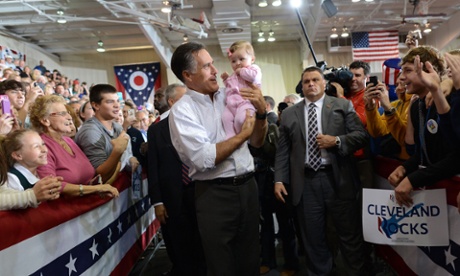
US Republican presidential candidate Mitt Romney holds a supporter’s baby during a campaign rally at Avon Lake High School in Avon Lake, on Ohio. Photograph: Emmanuel Dunard/AFP/Getty Images
In any election, politicians’ pretty much always-false modesty prompts them to exclaim that they themselves are playing but a part in the march of history. Obama cut an ad that admitted:
“Sometimes, politics can seem very small – but the choice you face? It couldn’t be bigger.”
Last week, Paul Ryan made a feint at bipartisanship with a similar argument:
“Mitt and I have a message that’s bigger than party.”
Hurricane Sandy reminds us of what truly monumental events, and the decisions we make in the face of them, look like. Sandy is not just bigger than any campaign and powerful enough to banish all the feeble fantasies humans s have about our relationship to the physical world. Though Sandy may finally bring a discussion about the environment to the forefront of politicians’ minds, one of humanity’s only creations that’s almost impervious to the kind of force battering the US east coast is denial. (Then again, note the Earth’s stubborn, intractable reactions to our abuse.) We can talk about “man-made” climate change, but there’s a difference between having control over something and taking responsibility for it. Our part in global warming is more like that of someone dropping a lit cigarette in the forest, rather than someone starting a fire for heat. As for arguments about who did or didn’t “build that” – Sandy don’t care. Buildings are flimsy and our plans even more insubstantial; our opinions revealed to be nothing more than spit and a wish for wind in the right direction. You can sense among political professionals a vague sense of panic about Sandy, which is ancillary to the more specific and very real worries that they harbor about loved ones and their own, mostly likely east coast, lives. We don’t yet know Sandy’s precise impact on the election – on a practical level, the storm will disrupt early in-person voting, rallies in east-coast states will go unattended, ads may be inescapable when people are driven indoors, or they may be unwatched in places that lose power. Beyond that immediate effect, will Sandy wash away political trivia and remind voters of the true stakes of picking a president? Will these disruptions freeze the race where it is, or will Sandy remind people of the stakes involved in picking a leader, swaying them toward the one who seems the safer choice? The magnitude of the storm should underscore, not contrast, the relationship between the people’s will and predictions that existed before. It’s not as though pundits and pols had any better idea of what would happen prior to Sandy’s landfall. This election has been unprecedented on so many levels, you couldn’t even tweet them all: the amount of money being spent, the ideological divide between the parties, the infuriating vagueness of one candidate’s ideas. Sandy is just another element beyond control: you can’t even poll a storm – much like the ideas of low-information, undecided voters, it’s nothing but a resounding, echoing howl. The Frankenstorm – an appellation that would make Mary Shelley wince at the lack of a possessive, though she might approve of the sentiment – is an immediate, measurable reminder that politics is, in the end, not about messaging and postures and positioning, but the structure of people’s lives: who they can turn to when they have no resources left themselves, who they can look to when all the options are bad, and what they can do with what they have left when it seems like nothing at all. We’re not choosing the nation’s CEO, a boss-in-chief. Mitt Romney‘s approach to poor performance is eliminating jobs, it’s only Federal Emergency Management Agency (Fema) employees he could fire – and he’s said he wants to – not the natural disaster itself. You can’t put the bravery of first responders on a balance sheet, or quantify human loss. Whoever becomes president, the job is really that of a community organizer – whether that’s the role they’re prepared for or not.








 Advertisement