Category: General news

Managing director of Ebono Institute and major sponsor of The Generator, Geoff Ebbs, is running against Kevin Rudd in the seat of Griffith at the next Federal election. By the expression on their faces in this candid shot it looks like a pretty dull campaign. Read on

  • Did you hear what he said? Claire, Solar Citizens

    2 of 21

    Did you hear what he said?

    Inbox
    x

    Claire, Solar Citizens

    12:20 PM (19 minutes ago)

    to me

    Dear Neville —

    Malcolm Turnbull was in the Prime Minister’s parliamentary chair for barely 48 hours when he made a statement that caused us some distinct alarm. In question time Wednesday our new PM said the proposed goal of 50% renewable energy was “one of the most reckless proposals the Labor Party has made”.

    Here’s what we have learned about reckless behaviour over the past two years:

    • The Abbott government was reckless from day one, moving to slash the Renewable Energy Target from 41,000 to 33,000 gigawatt hours which cost thousands of jobs and millions in investment.
    • The Abbott government attacked the Australian Renewable Energy Agency, an agency that fosters innovation and industry development – it was protected through the courageous actions of cross bench Senators including Glenn Lazarus, Dio Wang and Ricky Muir.
    • The Abbott government also relentlessly pursued the Clean Energy Finance Corporation, a body that invests in renewable energy projects and has delivered 100% profit back to the taxpayer!

    With a new Prime Minister in charge, it’s the right time for a race to the top on renewables, not round after round of argy bargy between the two major parties. Will you share this image on Facebook to make sure people know what was said by our new Prime Minister in his first week on the job?
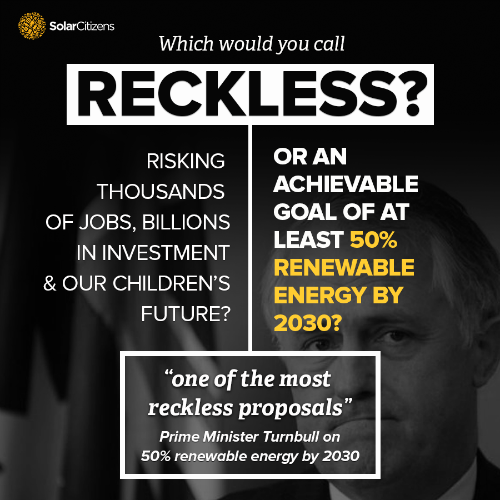
    turbull-reckless-small.png


    It’s a troubling signal from the Turnbull government so early in the piece. The goal of at least 50% renewable energy is something the vast majority of Australians support, because it means we’re making the sensible move to use that handy and plentiful natural resource – sunshine.

    Our new Prime Minister has the opportunity to lift the public debate on renewables and embrace the sunny future we all want to see, so it’s up to us to show him that people everywhere are calling for a new dawn for solar. Share this image on Facebook now to show that you won’t let negative statements from our politicians go unchallenged.

    Let’s not forget, this is our future were talking about. Australians everywhere want a strong solar future and all the benefits that entails: good jobs, investment and a better future for our children in a thriving economy. And, earlier this week, the PM was embracing these sentiments, saying: “The Australia of the future has to be a nation that is agile, that is innovative, that is creative.” We agree.

    There’s no time to waste in this busy week of politics – let’s make sure our message shines!

    For a strong solar Australia,

    Claire, National Director

    claire-email-small.jpg

    PS: Don’t have Facebook? Instead you can click here to send your personal message to Prime Minister Turnbull using our easy online tool.

    PPS: We’ll continue campaigning until all our politicians Stand Up for Solar and Support policies that allow us all to use the plentiful clean, renewable resources we have at our disposal. Make your donation to Solar Citizens today and help us show people in the corridors of power that Australians everywhere want a solar future.

  • Young jobseekers need a Newstart with Turnbull GET UP

    More

    1 of 39

    Young jobseekers need a Newstart with Turnbull

    Inbox
    x

    Alycia – GetUp!

    6:30 PM (23 minutes ago)

    to me


    NEVILLE,

    Australia may have a new Prime Minister, but by the looks of the first policy-cab off the rank, you’d be forgiven for not realising it.

    One of the Prime Minister Turnbill’s first acts has been to reintroduce the Abbott Government’s proposal to force young jobseekers to wait four weeks for Newstart support. This is the Turnbull Government’s first statement on the Abbott Budget, and the way we respond could set the tone for so many other of our issues – from $100K university degrees to $80 billion cuts to our schools and hospitals.

    If the Coalition thinks all it takes is a change in salesman to make Abbott’s Budget measures more palatable, they have another thing coming. We need to take this opportunity to show them these cuts are just as unpopular as they were before.

    Let your Coalition MP or senator know, if they’re looking to take a different direction, they’d best not stray down the same old path. Send them a message, telling them to abandon the changes to Newstart: https://www.getup.org.au/turnbulls-newstart

    Day one: Mr Turnbull follows Abbott’s suit: delaying marriage equality by blocking a free vote, and making a deal with the Nationals that would rule out a price on emissions during his prime-ministership. Day two: Just a week after the Senate blocked the changes to Newstart, the Turnbull Government reintroduces the proposal, which would leave young jobseekers with no support for four weeks. It’s an ominous start and one that begs the question, what’ll be next? $100K university degrees? Attacks on our Medicare?

    Right now, the Turnbull Government is weighing up which policies they’ll abandon, and which of them they’ll stick with. As we head towards an election year, public reaction will be a critical factor in determining the policies that stick.

    When it comes to the changes in Newstart, GetUp members have shown the government just how much the policy will hurt them at the polls. We’ve sent thousands of emails to their MPs and senators, rallied in streets around the country, and flooded Senator Abetz’s inbox with cheeky “job applications” after the Employment Minister suggested jobseekers send 40 applications a month. The overwhelming community backlash to the proposal forced the government to backdown from a waiting period of 6 months to four weeks, which was also knocked down by the Senate just last week.

    We’ve seen what happens when 81,000 people come together to stand up for a strong safety net for those who need it most. Now we need to do it again.

    Click here to send your Coalition MP or senator a message about the fight they face in pushing this reckless proposal through Parliament.

    Together, GetUp members have quashed many of the harsh budget measures proposed by the former Abbott Government – from the GP co-payment, to pension cuts, to $100,000 university degrees. While it remains to be seen whether Mr Turnbull will pursue the Abbott Government’s budget measures, it’s clear his government has wasted no time re-introducing a policy that will punish young jobseekers.

    Perhaps the Turnbull Government has already forgotten about the overwhelming community backlash that arose when the cuts were first proposed. Let’s remind them of it, shall we?

    Alycia, Daney, Nat and Mark for the GetUp team

    References
    [1] Senate rejects bid to make young jobseekers wait extra four weeks for welfare, The Guardian, 10 September 2015

  • Don’t let them kill baby whales FIGHT FOR THE REEF

    1 of 19

    Don’t let them kill baby whales

    Inbox
    x

    Gemma Plesman – Fight for the Reef info@fightforthereef.org.au via cmail1.com 

    4:50 PM (11 minutes ago)

    to me

    A mother has lost her baby.
    No Images? Click here
    Fight for the Reef
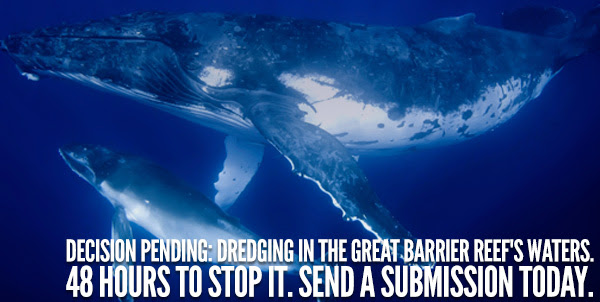
    48 hours to stop dredging.
    Dear NEVILLE,

    A mother has lost her baby.

    A tugboat was trying to berth a coal ship at Hay Point, one of the Reef’s biggest mega coal ports, when it struck a baby humpback whale. The whale was found dead underneath.

    With your help, we’ve been campaigning against the industrialisation of the Reef: coal ports, shipping and dredging. This is why.

    Together, we’ve banned the dumping of dredge spoil on the Reef. Now we need your help again.

    Click here and send a submission to stop the dredging of Abbot Point now.

    Hay Point sits to the south of Whitsunday Islands. Abbot Point to the north.

    Both are mega ports, with thousands of tonnes of coal passing through every year to mega coal ships.

    Whales often swim around the Hay Point area. Mothers and babies come in seeking refuge on their lengthy journey along Australia’s east coast, through the waters of the Reef. It’s a huge attraction for tourists.

    Clearly, this is no place for new coal ports. It’s no place for more massive coal ships. And it’s no place to expand the current coal ports that are already operating under capacity.

    It’s a place for whales: mums and babies.

    Right now the Queensland and Federal governments are planning to expand Abbot Point. Abbot Point is home to humpback whales as well as dugongs and sea turtles.

    Can you send a submission to the approval process calling on them to withdraw plans to expand Abbot Point? It only takes a minute using the tools on our website. 

    We’ve told them before we don’t want this project, and they backed down on dumping the dredge spoil in the Reef’s waters.

    Once again, we’ve got to stand up and say no. No more dredging at Abbot Point. No more dredging and no more industrialisation.

    People don’t come to see coal ports. People don’t come to see dredging.

    People come to see whales and a healthy Reef.

    Don’t let them kill the baby whales.

    Thank you for your ongoing support,

    Gemma Plesman
    on behalf of the Fight for the Reef team

  • Do you have Room ? Sarah Hansen Young

    More

    1 of 39

    Do you have room?

    Inbox
    x

    Sarah Hanson-Young <sarah@sarahhansonyoung.com>

    4:28 PM (4 minutes ago)

    to me

    NIMN_600x100.jpeg

    Dear Neville,
    The picture of 3-year-old Aylan Kurdi, who lost his life in search of a safe place to grow up, has opened Australian hearts and minds.

    Following the publication of that one image and the announcement that Australia will be taking 12,000 Syrian refugees, my office was inundated with messages from people offering a room in their homes to support a refugee.

    It was in response to that outpouring of support that Aylan’s List was born.

    Will you join Aylan’s List and pledge to support a refugee, on a short term basis, in your home?

    In partnership with the Australian Homestay Network, we will use Aylan’s List to offer a safe space for newly arrived refugees so that they can begin rebuilding their lives.

    If you aren’t able to offer a room in your home, there are many other ways that you can support refugees who are coming to Australia.

    Will you pledge to give food or toys to a refugee in need?

    Millions of people have fled Syria and Iraq in search of a safe place to live. The political tide in Australia is turning and we are strong enough to offer refugees permanent and lasting protection.

    Together, we can give shelter and compassion to people in need.

    Yours in hope,
    Sarah Hanson-Young.

    P.S There are many ways that you can help a refugee rebuild their life in Australia. Check out www.aylanslist.com for more information.

    http://www.sarahhansonyoung.com/

  • Dredging the dugong’s home avaaz

    3 of 41

    Dredging the dugong’s home

    Inbox
    x

    Emily Mulligan – Avaaz Unsubscribe

    2:11 PM (1 hour ago)

    to me

    Despite the change of Prime Minister and huge environmental risks, the Australian Government is still pushing forward to build the Abbot Point coal port. This would be disastrous for The Great Barrier Reef, but they have to listen to us.  We have three days. Send a message now to stop the dredging: 

    Send a message
    Dear friends,

    Amidst the political turmoil in Canberra, the government is pushing forward the Abbot Point coal port in the Great Barrier Reef World Heritage Area. The dredging to build this port will harm the habitat that dugongs and turtles rely on for food. There’s just 3 days left to make our voices heard and stop the dredging!

    With a change in leadership, the Australian government are are in prime position to remove their support from this doomed project. They answer to us, let’s show them the public doesn’t support the climate-cooking coal mines.

    Let’s flood the public consultation on Abbot Point now to stop the damaging dredging. The government has to consider our comments before making their decision — send a message now!

    https://secure.avaaz.org/en/australia_dont_dredge/?bhPqncb&v=65024

    The dredging would affect more than 60 hectares of the Great Barrier Reef’s World Heritage Area, all to make a port for a coal mine that may never go ahead. The plume of sediment that results from dredging spreads for kilometres, spreading to nearby coral reefs, stopping light from reaching the sea bed and wreaking havoc on water visibility.

    Banks are ruling out investing in this risky project, Abbot Point lost its Federal approval in the courts and Indigenous leaders in the area are speaking out. The Australian Government are Adani’s last supporters, now with business savvy Prime Minister Turnbull, we have our best chance in years to scrap the mega coal projects for good.

    Send a message now, each one will have to be considered in the government’s process:

    https://secure.avaaz.org/en/australia_dont_dredge/?bhPqncb&v=65024

    Avaaz members all over the world have come together for the extraordinary Great Barrier Reef time and time again. Even if we have never seen the reef before, we can acknowledge that our actions now will determine whether the reef will be around for our grandkids. This is one of the monumental environmental battles in Australia — let’s ensure we give our all to this fight.

    With hope,

    Emily, Nic, Will, Scott, David, Allison and the whole Avaaz team

    SOURCES

    Have your say on Abbot Point project (Daily Mercury)
    http://www.dailymercury.com.au/news/have-your-say-abbot-point-project/2746926/

    Abbot Point expansion environmental impact statement issued (Brisbane Times)
    http://www.brisbanetimes.com.au/business/mining-and-resources/abbot-point-expansion-environmental-impact-statement-issued-20150820-gj3j3y.html


    Avaaz.org is a 41-million-person global campaign network
    that works to ensure that the views and values of the world’s people shape global decision-making. (“Avaaz” means “voice” or “song” in many languages.) Avaaz members live in every nation of the world; our team is spread across 18 countries on 6 continents and operates in 17 languages. Learn about some of Avaaz’s biggest campaigns here, or follow us on Facebook or Twitter.

    You became a member of the Avaaz movement and started receiving these emails when you signed “Save our dying planet!” on 2011-12-08 using the email address nevilleg729@gmail.com.
    To ensure that Avaaz messages reach your inbox, please add avaaz@avaaz.org to your address book. To change your email address, language settings, or other personal information, contact us, or simply go here to unsubscribe.

    dRERDGINGTo contact Avaaz, please do not reply to this email. Instead, write to us at www.avaaz.org/en/contact or call us at +1-888-922-8229 (US).

  • Atmospheric water generator

    Atmospheric water generator

    From Wikipedia, the free encyclopedia

    An atmospheric water generator (AWG), is a device that extracts water from humid ambient air. Water vapor in the air is condensed by cooling the air below its dew point, exposing the air to desiccants, or pressurizing the air. Unlike a dehumidifier, an AWG is designed to render the water potable. AWGs are useful where pure drinking water is difficult or impossible to obtain, because there is almost always a small amount of water in the air that can be extracted. The two primary techniques in use are cooling and desiccants.

    The extraction of atmospheric water may not be completely free of cost, because significant input of energy is required to drive some AWG processes. Certain traditional AWG methods are completely passive, relying on natural temperature differences, and requiring no external energy source. Research has also developed AWG technologies to produce useful yields of water at a reduced (but non-zero) energy cost.

    Contents

    History

    The Incas were able to sustain their culture above the rain line by collecting dew and channeling it to cisterns for later distribution. Historical records indicate the use of water-collecting fog fences. These traditional methods have usually been completely passive, requiring no external energy source other than naturally occurring temperature variations.[citation needed]

    Modern technologies

    Many atmospheric water generators operate in a manner very similar to that of a dehumidifier: air is passed over a cooled coil, causing water to condense. The rate of water production depends on the ambient temperature, humidity, the volume of air passing over the coil, and the machine’s capacity to cool the coil. These systems reduce air temperature, which in turn reduces the air’s capacity to carry water vapor. This is the most common technology in use, but when powered by coal-based electricity it has one of the worst carbon footprints of any water source (exceeding reverse osmosis seawater desalination by three orders of magnitude) and it demands more than four times as much water up the supply chain as it delivers to the user.[1]

    An alternative available technology uses liquid, or “wet” desiccants such as lithium chloride or lithium bromide to pull water from the air via hygroscopic processes.[2] A proposed similar technique combines the use of solid desiccants, such as silica gel and zeolite, with pressure condensation.

    Cooling condensation

    Example of cooling-condensation process.

    In a cooling condensation type atmospheric water generator, a compressor circulates refrigerant through a condenser and then an evaporator coil which cools the air surrounding it. This lowers the air temperature to its dew point, causing water to condense. A controlled-speed fan pushes filtered air over the coil. The resulting water is then passed into a holding tank with purification and filtration system to help keep the water pure and reduce the risk posed by viruses and bacteria which may be collected from the ambient air on the evaporator coil by the condensing water.[3]

    The rate at which water can be produced depends on relative humidity and ambient air temperature and size of the compressor. Atmospheric water generators become more effective as relative humidity and air temperature increase. As a rule of thumb, cooling condensation atmospheric water generators do not work efficiently when the temperature falls below 18.3°C (65°F) or the relative humidity drops below 30%. This means they are relatively inefficient when located inside air-conditioned offices. The cost-effectiveness of an AWG depends on the capacity of the machine, local humidity and temperature conditions and the cost to power the unit.

    Wet desiccation

    One form of wet desiccant water generation involves the use of salt in a concentrated brine solution to absorb the ambient humidity. These systems then extract the water from the solution and purify it for consumption. A version of this technology was developed as portable devices which run on generators. Large versions, mounted on trailers, are said to produce up to 1,200 US gallons (4,500 l) of water per day, at a ratio of up to 5 gallons of water per gallon of fuel.[4] This technology was contracted for use by the US Army and the US Navy from Terralab[citation needed] and the Federal Emergency Management Agency (FEMA).[5]

    A variation of this technology has been developed to be more environmentally friendly, primarily through the use of passive solar energy and gravity. Brine is streamed down the outside of towers, where it absorbs water from the air. The brine then enters a chamber and subjected to a partial vacuum and heated. The water vapor is collected and condensed, while the renewed brine is recirculated through the system. As the condensed water is removed from the system using gravity, it creates the vacuum which lowers the boiling point of the brine.[6]

    In greenhouses

    A special case is the water-generation in greenhouses because the air inside a greenhouse is much hotter and more humid than the outside. Particularly in climatic zones with water scarcity, a greenhouse can strongly enhance the conditions necessary for atmospheric water generation. Examples are the seawater greenhouse in Oman, and the proposed Integrated Biotectural System or IBTS-Greenhouse.

    In fiction

    In the Dune series, Fremen on the desert world Arrakis collected water from the atmosphere on a massive scale by erecting wind traps that funneled dew-laden air into cool underground caverns.

    In Star Wars, Luke Skywalker’s family on Tatooine used atmospheric water generation on their moisture farm.

    In the Star Trek: The Next Generation episode “The Inner Light“, Captain Picard suggests building “atmospheric condensers” for a planet experiencing prolonged drought.

    See also

    References


    Drinking Water From Air Humidity. ScienceDaily (June 8, 2009)