Managing director of Ebono Institute and major sponsor of The Generator, Geoff Ebbs, is running against Kevin Rudd in the seat of Griffith at the next Federal election. By the expression on their faces in this candid shot it looks like a pretty dull campaign. Read on
Finger-pointing … Energy Minister Chris Hartcher and Premier Barry O’Farrell. Photo: Rob Homer
Not for the first time, the NSW Liberals’ dirty laundry has been aired in open court.
The Supreme Court injunction that has scuttled today’s scheduled annual meeting of the party’s state council ensured the internal business so strictly guarded by the party would be very much on public display.
In the past, seats in the Hills district, north west of Sydney, have been the flashpoint for legal action, thanks to the battle for local supremacy between the state upper house MP David Clarke and his supporters and the federal MP for Mitchell, Alex Hawke.
This time it’s the central coast. But there is an important difference that elevates the significance of this factional stoush.
Advertisement
It has brought the cabinet minister who controls the Liberal branches in the area, Chris Hartcher, into direct conflict with the Premier, Barry O’Farrell.
The court action, which was taken against each member of the state executive, including O’Farrell, was backed by Hartcher.
It was all about trying to force a vote to change the way preselections are conducted within the NSW Liberals for state and federal seats.
The hard right faction, of which Hartcher is a senior member, argues a move to direct election of candidates by branch members would democratise the party by removing the influence of the ruling body, the state executive, over preselections.
But the left and centre right factions, which control the state executive, fear the change will lead to an outbreak of branch stacking in seats held by vulnerable MPs.
As the Herald reported this week, Hartcher confronted O’Farrell over the court case during Tuesday’s party room meeting. Reportedly with much finger-pointing in front of the room full of Liberal MPs, he told O’Farrell, who had called publicly to defer consideration of the issue until next year, that even if the case failed ”this won’t be the end of the matter”.
It’s no secret that Hartcher and O’Farrell do not like each other. But this episode will have heightened the tensions between them. There is talk about whether Hartcher has pushed O’Farrell far enough to have him reconsider his position in the ministry.
It’s not just the court case, which has emerged from a motion moved by Hartcher at the Roberston federal electorate conference in May. Earlier this year, Hartcher was accused of – but denied – being the source of a cabinet leak that embarrassed the government over its ethanol policy. And two of his staff are embroiled in an investigation by the Electoral Funding Authority into alleged irregularities on the central coast.
Hartcher’s electorate officer, Ray Carter, and policy adviser Tim Koelma were suspended on full pay in late March after the party referred alleged breaches of political donations laws to the authority. Koelma has since resigned to take up another job. The investigation has been referred to another authority, but the Electoral Funding Authority is tight-lipped about which one.
There is plenty of talk that the outcome has the potential to embarrass Hartcher. (In a bizarre link between the donations scandal and the court case, it has emerged that Denis Pogson, the central coast branch member who brought the case, rents a room in Carter’s Wyong home).
While many believe O’Farrell should sack Hartcher in light of his role in the court case, they say he won’t because it would spark a factional war within the party if he dumps one of the hard right’s most senior MPs.
In question time on Wednesday and Thursday, O’Farrell was asked by Labor if he retained confidence in Hartcher. He responded both times with a curt ”yes”. But his patience must be being sorely tested.
Thursday, 13 September 2012 08:59 Neville Gillmore
Hansen still argues 5m 21st C sea level rise possible
by Stuart Staniford
This is interesting – here is the latest paper from James Hansen and coauthor Miki Sato Paleoclimate Implications for Human-Made Climate Change. If you are up to reading climate science papers it’s highly recommended (I’m a little slow in getting to it – the press release was Dec 8th 2011 but I just got to reading it yesterday and today). A little background is in order – one of the serious scientific debates in the climate science community over the last decade has been the implications of the unexpectedly large acceleration of glacier discharge in Greenland and Antarctica and in particular a discovery by Zwally et al in 2002 that surface melt water can get down the base of a glacier and lubricate its motion. Prior to the early 2000s it was assumed that ice sheets would decay mainly by melting on the surface and climate models all assumed that they would decay only very slowly in a warmer world – it was a surprise to realize that the most important breakdown mode was actually basal lubrication and sliding down into the ocean. Hansen in particular became the leading spokesman for the view that the ice sheets on Greenland and parts of Antarctica would prove quite unstable under Anthropocene conditions and might break down in a rapid non-linear manner and cause very large levels of twenty-first century sea level rise. See for example this essay from 2005 in which he says:
Consider the situation during past ice sheet disintegrations. In melt-water pulse 1A, about 14,000 years ago, sea level rose about 20 m in approximately 400 years (Kienast et al., 2003). That is an average of 1 m of sea level rise every 20 years. The nature of glacier disintegration required for delivery of that much water from the ice sheets to the ocean would be spectacular (5 cm of sea level, the mean annual change, is about 15,000 cubic kilometers of water). “Explosively” would be an apt description, if future ice sheet disintegration were to occur at a substantial fraction of the melt-water pulse 1A rate. Are we on a slippery slope now? Can human-made global warming cause ice sheet melting measured in meters of sea level rise, not centimeters, and can this occur in centuries, not millennia? Can the very inertia of the ice sheets, which protects us from rapid sea level change now, become our bete noire as portions of the ice sheet begin to accelerate, making it practically impossible to avoid disaster for coastal regions?
This kind of nigh-apocalyptic rhetoric from a very senior and respected climate scientist provoked a flurry of papers in response seeking to analyze the situation. Most of these suggested various reasons why 21st century sea level rise, while likely worse than previously projected (for example in the 3rd IPCC report in 2001), would not be as bad as the worst fears of Hansen. Hansen and Sato’s own description of this new literature seems fair to me:
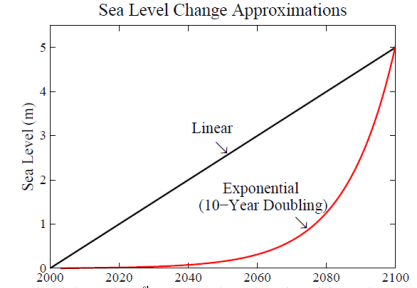
Rahmstorf (2007) made an important contribution to the sea level discussion by pointing out that even a linear relation between global temperature and the rate of sea level rise, calibrated with 20th century data, implies a 21st sea level rise of about a meter, given expected global warming for BAU greenhouse gas emissions. Vermeer and Rahmstorf (2009) extended Rahmstorf’s semi-empirical approach by adding a rapid response term, projecting sea level rise by 2100 of 0.75-1.9 m for the full range of IPCC climate scenarios. Grinsted et al. (2010) fit a 4-parameter linear response equation to temperature and sea level data for the past 2000 years, projecting a sea level rise of 0.9-1.3 m by 2100 for a middle IPCC scenario (A1B). These projections are typically a factor of 3-4 larger than the IPCC (2007) estimates, and thus they altered perceptions about the potential magnitude of human-caused sea level change. Alley (2010) reviewed projections of sea level rise by 2100, showing several clustered around 1 m and one outlier at 5 m, all of these approximated as linear in his graph. The 5 m estimate is what Hansen (2007) suggested was possible under IPCC’s BAU climate forcing. Such a graph is comforting – not only does the 5-meter sea level rise disagree with all other projections, but its half-meter sea level rise this decade is clearly preposterous. However, the fundamental issue is linearity versus non-linearity. Hansen (2005, 2007) argues that amplifying feedbacks make ice sheet disintegration necessarily highly non-linear, and that IPCC’s BAU forcing is so huge that it is difficult to see how ice shelves would survive. As warming increases, the number of ice streams contributing to mass loss will increase, contributing to a nonlinear response that should be approximated better by an exponential than by a linear fit. Hansen (2007) suggested that a 10-year doubling time was plausible, and pointed out that such a doubling time, from a 1 mm per year ice sheet contribution to sea level in the decade 2005-2015, would lead to a cumulative 5 m sea level rise by 2095. Nonlinear ice sheet disintegration can be slowed by negative feedbacks. Pfeffer et al. (2008) argue that kinematic constraints make sea level rise of more than 2 m this century physically untenable, and they contend that such a magnitude could occur only if all variables quickly accelerate to extremely high limits. They conclude that more plausible but still accelerated conditions could lead to sea level rise of 80 cm by 2100
I had been following this debate and reading the papers in question and had been somewhat reassured that 21st century sea level rise would be not too problematic for civilization at large (though it clearly would be very painful for coastal property owners and jurisdictions). (Before we go on it’s worth emphasizing the important aside – hardly any climate scientists doubt that huge quantities of the Greenland and Antarctic ice sheets would eventually melt and cause tens of meters of sea level rise as a result of human climate modifications – the debate is solely about how much of the consequences of our actions we will experience in the 21st century). However, Hansen is not reassured by these new papers and is doubling down:
The kinematic constraint may have relevance to the Greenland ice sheet, although the assumptions of Pfeffer at al. (2008) are questionable even for Greenland. They assume that ice streams this century will disgorge ice no faster than the fastest rate observed in recent decades. That assumption is dubious, given the huge climate change that will occur under BAU scenarios, which have a positive (warming) climate forcing that is increasing at a rate dwarfing any known natural forcing. BAU scenarios lead to CO2 levels higher than any since 32 My ago, when Antarctica glaciated. By mid-century most of Greenland would be experiencing summer melting in a longer melt season. Also some Greenland ice stream outlets are in valleys with bedrock below sea level. As the terminus of an ice stream retreats inland, glacier sidewalls can collapse, creating a wider pathway for disgorging ice. The main flaw with the kinematic constraint concept is the geology of Antarctica, where large portions of the ice sheet are buttressed by ice shelves that are unlikely to survive BAU climate scenarios. West Antarctica’s Pine Island Glacier (PIG) illustrates nonlinear processes already coming into play. The floating ice shelf at PIG’s terminus has been thinning in the past two decades as the ocean around Antarctica warms (Shepherd et al., 2004; Jenkins et al., 2010). Thus the grounding line of the glacier has moved inland by 30 km into deeper water, allowing potentially unstable ice sheet retreat. PIG’s rate of mass loss has accelerated almost continuously for the past decade (Wingham et al., 2009) and may account for about half of the mass loss of the West Antarctic ice sheet, which is of the order of 100 km^3 per year (Sasgen et al., 2010). PIG and neighboring glaciers in the Amundsen Sea sector of West Antarctica, which are also accelerating, contain enough ice to contribute 1-2 m to sea level. Most of the West Antarctic ice sheet, with at least 5 m of sea level, and about a third of the East Antarctic ice sheet, with another 15-20 m of sea level, are grounded below sea level. This more vulnerable ice may have been the source of the 25 ± 10 m sea level rise of the Pliocene (Dowsett et al., 1990, 1994). If human-made global warming reaches Pliocene levels this century, as expected under BAU scenarios, these greater volumes of ice will surely begin to contribute to sea level change. Indeed, satellite gravity and radar interferometry data reveal that the Totten Glacier of East Antarctica, which fronts a large ice mass grounded below sea level, is already beginning to lose mass (Rignot et al., 2008).
However, probably their main point is that the data we have on the Antarctic/Greenland meltdown is relatively short and is consistent with the idea that it’s doubling with a relatively short (decade or less) timescale and if you extrapolate that out over the 21st century you get to very large values of sea level rise (a point I made in a blog post back in 2006). This leads them to include this figure (which I take to be a conceptual sketch rather than an exact forecast):
The picture that emerges is a relatively slow manageable sea level rise in the first part of the century followed by increasingly catastrophic levels of change in the latter part of the century as the rapid breakdown of the ice sheets overwhelms everything else. I take Hansen’s opinions very seriously. It’s certainly true that there isn’t enough data to rule out this scenario yet (though another decade of data should help a lot). Obviously at this point he hasn’t succeeded in persuading most of his colleagues, but neither have they persuaded him. Only more data is likely to resolve the situation.
Ricken, Nick, Mary, Jamie, Wissam, Diego, Rewan and the rest of the Avaaz team
Support the Avaaz Community!
We’re entirely funded by donations and receive no money from governments or corporations. Our dedicated team ensures even the smallest contributions go a long way.
Avaaz.org is a 15-million-person global campaign network that works to ensure that the views and values of the world’s people shape global decision-making. (“Avaaz” means “voice” or “song” in many languages.) Avaaz members live in every nation of the world; our team is spread across 19 countries on 6 continents and operates in 14 languages. Learn about some of Avaaz’s biggest campaigns here, or follow us on Facebook or Twitter. You are getting this message because you signed “Save our dying planet!” on 2011-12-08 using the email address nevilleg729@gmail.com. To ensure that Avaaz messages reach your inbox, please add avaaz@avaaz.org to your address book. To change your email address, language settings, or other personal information, https://secure.avaaz.org/act/index.php?r=profile&user=6be3e9aa63582c9b1397464fcc49baa9&lang=en, or simply go here to unsubscribe.
The Minister for Human Services and Social Inclusion Tanya Plibersek talking to seniors at the Peninsula Community Centre about the Federal Government’s Carbon Tax.
THE Central Coast faces the greatest risk from sea level rise in NSW if no action is taken against climate change.
That’s what Human Services Minister Tanya Plibersek told residents during her visit to the coast on Tuesday to sell the government’s carbon tax.
“We know the science tells us that we need to act on dangerous climate change,” Ms Plibersek said.
“The science shows us that the Central Coast faces the highest risk of inundation from sea level rise in NSW.
“The Federal Government is taking action to tackle dangerous climate change and move Australia towards a clean energy future while supporting jobs and providing assistance to households and pensioners.”
According to the 2009 report Climate Change Risks to Coastal Buildings and Infrastructure, Lake Macquarie, Wyong and Gosford Local Government Areas LGAs were the top three areas estimated to see the highest number of homes in NSW at risk of inundation from a sea level rise.
Lake Macquarie alone may see between 5100 and 6800 residential buildings affected by sea level rise and storm inundation by 2100.
GOSFORD Mayor Laurie Maher said he was not surprised to hear the Central Coast rated highest in the number of homes predicted to be affected by sea level rise. 7 comments
We have the 2 camps on this topic. But I venture to say that the sceptics are in complete denial clinging to statements made by non-science spruikers and one or two scientists who have tried to put a time frame on events. The problem with those folk who live their lives using the flat earth policy is that they will most likely be the first to crow as the water begins to rise. It never ceases to amaze me that some people believe that you can add another 50 billion people to this planet, and then more again, and that she’ll be right. Most scientists have reached agreement on climate change coming after all available evidence was scrutinised and peer evaluated…. not becaust Tony Abbott and the big business lobby (which funds the re-election of politicians) says so. Our granchildren will pay the price for those of us who live on a ‘flat earth’ when this generation is long gone. What a legacy to leave one’s descendants.
Ashley McCallumwrites: Posted on 29 Jul 11 at 12:55pm
Well if Tanya is correct in her outlandish, baseless and alarmist predictions, she should have told her fellow discredited alarmist friend Tim Flannery before he bought his new house on the water at Coba Point, off the Hawkesbury River. Isn’t it odd how they say one thing with their mouths yet another with their wallets. You are being lied to people.
Davewrites: Posted on 29 Jul 11 at 10:27am
More Labor/Green lies to scare us into accepting an unjust and unnecessary tax. As the child once said “The King is in the altogether”. I am so glad that there are enough people in this country with the self confidence and intellect to stand up and call this for what it is; scare mongering, lies and deceit in the interest of a political agenda that can only be called extremist.
Mattwrites: Posted on 19 Jul 11 at 12:20pm
Can you picture those IPCC projections, with different lines on the graph, with the ‘best case’ prediction at the lowest and the ‘worst-case’ prediction at the highest? Those projections were first done in 1992 and re-done about ten years later. Since then, the real data has tracked right along the ‘worst-case’ line for just about everything they measured, including sea level. Yelling about the worst case scenario isn’t scaremongering. It’s happening already.
Peggywrites: Posted on 17 Jul 11 at 03:22pm
I think Tanya doesn’t know the difference between sea level rise and erosion. Wave action of the ocean erodes the sea shore. It’s been doing that long before global warming/climate change was ever invented.
The figures speak for themselves. Earth’s veil of atmosphere has warmed by 0.8 degrees since the middle of the 18th century when smoke billowing from furnaces of the Industrial Revolution began.
The temperature rise might not sound like a great deal, but make no mistake: the carbon dioxide being churned out today will linger for centuries to come, scientists say.
The polar icesheets, in particular, are vulnerable to a positive feedback loop that tends to boost the speed at which melting occurs. This, in part, is why the Arctic sea ice has shrunk to its smallest extent yet, raising concerns that Arctic summers might be largely free of ice by the 2030s.
Melting of sea ice does not, in itself, lead to a rise in sea level – but the melting of continental ice sheets, such as the Greenland ice cap in the Arctic, does, explains Monash University plant physiologist Roslyn Gleadow.
Advertisement
“Ice is white and reflects sunlight, ensuring that our polar regions keep cold,” Associate Professor Gleadow explains. “Areas that are ice-free are darker in colour and thus absorb sunlight; they also warm faster than if they were covered with ice.” This positive feedback mechanism serves to increase the initial warming.
To discuss these and related matters, the Royal Society of Victoria is hosting a climate change symposium that opened last night in Melbourne with a free public lecture entitled “Addressing the myths of climate change”.
Today, the symposium begins in earnest with world experts discussing each of three key areas of research: science, impacts and adaptation.
“The symposium aims to provide a forum where experts can engage with the community about issues without the need for overly technical language or political hype,” says co-organiser Associate Professor Gleadow.
The first session this morning will review the welter of evidence for climate change, how it is measured and what is understood about these changes. It will then move to describe projections for the future.
The second session will address impacts on Victoria, along with matters such as water supply, sea-level inundation, agricultural productivity and extreme-weather expectations.
The symposium’s final session will consider options for adaptation to reduce exposure to climate-change impacts. “This is really important because there are opportunities as well as challenges ahead, and we need people from all walks of life to be engaged in this process if we are to arrive at the best possible outcomes,” Associate Professor Gleadow says.
Likely impacts
The projected effects of sea level rise are of intense interest worldwide.
NASA satellite measurements show that coastal regions of the East Antarctic ice sheet, including long stretches of the Australian Antarctic Territory, have been losing about 57 billion tonnes of ice each year for the past three years. The complete loss of the sheet, the world’s biggest expanse of frozen water, would raise sea levels by roughly 50 metres, polar scientists believe.
The West Antarctic ice sheet, in particular, is losing about 132 billion tonnes of ice a year. Global ice losses now contribute an estimated 1.8 millimetres a year to rises in sea level.
Such calculations have given rise to reports suggesting that more than 250,000 homes in Australia could be damaged or lost due to storm surge and sea level rise in coming decades.
Claims that up to 45,000 homes in Victoria alone – worth more than $10 billion – would be threatened by rising sea levels by 2100, were followed by two CSIRO reports that suggest sea levels during storms are likely to be about 15 centimetres higher in 2030 than today.
Another report will consider four sea-level scenarios by 2100, including two based on rises of 80 centimetres, one of 110 centimetres and one of 140 centimetres. Victorian planning regulations currently forecast a rise in sea level of 80centimetres by the end of the century.
Australia contributes significantly to its own potential problems. The nation’s “ecological footprint” is estimated to be something like 7.8 global hectares per person – 2.8 times the average global footprint.
Links
• Find out what’s on today at the Royal Society’s climate change symposium here