Category: General news

Managing director of Ebono Institute and major sponsor of The Generator, Geoff Ebbs, is running against Kevin Rudd in the seat of Griffith at the next Federal election. By the expression on their faces in this candid shot it looks like a pretty dull campaign. Read on

  • Barry O’Farrell: Give us an NDIS GET-UP

    Barry O’Farrell: Give us an NDIS

    Inbox
    x
    GetUp!
    4:01 PM (46 minutes ago)

    to me

    — We are forwarding the below email on behalf of a GetUp member who wished to make a special appeal on this urgent campaign. We have not shared your personal details. —

    Dear NEVILLE, 

    Allow me to introduce myself. My name is Heike, and I’m a fellow GetUp member living in NSW. I have a six year old, Billie, who has cerebral palsy and a cheeky smile. 

    Like many Australians, I had always assumed that if a child is born with a disability or acquires one later in life, that some system, somewhere, will take care of them. How wrong I was. My family has accumulated $300,000 in debts buying equipment like manual and electric wheelchairs (more than $30,000), a walking frame ($550) and weekly speech therapy sessions ($75 a session). These costs are not a choice for us, because we love our child and want her to live up to her full potential. In fact, we see them as investments rather than costs.

    But right now there’s a conversation happening between politicians that could save families like mine from financial ruin. NSW and other states are in negotiations with the Federal Government to establish the first step towards a National Disability Insurance Scheme.  

    This would be life-changing for thousands of families who’ve fallen through the cracks. Unfortunately, talks are breaking down over costs squabbling, and could collapse completely. That’s why I believe our Premier urgently needs to hear from us so he knows what’s at stake. Can you join me in writing to him today? Please click here to learn more and send a quick message now:

    http://www.getup.org.au/NSW-NDIS

    Disability support in Australia is currently described as a lottery.  In some states there’s insurance protection — so that if you acquire a disability through a car accident for instance, you get help to cover the ongoing costs of your care. In others, if you’re born with a disability or acquire one through injury, you receive absolutely no support whatsoever – no matter how  much your costs skyrocket.  

    A National Disability Insurance plan is a reform on the scale of Medicare and compulsory superannuation: it would prevent countless people with disabilities, families and carers from becoming impoverished and exhausted. It would also introduce common sense, low-cost reforms that would remove barriers to employment for many more people who want to contribute later on as adults, saving taxpayers money over the long term.    

    In many ways, my child is not all that different from yours, or those of your friends. She loves pretend play, arts & crafts, and chocolate. Barry O’ Farrell, our local member, has met Billie. When I hear that NSW gave $100 million to the Sydney Cricket Ground, but refuses to find $70 million to help people with disabilities and their families, I want to ask him to look her in the eye and explain why her future counts for so little. 

    Will you write a message to Premier O’Farrell  now, while there’s still time to make a difference? It may just be most important thing you do this year. 

    http://www.getup.org.au/NSW-NDIS

    Thank you so much for taking the time to help my family, 
    Heike Fabig, NSW 

    PS – Many inspiring people have been working on the NDIS for years. Learn more about the campaign for an NDIS by visiting and signing up as a supporter at: http://everyaustraliancounts.com.au/


    GetUp is an independent, not-for-profit community campaigning group. We use new technology to empower Australians to have their say on important national issues. We receive no political party or government funding, and every campaign we run is entirely supported by voluntary donations. If you’d like to contribute to help fund GetUp’s work, please donate now! If you have trouble with any links in this email, please go directly to www.getup.org.au. To unsubscribe from GetUp, please click here. Authorised by Simon Sheikh, Level 2, 104 Commonwealth Street, Surry Hills NSW 2010.

  • Impact of coastal erosion in Australia

    Impact of coastal erosion in Australia 

    As a follow up to the Impending Coastal Crisis feature we posted earlier this week, Senior Coastal Scientist at Coastalwatch Professor Andrew Short has compiled a comprehensive piece focusing on coastal erosion in Australia.

    For the 50% of the Australian coast that is composed of sand and in some places mud, the shoreline is prone to change, building seaward and in some places eroding landward. In most locations this is a natural process with usually no impact on human settlement. Coastal protection of the shoreline is rarely required in Australia, however in a few locations the dynamic shoreline has become a problem, in some cases a major and expensive problem, and in almost all of these cases the problem is related to human interference or encroachment on the shoreline. Coastal protection works, such as breakwaters, groynes, or seawalls, are usually built to guard against erosion. In doing so they harden the coast and reduce its ability to adjust naturally. As a consequence, these defences can exacerbate further erosional problems, with seawalls reflecting and concentrating wave energy and erosion, and groynes starving downdrift the coast of sediment thereby leading to further erosion. There are areas where human have encroached into the dynamic beach environment only to suffer the consequences, and others where they have interfered with coastal processes leading to accelerated coastal erosion.

    Sand dredging at Currumbin Photo: Bartles
    Much of the shoreline of the rapidly expanding tropical city of Cairns appears especially vulnerable. The popular marina area and the hub of Cairns has encroached on Trinity Inlet and formerly mangrove-covered mudflats along the seafront are now bare and lined with seawalls, backed by development close to sea level. Much of Cairns is also built on a coastal plain, part of the Barron River delta, with the mangrove-lined tidal creeks that meandered through these plains all that remain. These are inundated at highest tides and demonstrate that critical infrastructure, such as the airport, lie close to present high tide level (as is often also the case with other airports, such as those at Brisbane and Sydney). At this level much of the coastal plain and city would be inundated by a 2.5 m storm surge calculated to accompany a 1 in 100 year storm, whereas dating sequences of coral rubble ridges deposited by large storms on nearby islands indicate that considerably larger events than those known from the past 200 years have recurred frequently over past millennia. The north Cairns coast along Yorkys Knob-Machans-Holloway beaches is lined with seawalls because much of the shoreline has been retreating, on a coast that in the long-term is building seaward as the Barron River delta progrades. The problem here is both the dynamic shoreline of the delta, which switches channels, has major floods and accompanying pulses of sediment, on a coast exposed to periodic tropical cyclones, all of which produces a highly dynamic shoreline. Roads and houses have been built on parts of the coast which will periodically be reclaimed by the sea, as well as periodically protected by wide beaches. Finally, when climate change is considered, the already perilously low-lying developments in Cairns are at considerable risk to inundation, as discussed in the next section.

    Cairns waterfront – low, eroding & vulnerable
    Australia’s best known strip of defended coastline, and a major holiday destination for local, national and international tourists, is the 35 km between the New South Wales-Queensland border at Point Danger and the Nerang Inlet, better known as the Gold Coast. 

    Here is a system that is part of a northerly conveyor belt of sand moving north from New South Wales across the border at a rate estimated at 500 000 m3/yr. In 1962-64 the Tweed River training walls were extended for navigation, 400 m out to sea. The southern wall blocked the movement of sand, which built out the adjacent Letitia Spit by 250 m, in the process trapping millions of cubic metres of sand and preventing it from moving across the border and along the Gold Coast beaches.

    As the sand supply was depleted, combined with a series of severe cyclones (Dinah, Barbara, Dulcie, Elaine and Glenda) in 1967, 8 million cubic metres of sand was eroded from the beaches and threatened the backing Gold Coast roads, houses and hotels. The solution has been threefold. First a continuous terminal seawall was built the length of the coast and covered with sand and dunes. Second between 1995 and 2000 3.5 million cubic meters of sand was dredged from the Tweed Bar and placed offshore of the southern Gold Coast beaches. Third, a permanent pumping system was built just south of the training wall, which since 2000 has pumped more than 500 000 m3 of sand each year from New South Wales across the border onto the Gold Coast beaches. In 2007 these beaches were as wide was they have ever been. However it has all come at a cost in the tens of millions of dollars.

    Sand pumping at Cooly/Tweed Photo: Bartles
    A similar training wall built between 1960-66 at the mouth of the Brunswick River, 50 km to the south, to service the small fishing fleet. Studies have shown that the walls impacted the beach to the north and south. The beach built it out for 8 km updrift, while erosion was observed to extend up to 17 km downdrift, with the shorelines not stabilising until 1987. The largest impacts were close to the wall with the small beachfront community of Sheltering Palms, located 2 km north of the wall, experiencing up to 90 m of shoreline erosion which resulted in some houses, roads and telegraph poles ending up in the surf zone and finally abandonment of the entire village by the mid 1970’s. Unlike the Gold Coast, this area did not warrant the massive expenditure on protection, so it was sacrificed. 

    Bruns river mouth Photo: Dan Wyer
    Coastal erosion, particularly associated with a cluster of east coast cyclones, has occurred at several points along the New South Wales coast. Dressing sheds at Manly were broken up by waves in 1913 and the North Steyne SLSC in Manly was severely damaged in 1950. The jetty at Byron Bay was removed in 1972, and ad hoc coastal protection was attempted at Belongil Spit with car bodies dumped to try to halt the erosion of sand. The 1974 storms, estimated as a 1:200 year event, destroyed the harbour side Manly pier and resulted in loss and damage of property and roads being cut at several points along the Sydney and south coast; elsewhere they were the first stage of erosion, with subsequent storms actually undermining property, as with the three houses that were destroyed during a storm in 1978 at Wamberal.

    NSW Wamberal Beach 1978, three house fall into sea Photo: Andrew Short
    Wamberal Beach Photo: Andrew Short
    Collaroy Beach on Sydney’s northern beaches is a classic example of inappropriate planning and shoreline subdivision that took place more than 100 years ago. The original property boundaries extend, and still do, down across the dune onto the beach, with most of the houses and now some high rises built on the beach-dune area. The consequences were entirely predictable, every time the beach retreated during high seas, the then beach shacks were undermined. Major erosion occurred in 1920, seven shacks fell into the sea in 1944-5, and one was washed out to sea in 1967. Following the 1945 storms the council voted to resume the remaining houses. Instead, within ten years the first block of flats was built and soon after the first high-rise, which in turn was undermined by the 1967 storms. More high rises followed, the next built just in time to be undermined by the 1974 storms. Here the council has allowed initial development in a hazard zone, and later massive over-development even after houses had been washed away. Collaroy remains a problem area with most of the affected properties fronted by makeshift seawalls. The council has started slowly buying back some properties and hopes the state government will allow massive beach nourishment at some time in the future. In the meantime every big sea removes the narrow beach and exposes the unsightly and hazardous seawalls on one of Sydney’s premier beaches.

    Wetherill St Collaroy/Sth Narrabeen. Real estate potentially threatened. Photo: Andrew Short
    Warilla Beach just south of Port Kembla was sacrificed to protect a row of low cost houses. Like Collaroy the houses had been built too close to the shoreline on the formerly active foredune. The volume of sand on the beach, already depleted through mining for export in the 1960s, was further reduced because longshore processes carried a proportion into the entrance to Lake Illawarra when the entrance lay to the south of a tombolo connected to an offshore island. Any sand returned by tidal processes leaked onto Perkins beach to the north when the tombolo closed off Warilla Beach, acting as a trapdoor. Finally when the 1974 storms threatened the houses, the council responded by building a rock seawall along the southern half of the beach, replacing the public beach with rock, even the surf club had to be moved. This example of poor planning has only been remediated recently when further works at the lake’s entrance, in an effort to keep it permanently open, led to significant nourishment of the beach. A series of storms generated by east coast lows in June and July 2007 however severely truncated the beach as the sand was being pumped south, providing an ominous warning of the likely long-term fate of the rebuilt beach.

    Warrilla – seawall built the length of beach, surf club had to close and move Photo: Andrew Short
    The rocky shores of New South Wales appear much more resistant against erosion. Locally however there are concerns about rock falls and public safety, as at Bilgola, Newport and Narrabeen headlands in Sydney. An exception is the steep cliffs at Coalcliff, first named by Flinders and Bass, where landslides are associated with the claystones and shales that are interbedded with the sandstones. The continual damage to Lawrence Hargrave Drive and the threat of falling rocks, led to the construction of the spectacular Seacliff bridge, a 665 m stretch of road that is built out from the cliff face over extensive rock platforms.

    Most of the Victorian coast is protected by a foreshore reserve, however at Portland the reserve was not wide enough to protect a stretch of beach known as the Dutton Way. Here problems started when a breakwater was completed in 1960 to expand the port of Portland, thereby interrupting the easterly movement of sand to the downdrift Dutton Way beach. As the beach began retreating threatening a road a seawall was commenced in 1970. Since then the wall has continue to follow the erosion to the east and now winds it way along the shore for 4.5 km. Low-lying areas around the Gippsland lakes are subject to flooding, particularly after the artificial opening of the Gippsland Lakes in 1889. Flooding in 2007 after intense rainfall over the catchments that drain into the lake was exacerbated at high tide and inundated much of Lakes Entrance.

    Dutton Way at Portland, the seawall just keeps growing Photo: Andrew Short
    Dutton Way, Portland Photo: Andrew Short
    The Adelaide metropolitan beaches have been experiencing erosion for decades, as a result of the natural 40,000-50,000 m3/yr northerly sand transport, exacerbated by dieback of nearshore seagrass meadows as a consequence of sewage pollution; and further aggravated by some roads and structured located too close to the shore. The erosion has been managed both by the construction of 14 kilometres of seawalls and the trucking of sand from the northern end of the system back to the south, and more recently pumping sand onshore from nearshore sand deposits. Maintenance of these metropolitan beaches continues at significant cost; but it has been possible to sustain the natural values of the coast, even re-establishing dunes in front of the esplanade at Brighton.

    Adelaide beaches – eroding & protected by seawalls & nourishment Photo: Andrew Short
    In a political decision that will ensure South Australia has generations of coastal problems the South Australian government in 1990 voted to freehold hundreds of beach shacks, many built close to or on the beaches and in low lying erosion and flood-prone areas. Now the shacks are freeholded it will be up to the government and taxpayers to maintain these unsightly ribbon developments and to try and protect these properties as they become increasingly exposed to shoreline erosion and sea level rise. 

    Lucky Bay – typical of the poorly sited shacks, now freeholded Photo: Andrew Short
    In contrast the Western Australian government has been successively removing the many hundreds of beach and fishing shacks that dotted the coast north of Perth as far as Geraldton. These have been removed along with the associated myriad of 4WD tracks and replaced by coastal reserves with well planned and designed access points along the coast, while neighbouring coastal towns are being developed as nodes for the increasing coastal population. Western Australia’s Geographe Bay is a relatively sheltered sandy embayment with a northerly drift of sand from Busselton north to Mandurah.

    Port Geographe canal development etc near Busselton and all the ensuring accretion seagrass (arrow) and erosion on north side (arrow) road and houses threatened Photo: Andrew Short
    In the early 1990s this northerly drift was interrupted by the construction of a series of training walls and groynes associated with a canal estate called Port Geographe. Not only sand but also piles of rotting seagrass built out 100 m against the updrift wall, while the beach on the northern side eroded back 250 m, threatening a road then houses. A combination of makeshift seawall and sand bypassing has been used with limited success; meanwhile the rotting seagrass continues to pile up and waft across the development. Just 120 km further north the Port Bouvard development built a similar training wall, but also added a permanent sand bypassing system, the result, no uplift build up and no down drift erosion.

    Port Geographe Photo: Andrew Short
    These few examples serve to illustrate that the coast is a dynamic and at times very inhospitable environment. When we develop the coast it is essential that we first understand the nature processes and hazards, including longterm rates of shoreline movement and change, and extent of inland erosion and inundation. We must then plan with this information in mind, so that no inappropriate structures or development are placed in this hazards zone, and if they have to be such as ports and airports, then they are properly defended. Likewise if we interrupt the long-shore movement of sand we need to make contingencies such as sand bypassing, otherwise nature will realign the shores and place any down-drift development at risk.

    – Professor Andrew Short, Senior Coastal Scientist, Coastalwatch

    Read more: http://www.coastalwatch.com/news/article.aspx?articleId=4524&cateId=3&title=Impact%20of%20coastal%20erosion%20in%20Australia#ixzz21hT15lLl

  • Surprising link between ice and atmosphere: GPS can now measure ice melt, change in Greenland over months rather than years

    Tropical plankton invade arctic waters: Researchers see natural cycle, but questions arise on climate change

    Posted: 24 Jul 2012 02:13 PM PDT

    For the first time, scientists have identified tropical and subtropical species of marine protozoa living in the Arctic Ocean. Apparently, they traveled thousands of miles on Atlantic currents and ended up above Norway with an unusual — but naturally cyclic — pulse of warm water, not as a direct result of overall warming climate, say the researchers. On the other hand: Arctic waters are warming rapidly, and such pulses are predicted to grow as global climate change causes shifts in long-distance currents.

    Unprecedented Greenland ice sheet surface melt

    Posted: 24 Jul 2012 10:16 AM PDT

    For several days this month, Greenland’s surface ice cover melted over a larger area than at any time in more than 30 years of satellite observations. Nearly the entire ice cover of Greenland, from its thin, low-lying coastal edges to its 2-mile-thick center, experienced some degree of melting at its surface, according to measurements from three independent satellites.

    Surprising link between ice and atmosphere: GPS can now measure ice melt, change in Greenland over months rather than years

    Posted: 24 Jul 2012 08:50 AM PDT

    Researchers have found a way to use GPS to measure short-term changes in the rate of ice loss on Greenland — and reveal a surprising link between the ice and the atmosphere above it.
  • Rise in temperatures and CO2 follow each other closely in climate change

    ScienceDaily: Earth Science News


    Rise in temperatures and CO2 follow each other closely in climate change

    Posted: 23 Jul 2012 01:27 PM PDT

    The greatest climate change the world has seen in the last 100,000 years was the transition from the ice age to the warm interglacial period. New research indicates that, contrary to previous opinion, the rise in temperature and the rise in the atmospheric carbon dioxide follow each other closely in terms of time.

    Existence of vitamin ‘deserts’ in the ocean confirmed

    Posted: 23 Jul 2012 01:26 PM PDT

    Using a newly developed analytical technique was used to identify long-hypothesized vitamin B deficient zones in the ocean.

    Polar bear evolution tracked climate change

    Posted: 23 Jul 2012 12:10 PM PDT

    A whole-genome analysis suggests that polar bear numbers waxed and waned with climate change, and that the animals may have interbred with brown bears since becoming a distinct species millions of years ago.

    Ancient alteration of seawater chemistry linked with past climate change

    Posted: 23 Jul 2012 10:48 AM PDT

    Scientists have discovered a potential cause of Earth’s “icehouse climate” cooling trend of the past 45 million years. It has everything to do with the chemistry of the world’s oceans.

    Fools’ gold found to regulate oxygen

    Posted: 23 Jul 2012 07:54 AM PDT

    As sulfur cycles through Earth’s atmosphere, oceans and land, it undergoes chemical changes that are often coupled to changes in other such elements as carbon and oxygen. Although this affects the concentration of free oxygen, sulfur has traditionally been portrayed as a secondary factor in regulating atmospheric oxygen, with most of the heavy lifting done by carbon. However, new findings suggest that sulfur’s role may have been underestimated.

    Croscat volcano may have been the last volcanic eruption in Spain, less than 13 thousand years ago

    Posted: 23 Jul 2012 06:51 AM PDT

    Using Carbon-14 dating and the analysis of fossilised pollen, researchers have  confirmed that one of the youngest volcanoes of the Iberian Peninsula is the Croscat Volcano, located in the region of La Garrotxa, Girona. They verified that its last eruption took place less than 13 thousand years ago.

    Traveling through a volcano: How pre-eruption collisions affect what exits a volcano

    Posted: 23 Jul 2012 06:48 AM PDT

    Scientists widely believe that volcanic particle size is determined by the initial fragmentation process, when bubbly magma deep in the volcano changes into gas-particle flows. But new research indicates a more dynamic process where the amount and size of volcanic ash actually depend on what happens afterward, as the particles race toward the surface.
    You are subscribed to email updates from ScienceDaily: Earth Science News
    To stop receiving these emails, you may unsubscribe now.
    Email delivery powered by Google
    Google Inc., 20 West Kinzie, Chicago IL USA 60610
  • climate code red A sober assessment of our situation (3)

    climate code red


    A sober assessment of our situation (3)

    Posted: 23 Jul 2012 08:36 PM PDT

    by David Spratt

    [Final of a 3-part series] 

    The first part in this series described some characteristics of the climate debate and the climate action advocacy movement in Australia. Part two explored some of the forces which have moulded the shape of climate politics in Australia today.

    3. Challenges

    3.1 The “possible” and the necessary

    Our goal is to achieve a desirable future, not to just reduce the misery, because the alternative is really awful, and failure is not an option. Current global greenhouse gas mitigation commitments will result in global warming of  4 degrees Celsius plus by 2100.Fatih Birol of the International Energy Agency says that “with the current policies in place, the world is perfectly on track to six degrees Celsius increasing the temperature, which is very bad news. And everybody, even school children, know this will have catastrophic implications for all of us.”
    A safe climate is now widely recognised in the literature as being under 350 ppm atmospheric carbon dioxide (CO2) or less than one degree Celsius (1C) of warming; for example in thePlanetary Boundaries paper published in Nature in 2009, and the research of NASA climate science chief James Hansen. In my humble opinion even 1C is too high, given the ecosystem changes and the extremes we are now witnessing at global warming of just 0.8C, including the destruction of the Arctic ecosystem.  If the planet warms by 2C+, positive feedbacks — for example, sea-ice and ice sheet loss and albedo changes, decline in terrestrial and ocean carbon sink efficiencies, release of large-scale Arctic carbon stores — will likely take the system into a warming cycle beyond human control.
    Greenland’s tipping point for large-scale ice mass loss and big sea-level rises has been revised down from around 3C to just 1.6C(uncertainty range of 0.8C-3.2C). Recent data suggests it would not be an unreasonable bet that Greenland has already passed significant points, but that is something that we will really only know in retrospect.  And predictions in 2011 suggested that as soon as 2020 carbon emissions from melting permafrost could be close to a billion tonnes a year. Researchers said that this positive permafrost carbon feedback will “will change the Arctic from a carbon sink to a source after the mid-2020s and is strong enough to cancel 42–88% of the total global land sink”.
    More than 1C of warming for an extended period of time is very risky, yet warming will exceed and be maintained above 1C for the greenhouse gases already in the atmosphere. It is now obvious that as well as reducing greenhouse emissions to zero, drawing down atmospheric carbon on a large-scale is necessary. And so too is short-term geo-engineering — if it can be done with relative safety — to stop too much warming whilst the other two strategies have time to work. We are now live in a world of making the least-worst choices.
    So what would get warming below 1C look like? Hansen, in “The Case for Young People and Nature: A Path to a Healthy, Natural, Prosperous Future”, provides a 1C scenario that includes global emission reductions of six per cent per year starting from 2013, plus 100 billion tonnes of carbon drawdown (carbon reforestation or similar) in the 2031-2080 period (charts here).

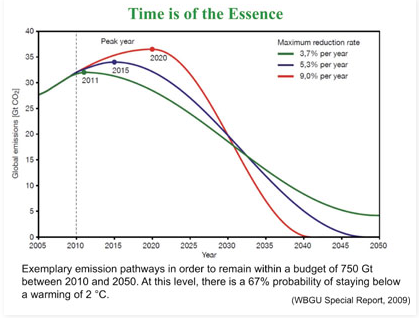
    A delay in reaching peak emissions makes the task more challenging, even for the unsafe 2-degree target. A presentation made by Hans Joachim Schellnhuber to the 4 degrees or more: Australia in a hotter world conference in Melbourne in 2011 showed that if emissions do not peak till 2020 (red line), then the maximum reduction rate is nine per cent per year. On present indications 2020 is being optimistic. Even for the 2C boundary it is four per cent a year from now.
    People will say that four, five, six per cent a year is politically impossible, just as they say holding warming to no more than 2C is all but impossible. Fatih Birol of the IAE says that “despite steps in the right direction, the door to 2C is closing”, whilst Prof Kevin Anderson says 2C is “almost impossible” to avoid. CSIRO has chimed in recently with “research over the past three years makes it increasingly clear that there is little chance of avoiding a minimum of +2C rise in average global temperatures”.
    It’s a growing sentiment, mitigated perhaps by some forlorn hope that 2C won’t be as bad as the science suggests.  On recent trends – where observations often exceed the scientific projections for rates of change – it’s likely to be worse.  
    It’s hard not to conclude that the recurring theme of “exhaustion” around parts of the climate movement is other than a psychologically displaced expression of the contradictions of climate activism: the perception that what needs to be achieved is politically impossible, and that even articulating what needs to be done is politically unacceptable.
    It is very difficult to bear contradictions without resolving the tension by dropping or denying or denigrating one side of the dilemma. That’s how the Nick Minchins of this world survive. The climate movement campaigns around what is “possible” to declare publicly, whilst knowing it is totally inadequate. Some people consequently drop out, ignore the problem or pretend life will be OK, others give up in despair and collapse into depression, while the activists go on, trying to carry the impossible tension, which is exhausting. This low point could spearhead engagement if we took the time to honestly re-assess our situation.
    For eNGOs, one big question is how much of their effort should be devoted to climate, because if curtailing warming to something manageable and then returning to a safe climate isn’t achieved, most of their other achievements and objectives will become irrelevant. (The same is true for non-environment NGOs such as the aid and welfare sectors). Without a successful safe climate strategy, they face the paradox of “unnatural conservation”
    So can the “impossible” be achieved? Perhaps the first thing is for us to imagine how that could happen, technically, economically, politically and socially. What are the scenarios? Philip Sutton and I had a bit of a go in “Climate Code Red”, as has Paul Gilding in “The Great Disruption” and others. In the UK there has been a lot of work done on carbon rationing, Beyond Zero Emissions drew a picture of transformation of the stationery energy sector at the speed and scale required, amongst many post-carbon pathway reports now published.
    What would the picture look like? The world may have to spend 10 per cent or more of global production on the task for a decade or two. The developed economies would build new energy systems for the least developed. Large amounts of fossil fuel infrastructure would be stranded, and there would be a huge effort at innovating and deploying our way to sustainability. Our economy would have to work at full capacity to replace the fossil fuel sector. Some non-essential consumption would be foregone to provide the savings and investment necessary. Neo-conservative politics and economics won’t do it. A whole-of-society effort is required, with the active consent and participation of citizens. It will be disruptive, but radically less so that the alternative of letting warming fly past 2C. People will accept big changes because they have made a conscious choice to support a plan for climate safety rather increasing, and then catastrophic, harm.
    We have got nothing to lose by developing courageous, public leadership around these ideas – politically “impossible” though they are said to be – because our present advocacy path is leading us over the cliff.  Not intentionally, but failure is the outcome, nevertheless.
    Impossible to achieve? That’s what most people say, especially those with most to lose from the dismantling of the status quo. But what we need to do is similar to the scale and speed of transformation that has been achieved already: in the war economies of the mid-20th century, and in the transformation of the Chinese and the Asian “tiger” economies, for example. 

    3.2 “Policy is an outcome of power, not a means of achieving it”

    So, if we have an emergency, and we have the tools to fight it, the only question is why we’re not doing so. And the answer, I think, is clear: it’s in the interest of some of the most powerful players on earth to prolong the status quo. Some of those players are countries, the ones with huge fossil-fuel reserves:recent research has demonstrated that the nations with the most coal, gas, and oil are the most recalcitrant in international negotiations.  And some of those players are companies: the fossil fuel industry is the most profitable enterprise in history, and it has proven more than willing to use its financial clout to block political action in the capitals that count.… We have to build movements—creative, hopeful movements that can summon our love for the planet, but also angry, realistic movements willing to point out the ultimate rip-off under way… As it happens, such movements are possible (but) they go against the power of the status quo, and hence they will be enacted only if we build movements strong enough to force them. We need politicians more afraid of voter outrage than they are of corporate retribution.— Bill McKibben, 7 June 2012

    Politics is primarily about power, and who wields it. The fossil fuel and mining industries, the big banks and the big end of town understand this well. But does our side? Reflecting on his experience in the US, Ken Ward writes

    We elevate climate policy above other avenues because we believe that it is the primary responsibility of environmentalists to craft the climate change solution. Why so? Because we think that if we hit upon just the right formula – the perfect blend of incentives, quasi-free markets trappings, tax breaks and so on – we can accomplish the political equivalent of changing lead into gold, and pass effective climate legislation without major opposition. But political power is immutable and we are not alchemists. Policy – a plan of governmental action – is an outcome of power, not a means of achieving it. We do not have enough power to win functional climate policy in the US,  and until we do so, there will be no global climate solution.

    Often in Australia, too, there is a conflation of policy with power, and access with influence. Most of the big environment and climate NGOs (ACF, WWF, Climate Institute, ClimateWorks, for example) spend most of their budgets on research, policy, gaining political access, and communications, but little or nothing on actively engaging and organising communities to consistently build serious political power. Changing public perceptions via communications strategies is about as far as people power gets.  Many treat even their own supporters and donors in a passive manner, with requests to send-an-email-there, or donate-here. Contrast that with the mobilisation of communities on coal seam gas, and the political power they have built.
    Some eNGOs, notably Greenpeace and many of the state and regionally-based organisations, have a different model.
    Perhaps many of the big eNGOs recognize the value of community mobilisation but see it as other people’s work, imaging a division of labour where they do the clever policy and lobbying work, whilst the unpaid activists in the grassroots community organisations do the hard slog of door-knocking and street-by-street organising? A bit like the lords in the castle and the serfs in the field.
    What you can achieve is a function of the power you have. At the moment what seems achievable is small compared to the task at hand. But do we ignore the big picture? Surely we must constantly advocate it so that understanding and support grows, even as we also campaign for particular objectives that are more immediately within our grasp? This is what BZE has done by proposing technical solutions that fit the urgency imperative.  Greenpeace’s campaign on coal in Queensland also has a wide political horizon. Many eNGOs have confined themselves to the immediately possible and denied themselves the opportunity to broaden the narrative to the big and the bold and the necessary. I don’t know, but I guess they think that the big picture is not possible.
    Schematically we know that a very rapid transition is necessary, but in conditions of vibrant democracy. Most people can’t picture this, and hope that some super-human force will swoop down and save us. In the business community, for example, that hopefulness is most often expressed in the view that human ingenuity, innovation and engineering will solve the problem (technological determinism).
    Nothing short of action that will of necessity over-turn the current economic paradigm can achieve the change on the timescale we need. For all the nose-wrinkling about such terms as emergency, great disruption, transition plan, war economy, rapid transition, and so on, I have yet to see any other set of propositions about how change might be achieved very fast. It’s a question that is mostly ignored.
    If rapid transition is the “big” picture, at the next (second) level down of specificity, we know that means replacing the fossil fuel industry with a new, sustainable economy based on renewable energy. And at next (third) level down in specificity, that means stopping this new mine or CSG project, eliminating that dirty subsidy, closing this dirty power station with renewable energy and energy efficiency, providing institutional and regulatory and budgetary support for that particular project, and so on.  What is surprising is that many people want to campaign and engage on the second – and particularly the third tiers – but studiously avoid the first. The reason as to why needs to be understood.

    3.3 Unity of action

    “I came back from the Copenhagen climate talks depressed for several reasons, but above all because, listening to the discussions at the citizens’ summit, it struck me that we no longer have movements; we have thousands of people each clamouring to have their own visions adopted. We might come together for occasional rallies and marches,but as soon as we start discussing alternatives, solidarity is shattered by possessive individualism. Consumerism has changed all of us. Our challenge is now to fight a system we have internalised.”— George Monbiot, “After this 60-year feeding frenzy, Earth itself has become disposable”, Guardian, 4 January 2010

    There is a large literature on movement building, and many successful models of engagement, such as Bill Moyer’s Movement Action Plan. Some characteristics include being honest about your political situation and about the balance of forces, and being clear and concrete about what you wish to achieve. Unity in action of all possible forces is a key to maximising mobilisation around common goals, as is clear, consistent and non-complex communication. Within that unity, the most important drivers of engagement are democratic processes and ensuring a diversity of empowering grassroots structures. Obstacles include putting form before content (organisation before politics), confusing the relationship between policy and power, and tactical inflexibility.
    In this light, the performance of the current climate action movement (both grassroots and NGOs) is a very mixed bag. 
    Many eNGOs are essentially undemocratic in form, and have little or no commitment to community organising. If they do, it’s often top-down management. Too often form becomes before content, with too much behaviour driven by marketing and branding imperatives. Too many campaigns are driven by a particular organisation, with insufficient attention paid to the need for  coordination and united action. The interests of the part dominate the interests of the whole.  Some of the problems facing local grassroots community groups have been discussed in section 2. Grassroots groups have often struggled to maintain momentum, coordination and capacity, so we need to better learn what are sustainable forms of local organising on climate.
    When confronted with John Howard’s repressive Work Choices industrial relations laws, trade unions and trade unionists united effectively in the “Your Rights at Work” campaign. Resources and organisers were deployed in they field in scores of marginal seats and real, local grassroots work was done outside of the regular structures. Power was built that was instrumental in defeating the Howard government in 2007. 
    Nothing like this has been attempted in the climate sphere. The big groups have large supporter and donor lists that they guard with their lives. Maybe that’s their survival.  Combine them or co-ordinate them, just once, to get some real momentum behind a community organising effort in a politically significant locality?  That was exactly the proposition put to a number of big groups in preparation for some campaigning in Melbourne’s inner north in 2010, and the answer was a big “no” just about all round. GetUp has had a go at getting local meetings of its supporters and activists. Can this be done on a bigger scale, with both the big and smaller NGOs and local activists involved, around some clear and concrete and principled objectives? Can the object be to build local capacity so that real political power can be mobilised in support of strong climate action? While the need is great, it’s hard to see that such a project has even been seriously attempted.

    3.4 What to do?

    Most of this blog was drafted in May 2012. Then came “what to do?” and the project came to a screeching halt. What could I say that wasn’t either obvious or trivial, or dismissed as impractical or idealist? Great work is being done on coal seam gas, and on the expanding coal export industry. Our efforts have stopped some new fossil fuel investments, others are teetering, and Contracts for Closure of some of Australia’s dirtiest power stations is still alive. Solar PV is on a trajectory few predicted a few years ago, and there is a wave of action for community wind and solar. Energy efficiency and rooftop PV have skewered wholesale prices for coal power. Yet for all that, we are going backwards, with Australia’s effective emissions set to grow, as are those of the rest of the world. So what could be done better? 

    1. Tell the big story, set out to fully solve the problem. If we don’t start doing this consistently (if at first only amongst ourselves) how can we understand, advocate and mobilise for action and strategies that will stop us falling over the cliff? Global warming and the bigger picture need to be explicitly used as a justification for campaigns in favour of renewable energy and against CSG and coal. There are numerous examples of campaigns which don’t mention climate at all. The best feature of the work of BZE is research and public education around actions consistent in speed and scale with the scientific imperatives (section 3.1) For all their limitations, Climate Code Red and The Great Disruption tried to paint big picture scenarios. We need to paint more of them. How else can we overcome the cognitive dissonance where the real challenge we face is excluded from discourse? (section 1.8

    2. Courageous, consistent public leadership for a safe climate. In the public affairs debate on refugees, for example, its easy to identify prominent figures, activists, lawyers and organisations who have taken a strong, consistent stand such as Malcolm Fraser, David Manne, David Marr, The Greens, Refugee Action Collective who regularly blitz the media. The same cannot be said of climate.  It’s a good example of the failure of the climate action movement in toto to take responsibility for the whole, making sure that all the basic functions and operations of a public campaign are covered and coordinated. It’s not rocket science, and it would not take a lot of time and resources to network and provide capacity to develop courageous, consistent public leadership for a safe climate.

    3. Power before policy. In reality policy outcomes are never about the elegance of a solution, but about power. As Bill McKibben makes clear, this is a struggle (to the death) between some of the most powerful players (both nations and industries) on earth who aim to prolong the status quo, and “hopeful movements that can summon our love for the planet, but also angry, realistic movements willing to point out the ultimate rip-off under way…”.  At ABC Unleashed on 28 June 2012, Tim Dunlop wrote: “The idea that knowledge is power is a cliche in our modern, democratic age. We believe almost reflexively that if only we could tell people the truth – share our knowledge of proven facts – our argument will prevail… As should be obvious, the efficacy of this belief is misplaced. Day after day, as those examples reveal, power trumps knowledge… No-one knows this better than the powerful themselves.”  (Section 3.2) Lobbying is meaningless unless the one lobbied believes there will be real political consequence from them failing to act.

    4. Common goals. Diversity is crucial and inherent to successful movements, but movements that are divided generally fail. We need to wrestle with this paradox if we are to achieve our aims. This experience should highlight the importance of developing a common set of concrete goals for the climate movement and a positive, united agenda. This platform cannot simply be set in the abstract, or necessarily a long period in advance, but must be developed dynamically in the “real world” with consideration to the evolving nature, politics and capabilities of the various forces in the movement

    5. Local mobilisation, united action. The fact is that we don’t have the power we need to win;  the emperor has no clothes (section 1.5). And the grassroots climate movement will not be able to build quickly enough without the support of the big eNGOs. Mobilisation starts in local communities (Lock the Gate), face-to-face, door-to-door, arm-in-arm. Building unity in action from such a beginning, with common goals, consistent messages, unified organising and tactical adroitness has been a feature of many struggles. There is no reason why it should not be the case with climate (Section 3.3). Mobilising to get Labor elected is not enough (section 2.2). The Replace Hazelwood campaign in Victoria, which forced a Labor government to turn round its climate policies, is a glimpse as to what some consistency, coordination and community engagement can do.

    6. Connecting to conservatives voters. “All the lines of evidence show that framing climate change as an environmental threat is obsolete when talking to conservatives. We need a frame that can reach across the divide of world-views and speak to common values. That frame is climate change as a threat to health, well-being and livelihood. It is a frame that projects our movement as the preservers and protectors of life: yours, your family’s, your community’s, your country’s. It is a frame that says – in this ever-changing world, a world of threats that seem insurmountable – that you, everyone, have a role to play in making it safe again, bringing security, bequeathing certainty.” (Section 1.2)

    7. Simple, consistent messages. There is now a vast array of communications, messages and stories being told about climate change, often in contradictory and complicated ways. But the history of social movements, advertising and modern political communications teaches us that what gets through to the population at large is much more limited. We need some simple messages that correspond with our goals, and that we repeat ad nauseam, if we are to have an effect on public opinion. To paraphrase Frank Luntz, the conservative pollster who coined the phrase “climate change” as a way of countering the frame of “global warming”, it is about repetition, repetition, repetition.

    8. Making climate an issue about now, not the future.Connecting the dots between extreme weather and climate change is really important. Over and again, increasing awareness of extreme weather – as a preview or window into the future climate — is turning around public opinion. As this is being written, there is another story from the US that “Record Heat Wave Pushes U.S. Belief in Climate Change to 70%”. Connecting the dots makes the climate story about people’s lived experience of extreme events, not about places and species distant in space and time. It connects to concerns about family and children and grandchildren, and how extremes will affect daily life: food security, water security, how and where we will be able to live.  It is also a means of driving more media coverage and helping to mitigate the partisanship which characterises the issue today (section 2.1)

    9. Honesty about out task. Brightsiding climate advocacy by refusing to engage people about how climate change will impact their lives – and instead telling only happy-clappy stories about “clean energy futures” – has been a disaster. Brightsiding in Australia has had the effect of taking climate impacts OFF the agenda  (section 1.3).  We can’t just sell people an unrelentingly smiley vision of how it will be, if that is not the path we will actually have to take to sustain a rapid transition. Effective engagement requires honesty about the problem; a positive vision of the solution; and an efficacious path that mobilises and engages people and communities. All three elements are essential.

    10. Flexibility and opportunity. The movement in Australia by and large missed the opportunity to “connect the dots” between extreme weather and climate change (record heat, fires, rains, floods).  Will we be ready next time, or have strategic plans become too inflexible? In a few weeks (around 9 September), the summer area of Arctic sea-ice may reach a new record low, as the sea-ice continues its death spiral on the path to creating an ice-free Arctic summer period. Are we really ready to tell this story for all it is worth?  There is a good chance that another GFC will hit sooner rather than late: what implications does that have for campaigning?  What if Rudd replaces Gillard and does a deal with the NSW Labor Right who put him there to jump the carbon price to a low floor price? Within a year, federal and most state government may be run by climate-denying conservatives, and the only field of politics readily open to us will be at the local government level, so what would that mean for campaigning? We can’t do everything, so what is strategically important, what are the game changers? Are endless carbon-intensive trips to futile international meetings a priority or an indulgence and a distraction? How do environment groups resolve the “unnatural conservation” paradox? 

    More questions than answers, that’s as far as I could get.

    My thanks to the many people who read, commented on and provided valuable insights which have been incorporated into the text. – David

    You are subscribed to email updates from climate code red
    To stop receiving these emails, you mayunsubscribe now.
    Email delivery powered by Google
    Google Inc., 20 West Kinzie, Chicago IL USA 60610
    Click here to Reply or Forward
    Ads – Why this ad?
    See How The Household Assistance Package Will Help Australians.
    0% full
    Using 0 GB of your 10 GB
    ©2012 G
  • Premiers cry poor ahead of disability scheme talks

    Premiers cry poor ahead of disability scheme talks

    Updated July 24, 2012 15:50:44

    The Prime Minister’s plan for a national disability insurance scheme (NDIS) co-funded by all states and territories is on shaky ground.

    Queensland Premier Campbell Newman is demanding his state be granted a trial site for the scheme but maintains his government cannot afford to contribute one cent of funding.

    State and territory leaders are arriving in Canberra for a Council of Australian Governments (COAG) meeting tomorrow.

    Julia Gillard says there is an expectation all governments will contribute to the scheme.

    “We’ve got $1 billion on the table to get launch sites in operation, making a difference for people and teaching us lessons about the full rollout of the scheme,” she said.

    “I will be putting the case very strongly to my state and territory colleagues that this is a shared task, a shared responsibility and we’ve got to get it done.”

    While Mr Newman reaffirmed his support for the NDIS, he said the Commonwealth must pay for it.

    He says Queensland risked becoming “the Spain of Australia” if it funded projects like the NDIS.

    “We’re prepared to support the program, we’re prepared to support a trial site in Gympie, but (the Commonwealth) must fund it and that’s what the Productivity Commission said,” Mr Newman said.

    “Frankly, Queenslanders are sick and tired of the Prime Minister putting her hand in their pockets, particularly with things like the carbon tax but also with the mining tax.

    “It’s take take take. What do we want to see? Some give, give, give.

    “If we had the money it might be a different matter, but we do not have the money right now.”

    South Australian Premier Jay Weatherill says Government cannot increase its contribution to the NDIS.

    Mr Weatherill says South Australia has budgeted for a substantial contribution and he is hopeful that will be enough.

    “Part of that was putting our $20 million on the table to fund a trial or launch site for the NDIS and we’re committed to that, but we don’t have the budget capacity to go further at this time.”

    Opposition frontbencher Christopher Pyne says the Federal Government has short-changed people with disabilities by failing to provide adequate funding.

    He says the states should be asking why the Commonwealth has under-funded the scheme.

    “The Productivity Commission talked about several billion dollars being necessary to kick-start the disability insurance scheme,” he said.

    “This Government under-funded that in the budget and discounted what was necessary by $2.9 billion, so the Government’s already let Australians with a disability down.”

    Topics:health, disabilities, federal-government, states-and-territories, australia, qld, sa

    First posted July 24, 2012 14:55:10