Category: General news

Managing director of Ebono Institute and major sponsor of The Generator, Geoff Ebbs, is running against Kevin Rudd in the seat of Griffith at the next Federal election. By the expression on their faces in this candid shot it looks like a pretty dull campaign. Read on

  • NASA Science News for June 20, 2012

    NASA Science News for June 20, 2012

    According to data from NASA’s Lunar Reconnaissance Orbiter, ice may make up as much as 22 percent of the surface material in Shackleton crater at the Moon’s south pole.

    FULL STORY: http://science.nasa.gov/science-news/science-at-nasa/2012/20jun_shackleton/

  • North West Rail Link an all out insult to those in the Hills

    North West Rail Link an all out insult to those in the Hills

    0
    $7 billion North West Rail Link

    The proposed alignment of the $7 billion North West Rail Link, revealed in NSW Transport tender documents obtained by the Daily Telegraph. The documents are dated May 13, 2011.Source: The Daily Telegraph

    Chanele Moss

    Commuter Chanele Moss at the bus stops outside QVB on George Street / Pic: Adam Ward Source: The Daily Telegraph

    THE North West Rail Link will now end at Chatswood – where passengers will have to change from a single-deck train to a double-deck train to get into the city.

    The shock announcement was made by Premier Barry O’Farrell and Transport Minister Gladys Berejiklian yesterday, as they presented a “20-year rail plan” for Sydney, involving the “metrofication” of the city’s rail network.

    Under the plan, the government said the $8.5 billion North West Rail Link – which will now be a Rouse Hill to Chatswood line – would be privately built and operated.

    Single-deck trains for North West

    Trains on the current Epping to Chatswood line would change to single deck.

    The pair also announced the government would eventually build a second Sydney Harbour rail crossing, allowing single deck rapid-transit “metro” services from Chatswood to Redfern and then out to Hurstville and Cabramatta.

    The rest of the carriages on the rail network would remain double decker.

    But the Transport Minister admitted she could not put a price on the second Harbour crossing, which some have said could cost up to $10 billion.

    “If I stand accused of not giving a figure on that, I’m quite happy to stand accused on that point,” she said.

    “When I have done sufficient homework on what it will cost, I will tell you.”

    The second Harbour crossing announcement was immediately undermined by Infrastructure NSW tsar Nick Greiner: “A second Harbour crossing is very, very expensive and might well not be necessary and will be a very, very long time in the future.”

    Mr Greiner confirmed, however, that Infrastructure NSW had lobbied hard for the change from double-decker trains into the city to a single deck northwest private line which ends at Chatswood.

    “We think the government has made fantastic progress in coming from its original plan to that one,” Mr Greiner said.

    “It’s far and away the best thing for the rail network.”

    Opposition Leader John Robertson accused the government of its biggest broken promise since the election – not providing direct services from Rouse Hill to the city.

    “What the people of the northwest are going to get is a shuttle service,” Mr Robertson said.


    Ms Berejiklian said the decision to build an independent metro service was influenced by submissions from industry experts and the community.

    “I assumed when I became Transport Minister that double decks were the way to go but expert advice, community input, industry input … and also looking at what happens around the world (changed my mind),” she said.

    “We are the only major city in the world that has solely double deckers. If you want to increase services … and get more people catching transport … you have to make this huge change.”

    Quizzed on whether commuters would be left stranded at Chatswood because of overcrowded trains, Ms Berejiklian said a timetable rewrite would increase services between Chatswood and the CBD from 16 to 20 an hour.

    The Premier said a new “rapid transit” metro system – in which northwest trains would run every three to five minutes – was what commuters wanted and they would be able to simply “walk across the platform” to the city-bound train.

    Former premier Morris Iemma, who proposed a $12 billion northwest metro line in 2008, yesterday predicted that, when the government went to tender, the private sector would suggest a direct metro line to run from the northwest to the city.


    15 comments on this story

  • Reputation of Shooters Party MP Robert Brown cops a beating

    Reputation of Shooters Party MP Robert Brown cops a beating

    1
    Robert Brown

    Lost his temper … Shooters party MP Robert Brown. Source: The Daily Telegraph

    A SHOOTERS MP said it was “unfortunate” he couldn’t take a rival MP “outside and beat you to death” as debate on shooting in national parks turned nasty.

    Greens MP Jeremy Buckingham yesterday accused the Game Council of taking millions in kickbacks over the bill to allow recreational hunters into national parks.

    An angry Shooters MP Robert Brown fired back: “I don’t have a thin skin but when a guy looks at you and points at you and says on to the record in this house they took $1 million kickback, to me that is impugning my reputation, mate. You either withdraw it here.

    “Unfortunately we’re in a modern era so I can’t take you outside and beat you to death.”

    Mr Buckingham withdrew his comment, but Greens colleague Cate Faehrmann demanded Mr Brown do the same. The Shooters Party MP apologised for the threat, saying: “I lost my temper.”

    “I’m sorry for what I said Jeremy.”

    Mr Buckingham said it was the second time he had received a death threat from the Shooters Party over the course of debate on the national parks bill.

  • Green News Round-up (The Guardian)

    Green news roundup: Name a species, James Lovelock and Rio+20

    The week’s top environment news stories and green events

    If you’re not already receiving this roundup, sign up here to get the briefing delivered to your inbox

    Name a species

    Name a species. Photograph: Natural England

    Name a Species competition

    Your chance to name a species
    Help us popularise 10 more British species by giving them a colourful common name

    Rio+20

    An indigenous man at a ceremony during the Rio+20 summit.

    Q&A: Rio+20 Earth summit
    Rio+20: Earth summit dawns with stormier clouds than in 1992
    Rio+20 negotiators accused of strong-arm tactics
    Rio+20 People’s summit gathers pace
    Ban Ki-moon: the momentum for change at Rio+20 is irreversible

    Environment news

    a traditional medicine shop selling grinding rhino horns  in downtown Hanoi

    Activists hail success of Twitter storm against fossil fuel subsidies
    Prince William condemns rhino horn trade
    Environmental activists ‘being killed at rate of one a week’
    George Osborne a ‘bloody idiot’ on wildlife protection
    Carbon capture project is a big risk, says SSE boss

    On the blogs

    environmental scientist James Lovelock

    Green-o-meter: Is the government keeping its green promises?
    Campaigners demand an end to $1tn fossil fuel subsidies
    James Lovelock on shale gas and the problem with ‘greens’
    Are you at Rio+20? Share your photos on our Flickr group

    Multimedia

    Rio+20 People’s summit – in pictures
    The week in wildlife – in pictures
    Lily Cole visits the Ghanaian producers of The Body Shop’s shea butter
    Satish Kumar on the future of the Resurgence and Ecologist magazines – video

    Features and comment

    James Lovelock: The UK should be going mad for fracking
    Ethical living: should vegans avoid eating honey?
    Village that defied Heathrow is slowly dying as BAA buys up homes

    …And finally

    Google Maps to feature canals and rivers
    Google begins process of mapping towpaths in England and Wales, so its Maps users can plan journeys that include waterways

    • SKY_Small_Business_Network
    • Button_Charity_Awards_2012
    • Email Services


    You are receiving this email because you are a Green Light subscriber.

    Click here if you do not wish to receive Green Light emails from the Guardian News and Media.
    Click here to find out about other Email Services from the Guardian.

    Guardian News & Media Limited – a member of Guardian Media Group PLC. Registered Office: Kings Place, 90 York Way, London, N1 9GU. Registered in England No. 908396

  • Environmental activists ‘being killed at rate of one a week’

    Environmental activists ‘being killed at rate of one a week’

    Death toll of campaigners involved in protection of forests, rivers and land has almost doubled in three years

    environment-activist-deaths

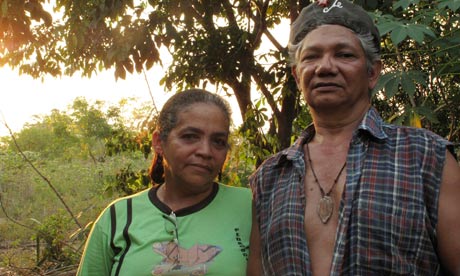
    Amazon rainforest activists José Cláudio Ribeiro da Silva and Maria do Espirito Santo, who were murdered last year. Photograph: Reuters

    The struggle for the world’s remaining natural resources is becoming more murderous, according to a new report that reveals that environmental activists were killed at the rate of one a week in 2011.

    The death toll of campaigners, community leaders and journalists involved in the protection of forests, rivers and land has risen dramatically in the past three years, said Global Witness.

    Brazil – the host of the Rio+20 conference on sustainable development – has the worst record for danger in a decade that has seen the deaths of more than 365 defenders, said the briefing, which was released on the eve of the high-level segment of the Earth Summit.

    The group called on the leaders at Rio to set up systems to monitor and counter the rising violence, which in many cases involves governments and foreign corporations, and to reduce the consumption pressures that are driving development into remote areas.

    “This trend points to the increasingly fierce global battle for resources, and represents the sharpest of wake-up calls for delegates in Rio,” said Billy Kyte, campaigner at Global Witness.

    The group acknowledges that their results are incomplete and skewed towards certain countries because information is fragmented and often missing. This means the toll is likely to be higher than their findings, which did not include deaths related to cross-border conflicts prompted by competition for natural resources, and fighting over gas and oil.

    Brazil recorded almost half of the killings worldwide, the majority of which were connected to illegal forest clearance by loggers and farmers in the Amazon and other remote areas, often described as the “wild west”.

    Among the recent high-profile cases were the murders last year of two high-profile Amazon activists, José Cláudio Ribeiro da Silva and Maria do Espirito Santo. Such are the risks that dozens of other activists and informers are now under state protection.

    Unlike most countries on the list, however, the number of killings in Brazil declined slightly last year, perhaps because the government is making a greater effort to intervene in deforestation cases.

    The reverse trend is apparent in the Philippines, where four activists were killed last month, prompting the Kalikasan People’s Network for Environment to talk of “bloody May”.

    Though Brazil, Peru and Colombia have reported high rates of killing in the past 10 years, this is partly because they are relatively transparent about the problem thanks to strong civil society groups, media organisations and church groups – notably the Catholic Land Commission in Brazil – which can monitor such crimes. Under-reporting is thought likely in China and Central Asia, which have more closed systems, said the report. The full picture has still to emerge.

    Last December, the UN special rapporteur on human rights noted: “Defenders working on land and environmental issues in connection with extractive industries and construction and development projects in the Americas … face the highest risk of death as result of their human rights activities.”

    19 June 2012 update: The number of deaths in Brazil was wrongly cited as 737 – this has been corrected to 365. The headline and opening line of this story have been changed to reflect that.

  • Cleveland Volcano eruption sends ash up to 35000 feet

    Cleveland Volcano eruption sends ash up to 35000 feet
    Anchorage Daily News
    A volcano on an uninhabited Aleutian island erupted Tuesday afternoon, sending ash thousands of feet into the air, according to the Alaska Volcano
    See all stories on this topic »
    Alert level raised for remote Alaska volcano
    The Olympian
    The alert level for a remote Alaska volcano has been raised after an apparent ash-producing explosion Tuesday afternoon.
    See all stories on this topic »