Category: General news

Managing director of Ebono Institute and major sponsor of The Generator, Geoff Ebbs, is running against Kevin Rudd in the seat of Griffith at the next Federal election. By the expression on their faces in this candid shot it looks like a pretty dull campaign. Read on

  • Bonn climate talks end in discord and disappointment

    Bonn climate talks end in discord and disappointment

    Climate crisis is not caused by lack of options and solutions, but lack of political action, says Greenpeace spokeswoman

    • guardian.co.uk, Friday 25 May 2012 17.51 BST
    • 2012 Bonn climate talks , Christiana Figueres, Executive Secretary of UNFCCC

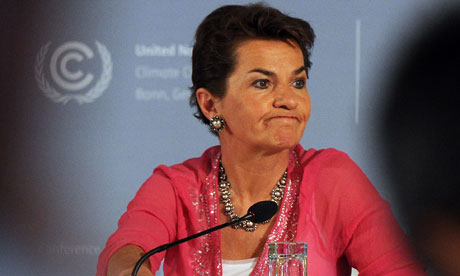
      Christiana Figueres, Executive Secretary of the UN Framework Convention on Climate Change (UNFCCC), gives a press conference on May 25, 2012, at the end of a UN climate conference in Bonn, western Germany. Photograph: Henning Kaiser/AFP/Getty Images

      The latest round of international climate change talks finished on Friday in discord and disappointment, with some participants concerned that important progress made last year was being unpicked.

      At the talks, countries were supposed to set out a workplan on negotiations that should result in a new global climate treaty, to be drafted by the end of 2015 and to come into force in 2020. But participants told the Guardian they were downbeat, disappointed and frustrated that the decision to work on a new treaty – reached after marathon late-running talks last December in Durban – was being questioned.

      China and India, both rapidly growing economies with an increasing share of global emissions, have tried to delay talks on such a treaty. Instead of a workplan for the next three years to achieve the objective of a new pact, governments have only managed to draw up a partial agenda. “It’s incredibly frustrating to have achieved so little,” said one developed country participant. “We’re stepping backwards, not forwards.”

      Connie Hedegaard, the EU climate chief, said: “The world cannot afford that a few want to backtrack from what was agreed in Durban only five months ago. Durban was – and is – a delicately balanced package where all elements must be delivered at the same pace. It is not a pick and choose menu. It is very worrisome that attempts to backtrack have been so obvious and time-consuming in the Bonn talks over the last two weeks.”

      There was also little progress on the key issue of the financing by rich countries of actions in the developing world. Meeting in Bonn, negotiators and officials from around the world haggled over the set-up of a ‘Green Climate Fund‘ that would channel cash from the developed world to poorer countries, to help them cut greenhouse gas emissions and cope with the effects of climate change.

      However, they agreed much of the detail that will be needed to extend the Kyoto protocol – currently the world’s only legally binding treaty on emissions cuts – beyond 2012 when its current provisions expire. That extension should be finalised at a conference in Doha, Qatar, this November – but may not be if the EU does not see sufficient progress in negotiations on the proposed new post-2020 treaty.

      Chrisiana Figueres, the top climate change official at the United Nations, who presided over the two weeks of talks, said: “Work at this session has been productive. Countries can now press on to ensure elements are in place to adopt the Doha amendment to the Kyoto protocol. I am pleased to say that the Bonn meeting produced more clarity on the protocols’s technical and legal details and options to enable a smooth transition between the two commitment periods of the protocol.”

      However, the only major developed countries that have agreed to continue the Kyoto protocol are those of the European Union. Canada and Japan have dropped out, and the US never ratified the 1997 accord.

      The fortnight-long talks in Bonn followed an unexpected last-ditch agreement in December at a meeting in Durban, when countries resolved to spend the next three to four years thrashing out the terms of a new global treaty on climate change and emissions cuts, which would come into force from 2020. Such a treaty would follow on from the Kyoto protocol and from the Copenhagen pledges made at a 2009 summit, in which both developed and developing countries agreed for the first time jointly to curb emissions by 2020. Those pledges do not have the legal force of a full treaty, however, and have been shown in a variety of studies to be inadequate to stave off dangerous levels of climate change.

      One of the main tasks for the fortnight-long meeting in Bonn was to flesh out a programme of work towards a new post-2020 treaty. That has been partially achieved, but participants said more needed to be done to draft a clear negotiating timetable. The last major international treaty on the climate that had full legal force – the Kyoto protocol – took five years to negotiate, so the current round of talks will be on a tight deadline if they are to finish in a fully drafted agreement by the end of 2015, as planned.

      Countries also discussed at Bonn whether they should try to cut emissions faster than currently planned within the next eight years. That question will be discussed further in the November talks. Green groups were pleased that the possibility of strengthening the 2020 targets was still on the table. However, some participants worried that it could prove a distraction to the difficult task of crafting a whole new post-2020 treaty by 2015.

      Celine Charveriat, advocacy and campaigns director at Oxfam, said: “No progress was made to deliver the financial support that the world’s poorest and most vulnerable need to deal with the growing impacts of climate change. It is now vital that, at the next UN climate summit in Qatar in November, rich countries commit to an initial US$10-15bn to the Green Climate Fund between 2013 and 2015, as part of a broader financial package.

      “At a time when ambitious emission reductions are more urgent than ever, developed countries in Bonn made no progress to close the gap between current climate targets and what is required to avoid the worst of climate change. Developed countries must improve on their current low level of ambition and accept higher reduction targets no later than at the Qatar summit.”

      Tove Maria Ryding, coordinator for climate policy at Greenpeace International, said: “Here in Bonn we’ve clearly seen that the climate crisis is not caused by lack of options and solutions, but lack of political action. It’s absurd to watch governments sit and point fingers and fight like little kids while the scientists explain about the terrifying impacts of climate change and the fact that we have all the technology we need to solve the problem while creating new green jobs.”

  • Corrupting influences: does Australia need a National Integrity Commissioner?

    25 May 2012, 1.33pm AEST

    Corrupting influences: does Australia need a National Integrity Commissioner?

    The Australian Greens have proposed the introduction of a National Integrity Commission to provide an anti-corruption body operating at the federal level. Earlier this week, Greens MP Adam Bandt announced the decision to bring forward legislation to create such a body, stating, “Anti-corruption bodies…

    Author

    Disclosure Statement

    Mike Pottenger does not work for, consult to, own shares in or receive funding from any company or organisation that would benefit from this article, and has no relevant affiliations.

    The Conversation provides independent analysis and commentary from academics and researchers.

    Founding and Strategic Partners are CSIRO, Melbourne, Monash, RMIT, UTS and UWA. Members are Deakin, Flinders, Murdoch, QUT, Swinburne, UniSA, UTAS, and VU.

    Articles by This Author

    5 April 2012 Good cop, bad cop: how corrupt police work with drug dealers

    Wv4sfbxk-1337748426 Now jailed former assistant director of the New South Wales Crime Commission Mark Standen is a key example of how corruption operates in Australia. AAP Image/Tracey Nearmy

    The Australian Greens have proposed the introduction of a National Integrity Commission to provide an anti-corruption body operating at the federal level.

    Earlier this week, Greens MP Adam Bandt announced the decision to bring forward legislation to create such a body, stating, “Anti-corruption bodies exist in most of the states but there is nothing at a Federal level, so action on an Integrity Commissioner is long overdue.”

    The National Integrity Commissioner Bill 2010 would establish a national anti-corruption body charged with overseeing public officials and Commonwealth agencies, with powers based on the existing Law Enforcement Integrity Commissioner which currently covers the Australian Federal Police, Crime Commission and Customs.

    The bill would broadly empower an National Integrity Commssioner to investigate alleged corrupt activity of “a minister, a parliamentarian, a former parliamentarian, a Commonwealth agency, an employee of a Commonwealth agency or a person employed under the Members of Parliament (Staff) Act 1984 or any other public official.”

    How would it work?

    The goal is laudable, and raises for discussion the important question of how best to design such an organisation, and the possible benefits and disadvantages that can come with different designs.

    A consistent national approach is intuitively appealing, with practical advantages. A lack of integrated laws can be exploited to the advantage of corrupt officials or organised criminals.

    For example, dealing with organisations that span the country is not made any simpler by having different laws on motorcycle gangs in different states of Australia.

    Attempts to combat bikie gangs can be complicated by different state laws. AAP Image/Dean Lewins

    And when one state creates tougher legislation (such as South Australia’s introduction of the Serious and Organised Crime (Control) Act 2008%20ACT%202008.aspx), there is an incentive for other states to follow suit, even if the legislation runs the risk of being difficult to enforce. In trying to deal with the crime of corruption, then, Australia might do well to develop a common national approach.

    Overlapping jurisdictions

    The appeal of such a body, however, will need to be tempered by considering the problematic questions surrounding its possible scope and powers, and the risk that the body might become corrupted by the very thing it is created to fight.

    The nature of this problem can be observed in the context of arguments about the suitability and capability of organisations such Victoria’s Office of Police Integrity.

    Consideration needs to be given to whether such a national body might ultimately replace the need for state-based commissions and, if not, how the possibly overlapping jurisdictions might interact. Even if the National Integrity Commission is tasked to investigate only those in federal authorities, and the state commissions are restricted to investigating individuals in state organisations, corrupt activity can easily cross such a theoretical distinction.

    So even if clear jurisdictional boundaries are hammered out, in practice there is likely to be some overlap between investigations conducted by a national body and existing state organisations. In such cases there are likely to be problems similar to concerns about information sharing between state police forces and the Australian Federal Police when conducting sensitive investigations.

    Playing politics

    To the extent that any jurisdictional overlap requires the input of the states, reaching a consensus a national approach may be additionally complicated by the politics of state-federal relations.

    The easiest way to explain the need for a national commission is to demonstrate the nature of the problem. But when the threat or incidence of corruption is mentioned, state governments have an incentive to reiterate their confidence in the mechanisms already in place in their state (and state opposition parties have an incentive to carp about those same mechanisms being inefficient). It’s called politics.

    Witness Andrew McIntosh, a minister in the Victorian Baillieu Government, who while in opposition felt that the problem of police corruption in Victoria was serious enough to warrant major changes to the Office of Police Integrity. But in March of 2012, in response to criticism of the limited powers and scope of the Baillieu Government’s proposed Independent Broad-based Anti-corruption Commission (IBAC), Mcintosh responded that, “Unlike NSW, unlike Queensland, unlike WA, which did have a serious problem in relation to corruption… in this state we don’t have that particular problem.”

    Major criminals like Carl Williams managed to corrupt police in Victoria, leading to establishment of bodies like the OPI. AAP/Julian Smith

    Great power, great responsibility

    Corruption is not just a persistent problem, it is one with a tendency to spread if left unchecked. This is just one reason why it was disappointing to hear McIntosh’s statement earlier this year.

    Regardless of whether the problem of corruption in a state is considered serious or not, unless vigilantly kept in check it will grow. It can rapidly evolve from small-scale unrelated acts of misconduct, to minor cooperative acts of corruption, to large-scale systematic corrupt behaviour within an organisation.

    As a result, there are many tough questions and few easy solutions when trying to create a new authority to oversee the problem. Corrupt activities tend to spread from public officials across institutional boundaries to involve private individuals.

    This highlights one of the problems restricting the Victorian Office of Police Integrity’s investigations, for example; having to constrain the scope of investigations to police officers, excluding politicians or organised criminals.

    Any discussion of a federal anti-corruption commission like that proposed by the Greens will need to carefully weigh how much power and scope to give such bodies.

    Who watches the watchmen?

    The question of how much power to give such bodies is not just a matter of their effectiveness in investigating the problem they are tasked with.

    Elinor Ostrom, a political scientist with a Nobel prize in economics, distinguishes between “first order social dilemmas” – fundamental problems that require rules to solve them – and the “second order social dilemmas” – the problems involved with establishing the rules themselves.

    The particularly nasty problem with the latter of these dilemmas is what political scientists and institutional theorists refer to as the “paradox of power”. The paradox is this: how can an organisation be granted sufficient powers to protect people from the threat at hand, while still being constrained from becoming a threat itself?

    Legendary “Untouchable” Elliott Ness: the Hollywood template for an anti-corruption officer. United States Government

    Put more simply – who will police the police? Consider Mark Standen, former Assistant Director of the NSW Crime Commission (a body with wide-ranging powers to investigate organised crime), and his conviction for his corrupt involvement in the planned importation of large quantities of pseudoephedrine (the very kind of criminal activity he was meant to police).

    The creation of a higher standing authority cannot solve the paradox of power – only elevate it to the next level. A National Integrity Commission like that proposed by the Greens to watch over public officials and Commonwealth agencies will ultimately need someone to watch over it as well.

    In trying to solve the paradox of power as it pertains to a body like the National Crime Commission (one of the bodies to be overseen by the NIC) by creating a new, encompassing investigative institution we must be careful not to fall victim to a kind of reverse matryoshka doll approach, where each collection of smaller bodies is swallowed up by an continuing series of larger ones.

    The Australian Greens’ proposal will hopefully put on the table a discussion not only about the possible benefits of a national, unified corruption watchdog, but also the problems involved in ensuring it is neither toothless nor easily corrupted itself.

    In planning a response to the slow-burning but ultimately persistent and serious problem of corruption, we would be well advised to remember that whatever form a national anti-corruption body might take, a new overarching authority should not be considered the end of the fight.

    Comments (4

  • Gillards response to 1700 foreign workers deal

    As Australians lose jobs, Gina Rinehart imports 1700 foreign workers

    0
    Frank Krause

    Frank Krause and Colin Jones are being laid off at the hydro aluminium plant in Kurri Kurri / Pic: James Croucher Source: The Daily Telegraph

    Gina Rinehart

    Foreign imports … mining magnate Gina Rinehart. Source: AAP

    PRIME Minister Julia Gillard vowed that no foreign worker would take a job that an Australian could do, as she battled to contain the fallout from a government decision to approve the hire of 1715 migrant labourers on a major mining project..

    Ms Gillard has been lashed by union leaders and members of her own party over yesterday’s announcement by the federal government that mining magnate Gina Rinehart would be permitted to hire up to 20 per cent of the construction workforce on her Roy Hill iron ore project from overseas.

    Labor Senator Doug Cameron warned earlier today at the Prime Minister faced tough questions at a caucus meeting on Tuesday over the issue, which erupted in the midst of a government campaign against resources billionaires as it attempts to sell its “battlers’ budget”.

    Speaking today in Melbourne, Ms Gillard attempted to douse the flames, saying that a “jobs board” would be created that would give Australian workers information about what jobs were available in the resources sector.

    “Yesterday I decided we would add to what we’re doing to make sure that Aussies are getting the jobs,” Ms Gillard said. “Companies won’t be able to bring in foreign workers if there is an Australian ready, able and willing to do the work on the jobs board.”

    Ms Gillard told union leaders in Canberra yesterday that she was “furious” that the decision on the Roy Hill workers by Immigration Minister Chris Bowen had not been taken to cabinet, but that by the time she learned of the approval on Wednesday, Ms Rinehart’s Hancock Prospecting had already been informed of the decision and it could not be reversed.

    A Labor source yesterday said Ms Gillard, whose leadership is under renewed threat, admitted at a meeting of angry union leaders and manufacturing sector representatives she only learned on Wednesday of her Immigration Minister Chris Bowen’s decision to grant the approval.

    Senior left-wing MP Doug Cameron said he was “gobsmacked” and said MPs had not been consulted by the PM’s office or Mr Bowen.

    “I am shocked that, while workers are being marched off the job at Kurri Kurri and Tullamarine … Chinese workers are going to be marching on to the job in the Pilbara,” he told The Daily Telegraph.

    “There must be a proper process of consultation with the caucus and the ACTU.

    I thought we were being pulled into a more consultative position, clearly not.”

    Paul Howes, AWU national secretary, demanded to know what “political genius” had granted the $9.5 billion Roy Hill iron ore mine temporary foreign labour in a week when 800 workers at Qantas and at the Hydro aluminium smelter had lost their jobs and said the decision was “sheer lunacy”.

    Mr Bowen said the project might stall without foreign labour. Managers of the Pilbara project told the government there was a lack of local workers in the region and it would need foreign labour to complete construction.

    Mr Howes said the policy made a mockery of his AWU ally Treasurer Wayne Swan’s campaign of bashing mining magnates Clive Palmer, Ms Rinehart and Andrew Forrest and spreading the benefits of the boom.

    After a budget framed as sharing mining wealth with all Australians, Mr Howes said: “After months of the government making it clear Gina Rinehart is our enemy, where is the consistency?, what are we doing? It doesn’t make sense.”

    The decision to grant the Roy Hill project an enterprise migration agreement to allow it to employ up to 1715 foreign workers during construction was announced the same day Mr Howes and other union leaders met with Ms Gillard for a manufacturing round table.

    “I expressed to the Prime Minister our amazement at this decision,” he said.

    “I still can’t get my head around what genius thought this was a good idea. It is sheer lunacy in a week where so many jobs have been cut.”

    The round table is trying to address the manufacturing crisis in which 130,000 people have lost their jobs since 2008.

    The foreign workers are expected to come from the UK, Europe, India, China, South Korea and the Philippines. At least 6758 Australians will be employed on construction, including 2000 trainees.

    “The temporary overseas workers will make up less than 20 per cent of the construction workforce, and the sooner construction is finished the sooner 2000 permanent jobs will be created for Australians,” a Roy Hill spokesman said.

    Mr Bowen defended the decision: “Governments make decisions based on the evidence before them.”


    58 comments on this story

  • Gillard should fire Bowen: ETU

    Minister Martin Ferguson was also involved in this and should also be removed from his portfolio.

    Gillard should fire Bowen: ETU

    Toby Mann, AAPMay 26, 2012, 1:40 pm

    Prime Minister Gillard should fire Immigration Minister Chris Bowen and scrutinise resource companies in more detail, a union argues.

    The government’s decision to allow the world’s richest woman Gina Rinehart to import workers for her $9.5 billion Roy Hill Iron Ore project in the Pilbara has been slammed by the Electrical Trades Union (ETU).

    There hasn’t been a proper attempt to find local workers for the project and unions haven’t had the opportunity to address the company about their ability to provide workers, ETU assistant national secretary Allen Hicks told AAP.

    “We haven’t seen any labour market analysis that Gina Rinehart and her company’s done,” he said.

    “We haven’t seen any advertisements for positions.

    “The money that’s on offer in these resource sectors, people will make the effort to get over there and involve themselves in that work.”

    Mr Hicks said people who have recently lost jobs in the manufacturing sector are the ideal candidates to approach for this work.

    The ETU argues the move to bring in 1700 foreign workers will deprive Australians of a chance to earn money and develop skills in the resources sector.

    Mr Hicks also said that, although the blame lies with Gina Rinehart and not the workers she wants to import, it will increase workplace hostility and racism.

    “Unfortunately it’s going to cause a significant amount of conflict on the sites,” he said.

    “People are going to see their kids not provided with opportunities, they’re going to see themselves missing out on work at the expense of overseas labour.”

    Allowing workers to be imported is an affront to rank-and-file union members and might cause them to vent their frustrations in the ballot box at the federal election, Mr Hicks said.

    “Our militant members are going to see this as an attack directly on them and they’re going to come out swinging.”

  • Wildfires sweep across south-west US amid historic drought conditions

    Unfortuneately we will get our turn during next summer.

    Wildfires sweep across south-west US amid historic drought conditions

    Lightning strikes and already-dry conditions are keeping firefighters busy fighting more than a dozen blazes

    • guardian.co.uk, Friday 25 May 2012 18.17 BST
    • Comments (10)
    • Hewlett Wildfire colorado

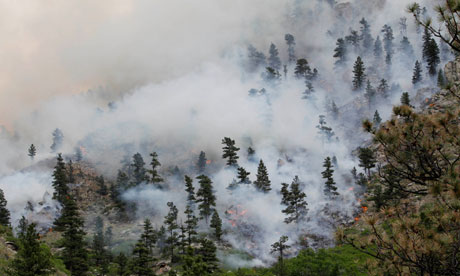
      Fire burns through trees in Poudre Canyon in Colorado last week. Photograph: Ed Andrieski/AP

      Wildfires raced across a dry and windy south-west on Friday, destroying dozens of homes and depositing a smoky haze over the city of Albuquerque, New Mexico.

      Fuelled by historic drought conditions, the wildfire season opened early this year in the rugged mountains of Arizona. By Friday morning, crews were fighting more than a dozen blazes in Arizona, Colorado, Nevada, New Mexico, California and Utah. A few small towns were under evacuation order, and at least 170 square miles of brush and forest had been consumed by flames.

      In New Mexico’s Gila national forest, fires started by lightening strikes tripled in size over the last 48 hours, with high winds forcing firefighters to the sidelines. More than a dozen summer cabins in the town of Willow Creek were destroyed as the fire burned across 110 miles of steep forested canyons.

      “The fire had been around about 10 days, lurking and creeping and then kaboom, it exploded,” said Tabitha Sims, secretary of the Willow Creek landowners association, told local reporters. “They made a heroic effort at trying to build a break, but I think it was unfortunate that this wind event happened to come right at the worst time.”

      Much of the state was covered in a haze, with local television stations reporting poor air quality in Albuquerque, some 170 miles away.
      High winds, with gusts of 60mph were expected until Sunday, blocking fire crews from cutting a containment line ahead of the fire.

      In Arizona, meanwhile, more than 1,100 fighters, backed up by aircraft, were slowly containing the most dangerous fire,the Gladiator fire, which had forced the evacuation of the old mining ton of Crown King and consumed 27 square miles of pine and brush north of Phoenix.

      A blast of humid air from the Pacific coast also brought some relief, slowing the march of the flames with crews reinforcing control lines around Arizona’s other fires.

      The early start to the fire season, with the Arizona fires, has deepened fears about a re-run of last year’s disastrous wildfires. More than 1,500 square miles across the south-west were torched, according to the National Interagency Fire Center.

      Tom Spencer, who heads the predictive service for the Texas forest service, warned earlier this month that similarly dangerous conditions were in place across the south-west.

      “It’s not looking very good for Arizona right now,” he said. “But all of the west right now has the potential to have an active fire season.”

      Other areas of the country are at high risk of wildfires too, after experiencing the warmest spring in the temperature records. March, April and May 2012 have brought summer temperatures, and set new heat records, across much of the mid-western and eastern United States.

      Those dry conditions have fuelled a fast-moving wildfire in Michigan‘s upper peninsula that was discovered after a lightening strike on Wednesday.

      Officials said a number of summer cabins were evacuated as the fire tore through pine forest around Duck Lake, north of the town of Newberry.

      Fire crews were also fighting a fire at the Seney national wildlife refuge, which covers about 95,000 acres.

  • Bizarre decision could be the straw that broke PM’s backing

    Bizarre decision could be the straw that broke PM’s backing

    0

    THE timing of this sweetheart deal for Gina Rinehart could not be worse for Julia Gillard, with her leadership on a knife edge.

    It will make absolutely no sense to the public, who have been brow beaten by the federal government for the last three months about how billionaires like Ms Rinehart don’t need any favours from government.

    It would appear to be another example of the poor political judgment the PM has been accused of by many colleagues since she became leader. And it could be the last straw.

    The external politics of it suggest to voters a policy of “do what I say not what I do”.

    On the one hand Gillard and Wayne Swan have gone out of their way to fuel a class war on the back of Ms Rinehart’s wealth. So how does Gillard now explain that 350 workers in Newcastle can lose their jobs as victims of the changing economy while offering cheap imported Labor to the mining giants that have driven this change?

    The internal politics of it, however, will be what determines her fate. The caucus was not consulted about the policy and many are furious.

    Even before this latest bizzare decision, secret discussions were taking place, including several last Monday night, following a meeting of Labor’s dominant national right caucus in parliament house.

    Senior NSW MPs were again pushing the case for Rudd. Two senior Federal Labor Ministers from Victoria are believed to have threatened to resign if the plan to draft Mr Rudd back into the leadership was revived.

    The Rudd haters will find it more and more difficult to justify their position in light of decisions like this.