Category: General news

Managing director of Ebono Institute and major sponsor of The Generator, Geoff Ebbs, is running against Kevin Rudd in the seat of Griffith at the next Federal election. By the expression on their faces in this candid shot it looks like a pretty dull campaign. Read on

  • A better tomorrow? Brooke, Common Grace

    1 of 62

    A better tomorrow?

    Inbox
    x

    Brooke, Common Grace <info@commongrace.org.au>

    1:46 PM (2 hours ago)

    to me
    Dear Neville,

    Nearly 18 months ago, I was invited to address a Queensland Parliamentary Committee regarding proposed changes to the Youth Justice Act that included, amongst other things: allowing repeat offenders’ information to be publicly published (aka “naming and shaming”); the creation of an additional offence for situations where a child commits a further offence while on bail; and the automatic transfer of children in juvenile detention to an adult prison when they turned 17, if they had six months or more left to serve in detention.

    I sat in Queensland’s Parliament that day knowing that these proposed changes had been developed without consultation with the Aboriginal community, despite the fact that 66% of the young people in the Queensland juvenile detention centres are Aboriginal and Torres Strait Islander young people and knowing that somehow I was the only Aboriginal person invited to speak that day.

    Flash forward to now, 18 months after that day, and the legislation has been approved and implemented, and still there has been no reduction in the numbers of Aboriginal and Torres Strait Islander young people in youth detention.

    I hear that the Western Australian Government is proposing to do something very similar and I cannot help but shake my head.  What else can I do?  How do we find victory in this system?  How do we have our voices heard?  How do we turn the statistics around? So many questions.

    I think the answer lies somewhere in the belief that we are stronger together.  So today, I am writing to ask for your help.

    AboriginalYouth.jpg

    At the time that I spoke to the Queensland Parliamentary Committee, I was shocked to discover that not one of my fellow Queenslanders that I spoke to had any idea about this legislation.  Many didn’t even know that an offender could be sent to adult prison at 17 years of age under Qld law.  Did you know?

    Just this last week, I looked into Amnesty International’s campaign which is addressing similar legislative changes that are currently proposed in Western Australia, and also at Change The Record’s website which detail that statistics for Aboriginal and Torres Strait Islander incarceration rates nationally. I again became aware that a lack of understanding still dominates this national issue.

    At a state level, many Australians do not know that Aboriginal young people in WA are already 58 times more likely to be in detention than non-Indigenous young people. At a national level, many Australians are unaware that Aboriginal and Torres Strait Islander juveniles are 24 times more likely to be in detention than non-Indigenous juveniles.  And let us remember that juveniles are children. So what that sentence just said, is that Aboriginal and Torres Strait Islander children are 24 times more likely to be in detention than non-Indigenous juveniles.

    These statistics are the reality of our Aboriginal and Torres Strait Islander communities.  But they are also the reality for all Australians. I am writing today to ask you to allow them to become your personal reality too.  To allow this reality to compel you to listen to the voices of Aboriginal Christian Leaders and join with us by standing up and using your voice against these injustices.  I want you to also know, these statistics mean something else.  They mean something else because each of these statistics have names – they are loved children and grandchildren, sisters and brothers, nieces and nephews.

    Many people are happy to talk about Reconciliation.  I often say that if Reconciliation is to occur in this land then, as Aboriginal people, we can’t do it on our own.  Reconciliation means standing together, side by side, not non-Indigenous people behind us or in front of us, but side by side, in truth, in justice and in love.  Many Aboriginal people, myself included, sometimes struggle with the word Reconciliation.  Reconciliation is meaningless without action. Will you take action and stand alongside us?

    The laws proposed in WA, as they do in Qld, contravene the UN Convention on the Rights of the Child. Slogans like “if they’ve done the crime then they should do the time,” especially when coupled with statistics, can be used in the media to give the impression that Aboriginal kids simply do more crime. But these responses are too simplistic and do not allow space for questions like: If you could not afford to pay a parking fine, do you believe you should be sent to jail?  If you are in the company of someone committing an offence and not doing anything wrong yourself, do you believe you should be sent to jail?  If you had a mental illness and there was no one to care for you do you believe you should be sent to jail?  These questions, not simplistic rhyming slogans, are the realities of our justice system for some Aboriginal and Torres Strait Islander peoples.

    Legislation like that which is proposed in WA and is now part of Qld’s law, only ends up “labelling young people as criminals incapable of reform and would leave them no pathways – except towards a prison cell” (Amnesty Australia). We can and must do better.

    We must have Aboriginal and Torres Strait Islander voices heard and listened to in our states and territories, and in this country.  Our government must have the courage to conduct proper, authentic, far-reaching and face-to-face consultation with Aboriginal and Torres Strait Islanders on these issues. We must all be serious about building our states, territories, and country for all Australians, based on respect, kindness and harmony.  And if we do so, we might just actually build the Australia I dream of and pray for, an Australia that truly is based on truth, justice, love and hope.

    Remember when I said I need your help?  Well here’s some ways you can help:
    –        Sign Amnesty’s online petition
    –        Join the pledge to #changetherecord
    –        Uphold Amnesty International Australia in prayer as they take a lead in this work
    –        #geteducated on the facts

    Let’s believe for a better tomorrow for this land now called Australia.

    Grace & Peace,
    Brooke, on behalf of Larissa, Shane, Tanya and all the Common Grace Team

    PS. If you’ve been shocked to learn that Aboriginal and Torres Strait Islander juveniles are 24 times more likely to be in detention than non-Indigenous juveniles, then share this story with your friends from our blog over here.

    Common Grace  http://www.commongrace.org.au/

    -=-=-Common Grace · Australia
  • Global Temperature

    Global Temperature

    Below are maps of the mean surface temperature anomaly for the past month, the past three months, and the past 12 months. Regional weather patterns, apparent on the monthly time scale, tend to disappear in averages over longer time scales. In the chart in the lower right we show the 12-month running means of the global land-ocean temperature anomalies.

    Most recent one, three and 12 month mean global temperature anomaly maps, and 12-month-running mean global temperature anomaly. (Also in PDF, last modified 2015/08/14, now with GHCN version 3.3.0 and ERSST v4).

    The figure below shows 60-month (5-year) and 132-month (11-year to minimize the effect of the solar cycle) running means of the surface temperature deviation from the 1951-1980 mean. This graph makes clear that global warming is continuing — it did not stop in 1998. The year 1998 was remarkably warm relative to the underlying trend line in association with the “El Nino of the century”.

    60-month and 132-month running means of global surface temperature anomaly with a base period 1951-1980. (Also in PDF, Data through July 2015 are used for computing the means. last modified 2015/08/14, now with GHCN version 3.3.0 and ERSST v4.)

    Additional figures are on More Figures page.
    Information in detail with tables and the original data sources are on NASA GISS temperature web pages.

    Note 1: GHCN-M version 3 replaced version 2 in GISS temperature analysis because NOAA/NCDC no longer updates version 2. (since 2011/12/15)
    GHCN v3.2.2 was replaced by v3.3.0 (since 2015/06/13, See NASA GISS Updates to Analysis page for details.)

    Note 2: Ocean data were switched from HadISST1 + OI SST to ERSST. (since 2013/01/15)
    Ocean data were switched again from ERSST v3b to ERSST v4. (since 2015/07/15, corrected on 2015/07/19)

    Our Essays:

  • DETAILED THUNDERSTORM SYDNEY 8.49 PM 24.8.2015

    SYDNEY CBD AREA COPPING HEAVY STORM AND HAIL

    Plan Image

  • climate code red david spratt

    1 of 15

    climate code red

    Inbox
    x

    Climate Code Red <noreply+feedproxy@google.com>

    6:06 PM (5 minutes ago)

    to me

    climate code red


    As 2015 smashes temperature records, it’s hotter than you think

    Posted: 23 Aug 2015 07:07 PM PDT

    by David Spratt

    There is an El Nino in full swing which helps push average global temperatures higher, and records are being broken, but just how hot is it? For several years, we have heard that global warming has pushed temperatures higher by around 0.8 to 0.85 degrees Celsius (°C).

    But in 2015, that number is not even close.

    Even before this year’s strong El Nino developed, 2015 was a hot year. The first few months of the year broken records for the hottest corresponding period in previous years all the way back to the start of the instrumental record in 1880. Each month, new records fell.

    With the July data in, the US Government’s National Oceanic and Atmospheric Administration reported that July was the hottest month among the 1627 months on record since 1880, and the first seven months of the year was the hottest January-July on record:

    The July average temperature across global land and ocean surfaces was 0.81°C above the 20th century average. As July is climatologically the warmest month for the year, this was also the all-time highest monthly temperature in the 1880-2015 record, at 16.61°C, surpassing the previous record set in 1998 by 0.08°C.

    The July globally-averaged sea surface temperature was 0.75°C above the 20th century average. This was the highest temperature for any month in the 1880-2015 record, surpassing the previous record set in July 2014 by 0.07°C. The global value was driven by record warmth across large expanses of the Pacific and Indian Oceans.

    The year-to-date temperature combined across global land and ocean surfaces was 0.85°C above the 20th century average. This was the highest for January-July in the 1880-2015 record, surpassing the previous record set in 2010 by 0.09°C.

    In addition the year-to-date globally-averaged land surface temperature beat the previous record in 2007 by a whopping 0.15°C, and the year-to-date globally-averaged sea surface temperature surpassed the previous record of 2010 by 0.06°C. Every major ocean basin observed record warmth in some areas.

    And, as Joe Romm has reported, “It was especially hot for the 6 billion of us up here in the northern hemisphere, where the first seven months of 2015 were a remarkable 0.3°F (0.17°C) warmer than the first seven months of any year on record — and nearly a half degree Fahrenheit warmer than any year before 2007”.

    El Nino may be strongest on record
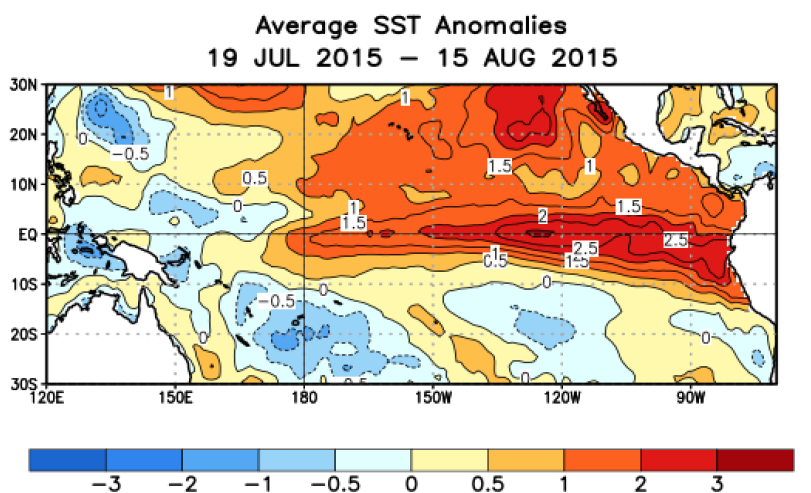
     So this year, records are not being broken. They are being smashed, as a strong El Nino (and perhaps the strongest on record) is set to persist through to 2016. El Nino conditions are characterised by a warm band of water across the eastern tropical Pacific Ocean and facilitate the transfer of heat from the ocean surface layer to the atmosphere and are associated with a hotter climate.

    The NOAA’s most recent El Nino update (Climate Prediction Center / NCEP 17 August 2015) reports that:

    All multi-model averages suggest that Niño 3.4 will be above +1.5ºC (a “strong” El Niño) during late 2015 into early 2016.

    (El Nino 3.4 is the zone of longitudes 120 to 150W along the equatorial Pacific Ocean).
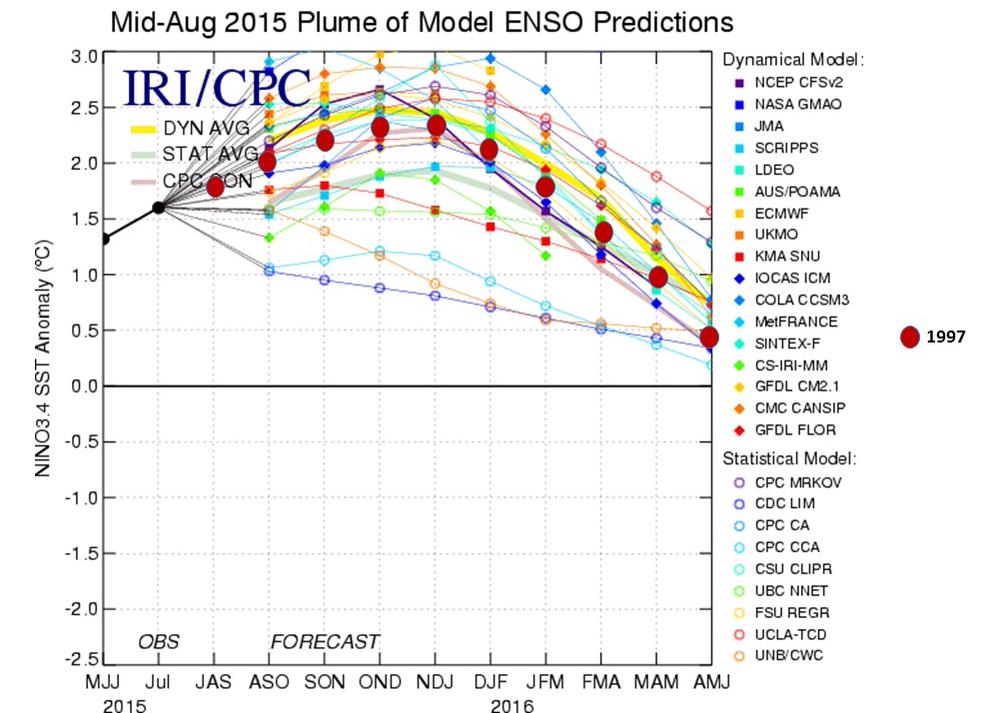
    As the chart above illustrates, the projected strength of the El Nino (yellow line) is slightly above the previous strongest such event in 1997 (red dots).

    So hot will 2015 be? The NOAA has already reported that the first seven months of the year was almost 0.1°C above the previous record.  This is a huge amount in a field where changes are often measured in one-hundredths of a degree.

    With a 90% chance of the El Nino persisting into 2016, it is as close as a certain bet can be that 2015 will be the hottest year on the instrumental record.

    And there is probably an even-money chance that the margin will exceed 0.1°C.  This would be an incredible result with scientists shocked at the margin by which records are being broken.

    And there is a good chance that 2016 will beat 2015 to become the hottest year on record.

    It’s hotter than you think

    But much hotter has it got already? The convention is to talk about the amount of warming “above pre-industrial”, that is, before the steam-and-coal industrial revolution, around 1750.

    But the instrumental record used by the major agencies in the US, the UK and Japan does not start till 1880, and it is this period that is often used to provide a “pre-industrial” baseline.  So when we hear that warming so far up to (the average of) the last decade as being 0.8°C or 0.85°C, it is the warming from a 1880 baseline (see light green column in figure below of 0.87°C, based on the NOAA dataset since 1880).

    But the climate around 1750 and 1880 were not the same.  Research using proxy data and modelling shows that between 1750 and 1880 the global average temperature increased by ~0.2°C.

    CLICK TO ENLARGE

    When that is added (dark green column), we find that the real warming from pre-industrial 1750  to the average of the last decade is 1.07°C. It is a shock to see that we are more than half way to the unsafe 2°C “guardrail” favoured by international policy-makers.

    The warming over 1750 pre-industrial to 2014 was 1.17°C.

    And for the first seven months of 2015, the margin is a staggering 1.26°C higher than the pre-industrial level.  Yes, it is a strong El Nino period, and it may drop back for a short while, but 2016 could be just as hot and we may be entering a new phase of accelerated warming.

    Greenhouse emissions continue to soar to record levels, and attempts to clean up and retire some of the world’s dirtiest coal power plants may result in a lowering of the production of aerosols (including black-carbon soot, organic carbon, sulphates, nitrates, as well as dust from smoke, manufacturing and windstorms) which at the moment provide a temporary (~1 week) cooling of 0.8-1°C.

    The leading climate researcher Michael E. Mann says that as fossil fuel use is curtailed, the aerosol cooling impact will lessen. Mann says that “if the world burns significantly less coal…we would have to limit CO2 to below roughly 405 ppm”, a level we will reach in two years.

    A climate emergency requiring levels of action far beyond anything that is currently perceived by policy makers? As temperatures soar to record levels and it is hotter than most people understand, you can bet on that.

  • Joe Hockey: Cut taxes for the rich Chris Bowen ALP

    More

    1 of 57

    Joe Hockey: Cut taxes for the rich

    Inbox
    x

    Chris Bowen Unsubscribe

    5:08 PM (40 minutes ago)

    to me
    The latest politics update from the Australian Labor Party | Unsubscribe
    .
    Neville —

    Joe Hockey has come out today and argued for lower taxes, particularly for those on higher incomes. This is from the same man who has said Australia has a ‘budget emergency’ and who has doubled the deficit.

    We’ve heard this before. Tony Abbott and Joe Hockey spent all of 2013 saying they wanted lower taxes. They’re now actually taxing people more than at anytime since the Howard Government.

    If Joe Hockey wants to have a serious discussion about making tax cuts he also needs to explain how he plans to pay for them. So far he hasn’t said anything about how he would fund these tax cuts, but we know what options they’ve put on the table: blow out the deficit, make even harder cuts, or raise the GST. We don’t think any of these are good options.

    The reality is Joe Hockey isn’t engaging in a serious policy discussion, he’s just looking for a way to save both Tony Abbott and himself.

    By contrast Labor has a plan to crackdown on large multinational companies avoiding tax which will raise over $7 billion. We’ve also released our policy to wind back some of the overly generous tax concessions for high income earners. These are tax reforms that make a difference to the budget bottom line but are also fair and sustainable.

    Thanks for your support,

    Chris Bowen
    Shadow Treasurer