Category: General news

Managing director of Ebono Institute and major sponsor of The Generator, Geoff Ebbs, is running against Kevin Rudd in the seat of Griffith at the next Federal election. By the expression on their faces in this candid shot it looks like a pretty dull campaign. Read on

  • Ice Sheet Disintegration ( HANSEN)


    Ice Sheet Disintegration

    Ice sheet change is expected to be a “slow” climate feedback. How rapidly ice sheets can disintegrate is one of the most uncertain and imporant climate issues. The dominant physical process causing ice sheet disintegration may be absorption of heat by the ocean (due to an increasing greenhouse effect), resulting melting of ice shelves, and thus an increased rate of discharge of ice from the ice sheet to the ocean. Once this process gets well underway, it may be difficult to prevent accelerating ice sheet disintegration under its own impetus ( http://pubs.iss.nasa.gov/docs/2005/2005_Hansen.pdf).

    Gravity satellite data of Greenland and Antarctic ice sheet mass loss. The monthly data (navy blue curves with plus signs) read from Velicogna, I. Geophys. Res. Lett., 36, L19503. (Also in PDF.)

    The figure above shows the rate of mass loss from the Greenland and Antarctic ice sheets, based on a recent publication of gravity satellite data. The rate of mass loss from Greenland has increased during the past 2-3 years, as it has from Antarctica. This is one of the most important geophysical measurements being made, so it is important to get a follow-on gravity satellite into space. A planned European gravity satellite is not sufficiently capable to yield accurate ice sheet mass change, and a planned NASA follow-on gravity mission is low on NASA’s priority list.

  • Volcano Alerts

    News 9 new results for volcanoes
    Blast shakes restless volcano in remote Aleutian Islands
    TheNewsTribune.com
    Cleveland Volcano, 940 miles southwest of Anchorage in the Aleutian Islands, may have blown off its lava dome and probably burped up a small amount of ash in an explosion late Wednesday, scientists say. Meanwhile, volcanologists are monitoring
    See all stories on this topic »

    TheNewsTribune.com
    Thursday quake arrives as scientists monitor Alaska’s Iliamna volcano
    Alaska Dispatch
    On Wednesday, the Alaska Volcano Observatory issued an alert that they were closely monitoring Iliamna Volcano, 130 miles from Anchorage on the lower west side of Cook Inlet, following a period of increased seismic activity. That was before a moderate
    See all stories on this topic »

    Alaska Dispatch
    Two Alaska volcanoes show signs of activity
    Chicago Tribune
    By Yereth Rosen ANCHORAGE, Alaska, March 8 (Reuters) – A remote Alaska volcano that has been restless since last summer belched ash in a small, short explosion, scientists said on Thursday, but the cloud was not expected to impact commercial airline
    See all stories on this topic »
    Northern Pacific Update: Bezymianny Put on Red Alert for Eruption, Seismicity
    Wired News
    By Erik Klemetti Bezymianny: KVERT placed this active Kamchatka volcano (right) on Red Alert status over the last few days after a sharp and sustained increase in seismic activity. They also noted a sizable increase in size and temperature of the
    See all stories on this topic »
    Bezymianny volcano erupts again
    The Voice of Russia
    Friday saw a new eruption of the Bezymianny volcano on the Kamchatka Peninsula in the Russian Far East. Earlier in the day, the volcano spewed ash up to 8 kilometers high, seismologists said, adding that the eruption does not pose a threat to
    See all stories on this topic »
    Tsunami 35 metres high the worst case scenario
    Stuff.co.nz
    Dr Graham Leonard, a natural hazard scientist from GNS Science, is an expert in hazard mapping and warning preparedness for volcanoes and tsunami. Dr William Power is a Tsunami Scientist from GNS Science whose expertise is in tsunami modelling and
    See all stories on this topic »

    Stuff.co.nz
    Alaska delegation, Parnell say Eielson move poses volcano risk
    Fairbanks Daily News-Miner
    When volcanoes near Anchorage erupt, they said, the air space can close. While the Air Force has measures in place to respond to a volcanic eruption, the cost of relocating the fighter planes to another base would be increased if the F-16s were at
    See all stories on this topic »
    TOURING HOKAIDO
    Powderlife Niseko
    Volcanoes, wildlife, free hot springs and cool temperatures are a major draw. Come summer the roads are packed with motorbikes. Don’t worry if you have problems reading your map or wonder which route would be more scenic. Japanese motorcycle enthusiast
    See all stories on this topic »

    Powderlife Niseko
    SA council lends sister city a hand in clouds
    Government News
    The City of Kokopo has a population of about 26000 and has been the administrative centre for the island of East New Britain, between the Bismarck and Solomon seas, since volcanoes devastated neighbouring island, Rabaul in 1994.
    See all stories on this topic »


    This once a day Google Alert is brought to you by Google.

    Delete this alert.
    Create another alert.

  • Sea Level Hansen and Sato


    Sea Level

    Sea level change is an important climate diagnostic. However, interpretation of the moderate rate of sea level rise of the past century is complicated by the fact that several competing processes contribute to net sea level change. The most important processes are melting of land ice (the large ice sheets on Greenland and Antarctica and mountain glaciers) and thermal expansion of ocean water as the ocean warms. Storage of water behind dams and depletion of groundwater aquifers also affect sea level.

    Over the past 5000 years the average rate of sea level rise was much less than 1 meter per millennium (1 mm/year), as shown by geologic markers on coastlines. In the past century tide gauges at coastal cities reveal a larger rate of sea level rise. The second chart below shows that sea level rose about 2 mm/year during 1920-2000.

    Satellites began to measure sea level precisely in 1993. Since then sea level has been rising about 3.2 mm/year. This rate is equal to just over one foot per century. The impact of such sea level change is substantial, yet the concern is that far greater sea level rise will occur this century if the major ice sheets disintegrate.

    .

    Global sea level change measured by TOPEX satellite (1992-2001), Jason-1 (2002-mid 2008) and Jason-2 (mid 2008-present). Data through September 10, 2011. Data source: University of Colorado at Boulder: Sea level change. Figure also available in PDF. (Last modified: 2012/02/14)

    .

    Sea level change for 1870-2001, based on tide gauge measurements, from Church J.A. and White N.J. “A 20th century acceleration in global sea-level rise” Geophys. Res. Lett. 2006; 33: L01602. University of Colorado data are shifted to have the same mean for 1993-2001 as Church and White. The trends were computed for 1870-1920, 1920-1975, 1975-2001 for Church and White data, and 1993 – September 10, 2011 for University of Colorado data. Figure also available in PDF. (Last modified: 2012/02/14)

    Greenland and Antarctica have begun to melt faster in the past few years, as shown on Ice Sheet Disintegration page, yet sea level rise slowed slightly in the past few years. The reason seems to be that ocean heat storage decreased in the past five years reducing thermal expansion. Reduced heat storage may be related in part to solar minimum radiation. Ocean heat uptake will surely resume, so acceleration of sea level rise in the next few years may occur. We will discuss the interconnections of climate forcings, global temperature, ocean heat storage, ice melt, and sea level in a paper now in preparation.

  • TED Talk James Hansen Website/YouTube

    James Hansen jimehansen@gmail.com via mail39.us1.mcsv.net
    1:38 PM (59 minutes ago)

    to me
    Email not displaying correctly? View it in your browser.
    TED Talk
    My TED talk is available at the TED website, on YouTube or from my website.  Powerpoint charts will be made available soon on my website.

    ~Jim

    Reply
    Forward
    Click here to Reply or Forward
  • Five grotty train stations set for sale to the private sector

    Five grotty train stations set for sale to the private sector

    4

    FIVE of Sydney’s overcrowded and grubby train stations could be handed over to the private sector for redevelopment.

    The state government is considering a radical proposal to “bundle” five CBD train stations and release them as a series of public-private partnerships for an overhaul.

    Commuters would benefit from redesigned and modern stations, attractive shopping precincts and affordable apartments, Infrastructure Partnerships Australia (IPA) said.

    The overhaul would include the five stations on the City Circle Loop – Redfern, Central, Town Hall, Martin Place and Circular Quay.

    IPA, the peak lobby group representing the infrastructure private sector, has submitted the radical plan to the Legislative Assembly committee’s inquiry into the utilisation of rail corridors.

    The inquiry was set up late last year to examine the use of air space above and around the rail corridor in the greater metropolitan area of Sydney, including the Hunter region and in the Illawarra.

    The five train, bus and ferry interchanges present an “opportunity for joint development” because they have high passenger frequency and are in key locations, IPA said.

    “This high level of patronage means the station concourse, airspace and adjacent land – if planned for, designed and delivered in a suitable way – is a potentially valuable commercial real estate holding for the government,” the report states.

    “Many of these stations are in a poor condition, with a sub-optimal legacy design and have not experienced wholesale renovation for many decades.”

    The private sector is in a position to invest in the proposal, IPA said. “The renovation of these five stations could be bundled as public- private partnerships, in which the private sector would finance train station redesign and renovation.

    “A joint development of the high-traffic CBD stations under this model would allow for the redevelopment of Sydney’s legacy CBD rail stations at substantially lower cost to the taxpayer while simultaneously delivering world-class facilities to rail commuters.

    “The redevelopment would also deliver high-value retail real estate in the CBD.”

    It was time to replace the “crappy old cafes, bottle shops and newsagents” with quality retail precincts, IPA chief executive Brendan Lyon said.

    “When you think about global cities and their transport interchanges, they have done a lot more with their major CBD transport hubs than Sydney has.”

    Transport Minister Gladys Berejiklian said the proposal would be considered.

    “The masterplan is looking at capacity and demand issues around the whole of the transport network, including the CBD railway lines and stations,” Ms Berejiklian said.


    49 comments on this story

  • Why the energy industry is so invested in climate change denial

    Why the energy industry is so invested in climate change denial

    The world most’s profitable companies are valued by their carbon reserves – never mind the resulting ruin to the planet

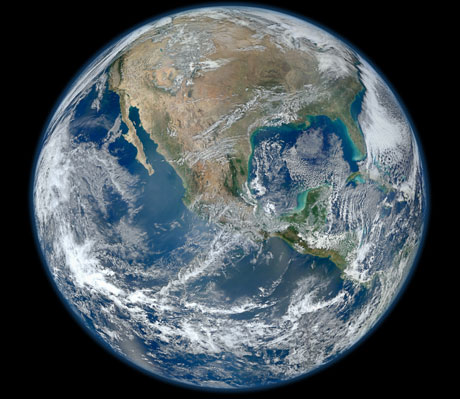
    • The earth seen from space, 4 January 2012, by Nasa

      The Americas, seen from space on 4 January 2012. Photograph: Nasa Goddard Photo

      If we could see the world with a particularly illuminating set of spectacles, one of its most prominent features at the moment would be a giant carbon bubble, whose bursting someday will make the housing bubble of 2007 look like a lark. As yet – as we shall see – it’s unfortunately largely invisible to us.

      In compensation, though, we have some truly beautiful images made possible by new technology. Last month, for instance, Nasa updated the most iconic photograph in our civilization’s gallery: “Blue Marble”, originally taken from Apollo 17 in 1972. The spectacular new high-def image shows a picture of the Americas on 4 January, a good day for snapping photos because there weren’t many clouds.

      It was also a good day because of the striking way it could demonstrate to us just how much the planet has changed in 40 years. As Jeff Masters, the web’s most widely read meteorologist, explains:

      “The US and Canada are virtually snow-free and cloud-free, which is extremely rare for a January day. The lack of snow in the mountains of the western US is particularly unusual. I doubt one could find a January day this cloud-free with so little snow on the ground throughout the entire satellite record, going back to the early 1960s.”

      In fact, it’s likely that the week that photo was taken will prove “the driest first week in recorded US history”. Indeed, it followed on 2011, which showed the greatest weather extremes in our history – 56% of the country was either in drought or flood, which was no surprise since “climate change science predicts wet areas will tend to get wetter and dry areas will tend to get drier.” Indeed, the nation suffered 14 weather disasters, each causing $1bn or more in damage last year. (The old record was nine.) Masters again: “Watching the weather over the past two years has been like watching a famous baseball hitter on steroids.”

      In the face of such data – statistics that you can duplicate for almost every region of the planet – you’d think we’d already be in an all-out effort to do something about climate change. Instead, we’re witnessing an all-out effort to … deny there’s a problem.

      Our GOP presidential candidates are working hard to make sure no one thinks they’d appease chemistry and physics. At the last Republican debate in Florida, Rick Santorum insisted that he should be the nominee because he’d caught on earlier than Newt or Mitt to the global warming “hoax”.

      Most of the media pays remarkably little attention to what’s happening. Coverage of global warming has dipped 40% over the last two years. When, say, there’s a rare outbreak of January tornadoes, TV anchors politely discuss “extreme weather,” but climate change is the disaster that dare not speak its name.

      And when they do break their silence, some of our elite organs are happy to indulge in outright denial. Last month, for instance, the Wall Street Journal published an op-ed by “16 scientists and engineers” headlined “No Need to Panic About Global Warming”. The article was easily debunked. It was nothing but a mash-up of long-since-disproved arguments by people who turned out mostly not to be climate scientists at all, quoting other scientists who immediately said their actual work showed just the opposite.

      It’s no secret where this denialism comes from: the fossil fuel industry pays for it. (Of the 16 authors of the Journal article, for instance, five had had ties to Exxon.) Writers from Ross Gelbspan to Naomi Oreskes have made this case with such overwhelming power that no one even really tries denying it any more. The open question is why the industry persists in denial in the face of an endless body of fact showing climate change is the greatest danger we’ve ever faced.

      Why doesn’t it fold, the way the tobacco industry eventually did? Why doesn’t it invest its riches in things like solar panels and so profit handsomely from the next generation of energy?

      The answer is more interesting than you might think.

      Part of it’s simple enough: the giant energy companies are making so much money right now that they can’t stop gorging themselves. ExxonMobil, year after year, pulls in more money than any company in history. Chevron’s not far behind. Everyone in the business is swimming in money.

      Still, they could theoretically invest all that cash in new clean technology or research and development for the same. As it happens, though, they’ve got a deeper problem, one that’s become clear only in the last few years. Put briefly: their value is largely based on fossil-fuel reserves that won’t be burned if we ever take global warming seriously.

      When I talked about a carbon bubble at the beginning of this essay, this is what I meant. Here are some of the relevant numbers, courtesy of the Capital Institute: we’re already seeing widespread climate disruption, but if we want to avoid utter, civilization-shaking disaster, many scientists have pointed to a two-degree rise in global temperatures as the most we could possibly deal with.

      If we spew 565 gigatons more carbon into the atmosphere, we’ll quite possibly go right past that reddest of red lines. But the oil companies, private and state-owned, have current reserves on the books equivalent to 2,795 gigatons – five times more than we can ever safely burn. It has to stay in the ground.

      Put another way, in ecological terms, it would be extremely prudent to write off $20tn-worth of those reserves. In economic terms, of course, it would be a disaster, first and foremost for shareholders and executives of companies like ExxonMobil (and people in places like Venezuela).

      If you run an oil company, this sort of write-off is the disastrous future staring you in the face as soon as climate change is taken as seriously as it should be, and that’s far scarier than drought and flood. It’s why you’ll do anything – including fund an endless campaigns of lies – to avoid coming to terms with its reality. So, instead, we simply charge ahead. To take just one example, last month, the boss of the US Chamber of Commerce, Thomas Donohue, called for burning all the country’s newly discovered coal, gas, and oil – believed to be 1,800 gigatons-worth of carbon from our nation alone.

      What he and the rest of the energy-industrial elite are denying, in other words, is that the business models at the center of our economy are in the deepest possible conflict with physics and chemistry. The carbon bubble that looms over our world needs to be deflated soon. As with our fiscal crisis, failure to do so will cause enormous pain – pain, in fact, almost beyond imagining. After all, if you think banks are too big to fail, consider the climate as a whole and imagine the nature of the bailout that would face us when that bubble finally bursts.

      Unfortunately, it won’t burst by itself – not in time, anyway. The fossil-fuel companies, with their heavily-funded denialism and their record campaign contributions, have been able to keep at bay even the tamest efforts at reining in carbon emissions. With each passing day, they’re leveraging us deeper into an unpayable carbon debt – and with each passing day, they’re raking in unimaginable returns. ExxonMobil last week reported its 2011 profits at $41bn, the second highest of all time. Do you wonder who owns the record? That would be ExxonMobil, in 2008, at $45bn.

      Telling the truth about climate change would require pulling away the biggest punchbowl in history, right when the party is in full swing. That’s why the fight is so pitched. That’s why those of us battling for the future need to raise our game.

      And it’s why that view from the satellites, however beautiful from a distance, is likely to become ever harder to recognize as our home planet.