Dear NEVILLE,
Wow. In news breaking today, it seems that the New South Wales government has been teaming up with AGL to ensure that little stands in the way of the company’s fracking plans.
A special report in the Sydney Morning Herald has revealed the government redefined planning laws at AGL’s behest to fast track approvals for their devastating coal seam gas mining just outside the community of Gloucester [1].
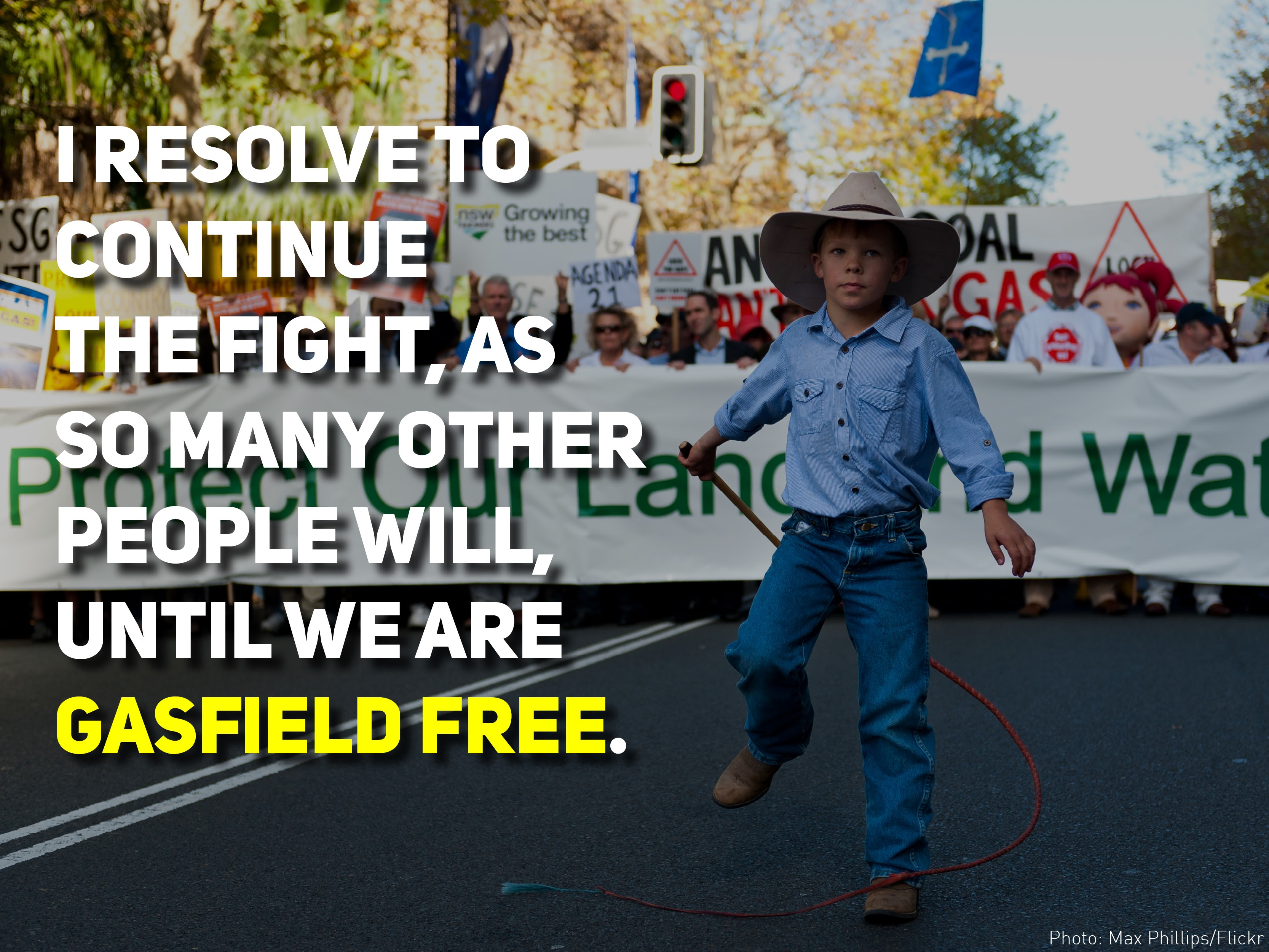
The Gloucester project has been a nightmare for local residents, with the government and AGL riding roughshod over concerns about the health and well-being of their community, their local environment and their prime agricultural land [2].
If the revelations are true, it would appear the New South Wales government is outsourcing environmental planning to Australia’s biggest polluter. What’s worse? AGL’s getting away with it. The good news is there’s something you can do to show AGL their apparent disregard for local communities is not on.
Tell AGL to frack off and join 12,000 others who’ve switched to a low-cost, cleaner energy company with genuine green credentials.
Since its inception, the Gloucester CSG project has been plagued by environmental problems, including the dumping of tainted water into Newcastle’s sewer system and the discovery of harmful BTEX chemicals in flowback water [3][4]. In both cases AGL got the all-clear from the NSW government and was allowed to go on drilling the heart out of this regional community [5][6].
Our government is the only thing standing between mining companies and the wholesale destruction of our natural environment, but now the truth is clearer than ever – they’re playing on the same team.
When governments can’t be trusted to uphold their own laws and hold big, polluting corporations to account, we the people need to step up and take matters into our own hands.
GetUp’s Better Power campaign is one way households can take the power back by switching away from Australia’s dirtiest energy companies to a low-cost, cleaner energy alternative.
Send a message to dirty energy giants like AGL by switching retailers through GetUp’s Better Power campaign.
For the Better Power campaign GetUp has partnered with Powershop – an affordable, carbon-neutral retailer which was ranked greenest in Australia by Greenpeace in their latest Green Electricity Guide [7]. Powershop is owned by Meridian, a 100% renewable energy generator which has already invested more than $1 billion in wind farms in Australia, and has a commitment never to invest in fossil fuels like coal and CSG.
You’ll still be getting your electricity from the grid, which means it won’t be different from the power you’re currently getting, but you’ll have peace of mind knowing that your energy consumption is offset and you’re no longer contributing to companies that fund and support CSG.
So far more than 12,000 everyday Australians have made the switch through Better Power, offsetting an estimated 70,000 tonnes of carbon dioxide over the coming year – equivalent to a whopping 28,000 cars off Australia’s roads! [8]
Best of all, for every person who switches through the campaign, Powershop pays a commission that goes towards GetUp’s pro-renewable and anti-CSG campaigns. So far we’ve raised more than $1.2 million through the Better Power campaign, and it all goes towards supporting real, meaningful action on climate change and against unconventional coal seam gas.
Plus, by switching you’ll be joining 12,000 others and adding your voice to a growing movement designed to show polluters, energy companies and the government that Australians mean business when it comes to renewable energy, and they’re prepared to vote with their wallet to show they care.
For too long, companies like AGL have been ignoring the community’s wishes on CSG and coal-fired power. Let’s make a stand today and use our power as consumers to raise our voices for change.
Anthony, for the GetUp Team
P.S. We know that this campaign, and the millions of dollars we take away from AGL’s retail brand as a result, will influence their upcoming decision on whether to continue with coal seam gas and the Gloucester project. Their own CEO said as much recently, admitting that the Gloucester project’s impact on AGL’s retail brand was “always something [they] have to be attentive to”[9]. Meanwhile leading investment analyst Credit Suisse estimated that if we switch 30,000 AGL customers, we’ll take $100 million off their bottom line[10]. So get switching!
References
[1] AGL coal seam gas in Gloucester: Government bowed to pressure for urgent amendment, documents show, Sydney Morning Herald, 13 August 2015
[2] CSG more trouble than it’s worth for AGL, Sydney Morning Herald, 14 March 2015
[3] AGL, Transpacific probed over fracking water discharges, Sydney Morning Herald, 9 January 2015
[4] AGL suspends coal seam gas project after traces of chemicals BTEX found in water samples, ABC Rural, 29 January 2015
[5] EPA finds ‘no breach’ in discharge of water from AGL’s Gloucester coal seam gas site, ABC News, 22 January 2015
[6] Coal seam gas: AGL cleared of adverse findings to resume operations in Gloucester, Sydney Morning Herald, 19 May 2015
[7] The Green Electricity Guide, Greenpeace, August 2014
[8] Modelling on Better Power campaign, ClimateCare, July 2015
[9] AGL takes $600m in writedowns, The Australian, 6 July 2015.
[10] Credit Suisse analysis, July 2014; Credit Suisse Research and Analytics, AGL Energy – I can see clearly now, 19 March 2015; Citi Research, 18 February 2015.






Lenore Taylor Political editor
Thursday 13 August 2015 06.37 AEST Last modified on Thursday 13 August 2015 10.19 AEST
Shares
Comments
238
Tony Abbott’s climate “strategy” – repeated sagely in many columns since Tuesday – is to “neutralise” the “environmental” argument with his new 26% greenhouse target and then attack Labor’s policy on economic grounds. This argument is several different kinds of stupid.
First the target can only “neutralise” the environmental argument if voters are silly enough to accept two things. One, that Australia has no obligation to do its fair share of the job of limiting global warming to 2 degrees. (The target is sort of in the ball-park of other developed nations’ targets, but it doesn’t represent a fair share.) And, two, that they take on trust that the Coalition’s “surprise box” of yet-to-be-announced climate policy (see graphic below) is capable of meeting the target, and delivering the environmental benefit. (Using a range of policies is probably quite sensible, but the only announced policy is the emissions reduction fund – all the others are not yet detailed, to the deep consternation of business leaders, who are calling out the policy void.)
Second, the economic “attack” can only succeed if voters are silly enough to accept that the cost of the yet-to-be-announced, and therefore uncosted Coalition policy is smaller than the costs of Labor’s yet-to-be-announced and therefore also uncosted alternative.
Let’s start with the government’s policy. We can’t “cost” it – as in add up the dollars needed for the various parts – because the various parts of the surprise box have not yet been detailed. But the target has been modelled. The government has not yet released the modelling, by leading economist Warwick McKibbin, but Guardian Australia has reported on it. It says the 26% target will shave 0.2% to 0.3% from GDP in 2030.
Then let’s look at the Labor policy. Oh, wait, there isn’t one. There are also no alternative targets. There’s a promise to have some sort of emissions trading scheme and a vague pledge to have 50% renewables. But there’s no detail. All those Bill Shorten press conferences in front of solar arrays and wind turbines have been long on rhetoric and devoid of policy fact. So there are no costings of Labor’s policy either.
This was obviously a problem for Abbott’s big comparative economic costings “attack”. So he made some up. Drawing on a carefully-placed story in the Daily Telegraph, which was based on publicly available modelling done by the Climate Change Authority three years ago, the government alleges Labor’s non-policy will cost $600bn, and cut 2% off GDP growth in 2030. I discuss the origins of this blown-up “scary” number in more detail here.
And even if Labor did decide to back a 40% greenhouse gas reduction target by 2030 – there is much more recent modelling of that. The government’s own modelling! The same modelling that showed a 26% target would shave 0.2% or 0.3% from GDP growth also found, using the same assumptions, that a 35% target would cut 0.3% to 0.5% from GDP and a 45% target would cut 0.5% to 0.7%. That’s a quarter of what the other modelling said. Much less scary. How inconvenient. No matter, Abbott proceeded with the argument that only Labor’s yet-to-be-announced policy will come at a cost to “growth and jobs”, whereas his yet-to-be-announced policy will protect them.
In the real world – rather than the sometimes entirely fictional world of political rhetoric – companies and voters would like to know exactly what policies the major parties are considering, instead of hot air comparing the unknown economic costs of two yet-to-be-announced plans.