Category: General news

Managing director of Ebono Institute and major sponsor of The Generator, Geoff Ebbs, is running against Kevin Rudd in the seat of Griffith at the next Federal election. By the expression on their faces in this candid shot it looks like a pretty dull campaign. Read on

  • Historic Greens bill aims for real action on climate change

    I have re-published this bill introduced after the IPCC and Hansen Report in Feb/March 2007. This bill was voted down by the Howard Govt. Over 700/000 buildings were identified as being at risk through sea level rise and coastal flooding.

    Historic Greens bill aims for real action on climate change

    Speech | Spokesperson Christine Milne
    Thursday 22nd March 2007, 12:00am

    CLIMATE CHANGE ACTION BILL 2006
    Second Reading

    Senator MILNE (Tasmania) (3.36 p.m.)-It is very important that we acknowledge that the Climate Change Action Bill 2006 is the first bill of its kind in the Australian parliament. It is a bill to seriously tackle climate change. The last time Australia dealt with a target for greenhouse gas emissions was upon ratification of the Kyoto protocol, when Australia demeaned itself in the eyes of the world by negotiating into the early hours of the morning to secure 108 per cent of 1990 levels as the target that Australia would meet in the first Kyoto commitment period, 2008-12. We now know that Australia is struggling to meet what is the world’s most generous target. We will only meet it-in spite of a struggle if we do-because we have had a windfall gain as a result of changes to land use, forestry and land clearance regulations.

    At the rate we are going, we are on track to secure 127 per cent of our target of 1990 levels. We have to act now. It is clear that history judges political leaders on whether they respond to the great issues of their time. In my view, history will judge Australia’s political leaders very harshly. Not only have they failed to respond appropriately to the great issues of our time; they have failed knowingly and deliberately. This is not about ignorance, it is not about a situation where some years have gone past where people did not know what the situation was. The situation has been made very clear to us on many occasions. Since I introduced this legislation last year we have had the Intergovernmental Panel on Climate Change delivering its report. On 2 February this year, the debate effectively ended about whether global warming has been impacted by human activities, when the world’s leading scientists made it very clear that there is more than a 90 per cent probability that human-induced climate change is responsible for the levels of global warming we are currently seeing.

    In their predictions the scientists also said that we can expect sea level rise as a result of thermal expansion of the oceans and the melting of icecaps and glaciers. They warned what might happen if the West Antarctic or the Arctic icesheets melt. We have already seen from the science a slowing down of the great ocean conveyor. If that were to stop, as it did in previous ages, then Europe would be plunged into an ice age. Until now, we have heard from Australian political leaders and business leaders a complete unwillingness to act and the honesty, at least in their responses, is that they do not act because ‘Australia’s competitive advantage is in coal, it is a fossil fuel, it is something we export and we have no intention of changing business as usual or taking leadership’, when other parts of the world have been quite prepared to demonstrate political leadership. The Europeans take this matter extremely seriously, unlike in Australian politics. And I note that the government benches are empty bar two people. History will also record that-that the government does not take the setting of greenhouse gas emission limits seriously.

    We will see later in the contributions to the debate that the government is likely to send in its climate sceptics to dispute the evidence, to come up with all sorts of extraneous arguments as to why Australia should not act. But we know from the IPCC report that we face a doubling of carbon dioxide concentrations that could occur as early as 2035, according to Stern, under a business as usual scenario, and that that would lead to global temperature increases of between two degrees and 4.5 degrees. However, the Prime Minister only recently said that a global average temperature rise between four and six degrees would make life ‘less comfortable for some,’ demonstrating his complete and utter ignorance of this matter.

    At the same time, the Minister for the Environment and Water Resources, the Hon. Malcolm Turnbull, talks about the possibility of a sea level rise up to one metre on the east coast of Australia-again, demonstrating no knowledge whatsoever of what the impact would be in terms of long-shore coastal erosion, estuaries, wetlands, Kakadu et cetera. The ignorance we hear from government ministers and the Prime Minister, who are charged with acting in Australia’s best interests, is extraordinary.

    The next report of the Intergovernmental Panel on Climate Change will come out in April this year. The last one was on the science, warning us about increased carbon dioxide concentrations and about increased sea level rises and telling us of the links between climate change and drought, more extreme weather events, floods, fires-and we had those in Australia this summer. But the Prime Minister and his ministers continue to disassociate extreme drought with climate change, because they do not want to be judged by history. It is too late for them. History will judge 11 years of inaction on climate change, because it is 11 years that we could not afford to waste.

    In fact, the choice of whether to act will be made by our generation, but it will affect life on earth for all generations to come. We have a decade to stabilise and reduce greenhouse gas emissions to the point where we can contain global temperature rise to below two degrees, if we are lucky. We already know the impacts of less than one degree of global temperature rise. Imagine that on a much larger scale. Imagine our river systems, imagine what will happen to our coastal areas-the extremes that we already suffering, with another degree of temperature rise and then another degree on top of that.

    So this is a moral and an ethical question. A leaked report of what we can expect-and, once again, we will have ‘Shock, horror’ from politicians who already know the answers to these questions-says that in April they will bring out another report and it will say: ‘Tens of millions of others will be flooded out of their homes each year as the earth reels from rising temperatures and sea levels. Things are happening and happening faster than we expected.’ And so on. Tens of millions will be flooded out of their homes each year. We are talking about our Pacific neighbours here. We are talking about Bangladesh. We are talking about global insecurity on a scale that we can hardly imagine. Already we have had Kiribati telling us that at least 40 of their islands are being marked for evacuation-30,000 people with nowhere to go-and Australia still refuses to accept a definition of environmental refugee in the UN convention on refugees.

    To get to the specifics of the bill before the House today: it would require the government to ratify the Kyoto protocol as a first step. I do not have to go into that; everybody understands. We have a moral obligation to uphold our responsibilities under international law. If we do not want to abide by international law then we endorse a lawless world. They are our only choices. The Greens certainly believe in Australia’s obligations under international law. We are also committed to a post-2012 global treaty of binding targets.

    The second thing the bill does is set national greenhouse gas emission targets for 2020 at 20 per cent below 1990 levels and 80 per cent below 1990 levels by 2050. I welcome the fact that in the media this week the shadow minister for the environment congratulated the Europeans for setting a target of 20 per cent below 1990 levels by 2020. I hope the Labor Party today will stand up and support this bill, because that is the nature of the deep cuts we need to make. Eighty per cent by 2050 will probably be seen probably as extremely conservative in the not too far distant future.

    We are also introducing a greenhouse gas trigger into the EPBC Act to ensure that information about the greenhouse gas emissions resulting from major developments is adequately considered during the approval process. That trigger will be any action likely to result in greenhouse gas emissions of more than 100,000 tonnes of carbon dioxide equivalent in any 12-month period. If we are serious about greenhouse gases, we have to make sure that major projects that are large greenhouse gas emitters are forced into the assessment process at a national level.

    This bill also introduces a national energy savings target, an energy efficiency target, to halt the growth in energy consumption by 2008. In effect, the trigger is equivalent to business-as-usual growth in energy consumption. So we are saying that that is the target we need to set to make sure that increases in energy are offset by the energy efficiency target. We want to require large energy users to implement the findings of their energy efficiency audits. We had that debate in here yesterday, and I seek yet another debate on that because we are talking about 250 companies in Australia using 40 per cent of Australia’s energy. If they were required to implement the findings of their energy efficiency audits, we could meet significant targets in terms of energy efficiency.

    We also want to increase the mandatory renewable energy targets so that renewable energy contributes at least 15 per cent to national demand by 2012 and 25 per cent by 2020. There is huge excitement around renewable energy. Every day you see in the papers reports from Europe and from the US, where targets have been set at state and national levels, showing enormous expansion and competitive advantage in those new industries. For example, in Spain, wind power generation has now risen to contribute 27 per cent of the country’s total daily power demand-from wind, right now. It is the second highest in the world, and we are going to see them increase installed wind capacity to 20,000 megawatts by 2010. That is extraordinary, and Spain is now aspiring to source 30 per cent of its electricity from renewables by 2010-30 per cent by 2010, and Australia’s mandatory renewable energy target is two per cent. At the same time, from California, we have had news about the expansion in concentrated solar thermal, talking about the huge investment going on there.

    In Europe, we have had a new directive with regard to fuel efficiency, such that European vehicles and Chinese vehicles will be the most popular vehicles into this century because they will be the most fuel efficient. They will be the small vehicles. Australia most certainly ought not continue its perverse incentives for building large vehicles that the public do not want, and the government should immediately change its purchasing policies to abandon support for six-cylinder vehicles and to move across to buying fuel-efficient vehicles and hybrids for the government car fleets.

    The Greens bill today also requires the establishment of a system of renewable energy feed-in tariffs to provide a minimum price per unit of produced renewable electricity for a set period to provide investors security on income. This is a fantastic idea. This is what has driven the solar revolution in Germany, whereby energy utilities are required to buy renewable energy at a fixed price for a fixed period of time. That means that, as a consumer, you can go and borrow the capital that you need to install the renewable energy because you know you can sell it. You have a guaranteed market at a guaranteed price for a guaranteed period of time. As a result, farmers, huge shopping complexes and local government have been rolling out renewable energy all over Germany because, once they have paid it off, they will have an additional income, plus they are making considerable impacts in generating renewable energy. Wouldn’t it be fantastic to have a feed-in tariff in Australia? This is part of this bill, and I hope it will get the support of both the government and the opposition today.

    The final aspect of this bill is to immediately end the harvesting of old growth forests, to maintain existing significant carbon stores. We had the embarrassing spectacle yesterday of the minister for forests making a fool of himself yet again in relation to his understanding of climate change and forests. He needs to go down to the Australian National University, where he will get some instruction from the academics about the fact that the soil carbon in an old growth forest, plus the carbon in the trees, is a huge amount of carbon-way beyond anything that the minister talks about with his plantation establishment.

    Sir Nicholas Stern has said that deforestation around the world-and we know that it is a major driver of climate change-is putting into the atmosphere more carbon dioxide than the whole transport effort from around the world. We could make a significant difference tomorrow by ending the logging of old growth forests, by protecting those carbon sinks and by stimulating the jobs that would come from the raft of measures that I am putting forward here today.

    We have a challenge on our hands. We congratulate the unions, who have come out today saying that there should be some movement here and putting pressure on the Labor Party, which has a mandatory renewable energy target of only five per cent. Greg Combet was today advocating at least a 10 per cent target. His leadership of the union movement with regard to putting forward a framework for dealing with climate change is extremely welcome.

    What is obvious to me is that the community is way ahead of its parliament in wanting to address climate change in Australia. Progressive businesses are crying out for government to take leadership. They cannot make investment decisions into the future unless they have some certainty about a price on carbon and some certainty in relation to developing an emissions trading scheme in this country or the imposition of a carbon tax or the combination of both. What we have is politicians on both sides committing vast amounts of money to unproven technologies which, we have already seen from the science, are years off-if ever they will be achieved-whereas, around the world, other countries are actually implementing the technology that can reduce greenhouse gases now.

    I return to where I began, and that is that history judges political leaders by whether or not they respond to the great issues of their time. History is going to judge this parliament. I say this parliament because, given the time frames, it is senators sitting on that side of the chamber, in this term and the next term, who will make the decisions for the rest of time for life on earth, for generations to come. It is all of us in this parliament now who are going to determine the impacts on threatened species.

    We have heard the World Conservation Union telling us that at least 30 per cent of species will be extinct by 2050 because of climate change. One only has to see the photos of polar bears on melting ice floes to see the impacts. Those impacts are affecting our very own alpine species; they are affecting the cider gum, in Tasmania, as we speak. We are seeing invasive species coming down the east coast of Tasmania as ocean currents change. All across the country we are seeing species going to extinction already because of climate change.

    I urge both the government and the Labor opposition to support this bill because the measures in it would create such excitement across Australia. Contrary to the view that it would shut down the economy, it would be the greatest boost to re-energising Australia that this parliament could deliver to the current generation of Australians and to future generations of Australians. I urge you to think beyond where you are now. Think outside the square and support this bill.

  • Heartland undermines the truth (Monbiot)

    Heartland undermines the truth

    Shocking, fascinating, entirely unsurprising: the leaked documents, if authentic, confirm what we suspected but could not prove. The Heartland Institute, which has helped lead the war against climate science in the United States, is funded among others by tobacco firms, fossil fuel companies and one of the billionaire Koch brothers.

    The leaked documents appear to show that, courtesy of its multi-millionaire donors, the institute has commissioned a global warming curriculum for schools, which teaches that “whether humans are changing the climate is a major scientific controversy” and “whether CO2 is a pollutant is controversial.”

    Click here for the rest of this important exposure by George Monbiot.

  • More on Volcanoes

    News 9 new results for volcanoes
    Volcano Watch: Complex interactions between air and land help shape Hawaii Island
    Hawaii 24/7 (press release)
    Images courtesy of UH-Hilo (Volcano Watch is a weekly article written by scientists at the US Geological Survey’s Hawaiian Volcano Observatory.) Currently, in Hawaii, we find ourselves in the middle of ho`oilo, or the wet season.
    See all stories on this topic »
    4.1 earthquake hits Hawaii Island
    Big Island Video News
    It occurred 5 miles west of Volcano. USGS maps put the quake in the same vicinity as the recent swarm of quakes between the Kilauea and Mauna Loa volcanoes. Earlier today, scientists said they are continuing to keep an eye on the swarm of small
    See all stories on this topic »

    Big Island Video News
    Two Alaskan Volcanoes Threaten to Erupt
    Earthweek – A Diary of the Planet
    Kanaga Volcano, viewed from the west with Mount Moffet, Adak and Great Sitkin in the background. Alaska’s Cleveland Volcano continues to show signs of unrest, with its expanding lava dome threatening to lead to an explosive eruption.
    See all stories on this topic »

    Earthweek – A Diary of the Planet
    Seismic Swarm of Quakes Reported Near Kilauea
    Maui Now
    A Press Release from the US Geological Survey’s Hawaiian Volcano Observatory indicates that seismic swarms in the area have sometimes heralded changes in Kilauea’s ongoing east rift zone eruption. As of yesterday afternoon though, scientists had not
    See all stories on this topic »

    Maui Now
    Marsquake? How rumblings could bolster hope for life on Mars.
    Christian Science Monitor
    If seismic activity on Mars is recent, and it can be traced to a volcano, it could mean that there is a source of heat to melt ice and provide potential habitats for simple forms of life. By Pete Spotts, Staff writer / February 23, 2012 Life on Mars?
    See all stories on this topic »

    Christian Science Monitor
    Could signs of Mars earthquakes mean there is life on the red planet?
    Alaska Dispatch
    A pair of long gashes in the surface of Mars associated with a towering volcano shows evidence of marsquakes that could have occurred within the past few million years, and perhaps within modern times, according to new research.
    See all stories on this topic »
    Anna Vogelzang: Canary in a Coal Mine
    PopMatters
    From lullaby opener “Undertow”, to the dueling imagery of placidity and explosiveness in “Volcanoes”, to clear-eyed closer “Birdfeeders”, each set of images feels fresh and understated. “I come home broken, bruised like a peach / You make a fruit pie,
    See all stories on this topic »
    Photo-op: capturing Iceland’s volcanoes and northern lights
    The Traveller’s Blog (blog)
    It helps to be on the right volcano at the right time. If you’re not already obsessed with travelling to Iceland (like we are) and always have a fare alert set for flights to Reykjavik then these photos might be just the thing. Spewing lava set against
    See all stories on this topic »

    The Traveller’s Blog (blog)
    Iceland Shines In Sandro Santioli’s Aerial Shots Of Exotic Landscapes (PHOTOS)
    Huffington Post
    In addition to volcanoes, the tiny island nation in the Atlantic has glaciers, craggy coastlines, spectacular geysers, thermal springs, and other features that invite exploration. But you don’t have to have your boots dirty to get a look at Iceland’s
    See all stories on this topic »


    Tip: Use a minus sign (-) in front of terms in your query that you want to exclude. Learn more.

  • South Pacific small island states to link marine reserves

    South Pacific small island states to link marine reserves

    The Micronesian and Polynesian nations are working to ease the impacts of over-fishing, pollution, acidification and climate change

    • guardian.co.uk, Thursday 23 February 2012 18.09 GMT
    • Article history
    • Marine reserve around Phoenix Islands , Kiribati

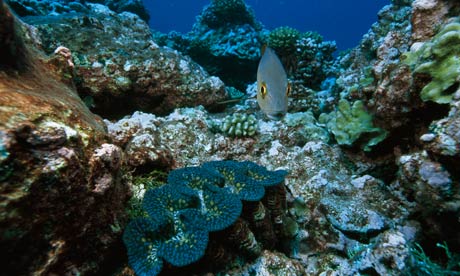
      A fish swims above a coral reef with a giant clam, Sydney Island, Phoenix Islands, Kiribati. Photograph: Paul Nicklen/NG/Getty Images

      Small island states in the South Pacific are to link up their marine resources this year in an effort to sustainably manage one tenth of the world’s oceans and boost maritime conservation globally.

      The Micronesian and Polynesian nations are implementing the network in conjunction with environmentalists to ease the impacts of over-fishing, pollution, acidification and climate change that are threatening their economic and social systems.

      The project – which aims to cover an area bigger than the combined territories of the US and Canada – was outlined during a World Oceans summit in Singapore that brought together scientists, politicians, NGOs and representatives from the fishing and shipping industries.

      It comes amid a raft of new moves to reduce the alarming deterioration of the world’s marine environment even as governments and businesses push ahead with ever more development of coastlines, industrial fishing and deep-sea mining.

      To counter these threats, Kiribati is positioning itself as a pioneer of ocean sustainability and a model for the “Blue Economy”.

      Having already created a vast nature reserve around the Pheonix Islands – which is now Unesco’s biggest natural heritage site – it signed up last September with 14 neighbouring island states to the Pacific Oceanscape Framework drawn up in conjunction with the US-based NGO, Conservation International.

      In the coming years, the signatories aim to cooperatively manage their marine resources and design policies that improve ocean health, increase resources, share expertise, and factor ocean issues into decisions about economic and sustainable development.

      Kiribati is the first state to try to put this scheme into practice. As an incentive – and to compensate for the loss of fisheries affected by the program – it will receive $5m from an endowment fund set up by Conservation International and the Global Environment Facility of the World Bank.

      It will be followed in August by Tokelau Island and Cook Island, which will add their combined sea area of 1.4m square kilometers – about three times the size of California – into the Pacific Oceanscape network.

      The president of Kiribati, Anote Tong, said his nation had learned that individual marine parks are not sufficient. “We have to connect them together,” he told delegates at the summit. “Political commitment at the highest level, with support from financial community, is essential.”

      Money remains a challenge. Hundreds of millions of dollars will be needed for the scheme to expand across all 15 states, which together account for about 40m square kilometres of ocean and a third of the world’s tuna stocks.

      Enforcement is another problem. Kiribati has only one coastguard boat to police an area the size of California. To bolster its capacity, the US coastguard has sent ships on “training missions” with Kiribati representatives on board. They have reportedly intercepted two poaching ships, which were fined several million dollars.

      This is a worldwide concern. Illegal and unreported fishing gobbles up $22bn of resources a year, almost 50% more than illegal logging, according to Malcolm Preston, global head of sustainability and climate change of PricewaterhouseCoopers.

      The search for solutions to this and other threats to the marine environment are belatedly picking up pace.

      The World Bank president, Robert Zoellick, will call on Friday for a new International Partnership for Oceans. Next week, the Antarctic Ocean Alliance – comprising conservation NGOs such as WWF, International Fund for Animal Welfare, Greenpeace and groups from China and South Korea – will launch a campaign to link 19 areas around Antarctica into what would be the world’s biggest nature reserve by an order of magnitude. The development of the “blue economy” is also expected to feature prominently at the Rio+20 meeting in Brazil in June.

      The former UK foreign secretary David Miliband said initiatives, such as that in South Pacific, showed that regional and international co-operation can promote economic growth and protect the marine environment.

      “The fact that we’re a terrestrial species on a marine planet has led to a real neglect of our oceans,” Miliband said. “In an interdependent world, you need to share sovereignty.”

      The extent to which Kiribati and its neighbours can influence the international debate remains to be seen. But Peter Seligmann of Conservation International, said these countries are playing a role that shows their true colours as “giant ocean states”.

      “In my 36 years of experience in conservation, I’ve never been involved in anything at this scale,” said Seligmann. “They are not saying they won’t have growth. But they want to manage their resources in a way that sustains culture and resources…This is the beacon on the hill. That’s what’s required.”

  • Labor faces tough battle against the Rudd rift

    Labor faces tough battle against the Rudd rift

    Updated February 24, 2012 16:05:28

    In my book The Party Thieves, I wrote that the leaks against the Gillard Government during the 2010 election campaign “was the greatest act of political bastardry in a generation”.

    I had no way of knowing who was behind them. But that’s not the point.

    What matters is that so many senior government ministers genuinely believe that Kevin Rudd was responsible.

    Yet until now, few people have understood the depth of hatred and resentment that such a belief can spawn.

    The ministers believe he sabotaged his own party at the height of an election campaign, surely the most heinous of political crimes.

    Yet still some senior political journalists speculate that Rudd can again lead the Labor Party. Such conjecture defies logic. Rudd critics in the party will see to it that never happens. There are enough of them to achieve that, no question, even if in the end Julia Gillard is no longer a viable leader.

    And when the ministers, after 20 months of repressed anger, finally tell it as they really believe it to be, they are accused of “dirty, demeaning and destructive behaviour”.

    Journalists who really believe that can hardly ever again demand honesty and candour of politicians.

    “Tell us what you really think, but don’t offend me!”

    Kevin Rudd has clearly lost the trust and confidence of the overwhelming majority of the caucus. That is why he – and his family – is going over the head of the parliamentary party and appealing to the people to rise up and phone their local member.

    As Jon Faine put it on 774:

    “He is asking people to harangue backbenchers because he himself is making no progress with them.”

    Now, of course, Rudd retaliates, as he is entitled to do.

    Gillard’s failings, as he sees them, are exposed. Attention is placed on Gillard’s ordinary performance during the election campaign.

    But Gillard supporters nevertheless are entitled to judge that the leaks were the difference between a minority and a majority government. And of course they were. Overnight, Labor lost five points in most polls, a huge hit to take at such a critical time. Several seats were lost as a result. Sure, Gillard’s own mistakes cost seats as well, but they were mistakes, not deliberate sabotage. And had the leaks not happened, she would have achieved majority government despite the self-inflicted wounds.

    How different it might have been if there hadn’t been an enemy within. Gillard would have headed up a majority government and assumed the authority, credibility and confidence that comes with that.

    With no independents or minor parties to deal with, the deadly line, “There will be no carbon tax under a government I lead,” would have been air brushed away with little relevance.

    And some wonder why, in the most testing, ugly and personally vindictive political climate that many of us have seen, the gasket finally blew?

    Consider the seniority of the ministers who this week lined up Rudd: Wayne Swan, Craig Emerson, Stephen Conroy, Tony Burke, Nicola Roxon, and Simon Crean, with Stephen Smith, Penny Wong, Bill Shorten and Peter Garrett weighing in as well, though in a more circumspect way.

    Right there is the future of the Labor Party, for better or worse, for a decade or more.

    However, because the big artillery was brought out, it will be difficult for Labor to regroup and present a united front. Even if Gillard gets twice Rudd’s vote, as she surely will, he can still make plenty of mischief from the backbench, albeit without any chance of a successful comeback.

    The Government’s only hope; the slimmest of hopes; is that Gillard emerges from the conflict with an image of toughness and strength, staring down a destabilising opponent.

    Then, with clear air, the Government sells a competent budget and gets a boost from the tax cuts and pension increases in June. Then the polls start to rise; that has its own momentum and Tony Abbott suddenly comes under some pressure of his own.

    That’s the lonely straw in the wind.

    The true mentality at work in the Government was exposed in this leadership contest.

    They bellow about who is best equipped to beat Tony Abbott.

    Can you believe that? They are in government, but it’s all about some Opposition Leader.

    Truly pathetic.

    Barrie Cassidy is the presenter of ABC programs Insiders and Offsiders. View his full profile here.

    Topics:alp, gillard-julia, rudd-kevin, government-and-politics, federal-government

    First posted February 24, 2012 15:58:43

  • Iran: Confrontation fears after talks fail

    News 10 new results for DANGER TO US NUCLEAR PLANTS
    Danger Zone: Ageing Nuclear Reactors
    Aljazeera.com
    Following Japan’s nuclear disaster last year there are fears the US may be heading for a nuclear catastrophe of its own. In March 2012, a devastating earthquake and tsunami in Japan caused a meltdown at the Fukushima nuclear power plant.
    See all stories on this topic »
    Falldown: Radioactive Fallout From Fukushima Posed Little Threat to the US
    TIME (blog)
    Just about 20% showed levels of radiation from the plant—and those levels were minimal at most, well below any threat to human health. Japan’s unfortunate nuclear nightmare provides a rare opportunity for US scientists to test an infrequently needed
    See all stories on this topic »

    TIME (blog)
    STUDY: JAPAN RADIATION POSED NO THREAT IN U.S.
    U-T San Diego
    A new study of fallout from the March 2011 nuclear plant disaster in Japan confirms earlier assessments that showed levels of radiation in the United States were far below human health concerns. The latest assessment, released Wednesday by the US
    See all stories on this topic »
    USGS finds low radiation threat from Japan
    Dalje.com
    Japan’s Fukushima nuclear power plant was crippled by a magnitude-9 earthquake and ensuing tsunami in March. The disaster sparked fears that radioactivity would become a threat in the United States. The US Environmental Protection Agency had said it
    See all stories on this topic »
    Nuclear threat to the South Shore?
    liherald.com
    The Fukushima Daiichi Nuclear Power Plant withstood the quake, but when it was hit by floodwaters, its cooling systems failed, the plant overheated and sections of it blew up, releasing high levels of radiation and forcing tens of thousands of people
    See all stories on this topic »
    People have misconception on N plants: AEC chief
    Deccan Herald
    The Atomic Energy Commission takes every safety measure to assure that nuclear plant does not pose any environmental hazard and threat on the human life. No scientific evidences are available so far to prove that radiation from the nuclear plants has
    See all stories on this topic »
    Sources: Iran set to expand nuclear activity in underground facility
    Haaretz
    By Reuters Tags: Iran nuclear Iran threat UN IAEA Iran is believed to be carrying out preparations to expand nuclear activity deep inside a mountain, diplomats say, in a further sign of defiance in the face of intensifying Western pressure to curb its
    See all stories on this topic »

    Haaretz
    ‘Harmless’ radiation found off Japanese coast
    FIS
    Scientists have detected radioactive elements from the stricken Fukushima nuclear power plant in seawater and marine organisms as far as 600km from Japan. However, this radioactivity has not been deemed dangerous, they said.
    See all stories on this topic »

    FIS
    CONFRONTATION FEARS AFTER TALKS FAIL
    National Post
    Related Iran research centre played key role in country’s ‘undeclared nuclear program’: report UN nuclear watchdog quits Iran after atomic talks fail Michael Ross: Iran leaves subtlety out of assassination plot Peter Goodspeed: Iran’s threat to plunge
    See all stories on this topic »

    National Post
    Attacking Iran Up in the air
    The Economist
    But the chances of it ending the country’s nuclear ambitions are low THE crisis has been a long time coming. Iran started exploring paths to nuclear weaponry before the fall of the shah in 1979. Ten years ago the outside world learned of the plants it
    See all stories on this topic »

    The Economist


    This once a day Google Alert is brought to you by Google.

    Delete this alert.
    Create another alert.