Category: General news

Managing director of Ebono Institute and major sponsor of The Generator, Geoff Ebbs, is running against Kevin Rudd in the seat of Griffith at the next Federal election. By the expression on their faces in this candid shot it looks like a pretty dull campaign. Read on

  • Greens say policy belongs with Hollowmen

    Greens say policy belongs with Hollowmen

    Updated: 12:00, Friday July 23, 2010

    Greens say policy belongs with Hollowmen

    Labor’s climate change policy has been described as a farcical stunt straight from the script of television’s political satire The Hollowmen.

    Prime Minister Julia Gillard outlined the policy on Thursday, pledging $1 billion over 10 years to make the national electricity grid more friendly to renewable energy.

    Ms Gillard also promised tougher standards for new coal-fired power stations.

    The prime minister also outlined plans for a citizens’ assembly of 150 people to discuss issues including an emissions trading scheme, which Labor will review in 2012.

    The Australian Greens were less than impressed, saying the announcement added hot air to the global warming problem.

    Climate change spokeswoman Christine Milne described the assembly as a ‘gabfest’ and ‘ideally suited to the Hollowmen’, the ABC’s hit comedy series.

    ‘The real community representative assembly is actually up for election right now,’ she told reporters in Canberra.

    Labor will try to ‘hide behind’ the assembly’s mandate to reach community consensus, when the Greens insist on a carbon price, Senator Milne warned.

    ‘The prime minister is not going to be able to get away with (that).’

    Senator Milne welcomed the $1 billion investment but said it wouldn’t ‘take the grid very far at all’.

    Business- and climate-conscious voters would have ‘nowhere to go’ but the Greens if they wanted to see action, she said.

    ‘Vote Green and give us the power in the Senate to … embarrass whichever party is in government into (action) on a carbon price.’

  • Monkton’s response to John Abraham is magnificently bonkers


    Throughout these 99 pages, Monckton ducks, dives and, like Ian Plimer, avoids answering Abraham’s questions by asking questions of his own: Monckton asks almost 500 of them. As far as I can see, he fails to provide a straight or convincing refutation of any of Abraham’s criticisms, and succeeds only in throwing a great deal of dust into the air.


    All this is accompanied, like so many of Monckton’s responses, with a demand for money (in this case $110,000 to be paid to a charity of Monckton’s choice), an apology and retraction and an insistence that Abraham’s critique be removed from all public places.


    Reading these ravings, I’m struck by two thoughts. The first is how frequently climate change deniers resort to demands for censorship or threats of litigation to try to shut down criticism of their views. Martin Durkin has done it, Richard North has done it, Monckton has done it many times before. They claim to want a debate, but as soon as it turns against them they try to stifle it by intimidating their opponents. To me it suggests that these people can give it out, but they can’t take it.


    The second thought is as follows: is this the man who was invited to testify before Congress? Who has become deputy leader of the UK Independence party? Who has been cited all over the internet as having proved that manmade climate change isn’t happening?


    One of the characteristics of the foot-soldiers of climate change denial seems to be their startling inability to spot a wrong ‘un. As well as publishing a long series of falsehoods about climate change, Monckton has falsely claimed to be a member of the House of Lords (although you can read his explanation here); falsely claimed to be a Nobel laureate; falsely claimed to have won the Falklands war (by suggesting to Margaret Thatcher that the SAS introduce a mild bacillus into the water supply in Port Stanley); maintained that he has invented a cure for HIV, multiple sclerosis, influenza and other diseases; and grossly exaggerated his role in shaping Margaret Thatcher’s views. Yet none of this seems to have discouraged his disciples one jot.


    There’s a pattern here too. Those who insist that sea levels are not actually rising, for example, often cite the work of Nils-Axel Morner, who maintains that his work in the Maldives proves that it’s all a false alarm. Our old friend Christopher Booker claimed that Morner “knows more about sea levels than anyone else in the world”, that he “has been using every known scientific method to study sea levels all over the globe” and that his findings demonstrate that “all this talk about the sea rising is nothing but a colossal scare story.”


    Morner’s work in fact consists of indirect measurements in just a few locations, which reveal the sum total of zilch about recent changes in sea level and have not been published in a peer-reviewed journal. But the interesting thing, which connects this to the Monckton issue, is that Morner has also made a series of wild claims about other matters. He maintains that he possesses paranormal abilities to find water and metal using a dowsing rod. He also insists that he has discovered “the Hong Kong of the [ancient] Greeks” in Sweden. Working with a homeopath called Bob Lind, Morner inflicted unauthorised damage on an Iron Age cemetery in order to try to prove his thesis.


    Similarly, Peter Taylor’s claims that the planet is in fact cooling down have been given prominence by the Daily Express and other outlets, though they are unfounded in science. His book Chill has been a hit in the denier community. Taylor has also claimed to have uncovered toxic dumping by venturing into the astral realms. He has speculated that a Masonic conspiracy was tuning into his thoughts, and had sent a “kook, a ninja freak, some throwback from past lives” to kill him. He has also maintained that plutonium may “possess healing powers, borne of Plutonic dimension, a preparation for rebirth, an awakener to higher consciousness”.


    As these examples suggest, those who lead the movement which claims that manmade climate change isn’t happening often seem to entertain a number of other irrational beliefs.


    In May, New Scientist interviewed the social psychologist Seth Kalichman, who has studied HIV denialist groups. He found that the leaders of these groups “display all the features of paranoid personality disorder”.


    These features include an intolerance of criticism and an inflated sense of their own importance. They succumb to what psychologists call “suspicious thinking”.


    The cognitive style of the denialist represents a warped sense of reality, which is why arguing with them gets you nowhere … All people fit the world into their own sense of reality, but the suspicious person distorts reality with uncommon rigidity.


    I’m no psychologist, but the wide range of crazy beliefs the gurus of climate change denial entertain suggests that something of the kind that Kalichman identifies is likely to be at play. The question which bugs me is this: why, when it seems so obvious that men like Monckton, Morner and Taylor have serious issues with reality, are so many people prepared to follow them?


    www.monbiot.com

  • Google climate map offers a glimpse of a 4C world

    Google climate map offers a glimpse of a 4C world

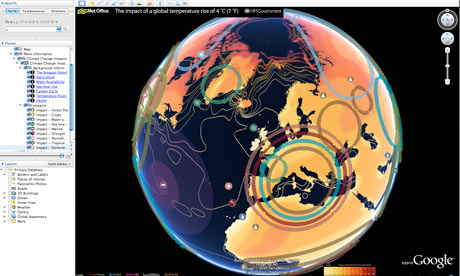
    Interactive tool layering climate data over Google Earth maps shows the impact of an average global temperature rise of 4C


    A new interactive Google Earth map showing the impacts of a 4°C world A new interactive Google Earth map was developed using peer-reviewed science from the Met Office Hadley Centre and other leading impact scientists. Photograph: earth.google.co.uk

    Think it’s hot this summer? Wait until you see Google’s simulation of a world with an average global temperature rise of 4C.

    Using a map that was first launched by the former Labour administration in October 2009, the coalition government has taken temperature data from the Met Office Hadley Centre and other climate research centres and imposed it on to a Google Earth layer.

    It’s a timely arrival, with warnings this month that current international carbon pledges will lead to a rise of nearly 4C and the Muir Russell report censuring some climate scientists for not being more open with their data (but exonerating them of manipulating the scientific evidence).

    Unlike a similar tool using IPCC data that was launched by Google in the run-up to the Copenhagen climate conference last year, this map will be updated regularly with new data. It also has a series of YouTube videos of experts across the globe, with Met Office staff talking about forest fires in sub-Saharan Africa and researchers at the Tyndall Centre for Climate Change Research explaining sea level rises. To go more in-depth you can follow links to government sites, such as this one on water availability in a warming world.

    Playing with the layer is surprisingly addictive, mainly thanks to Google Earth’s draggable interface. Unlike the static map of last year, it also has the bonus of showing more obviously how temperature rises will differ drastically around the world. The poles glow a red (a potential rise of around 10C) while most of northern Europe escapes with light orange 2-3C rises. Other hotspots, such as Alaska, the Amazon and central Asia, also stand out.

    Neatly, you can turn different climate “impacts” on and off. If you just want to see which regions will be worst affected by sea level rises – such as the UK and Netherlands as well as low-lying island states – you can. One limitation is that you have to zoom out to continental level to see the layer: if you’re zoomed on your street, you can’t see it.

    Climate change minister Greg Barker launched the map today alongside the government’s chief scientist, Prof John Beddington. Barker said: “This map reinforces our determination to act against dangerous man-made climate change. We know the stakes are high and that’s why we want to help secure an ambitious global climate change deal.”

    The layer, of course, isn’t the only one with an environmental theme to land on Google Earth. The UN’s environment programme has one showing deforestation, WWF has a layer highlighting its projects across the globe and Google even has its own climate change “tours” for Google Earth. What other good green Earth layers have you stumbled across? And how do you rate the newest addition from the UK government?

    • The KML layer of The impact of a global temperature rise of 4C is available now (you’ll need a browser plug-in or the Google Earth app installed to view it)

  • Gillard urged to spell out plan to tackle climate change


    “It is as disappointing to me as it is to millions of Australians that we do not have a price on carbon,” she said.

    “If elected as Prime Minister I will re-prosecute the case for a carbon price at home and abroad.”

    Opposition environment spokesman Greg Hunt told The Australian Online today that the only option open to Ms Gillard was to adopt a form of the Coalition’s policy.

    “I think we are set for the government to adopt significant elements of the Coalition’s policy, but in standard practice, to deny that they’ve done it,” he said.

    He also accused Ms Gillard of engaging in a “deliberate deception”.

    “On the first day she clearly indicated to the Australian people that she intended to proceed with an ETS and carbon pricing. And that was a deliberate deception and she’s been forced to back down within two weeks.”

    Mr Hunt concluded that if the Prime Minister wouldn’t consider proceeding with an ETS until 2012 it would not be implemented until at least 2014.

    Senator Brown has also reacted angrily to the postponement of a carbon price.

    “Australians are going to be thoroughly disappointed,” he said.

    “This is really a failure of action by a future Gillard government and it’s being dragged to the electorate before the election.”

    A paper released yesterday at the Lowy Institute that charting an alternate path to address global climate change also appeared to be dismissed by the government yesterday.

    The paper – co-authored by economist and Reserve Bank board member Professor Warwick McKibbin – recommends that the Major Economies Forum instead of the UN should move to implement a carbon price because its 17 members were responsible for 80 per cent of carbon emissions world-wide.

    It would see heavy-polluting countries like Australia, the US and China agree to set a similar carbon price, to rise over time, while the UN could continue with its own efforts.

    But the office of Climate Change Minister Penny Wong was dismissive of the proposal.

    “Our efforts are best focused on implementing the pledges already made through the Copenhagen Accord, rather than spending valuable time re-negotiating the whole global framework for tackling climate change,” a spokeswoman told The Australian Online.
     

  • Andrew Macintosh’s dissection of Tim Flannery’s latest sillyness

    Worth reading Andrew Macintosh’s dissection of Tim Flannery’s latest
    silliness:

    12. Flannery on the CPRS: separating fact from Flannery
    Associate director of the ANU Centre for Climate Law and Policy Andrew
    Mcintosh writes:

    CLIMATE CHANGE, CPRS

    In the Sydney Morning Herald on the weekend, Professor Tim Flannery
    attacked the Liberals and the Greens for their positions on the Carbon
    Pollution Reduction Scheme (CPRS), calling them liars and stating that
    their claims are “just plain wrong”. In the interests of an honest and
    accurate debate, I decided to see whether I could find any errors or
    untruths in Flannery’s article. It wasn’t hard. After extracting the
    errors, there is not much left of the article. Set out below are details
    of his biggest howlers (in the order they appear in the article).
    Claim: “If implemented, it [the CPRS] would see Australia emitting 5 per
    cent less greenhouse gas in 2020 than it did in 2000″.
    Fact: Wrong. If the CPRS was introduced with a 5% target, Australia’s
    emissions would probably increase. However, Australia’s net emissions —
    domestic emissions less imported offset credits — would decline. Provided
    the imported credits represent actual abatement, they will not undermine
    the environmental integrity of Australia’s target. Yet the extent to which
    these credits will represent actual abatement is still uncertain and, to a
    large extent, will depend on the outcomes from the current international
    negotiations.
    Claim: Nicholas Stern’s analysis suggests that “humanity is set to be
    emitting 48 billion tonnes of CO2 by 2020 – up a mere billion tonnes from
    today’s 47 billion tonnes”.
    Fact: Wrong on two fronts. First, Flannery uses incorrect units. Current
    emissions of carbon dioxide (CO2) are about 36 billion tonnes (Gt), not 47
    Gt. He presumably meant emissions of carbon dioxide equivalents (CO2-e).
    Second, Stern’s analysis does not show that “humanity is set to be
    emitting” 48 GtCO2-e by 2020. Flannery refers to a recent article by Stern
    in the New York Review of Books as his source. The full details of Stern’s
    analysis are contained in a paper co-authored by Chris Taylor (a senior
    economist in the UK Department of Energy and Climate Change) that was
    published in March 2010 by the Grantham Research Institute and the Centre
    for Climate Change Economics and Policy.
    The paper concludes that global emissions are likely to be 48.2 GtCO2-e in
    2020 but only if all countries adopt and achieve their highest targets, no
    surplus emissions allowances are carried over from the first commitment
    period of the Kyoto Protocol, there is no double counting of mitigation
    commitments, the rules regarding terrestrial carbon do not weaken the
    level of ambition and economic development in developing countries follows
    current expectations.
    These caveats on Stern and Taylor’s projections are of critical
    importance, a point they stress. Combined, the caveats almost represent
    the difference between the projected 48.2 GtCO2-e and emissions under
    “business-as-usual” conditions. And to suggest that all of these areas of
    uncertainty are going to fall in favour of a strong mitigation outcome is
    extremely optimistic; some might say delusional. Even if the analysis is
    confined to whether all countries will adopt their high-end target, it
    takes an eternal optimist to believe the international negotiations are
    headed for this sort of outcome. For example, Australia’s target range is
    5%-25% reductions below 2000 levels by 2020. Yet discussion of Australia
    going beyond 15% has all but dried up. Similar dynamics are playing out in
    other developed and developing countries.
    Claim: “To avoid dangerous climate change (a warming of less than 2
    degrees) we need to reduce emissions to about 44 billion tonnes by 2020.
    This could be achieved if Europe agrees on its planned 30 per cent target
    rather than the current 20 per cent, and the US and other developed
    nations increase their own targets by a few percentage points”.
    Fact: Wrong. Stern and Taylor’s conditional estimate of 48 GtCO2-e already
    assumes Europe and every other party that has a conditional pledge adopts
    and implements their high-end target. Stern makes this point in his
    article in the New York Review of Books when he states, “If countries
    deliver their ‘high intention’ reductions, the plans submitted to the
    Copenhagen Accord would result in global annual emissions of about 48
    billion metric tones of carbon-dioxide equivalent in 2020″.
    To bring global emissions down to 44 GtCO2-e in 2020, both developed and
    developing countries need to raise their pledges significantly — a few
    percentage points within the current range is not enough. For developed
    countries, the pledges currently add up to cuts of between 10%-14% below
    1990 levels. As analysis by the Intergovernmental Panel on Climate Change
    (IPCC) has shown, to provide a realistic chance of keeping warming to 2°C,
    the aggregate reduction in developed countries has to be greater than 25%.
    Current pledges fall well short of what is required.
    Claim: “If Australia increased its target from 5 per cent to between 7 per
    cent and 15 per cent, we could rightly say we were contributing our fair
    share to the global target. This is a far cry from the Greens’ unrealistic
    demands for 25 per cent to 40 per cent cuts.”
    Fact: What constitutes a “fair” contribution to a 2°C outcome is
    subjective and there is no universally accepted method for “equitably”
    distributing the global abatement burden among countries. Having said
    that, the notion that Australia could adopt a target of 7% for 2020 and
    say it is making a fair contribution is difficult to defend. Under
    Flannery’s approach, Australia’s per capita emissions in 2020 would be
    almost three times larger than Europe’s and four times the global average.
    Other developed countries are unlikely to accept such a low target, to say
    nothing of developing countries.
    Claim: The CPRS is one of the emissions trading schemes “with the fewest
    give-aways of free permits” in the world, “with 70 per cent to be
    auctioned”.
    Fact: In the early years of the CPRS, the proportion of free permits
    issued to coal-generators and emissions-intensive trade-exposed industries
    would be about 30%. However, by 2020, the proportion of free permits
    allocated to these industries would rise to about 50%.
    Claim: “The Greens argue that allowing industry to offset emissions into
    forestry and agriculture is a kind of get-out-of-jail card for polluters.
    Again, this is not true. Offsets into agriculture will have to be real,
    and will come at a cost”.
    Fact: The rules regarding terrestrial carbon offsets have yet to be
    determined for the post-2012 international climate regime and the CPRS.
    Therefore, it is impossible at this stage to say whether these offsets
    “will have to be real”. Under the present international regime, one of the
    main issues with terrestrial carbon offsets is “additionality” — the
    offsets often do not represented an actual decrease in emissions or
    increase in removals beyond what would have occurred under normal
    circumstances.
    Claim: Emissions trading schemes do not impose any costs on the economy.
    In Flannery’s words “It is increasingly clear only one thing changes when
    emissions trading schemes are introduced — the level of emissions”.
    Fact: Wrong. The only way this could be correct is if there was a
    limitless supply of zero cost abatement. If there was, we would not need
    an emissions trading scheme.
    Send your tips to boss@crikey.com.au or submit them anonymously here.

  • What’s the carbon footprint of …a bushfire?

    If you were looking for the single most carbon-intensive thing you could do in your live, starting a bushfire would be a fairly good candidate. That one strike of a match could make your footprint many thousands of times greater than most people achieve over their lifetimes.

    The estimate given above is for the catastrophic “Black Saturday” bushfires in Australia last year. It assumes that 450,000 hectares (1750 square miles) of forest containing 100 tonnes of carbon per hectare was burned, and that all of that carbon becomes CO2. It’s an extremely approximate figure, for sure (some of the carbon would doubtless remain in place) but it does give a sense of the scale. To put 165 million tonnes of CO2e into perspective, the most recent estimate of Australia’s entire annual footprint was 529 million tonnes CO2e, so the fires may have added nearly one-third.

    Emissions from bushfires vary from year to year. In 1997–98 they are thought to have been around 2.1 billion tonnes. In theory, regrowth will absorb the CO2 from the air in time, thus making the fire carbon neutral in the long term. However, it is looking increasingly likely that permanent changes in terrain are taking place, almost certainly helped along by a nasty feedback loop that sees climate change cause drier forests, which in turn lead to more fires, more emissions and more climate change. And so on.

    Furthermore, even if the fires were neutral overall in terms of CO2, they are also a major source of black carbon – also known as soot – which acts as a powerful but short-lived greenhouse gas and one of the key drivers of man-made climate change.

    See more carbon footprints.

    • This article draws from How Bad Are Bananas? The Carbon Footprint of Everything by Mike Berners-Lee.