Category: Energy Matters

The twentieth century way of life has been made available, largely due to the miracle of cheap energy. The price of energy has been at record lows for the past century and a half.As oil becomes increasingly scarce, it is becoming obvious to everyone, that the rapid economic and industrial growth we have enjoyed for that time is not sustainable.Now, the hunt is on. For renewable sources of energy, for alternative sources of energy, for a way of life that is less dependent on cheap energy. 

  • Magnesium oxide: From Earth to super-Earth

    ScienceDaily: Earth Science News


    Magnesium oxide: From Earth to super-Earth

    Posted: 22 Nov 2012 12:29 PM PST

    The mantles of Earth and other rocky planets are rich in magnesium and oxygen. Due to its simplicity, the mineral magnesium oxide is a good model for studying the nature of planetary interiors. New work studied how magnesium oxide behaves under the extreme conditions deep within planets and found evidence that alters our understanding of planetary evolution.

  • More than 1,000 new coal plants planned worldwide, figures show

    More than 1,000 new coal plants planned worldwide, figures show

    World Resources Institute identifies 1,200 coal plants in planning across 59 countries, with about three-quarters in China and India

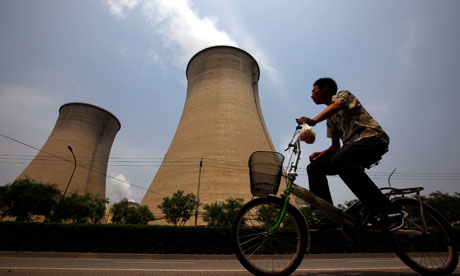
    Coal-burning power station in Beijing, China

    A coal-burning power station in Beijing, China – the country is planning to build 363 new coal-fired power plants. Photograph: David Gray/Reuters

    More than 1,000 coal-fired power plants are being planned worldwide, new research has revealed.

    The huge planned expansion comes despite warnings from politicians, scientists and campaigners that the planet’s fast-rising carbon emissions must peak within a few years if runaway climate change is to be avoided and that fossil fuel assets risk becoming worthless if international action on global warming moves forward.

    Coal plants are the most polluting of all power stations and the World Resources Institute (WRI) identified 1,200 coal plants in planning across 59 countries, with about three-quarters in China and India. The capacity of the new plants add up to 1,400GW to global greenhouse gas emissions, the equivalent of adding another China – the world’s biggest emitter. India is planning 455 new plants compared to 363 in China, which is seeing a slowdown in its coal investments after a vast building programme in the past decade.

    “This is definitely not in line with a safe climate scenario – it would put us on a really dangerous trajectory,” said the WRI’s Ailun Yang, who compiled the report, considered to be the most comprehensive in the public domain. But she said new emissions limits proposed in the US and a voluntary cap on coal use in China could begin to turn the tide. “These policies would give really strong signals about the risks to the future financial performance of coal of climate policies.”

    Nick Robins, head of the Climate Change Centre at HSBC, said: “If you think about low-carbon energy only in terms of carbon, then things look tough [in terms of not using coal]. But if you take into account all factors, then dealing with coal [ie not using it] looks a little less difficult.”

    He cited the increasing replacement of coal with shale gas and renewable energy, tightening air pollution regulations, the gradual cleaning of economies like China’s and the increasing scarcity of water, which is needed in large quantities by coal-fired power stations.

    “We expect financiers and investors increasingly to include these factors into investment decisions for coal to avoid the threat of stranded assets,” Robins said.

    The WRI report also found that, after a slight dip during the economic troubles of 2008, the global coal trade has rebounded and rose by 13% in 2010. A structural shift has moved the bulk of the international coal trade from the Atlantic, serving Europe and the US, to the Pacific. China became a net importer of coal in 2009 but the biggest changes are fast-rising imports by Japan, South Korea and Taiwan, which all have large numbers of coal-fired plants but produce virtually no coal of their own.

    However, Germany, the UK and France remain in the top 10 importers, and coal use rose 4% in 2011 in Europe as prices fell and plants due to close under clean air rules use up their allotted running hours. Indonesia and Australia are the largest coal exporters, with the latter planning to triple its mine and port capacity to almost 1bn tonnes a year.

    Many developing countries, such as Guatemala, Cambodia, Morocco, Namibia, Senegal and Sri Lanka, and Uzbekistan, are planning new coal-fired plants even when they produce almost no coal at all. “There is a long way to go to raise awareness that you can meet energy needs from sources other than coal,” said Yang.

    Most new coal-fired plants will be built by Chinese or Indian companies. But new plants have largely been financed by both commercial banks and development banks. JP Morgan Chase has provided more than $16.5bn (£10.3bn) for new coal plants over the past six years, followed by Citi ($13.8bn). Barclays ($11.5bn) comes in as the fifth biggest coal backer and the Royal Bank of Scotland ($10.9bn) as the seventh. The Japan Bank for International Co-operation was the biggest development bank ($8.1bn), with the World Bank ($5.3bn) second.

    Guy Shrubsole, at Friends of the Earth, said of the WRI report: “This is a scary number of coal-fired plants being planned. It is clear that the vested interests of coal companies are driving this forward and that they will have to be reined in by governments.”

    In January, the Bank of England was warned that fossil fuel sub-prime assets posed a systemic risk to economic stability, because only 20% of the reserves of the top 100 coal and top 100 oil and gas companies could be burned while keeping the global temperature rise under the internationally agreed limit of 2C.

  • Iran steps up pace and capacity of uranium enrichment, says IAEA report

    Iran steps up pace and capacity of uranium enrichment, says IAEA report

    Israel’s ‘red line’ could be hit in June, the point when Iranians have enough 20%-enriched uranium to produce a warhead

    Binyamin Netanyahu

    Iran’s uranium-enrichment programme is more the 70% of the way to producing a nuclear weapon, Israel’s prime minister, Binyamin Netanyahu, tells the UN. Photograph: Mario Tama/Getty Images

    Iran has expanded its enrichment capacity and is enriching uranium at a pace that would bring it to what Israel has declared an unacceptable red line in just over seven months, according to a report by the UN nuclear watchdog.

    The International Atomic Energy Agency also found that Iranian technicians had removed the fuel rods from the country’s only functioning nuclear power station at Bushehr, suggesting the new reactor has serious problems. Iran did not tell IAEA inspectors what those problems were.

    The IAEA quarterly report on Iran’s nuclear programme was released just days before the expected launch of a new diplomatic initiative to resolve the international impasse over the issue.

    It also comes soon after Israeli official stated that the red line drawn by Israel’s prime minister, Binyamin Netanyahu, during his UN appearance in September, represented 240kg of 20%-enriched uranium, enough to make a warhead if further enriched to weapons grade.

    The sensitivity of 20% uranium figure is that it can be turned into weapons grade relatively fast and easily.

    The last time the IAEA inspectors drew up a report, three months ago, Iran had made 189kg of 20% uranium but had used nearly 100kg for civilian purposes, leaving an outstanding 96kg.

    In the last three months, that stockpile has grown by 43kg and Iran has not diverted any more of it to civil uses. At the current steady rate of production, that would bring Iran to the Israeli red line by mid-June. But it also installed new centrifuges at its underground enrichment plant in Fordow, with which it could double its rate of production if it chose to do so.

    However, it could also decide to divert more uranium to civilian uses, or – as western diplomats hope – strike a deal, exchanging 20% uranium for sanctions relief, and thus defuse the crisis.

    Diplomats from six major powers are due to meet next week to discuss a common negotiating strategy as an expected prelude to restarting high-level talks with Iran at about the end of this month.

  • Scientists unlock nature’s hydrogen secrets

    Scientists unlock nature’s hydrogen secrets

    Updated Sat Nov 10, 2012 12:15am AEDT

    Two Canberra scientists believe they have made a major breakthrough in how to best produce hydrogen which can be used as a clean and renewable energy source.

    Professors Rob Stranger and Ron Pace from the Research School of Chemistry at the Australian National University (ANU) have used computer modelling to reveal the molecular structure of the photosynthesis reaction site in plants.

    Professor Pace says the discovery takes a leaf out of nature’s handbook, for the first time identifying the specific water molecules in a plant’s photosystem that are converted into oxygen.

    “Nature very early on in the evolutionary process on Earth figured out how to do this particular piece of chemistry with close to 100 per cent efficiency,” he said.

    Professor Stranger says the work offers clues as to how scientists can create alternative fuel.

    “The part of the plant’s photosystem that is important to this process is called the oxygen-evolving-complex (OEC),” he said.

    “If we can steal nature’s secrets and understand how the OEC performs its chemistry, then we can learn to make hydrogen much more efficiently, and hydrogen is the fuel for a totally renewable fuel future.”


    Professor Pace says that while scientists know the OEC contains four manganese atoms and a calcium atom, they have been trying for decades to determine the exact structure of the system and how it works.

    “Our work confirms the OEC structure and means researchers can progress new fuel developments based on photosynthesis,” he said.

    New method

    Scientists have been splitting water molecules to create hydrogen gas for decades, but the process requires electricity.

    Professor Stranger says the current system of using electricity from other sources to create hydrogen is wasteful and not ideal.

    “This has been a very big challenge for chemists and scientists,” he said.

    “We did computer modelling to try and rationalise [how photosynthesis does it] and try and make sense of it.

    “So did a lot of other people worldwide, but they didn’t get anywhere with it, but we were able to.”

    Professor Pace says other scientists had less luck because they underestimated nature’s creativity.

    “It turns out that nature very cleverly doesn’t charge the process up more than is absolutely necessary,” he said.

    “That’s what’s confused our colleagues because they believed that the chemistry wasn’t quite that clever.

    “We can see now that you don’t need to use as much electric charge as was previously thought, which is very important.

    “The more you do that, the more dangerous you make this reaction, which is already the most dangerous reaction in nature.”

    The next step for the two scientists is to publish their findings before handing it over to a laboratory to try and mimic the process of photosynthesis, something they believe will be a reality within five years.

    But Professor Pace is quick to ease thoughts the future will involve leaving a car in the sun and fuelling it up with a garden hose.

    “If I was a shonk I’d tell you yes,” he said.

    “But in fact that’s not the way I see it sensibly happening.”

    Topics:earth-sciences, alternative-energy, energy, act, canberra-2600

    First posted Fri Nov 9, 2012 7:33pm AEDT

  • London Array wind turbines generate first power

    London Array wind turbines generate first power

    First turbines have begun to generate electricity in what will become the world’s largest offshore windfarm

    London Array offshore wind farm

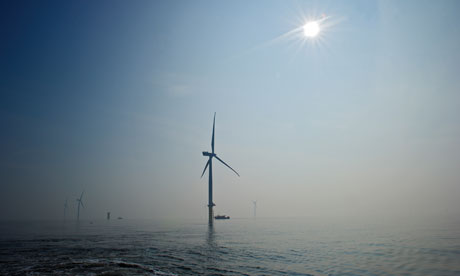
    The London Array will be the world’s largest offshore windfarm when completed. Photograph: Mark Turner/London Array Limited

    The first power has been generated from the world’s largest offshore windfarm, the companies behind the scheme said on Monday.

    The first phase of the London Array project, around 12 miles off the coasts of Kent and Essex in the Thames Estuary, will see 175 turbines generating enough power to supply more than 470,000 homes.

    Already 151 turbines have been installed since construction began in March 2011, and when the first phase is completed by the end of the year, the 630-megawatt scheme will be the largest offshore windfarm in the world, the companies said.

    If approved, the second phase will add enough turbines to bring the total capacity of the windfarm to 870MW. The plans have had to be resubmitted with a reduction in the area the turbines would cover following concerns the scheme would hit the red-throated diver population in the estuary.

    Dong Energy has a 50% stake in the project, energy giant E.ON owns 30% and Abu Dhabi renewables company Masdar has a 20% stake.

    Benj Sykes, wind UK country manager at Dong Energy, said: “Being able to efficiently develop large offshore windfarms and harvest the scale advantages in both construction and operation is an important element in our continuous efforts to bring down the costs of energy of offshore wind.”

    Tony Cocker, chief executive of E.ON UK, described the first generation of power as an important milestone not only for London Array but for the global renewables sector.

    He said: “We firmly believe that electricity from renewable sources has a vital part to play in helping us deliver energy in a way that is sustainable, affordable and secure and this is why we are aiming to reduce the costs of offshore wind by 40% by 2015.”