Category: Energy Matters

The twentieth century way of life has been made available, largely due to the miracle of cheap energy. The price of energy has been at record lows for the past century and a half.As oil becomes increasingly scarce, it is becoming obvious to everyone, that the rapid economic and industrial growth we have enjoyed for that time is not sustainable.Now, the hunt is on. For renewable sources of energy, for alternative sources of energy, for a way of life that is less dependent on cheap energy. 

  • Solar islands floated as clean energy source for crowded continents

    Solar islands floated as clean energy source for crowded continents

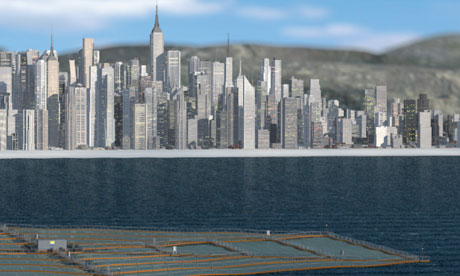
    There are no palm trees to be found on this sunny island, which could generate enough electricity for 30,000 people

    SUNdy, a large scale floating offshore solar field concept

    SUNdy, a large scale floating offshore solar field concept by consultancy DNV. Photograph: DNV

    Global consultancy and certification firm DNV has unveiled designs for floating solar arrays that could rival offshore wind farms.

    The plans envisage a group of hexagonal artificial islands linked together and supporting 4,200 solar photovoltaic panels across an area the size of a football stadium. Multiple islands connected together could then make up a solar field of 50MW or more, producing enough electricity for 30,000 people.

    The concept, dubbed SUNdy, is made possible using 560W thin film solar panels, which are lighter and more flexible than traditional glass-based modules, allowing them to move with the waves on the sea’s surface.

    DNV says separating the solar arrays into prefabricated sections allows for large-scale manufacturing and streamlined assembly offshore, while the cable grid provides for maintenance access in the form of floating gangways. Below the surface, the island is then kept in shape by lengthy spread mooring.

    Bjørn Tore Markussen, chief operational officer at DNV KEMA Energy & Sustainability Asia, said SUNdy allows even the most densely populated countries to power their economies with renewable energy.

    “Many countries are turning to solar technology and renewable energy because of a need for alternative energy sources and environmental concerns,” he said.

    “We firmly believe the SUNdy floating solar field concept offers sound and sustainable development prospects, particularly in Asia and the congested coastal megacities where there’s limited opportunity for rooftop solar power and urban areas which command premium prices for large-scale mounted solar production.”

  • $1b waste as infrastructure gathers dust

    $1b waste as infrastructure gathers dust

    0
    Substation

    The $40 million substation in Charlestown. Picture: Waide Maguire Source: The Daily Telegraph

    POWER users paid for a $40 million substation as part of $1 billion spent on gold-plating electricity infrastructure – and it’s not even hooked up to the grid.

    State-owned energy company Ausgrid spent the cash in breach of national electricity guidelines, with the costs passed on to consumers as higher network charges on their quarterly power bills.

    The company is planning to spend another $1 billion on pointless upgrades to poles and wires over the next two years, potentially adding a further $502 to the annual family power bill, according to the national regulator.

    A report commissioned by the Australian Energy Market Commission into recent electricity price hikes revealed that Ausgrid had “overspent” $1 billion on Sydney‘s power distribution network between 2005 and 2009.

    As one example of the so called “gold plating” pushing up power prices, it was revealed $40 million was spent on a needless substation built on the outskirts of Newcastle which would not be needed for another decade, and which a Senate inquiry has been told was not even connected to the power grid. Another, at a cost of $25 million, was built in Warringah and would not be “cost effective” for at least five years.

    Ausgrid, which owns and operates the power distribution network for Sydney, the Central Coast and the Hunter, also overspent $83 million on IT services and had paid almost $100 million for land in the Sydney CBD.

    “Ausgrid overspent on capex by approximately $925 million compared to the benchmark expenditures set by the regulators,” the report by independent auditors Parson Brinckerhoff revealed.

    A second report by the the Australian Energy Market Operator also revealed that Ausgrid was set to spend another $1 billion in 2013-2015 on network improvements that were not needed.

    The AEMO said that if the government cancelled the spending planned for next year, it would save $50 immediately for families struggling to pay their bills and up to $502 in annual savings by 2015.

    Both reports have been provided to a federal committee set up by Prime Minister Julia Gillard to investigate the reasons for power price rises in NSW.

    “The committee has heard evidence of gold plating by state-owned network businesses and consumers have been paying for this through their electricity bills,” committee chair Senator Matt Thistlethwaite said.

    “The states have failed to tackle this issue so the committee is considering measures to eliminate over-investment by network businesses and reduce pressure on household bills.”

    The AEMO has called for a more flexible cost-benefit approach to future planning for the electricity network.

  • Methane conversion makes piggery carbon neutral

    Methane conversion makes piggery carbon neutral

    ABCUpdated October 25, 2012, 10:54 am
    A pig farm in central western New South Wales is Australia s first to offset its carbon emissions.

    ABC © Enlarge photo

    A pig farm in central-western New South Wales has started converting methane from the animals’ manure into electricity, to become the first piggery to completely offset its carbon emissions.

    The electricity generated is helping power the farm at Young.

    Federal Parliamentary Secretary for Climate Change Mark Dreyfus is officially launching the project that entitles the farmers to earn carbon credits for capturing the gas.

    The farm’s owner, Edwina Beveridge, says it has been a huge success.

    “We’re the first farm,” she said.

    “I believe the people before us are flaring land fill gas, so we’re the first farm, first people in New South Wales, first pig farm, first of a lot of things.

    “I will have to do some calculations based on the electricity we generate. A rough estimate we expect that we might be able to earn $80,000 a year.”

    The piggery no longer has power bills as a result of the project.

    “Our electricity and gas bill combined used to be about $15,000 a month,” Ms Beveridge said.

    “We are now earning $5,000 a month with selling excess electricity. The project has, we think, a three-year payback period, so you can do the maths.

    “It’s nice to be at the head of the pack.”

  • UK public favours wind turbines over shale gas wells, poll finds

    UK public favours wind turbines over shale gas wells, poll finds

    More than two-thirds of people would rather have a wind turbine than a shale gas well near their home

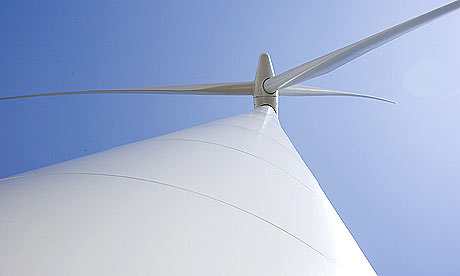
    Wind turbine

    An ICM poll found that 67% of people would prefer a wind turbine than a shale gas well near their home. Photograph: Murdo Macleod for the Guardian

    More than two-thirds of people would rather have a wind turbine than a shale gas well near their home, according to a new opinion poll published on Tuesday.

    Asked to choose between having the two energy sources within two miles of their home, 67% of respondents favoured a turbine, compared to just 11% who would support the gas development.

    The findings of the UK-wide ICM survey shows that only nuclear power and coal are less popular than shale gas developments.

    The ICM poll, together with a second new poll from YouGov, show public opinion is against George Osborne’s push for a new “dash for gas” as the central plank of the government’s energy policy.

    The polls come at a critical time for the government’s energy bill, which aims to deliver the £200bn required to replace and develop the nation’s ageing energy infrastructure, due to be published on 5 November. The investment required will be added to household energy bills that are already rising and proving a political headache for David Cameron.

    “This [ICM] poll puts to the sword the myth that the public are set against onshore wind and wish to rush into a second dash for gas,” said Paul Monaghan, head of social goals at the Co-operative, which commissioned the ICM poll for the launch of the Co-op’s Manifesto for a community energy revolution which it is backing with £100m of investment.

    The poll showed 49% of people would support a wind turbine being erected within two miles of their home, with 22% against. But if the project were community-owned, support rose to 68% and opposition plummeted to 7%. In Germany, where 65% of its huge renewable energy capacity is community-owned, opposition is much rarer than in UK where community ownership is less than 10%.

    Onshore windfarms have become an increasingly divisive issue, with 100 backbench Conservative MPs demanding subsidy cuts from Cameron earlier this year. Negotiations over the energy bill have been severely hampered by a feud between Osborne and the Liberal Democrat energy secretary, Ed Davey.

    But new energy minister and Tory MP, John Hayes, told the Guardian the onshore wind controversy has cast a shadow over the wider energy debate and that it could be resolved by the current consultation over community benefits from renewable energy projects, which could see local people getting lower bills, for example.

    “Appropriately sited onshore wind has a role to play, but if we’re to make this work in a way that garners popular support, we’ve got to see a big improvement in how developers engage with local communities, new ways of ensuring a sense of local ownership and more obvious local economic benefits,” said Hayes, when launching the consultation.

    “The new research demonstrates we need to see a stronger deployment of community-owned projects, especially in those parts of the country where a small, but highly vocal, minority are blocking progress,” said Monaghan. “The UK has made massive strides in recent years with its renewables generation capacity, and it’s essential this continue.”

    In his battle with Davey, Osborne won a commitment to a new gas strategy, also due to be published on 5 November. But the chancellor’s enthusiasm for gas is not shared by the public, according to the poll.

    Natural gas was the most preferred energy source of just 7% of people polled by ICM, behind solar, hydro and offshore wind power, although ahead of onshore windfarms.

    The YouGov poll showed that 55% of people want more windfarms, compared to just 17% who want more gas power stations. It also showed that less than one in three people thinks the government should give the go-ahead to fracking. RenewableUK’s deputy chief exective, Maf Smith, said: “Support for renewable energy is consistently strong, in this and other independent polls. One stark message from this survey is the public’s evident disenchantment with fossil fuels, including the unpopularity of fracking.”

    Osborne announced recently “generous” tax breaks for fracking and the environment secretary, Owen Paterson, pledged to make licensing as simple as possible by setting up a “one-stop shop”.

    Independent experts argue that shale gas may make a small contribution to UK energy supply in a decade or so, but say it will not have the dramatic impact it has in the US. Former energy minister Charles Hendry, sacked in September’s reshuffle, said on Sunday: “Our future can’t depend on gas alone … betting the farm on shale brings serious risks of future price rises.”

    The energy bill will also attempt to make building new nuclear power stations sufficiently attractive to investors, while attempting to keep the coalition’s pledge not to subsidise the reactors. But nuclear power remains deeply unpopular with the public, with the poll showing it is by far the least preferred energy source.

    The poll showed significant differences between younger and older people, with 19% of those over 65 choosing nuclear power as their most preferred energy source compared to 6% of those aged 18 to 34. The over 65s showed far less support for local wind turbines (38%) versus those in the 18-34 age group (64%) and more enthusiasm for local shale gas rather than local wind (19% of over 65s, 10% of 18-34s).

  • Siemens pulls out of loss-making solar power business

    Siemens pulls out of loss-making solar power business

    German industrial group to concentrate renewable energy business on wind and hydroelectric power

    Solar panel

    Growing competition from manufacturers in Asia has cut the cost of solar panels. Photograph: Yuriko Nakao/Reuters

    German industrial group Siemens is pulling out of its loss-making solar power business, in the latest sign of difficulties in the renewable energy market.

    The company said on Monday it would concentrate its renewable energy business on wind and hydroelectric power in a bid to increase productivity. It hopes to sell the unit and is in talks with possible buyers.

    Siemens said the solar business had not been as profitable as hoped. “Due to the changed framework conditions, lower growth and strong price pressure in the solar markets, the company’s expectations for its solar energy activities have not been met.” It said the solar and hydro division generated sales “in the low triple-digit millions” in the year to September and has “roughly 800 employees”.

    Growing competition from manufacturers in Asia has caused the cost of solar panels to plummet. The industry has also been hit by weaker sales and falling government subsidies. Bruce Jenkyn-Jones, managing director at Impax, an environmental investor with £1.8bn of assets under management, said: “The cost has come down dramatically. There has been an influx of capital. It’s very, very competitive; it’s only going to be the lowest-cost producers that survive in the middle of this downturn.” Various German solar manufacturers have filed for bankruptcy in the past 12 months, including QE Cells and Solar Millennium.

    The news comes shortly after General Electric said a poor performance at its wind unit contributed to disappointing third-quarter results. Wind-turbine orders at the industrial conglomerate plunged because a key US subsidy for wind power is scheduled to expire at the end of the year. The chief executive, Jeff Immelt, said GE is assuming “no market” in the US for wind turbines next year without the subsidy. He expects wind revenue to drop 40% next year.

    Jenkyn-Jones said: “There’s definitely a cyclical element to some of this. In the long term, renewables still look interesting.” He said policy changes with regards to renewables posed a major challenge to investors in the industry. “The most important issue for governments is to provide stable frameworks for investors to make sensible decisions.”

  • Every part of our society depends on energy. Yet we don’t have a plan

    Every part of our society depends on energy. Yet we don’t have a plan

    Cutting household costs is vital, but that can only be part of a much wider approach to how we keep the nation going

    Cow in field Suffolk England

    The use of energy is woven into the fabric of our society from farming to transport. Photograph: geogphotos / Alamy/Alamy

    Why is Britain not better insulated against volatile energy prices? It’s an issue much bigger than how we heat our homes. More than a decade ago, rising fuel prices triggered protests by truck drivers that revealed the fragile nature of the nation’s infrastructure. The government and the protesters seemed equally stunned at the swiftness with which a blockade of a handful of fuel depots could interrupt so many vital supply lines and services.

    In an atmosphere of near panic, Whitehall met supermarket bosses who were warning that their shops had just three days’ worth of food on the shelves. In 2008, there was a triple whammy of the banking crisis, rocketing oil costs and food prices driven both by the price of oil and crop failures due to extreme weather. It can’t be exaggerated how much the fate of transport, farming, households and industry is sewn into the fabric of the energy system. It carries a kind of DNA for our livelihoods. Everything relies on energy and changes in the industry have impacts that work through the wider economy in complex and interwoven ways. Now the fabric of the system has worn thin and could be ripped apart by the economic and environmental pressures pulling on it.

    Faced with this picture, end-of-pipe policy reforms, such as David Cameron‘s voter-friendly but ill-prepared pledge to force the big utilities to offer customers their cheapest deal, are entirely inadequate. They are no substitute for grabbing the overdue economic opportunity of investing in a modern, resilient, low-carbon energy system.

    The big picture is important. Debate could easily get bogged down in technology versus technology point scoring. And it easy to pick off those who overclaim for certain technologies That would simply continue the locked-in mess we already have. But if we ask questions such as how many jobs can be created, how much carbon can you cut and how much energy do you get back for the amount of energy invested, a mix of renewable technologies will be first in queue

    Since 2008, two different governments have had the chance to create countless jobs, build a better energy system, ensure Britain has warmer homes in winter and tackle climate change by investing at scale in a “green new deal”.

    It is still the case that a tiny fraction of the public resources used to underpin the banking system could revolutionise energy generation and radically reduce consumption and dependence through energy efficiency measures in the nation’s building stock. Why not, for example, inject productive capital in a targeted way into the real economy through green bonds via the Green Investment Bank?

    Last week, the IMF noted that the negative, “reverse leverage” of spending cuts was worse than it thought. To no one’s surprise, George Osborne’s faith in the exotic economic notion of “expansionary fiscal contraction” didn’t work. At the same time, in response to voices from business, the government acknowledges that some kind of industrial policy is now necessary to get the nation back to work and energy is key to this.

    Yet, in spite of high prices and climate change targets, there is still a sense in which energy policy is stuck in the mindset that characterised transport policy back in the 1970s and 1980s – one of predict and provide, rather than simply pushing the utilities to offer lower prices.

    It is oddly appropriate that the banking sector’s former chief lobbyist, Angela Knight, who represented the British Bankers’ Association, is now the voice of the big energy companies at Energy UK. For complacency on energy policy today ranks with the overconfident thinking in 2006 on banking and finance. While all energy issues matter, it is still the case that the greatest overall threat comes from our dependence on oil – high and volatile in price, environmentally destabilising in use and explosive in terms of geopolitics.

    George Osborne gives the oil companies tax breaks and self-serving reports from within the industry tell us that oil is entering a new golden age, exploiting its newer “unconventional” sources such as Alaskan shale oil. Such a case was made recently in a report funded by the oil company BP, written by a former oil company executive Leonardo Maugeri and published by the Harvard Kennedy School. Nothing could be more wrong and ranks in terms of complacency with Gordon Brown’s 2006 Mansion House speech boast on the success of the UK’s “light touch” financial regulation.

    A recent and methodologically more complete analysis than Maugeri’s by the IMF on the future of oil notes that diminishing increases in production can only be bought at a likely doubling of the price of oil over the next decade. This is likely to usher in the phenomenon of what might be called economic peak oil – “a pain barrier” beyond which the level of oil prices has a dramatic effect. The IMF calls it a “shock” that will have “large and persistent” macro-economic effects.

    Then there is the climate question. The UK and the EU are committed to a course of action that will prevent temperatures rising by more than 2°C. And the latest science tells us that to meet that we can only afford to burn around one-fifth of the available, and economically recoverable, fossil fuel reserves between today and 2050.

    There must be a strong sense of deja-vu in households bewildered by how their energy costs float up against a backdrop of rising international fuel prices but don’t seem to float down when they reduce. Several factors explain why. The market is over-concentrated, with too few, too large self-interested energy companies that regulators either cannot or won’t regulate in the public interest. Second, it is precisely because Britain has failed aggressively to diversify its energy supply, so that it remains highly vulnerable to changes in the prices of fossil fuels. Equally, the economic opportunity to invest at scale in energy efficiency and the insulation of Britain’s old, draughty building stock would more than pay for itself bringing jobs, lower fuel bills, warmer homes in winter and boost the overall economy.

    As it is, we suffer an uncompetitive market, with too little diversity of supply and a clean, renewables sector crying out for the investment conditions to expand, which is further hampered by a government too hidebound by economic doctrine to see the one policy – a green new deal – that could solve all these problems. So here is that rare political thing – a win-win situation. It’s the sort of thing that great legacies are made of. With so many other problems around, wouldn’t any politician want to grab it with both hands?