Category: Energy Matters

The twentieth century way of life has been made available, largely due to the miracle of cheap energy. The price of energy has been at record lows for the past century and a half.As oil becomes increasingly scarce, it is becoming obvious to everyone, that the rapid economic and industrial growth we have enjoyed for that time is not sustainable.Now, the hunt is on. For renewable sources of energy, for alternative sources of energy, for a way of life that is less dependent on cheap energy. 

  • LNP said no uranium mining: green group

    LNP said no uranium mining: green group

    0

    ENVIRONMENTALISTS say the Queensland government has reneged on its election promise to keep a ban on uranium mining.

    Resources Minister Andrew Cripps called for a discussion on Friday after the Queensland Resources Council said it was time to lift the decades-long ban.

    Australian Conservation Foundation (ACF) spokesman Dave Sweeney said during the state election campaign, the Liberal National Party (LNP) committed itself to upholding the ban.

    “We remind the Queensland government and the LNP they went with a clear commitment to the people they had no intention to expand or facilitate the uranium industry in Queensland,” he told AAP.

    Mr Sweeney said the uranium industry is one of “headlines and heartaches”.

    “We will actively take part in this debate highlighting the costs and consequences both here and overseas,” he said.

    “Don’t forget Australian uranium was inside Fukushima (nuclear reactors in Japan) when it melted down.

    “Rocks from Kakadu are now causing radioactive fallout.”

  • Japan finds another gap in its disaster readiness: Mount Fuj

    Japan finds another gap in its disaster readiness: Mount Fuji
    NBCNews.com
    “They always forget about the volcanoes,” he said. “The government has never included Mount Fuji in its earthquake scenarios.” Fujii’s job is to change that. More than a year after the earthquake, tsunami and nuclear power plant meltdown that scarred a
    See all stories on this topic »

  • Fw: Study: 144,000 wind turbines at sea could power East Coast

    Fw: Study: 144,000 wind turbines at sea could power East Coast

    Inbox

    tFrom: MSNBC News
    Sent: Saturday, September 15, 2012 11:22 PM
    Subject: Study: 144,000 wind turbines at sea could power East Coast


    Placing wind turbines off the East Coast could meet the entire demand for electricity from Florida to Maine, according to engineering experts at Stanford University.Placing wind turbines off the East Coast could meet the entire demand for electricity from Florida to Maine, according to engineering experts at Stanford University.


    Email this Article Add to Newsvine

  • Benefits of thorium as alternative nuclear fuel are ‘overstated’

    Benefits of thorium as alternative nuclear fuel are ‘overstated’

    A report on thorium’s potential says the UK should continue to research the technology but downplays proponents’ claims

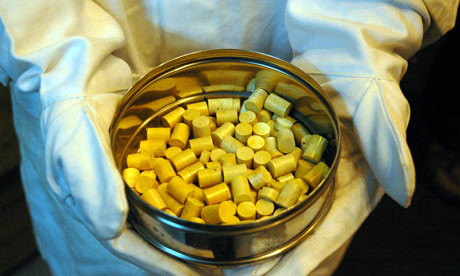
    India nuclear plans: Thorium pellets at the Bhabha Atomic Research Centre (BARC) in Mumbai

    Thorium, which has been hailed as an alternative nuclear fuel. Photograph: Pallava Bagla/Corbis

    The benefits of an alternative nuclear fuel that could offer a safer and more abundant alternative to the uranium that powers conventional reactors have been “overstated”, according a new government report on the potential of thorium.

    The report says the UK should continue to be engaged with the technology but downplays claims by thorium proponents who say that the radioactive chemical element makes it impossible to build a bomb from nuclear waste, leaves less hazardous waste than uranium reactors, and that it runs more efficiently.

    “Thorium has theoretical advantages regarding sustainability, reducing radiotoxicity and reducing proliferation risk,” states the report, prepared for the Department of Energy and Climate Change by the National Nuclear Laboratory (NNL). “While there is some justification for these benefits, they are often overstated.”

    Some of NNL’s hesitance comes from UK utility companies’ unwillingness to invest the money in research and development necessary to draw out thorium’s advantages.

    “Nevertheless, it is important to recognise that worldwide there remains interest in thorium fuel cycles and this is not likely to diminish in the near future,” the report concludes. “It may therefore be judicious for the UK to maintain a low level of engagement in thorium fuel cycle research and development by involvement in international collaborative research activities.”

    The report notes that thorium’s advantages would be most noticeable in reactor types other than the conventional solid fuel, water-cooled reactors used in almost all of the world’s commercial nuclear electricity stations today.

    In particular, a design known as a very high temperature reactor is “especially well suited to thorium fuels,” NNL states. The old UK Atomic Energy Authority built and operated an experimental thorium-fueled high temperature at Winfrith in the 1960s and 70s. The reactor, nicknamed Dragon, is partially decommissioned.

    Several thorium initiatives are under way outside the UK. In the US, Flibe Energy is developing a thorium reactor based on designs developed in the 1960s by the US Department of Energy’s Oak Ridge National Laboratory in Tennessee.

    China is also developing different types of thorium reactors, and India is expected to start construction in four or five years of one that uses solid thorium fuel.

    Thorium is an abundant, mildly radioactive element that occurs naturally around the world. The largest reserves exist in Australia, the US, Turkey, India, Brazil and Venezuela, according to the World Nuclear Association.

  • Open-cut mine threat to Gardens of Stone

    Open-cut mine threat to Gardens of Stone

    0
    Macarthur Coal's Coppabella coal mine

    Conservationists fear open-cut mining will destroy one of the state’s most stunning landscapes at Ben Bullen State Forest. Source: Supplied

    A MASSIVE open-cut coal mine which would raze almost 1000ha of state forest has outraged conservationists, raised major health concerns, split the local community and sparked claims of increased power bills if it is not approved.

    Coalpac wants to expand its mining operations at Cullen Bullen on the western shoulders of the Blue Mountains near Lithgow to include open-cut coal mining in the Ben Bullen State Forest bordering the famed Gardens of Stone National Park.

    Conservationists fear open-cut mining will destroy one of the state’s most stunning landscapes and create health issues from dust, blast emissions and noise pollution from the proposed 24-hour-a-day operation.

    Public hearings into development consent for Coalpac’s proposal are to begin next week.

    “This sort of hillside open-cut coal mining below scenic cliff lines is unprecedented,” Colong Foundation for Wilderness director Keith Muir said.

    Coalpac CEO Dr Ian Follington warned power prices could rise and the company faced a bleak future if the proposal was not approved.

  • Coal Seam Gas green light shocks lobbyists

    Coal Seam Gas green light shocks lobbyists

    ABCUpdated September 12, 2012, 8:55 pm

    The Premier Barry O’Farrell has defended his Government’s renewal of Coal Seam Gas exploration licenses.

    A moratorium on fracking and a freeze on licensing was lifted yesterday with the announcement of a new Strategic Land Use Policy

    The policy increases the amount of strategic agricultural land mapped for protection in the Hunter and New England, and drops a provision that would have allowed Cabinet to override new independent approval processes for CSG projects.

    Today the Government has renewed 22 licences for exploration and approved one for production.

    Barry O’Farrell says it was not a revenue raising exercise with tough new regulations guiding approvals.

    “There are now codes of practice around exploration licences including deposits including an extra 40 regulatory staff to ensure that what’s been approved is what’s going to happen.”

    “So for the first time we have a new set of rules around exploration licenses, the way in which land use is going to be assessed and that is not only the toughest regime in the nation but some are saying it’s the toughest in the world.”

    Lobbyists are shocked at how quickly the renewals flowed in.

    Jess Moore from Stop CSG Illawarra says of particular concern was the inclusion of an exploration licence that cuts across two drinking water catchments in north Illawarra.

    “To have the Government actually offer the company a renewal in that area is just such a slap in the face to this community.”

    The Australian Petroleum Producers and Exploration Association’s Lyall Howard says the new policy is a win for farmers but the regulations are heavy handed.

    But he says they will live with it.

    “Investment has been totally immobilised for 18 months and what this does now is give the industry some confidence that there is a set of rules that if they follow them that investment will flow,” he said.

    Resources Company Santos says the new rules should ease concerns about its impact.

    Santos Spokesman, Sam Crafter says the Company may use hydraulic fracturing in the future.

    “It’s something that we’re not planning on doing at this point in time but look we’re not saying that it won’t be done, it’s something that’s done very safely in other parts of Australia and the increased processes and code of conduct also increase the regulation around which can give people comfort that this actually, if it does occur in New South Wales will be done safely.”

    Anti Coal Seam Gas activists say the State Government’s new Strategic Land Use policy ignores the impact that mining and coal seam gas projects have on local communities.