The twentieth century way of life has been made available, largely due to the miracle of cheap energy. The price of energy has been at record lows for the past century and a half.As oil becomes increasingly scarce, it is becoming obvious to everyone, that the rapid economic and industrial growth we have enjoyed for that time is not sustainable.Now, the hunt is on. For renewable sources of energy, for alternative sources of energy, for a way of life that is less dependent on cheap energy.Â
BHP Billiton has had to write down the value of its American shale gas assets by $US2.84 billion ($2.7 billion) and it also cut the value of its nickel assets by $US450 million.
A glut of gas supply in the United States and subsequent low gas prices there forced the world’s biggest resources company to take massive impairment.
BHP will write down the value of the Fayetteville shale gas assets that it acquired from Chesapeake Energy in February 2011.
Advertisement
Analysts had been expecting a writedown of at least $US3 billion for BHP’s natural gas assets, bought for a total of $US17 billion when US gas prices were far above current levels.
BHP shares sank as much as 71 cents, or 2.2 per cent, to $31.31 in early trading, compared with a drop of about 0.5 per cent in the overall market.
BHP said the value of its onshore US shale liquids and gas assets acquired with Petrohawk Energy were not affected by the writedown.
BHP Chief Executive Marius Kloppers and petroleum head Mike Yeager had requested they not be considered for a bonus in 2012, the company added.
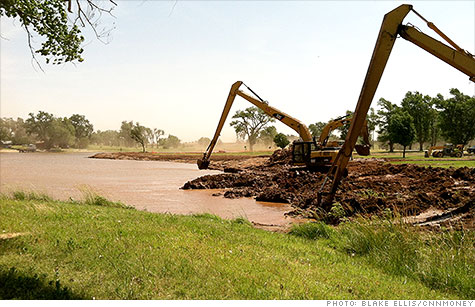
Excavators prepare water for the oil industry in Kansas. The drought is restricting water available for fracking, which could harm U.S. oil production.
NEW YORK (CNNMoney) — One of the worst droughts in U.S. history is hampering oil production, pitting farmers against oilmen and highlighting just how dependent on water modern U.S. energy development has become.
Over 60% of the nation is in some form of drought. Areas affected include West Texas, North Dakota, Kansas, Colorado and Pennsylvania, all of which are part of the recent boom in North American energy production.
That boom is possible partly by hydraulic fracturing. Known as fracking for short, the controversial practice gets oil and natural gas to flow by cracking shale rock with sand, chemicals, pressure and water.
Lots of water. Each shale well takes between two and 12 million gallons of water to frack. That’s 18 Olympic-sized swimming pools worth of water per well.
“We’re having difficulty acquiring water,” said Chris Faulkner, CEO of Breitling Oil and Gas, an oil company with operations in many of the new shale regions including Bakken in North Dakota and Marcellus in Pennsylvania.
Faulkner said officials in two Pennsylvania counties have stopped issuing permits for oil companies to draw water from rivers, forcing them to go further afield to obtain the crucial resource.
In Kansas, he said much of the industry’s water comes from wells owned by farmers. Farmers used to sell him water for 35 cents a barrel. Now, he said, they are turning down offers of 75 cents or more.
As a result, between 10% and 12% of the wells Breitling planned on fracking have been put on hold.
“As the drought continues, those numbers will rise,” said Faulkner.
Similar problems are happening at companies industry-wide, said Neal Dingmann, an analyst SunTrust Robinson Humphrey in Houston who covers many of the smaller and mid-sized companies that operate in the new shale plays.
Dingmann said he expects to see maybe a 5% reduction in new wells by the companies he covers.
Those numbers aren’t expected to have a meaningful impact on oil or gasoline prices.
Oil from shale rock is just a small portion of overall U.S. oil production, which in turn contributes just a fraction to global oil supplies, the main determinant in prices.
Plus, the drought is not expected to continue forever.
But shale oil is playing an important part in new U.S. supply growth, and the drought illustrates how vulnerable that production is to disruptions in the availability of water.
Other segments of the energy chain are also being hit by the drought.
Much of the country’s natural gas is produced by fracking. Unlike oil, natural gas can’t be easily shipped around the world, so its price is more closely tied to local conditions.
Natural gas prices have surged some 70% over the last couple of months. The runup is mostly due to increased demand for air conditioning during the heat wave and a switch to natural gas from coal by many utilities. But at least one analyst puts part of the blame on drought-induced production problems.
“Another rally in natural gas as drought concerns may lead to a cessation of non-conventional shale production,” Stephen Schork, an energy trader and publisher of the industry newsletter the Schork Report, wrote in a note last week.
Corn-based ethanol prices have jumped roughly 30% since the start of June, in step with corn prices that have reached record highs. Ethanol makes up about 10% of a gallon of gas in most parts of the country.
The recent rise in gasoline prices has more to do with rising oil prices, which are being driven by the standoff with Iran and hopes for a looser monetary policy rather than drought conditions the United States. But the higher ethanol prices are probably playing a small part, said Brian Milne, refined fuels editor at the information provider DTN.
Another water-dependent link in the nation’s energy supply chain is transport — specifically, barges on the nation’s canals and rivers.
Andrew Lebow, an broker at Jefferies Bache in New York, said people are concerned that some energy terminals will have a hard time getting supplies if low water levels make routes impassable.
“I don’t think the impact will be widespread,” said Lebow. “But you could see prices rise in some areas.”
Nuclear power is too dangerous to continue Post-Bulletin Nuclear weapons production is joined at the hip to nuclear power plants. Nuclear weapons useplutonium (produced as high-level radioactive waste at these power plants). Nuclear weapons proliferation around the world relies first and foremost on a country … See all stories on this topic »
Are Fast-Breeder Reactors A Nuclear Power Panacea? CounterCurrents.org … technology to burn plutonium in a new generation of “fast” reactors. That could dispose of the waste problem, reducing the threat of radiation and nuclear proliferation, and at the same time generate vast amounts of low-carbon energy. … Fast reactors could do the same for the U.S. Under the presidency of George W. Bush, the U.S. launched a Global Nuclear Energy Partnership aimed at developing technologies to consume plutonium in spent fuel. But President Obama drastically cut the partnership’s funding, while … See all stories on this topic »
Tip: Use quotes (“like this”) around a set of words in your query to match them exactly. Learn more.
Oilprice.com’s geopolitical editor Daniel J. Graeber was a guest on Infowars evening show last night where he discussed the following topics: • Middle East tensions and their impact on oil prices.• Why oil prices will remain stable the remainder of this year.• How the government will most likely respond to oil price rises.• Why alternatives are taking so long to come on line• Why oil prices aren’t the hot issue they once were• Gas prices and the elections• Tapping…
The Association of American Railroads reports the number of rail tankers carrying crude oil and petroleum products in the United States increased more than 35 percent during the first six months of the year when compared with 2011. After the U.S. Energy Department, in its report, noted the lack of pipeline infrastructure in North Dakota, British supermajor BP announced it was considering rail to bring oil from the Bakken formation there to its refinery in Washington state. In terms of the environmental footprint, meanwhile, rail deliveries account…
Global production of nuclear energy is expected to grow significantly in future years, despite setbacks in Japan and Germany, as China and the United States eyes next-generation reactors.Worldwide nuclear electricity generating capacity is expected to increase between 44 percent and 99 percent by 2035, the International Atomic Energy Agency and the Organization for Economic Cooperation and Development Nuclear Energy Agency said in their joint biannual report on uranium resources, released this week.Japan’s decision to shut down all but two of its…
GASFRAC of Calgary, Alberta, Canada, has developed an innovative closed stimulation process and injection method, utilizing gelled LPG rather than water based conventional formation fracturing fluids.The firm has developed a Liquefied Petroleum Gas (LPG) or propane based gel that is as natural to a well as soil is to the earth. It’s dissolves into the formation hydrocarbons improving performance without using water.LPG will burn of course so GASFRAC has developed a zero-oxygen, closed system and specialized equipment that protects worker…
Let me say at the outset that geoengineering to control Earth’s climate is not the wisest path which Homo sapiens (“Wise Man”) could travel down. Because of the large scales involved, future geoengineering may turn out to be the dumbest thing our dumb (albeit clever) species has ever done.On Tuesday Jim Kunstler spoke of the unintended consequences of applying technology willy-nilly to solve all our problems. As global warming really gets going in the coming decades, the temptation to geoengineer the climate will become stronger and stronger.Indeed,…
Economic, social, political, and demographic changes are key drivers in what is a transforming global strategic architecture. This will necessitate a revision of existing power projection, trade, and intelligence priorities, structures, and doctrine to meet the emerging realities. But they are not yet set in stone. Oswald Spengler gave ample warning, in The Decline of the West (which he wrote mainly during World War I), that Western civilization was even then reaching some of its natural limits. He demonstrated that Roman and later Western civilization…
India has suffered yet more blackouts, this time leaving more than 700 million people without power, and raising serious doubts about the country’s failing infrastructure and the government’s ability to meet the increasing energy demand as they pursue ambitions to become an Asian superpower.20 of India’s 28 states were left without electricity, including the capital New Delhi, when three out of the nation’s five grids went down.Hundreds of trains ground to a halt, leaving passengers stranded along tracks from Kashmir to…
In the recent Forum on Chinese-Africa Cooperation (FOCAC), China has secured its ties with Africa by pledging almost twice as much aid money as last year. President Hu Jintao promised $20 billion to help develop infrastructure and agriculture in Africa.China’s interest and investment in Africa is purely to do with the continents hydrocarbon reserves. Niger’s President Mahamadou Issoufou recently visited CNPC in China and praised them for “turning Niger into an oil producer.” Ghana’s Vice President John Dramani Mahama…
Lloyds Banking Group has recently declared that it will invest £1 billion into the British governments new Infrastructure Plan. Lloyds have identified nine social and economic infrastructure projects, three conventional power plants, and up to 12 clean energy projects where it will invest its money. Around £333 million will be set aside to be invested in renewable energy projects.Chris Heathcote, Lloyds managing director and global head of project finance, said that Lloyds is mainly interested offshore wind, solar power, and biomass…
Russia and Saudi Arabia’s opposing stances over the situation in Syria has finally led to action. Saudi business tycoon Mubarak Swaikat has cancelled several multi-million dollar oil and gas contracts with nearly 20 Russian companies in protest against Moscow’s support of Syrian President Bashar Al-Assad’s regime. The decision was made by Swaikat himself without any pressure from the government.“This is the least that I can do to support our brothers in Syria. The Saudi government and society have already given a shining…
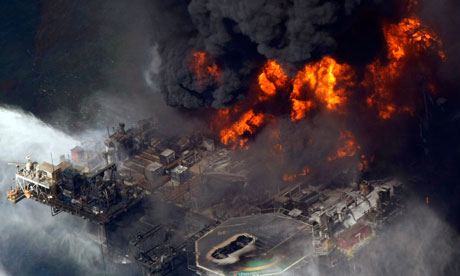
BP’s total bill for the Deepwater Horizon disaster is now $38bn. Photograph: Gerald Herbert/AP
The Gulf of Mexico oil spill continues to plague BP more than two years after the disaster as the company has revealed another $847m (£538m) hit to cover rising legal costs.
The additional charge for the second quarter brings the total bill for the fatal Deepwater Horizon incident to $38bn, BP said.
BP is struggling to shake off the reputational blow of the April 2010 Macondo blow-out after recently coming under further fire in a report from a US government safety panel.
And the underlying picture at BP is not much brighter, as the company revealed a 24% slide in underlying replacement cost profit to $8.5bn in the first half of the year as oil prices fell and maintenance work disrupted production.
The BP group chief executive, Bob Dudley, said: “We recognise this was a weak earnings quarter, driven by a combination of factors affecting both the sector and BP specifically.”
The group’s production also continues to suffer from the drilling ban imposed on it in the wake of the Gulf of Mexico spill, while it is also ramping up asset disposals under a programme to sell $38bn (£24.4bn) of assets by 2013.
It has entered into agreements to sell assets with a value of $24bn (£15.3bn) since 2010.
BP’s production of oil and gas, excluding results from its Russian joint venture TNK-BP, averaged 2.27m barrels of oil per day in the second quarter, compared with 2.46m for the same period last year, a slide of 7%.
The oil giant warned that production was expected to slide lower in the third quarter, between July and September, before returning to growth in the final three months of 2012.
The group also took a $4.8bn hit for writing down the value of a series of assets including US shale gas and its decision to suspend the Liberty project in Alaska – an offshore oil field with about 100m barrels of recoverable oil.
BP set up a $20bn trust to cover the costs of claims for the Deepwater Horizon incident, which is included within the $38bn provision.
BP had paid nearly $8.8bn by 30 June for individual, business and government claims, including payments made before the establishment of the trust.
A total of $7bn had been paid to individual and business claimants, while federal, state and local government authorities had received $1.4bn for claims and advances.
BP is facing a bid battle for its stake in TNK-BP, after Russia’s state oil company Rosneft entered the fray just a week after TNK partner AAR confirmed it was interested in extending its stake.
Its plans to offload the TNK-BP stake follow a chequered history in Russia. An attempt by BP and Rosneft to buy out AAR last year for about £20bn – as part of an attempt to salvage their Arctic exploration tie-up – was blocked by AAR.
Shares in BP were down 3% after Tuesday’s update was published.
India’s energy crisis cascaded over half the country on Tuesday when three of its regional grids collapsed, leaving 620 million people without government-supplied electricity for several hours in, by far, the world’s biggest blackout.
Hundreds of trains stalled across the country and traffic lights went out, causing widespread traffic jams in New Delhi. Electric crematoria stopped operating, some with bodies half burnt, power officials said. Emergency workers rushed generators to coal mines to rescue miners trapped underground.
The massive failure – a day after a similar, but smaller power failure – has raised serious concerns about India’s outdated infrastructure and the government’s inability to meet its huge appetite for energy as the country aspires to become a regional economic superpower.
Kolkata is plunged into darkness. Photo: AP
Power Minister Sushil Kumar Shinde blamed the new crisis on states taking more than their allotted share of electricity.
Advertisement
“Everyone overdraws from the grid. Just this morning I held a meeting with power officials from the states and I gave directions that states that overdraw should be punished. We have given instructions that their power supply could be cut,” he told reporters.
The new power failure affected 620 million people across 20 of India’s 28 states – about double the population of the United States. The blackout was unusual in its reach, stretching from the border with Myanmar in the northeast to the Pakistani border about 3000 kilometres away. Its impact, however, was softened by Indians’ familiarity with frequent blackouts and the widespread use of backup generators for major businesses and key facilities such as hospitals and airports.
Passenger stranded inside a stalled train. Photo: AP
Shinde later said power was fully restored in the northeast grid four hours after it went down, and that the north grid had 45 per cent power and the east grid 35 per cent. R.N. Nayak, chairman of Power Grid, which runs the nation’s power system, said he expected to have full power later in the evening.
Oddly, as the crisis dragged into the evening, Shinde was promoted, becoming India’s home minister, its top internal security official. The promotion had been planned previously as part of a greater Cabinet shuffle before he presided over the world’s two worst power outages.
The outages came just a day after India’s northern power grid collapsed for several hours. Indian officials managed to restore power several hours later, but at 1:05 pm on Tuesday the northern grid collapsed again, said Shailendre Dubey, an official at the Uttar Pradesh Power in India’s largest state. About the same time, the eastern grid failed and then the northeastern grid followed, energy officials in those regions said. The grids serve more than half India’s population.
In West Bengal, express trains and local electric trains were stopped at stations across the state of West Bengal on the eastern grid. Crowds of people thronged the stations, waiting for any transport to take them to their destinations.
Chief Minister Mamata Banerjee said it would take at least 10 to 12 hours to restore power and asked office workers to go home.
“The situation is very grave. We are doing everything to restore power,” West Bengal Power Minister Manish Gupta said.
New Delhi’s Metro rail system, which serves about 1.8 million people a day, immediately shut down for the second day in a row. Police said they managed to evacuate Delhi’s busy Rajiv Chowk station in under half an hour before closing the shutters.
S.K. Jain, 54, said he was on his way to file his income tax return when the Metro closed and now would almost certainly miss the deadline. Hours later, the government announced it was giving taxpayers an extra month to file because of the chaos.
Tuesday’s blackout eclipsed Monday’s in India, which covered territory including 370 million people. The third largest blackout affected 100 million people in Indonesia in 2005, according to reports by The Associated Press.
India’s demand for electricity has soared along with its economy in recent years, but utilities have been unable to meet the growing needs. India’s Central Electricity Authority reported power deficits of more than 8 per cent in recent months.
In addition, vast amounts of power are pirated through unauthorized wiring that taps into the electrical system.
The power deficit was worsened by a weak monsoon that lowered hydroelectric generation and kept temperatures higher, further increasing electricity usage as people seek to cool off.
But any connection to the grid remains a luxury for many. One-third of India’s households do not even have electricity to power a light bulb, according to last year’s census.

 Email
Email