Category: Energy Matters

The twentieth century way of life has been made available, largely due to the miracle of cheap energy. The price of energy has been at record lows for the past century and a half.As oil becomes increasingly scarce, it is becoming obvious to everyone, that the rapid economic and industrial growth we have enjoyed for that time is not sustainable.Now, the hunt is on. For renewable sources of energy, for alternative sources of energy, for a way of life that is less dependent on cheap energy. 

  • Families sick in Qld gas field- Hutton

    Families sick in Qld gas field- Hutton

    Updated: 16:16, Thursday July 5, 2012

    A number of Queenslanders living near coal seam gas (CSG) wells are reporting symptoms consistent with exposure to gas, the Australian Medical Association (AMA) says.

    AMA Queensland’s Dr Christian Rowan says the association is aware of a concerning number of patients who claim CSG activities are making them sick.

    ‘A number of people live near where CSG exploration is occurring and they are reporting symptoms that are consistent to gas exposure,’ Dr Rowan said.

    He said he does not have enough information to comment on complaints of rashes, bleeding noses, severe headaches and vomiting by families living at the Tara residential estate, west of Brisbane.

    However, eye and throat irritation, headaches, nausea, vomiting, dizziness and sometimes heart palpitations and blurred vision were symptoms of gas exposure.

    In June, government investigators were sent to the Tara estate amid reports of gassy odours and health concerns.

    There are five CSG wells inside the large estate and many more surrounding it.

    While the investigation continues, Lock the Gate Alliance president Drew Hutton said more people were reporting symptoms.

    ‘They’re ringing in saying their whole family is sick,’ he told AAP.

    The Australian Petroleum Production and Exploration Association (APPEA) says it has only been made aware of one mother, Debbie Orr, who is claiming health problems at Tara.

    The pregnant mother of five, who runs a support group, says at least 19 other families have experienced the same symptoms as her children.

    An APPEA spokesman says Ms Orr has refused gas industry offers to provide medical assessments.

    He says gas and air sampling by the state government last year found insignificant levels or no trace of volatile organic compounds or heavy metals at gas fields across Queensland, including at Tara.

    Ms Orr has called for an independent health study and says many are afraid to speak up against a powerful lucrative industry.

    ‘There’s just too many of us with the same symptoms,’ she said.

  • Could economics doom ailing Calif. nuke plant?

    Could economics doom ailing Calif. nuke plant?
    Huffington Post
    Activists critical of the nuclear industry argue it’s too dangerous to restart a damaged plant with 7.4 million people living within 50 miles of its twin domes. The tube damage “has the potential to cause extremely serious releases of radioactivity
    See all stories on this topic »
    Belgium to Start Nuclear Phase-out in 2015
    Fox Business
    Belgium Wednesday decided to extend the life of one of its oldest nuclear reactors by a decade to avoid the danger of blackouts while atomic power is phased out, but agreed to stick to a 2025 target date to exit nuclear power. Mr. Wathelet said
    See all stories on this topic »

  • Australia to Invest $10 Million in New Wave Energy Technologies

    Australia to Invest $10 Million in New Wave Energy Technologies

    Posted: 03 Jul 2012 03:18 PM PDT

    The Australian government has announced it will use its $126 million Emerging Renewables fund to invest almost $10 million in two new Australian-developed wave technology systems, one of which claims to be the largest ever wave energy turbine.Martin Ferguson, the Resources and Energy Minister, believes that “wave energy is still very much an emerging technology and this funding will position Australia as a global leader in developing this technology.”$5.6 million will be invested in a 250kW plant developed by BioPower Systems. The new…

    Read more…

  • Update on the Big Electricity Switch

    Update on the Big Electricity Switch

    Inbox
    x

    One Big Switch contact@onebigswitch.com.au via cmail1.com
    8:01 AM (2 hours ago)

    to me
    Can’t read this email? View the online version

    You are now truly part of something Big.

    More than 100,000 homes and businesses have signed up in just over two weeks.

    We had counted on more like 25,000, but people power proved to be more ambitious.

    The campaign remains open until midnight Sunday 15 July.

    There’s no limit on numbers so please spread the word.

    The more people who join the campaign, the louder the message will get.

    Sit tight. One Big Switch will be negotiating with the electricity providers to source discounted electricity and gas offers.

    These negotiations will not be finalised until after July 15. Once this happens we will email you the full details.

    The offers are cost and obligation free. You choose if any one is right for you. You can even use them to shop around, or ask your existing provider for a better deal.

    You can update your Big Electricity Switch details, and register for more discounted special offers by visit the One Big Switch website.

    The email address and password you registered for the Big Electricity Switch can be used to log in to One Big Switch.

    Finally, Thanks for being a part of one of the fastest growing consumer campaigns ever held in Australia. One Big Switch will be in touch via email to keep you in the loop.

    The One Big Switch Team


    Forward to a friend | Unsubscribe

  • U.S. & China Collaborate on Thorium Nuclear Power Research

    U.S. & China Collaborate on Thorium Nuclear Power Research

    Posted: 02 Jul 2012 01:34 PM PDT

    Mark Halper writing for SmartPlanet reports the U.S. Department of Energy is quietly collaborating with China on an alternative nuclear power design known as the molten salt reactor that should run on thorium for fuel.According to a March presentation at the Chinese Academy of Sciences (CAS) on thorium molten salt reactors, Peter Lyons DOE’s assistant secretary for nuclear energy is co-chairing the partnership’s executive committee, along with Jiang Mianheng from the CAS.CAS is a Chinese government group overseeing about 100 research…Read more…

  • US Navy’s ‘great green fleet’ sets sail for Pacific

    US Navy’s ‘great green fleet’ sets sail for Pacific

    Political storm rumbles on as first carrier strike group to be powered largely by biofuels heads for testing manoeuvres

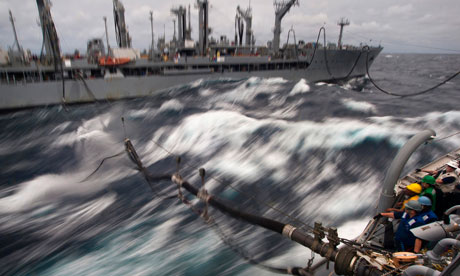
    USNS Henry J. Kaiser : US biofuel ships

    The USNS Henry J Kaiseris refueled at sea on its way to international maritime warfare manoeuvres in the Pacific. Photograph: James R. Evans/U.S. Navy

    A US Navy oiler slipped away from a fuel depot on the Puget Sound in Washington state last week, headed toward the central Pacific and into the storm over the Pentagon’s controversial green fuels initiative.

    In its tanks, the USNS Henry J Kaiser carried nearly 900,000 gallons of biofuel blended with petroleum to power the cruisers, destroyers and fighter jets of what the Navy has taken to calling the “great green fleet,” the first carrier strike group to be powered largely by alternative fuels.

    Conventionally powered ships and aircraft in the strike group will burn the blend in an operational setting for the first time this month during the 20-nation Rim of the Pacific exercise, the largest annual international maritime warfare manoeuvres. The six-week exercise began on Friday.

    The Pentagon hopes it can prove the Navy looks as impressive burning fuel squeezed from seeds, algae and chicken fat as it does using petroleum.

    But the demonstration, years in the making, may be a Pyrrhic victory.

    Some Republican lawmakers have seized on the fuel’s price, which is $26 a gallon compared to $3.60 for conventional fuel. They paint the programme as a waste of precious funds at a time when the US government’s budget remains severely strained, the Pentagon is facing cuts and energy companies are finding big quantities of oil and gas in the United States.

    Navy Secretary Ray Mabus, the programme’s biggest public booster, calls it vital for the military’s energy security.

    But to Barack Obama’s critics, it is an opportunity to accuse the US president of pushing green energy policies even if they don’t make economic sense. The bankruptcy of government-funded solar panel maker Solyndra last year was a previous example of that, they say.

    The US Defense, Energy and Agriculture departments are jointly sponsoring a half-a-billion-dollar initiative to foster a competitive biofuels industry. Mabus and his counterparts at the departments of energy and agriculture are due to announce new investments in biofuels industry on Monday.

    Senator John McCain, the top Republican on the Senate Armed Services Committee, expressed outrage over the costs of the fuel at a hearing earlier this year.

    “I don’t believe it’s the job of the Navy to be involved in building … new technologies,” he said. “I don’t believe we can afford it.”

    The biofuels effort is one of the most ambitious Pentagon energy programmes since then-Defense Secretary Donald Rumsfeld set up a task force in 2006 to find ways to reduce the military’s fossil fuels dependency, involving more than 300,000 barrels a day.

    “The reason we’re doing this is that we simply buy too many fossil fuels from either actually or potentially volatile places on earth,” Mabus told a conference on climate and security last month.

    He says the Pentagon can use its buying muscle – it is the largest single consumer of petroleum in the world – to guarantee the demand needed for biofuel businesses to produce at a scale that will eventually drive down costs.

    “We use 2% of all the fossil fuels that the United States uses,” Mabus told the conference. “And one of the things that this means is that we can bring the market. And to paraphrase the old Field of Dreams line, if the Navy comes, they will build it.”

    Mabus, a former Mississippi governor and ambassador to Saudi Arabia, aims for biofuels to supply about half of the Navy’s non-nuclear fuel needs by 2020, about 8m barrels a year.