Category: Energy Matters

The twentieth century way of life has been made available, largely due to the miracle of cheap energy. The price of energy has been at record lows for the past century and a half.As oil becomes increasingly scarce, it is becoming obvious to everyone, that the rapid economic and industrial growth we have enjoyed for that time is not sustainable.Now, the hunt is on. For renewable sources of energy, for alternative sources of energy, for a way of life that is less dependent on cheap energy. 

  • Chinese get tough on foreign projects

    Chinese get tough on foreign projects

    Peter Cai

    April 13, 2012

    Clinton Dines.

    Clinton Dines … new hurdles will ensure proper due diligence.

    CHINESE authorities are cracking down on foreign investment after a string of troubled projects that have run up tens of billions of dollars in losses, including two big resources deals in Australia.

    In a decision that will have implications for Australia’s booming resources sector, China’s State Assets Supervision and Administration Commission has published new rules that will hold state-owned enterprises and their executives accountable for bad overseas investment decisions.

    The commission’s move follows two disastrous investments in Australia’s resources sector.

    The largest Chinese investment project in Australia, the $7 billion CITIC Pacific Sino Iron project, conceived by the magnate Clive Palmer, has been dogged by huge cost blowouts and delay. The budget for the project has almost tripled from the initial $2.5 billion estimate.

    A second big investment project, the $2 billion Sinosteel Midwest project, was shelved last year after a string of difficulties. The head of Sinosteel, Huang Tianwen, reportedly lost his job because of investments that had gone awry in Western Australia.

    The commission has demanded more due diligence and risk management on all overseas investment deals by state-owned companies. No penalties have been announced but executives will be held ”accountable” for foreign investments that result in significant losses for the state.

    Since the start of China’s ”going out” initiative in 2003, which encouraged Chinese companies to invest overseas, Australia has been a favourite hunting ground for them.

    The Labor government is believed to have approved more than $70 billion worth of investments from Chinese companies since it was elected in 2007.

    That growing investment in Australia will be affected by the commission’s new regulations.

    ”Failed Chinese investors are likely to point their fingers at Australia and there is the potential for the ill-judged investments to become part of the tone of the bilateral relationship,” the former president of BHP Billiton China, Clinton Dines, said.

    But he said there should be a long-term benefit. ”That the Chinese government is putting some filters and hurdles in place to ensure that more proper due diligence is done is a good thing.

    ”A lot of prospective Chinese investors don’t know much about owning, operating and investing in the resources industry. If there were to be too many bad Chinese investments in Australia, these difficulties would inevitably bleed across into the government sphere and that cannot be good for the bilateral relationship.”

    Mr Dines, who is now the executive chairman (Asia) of the private equity firm Caledonia, said the introduction of the new rules was ”consistent with the evolution of policy thinking in Beijing” as the government reassessed resources security.

    ”The Chinese government has learnt two important lessons since the advent of the ‘going out’ initiative,” he said. ”Firstly, that Chinese companies are not always equipped to be successful buyers, owners and operators of overseas projects.

    ”Secondly, Chinese government thinking is gradually evolving towards the conclusion that security of supply does not necessarily require ownership of these assets.”

    While a number of projects in Australia have cost the Chinese government billions, one is held up as a model of how to invest abroad successfully.

    That company is Minerals and Metals Group, a wholly owned subsidiary of China Minmetals that emerged from the purchase of key assets from OZ Minerals in 2009.

    MMG’s chief executive, Andrew Michelmore, said all his dealings with the state-owned parent company had been positive.

    ”All my experience with Minmetals has been about the return on investments, profitability and shareholder values,” he said.

    Read more: http://www.smh.com.au/business/chinese-get-tough-on-foreign-projects-20120412-1wwob.html#ixzz1rv9ZC8iT

  • Nuclear google alerts

    Reports: North Korea planning a new nuclear test (+video)
    Christian Science Monitor
    The threat of such a test, coming amid plans to test a controversial rocket this week, is seen as an effort by North Korea to extort more aid from the international community. By Tom A. Peter, Correspondent / April 9, 2012 A soldier stands guard in
    See all stories on this topic »

    Christian Science Monitor

    The Ideology of Catastrophe
    Wall Street Journal
    natural disasters will multiply, the climate will bring us to war, and nuclear plants will explode. Man has committed the sin of pride; he has destroyed his habitat and ravaged the planet; he must atone. My point is not to minimize our dangers.
    See all stories on this topic »

  • Italy’s high-speed train line under the alps gathers pace

    Italy’s high-speed train line under the Alps gathers pace

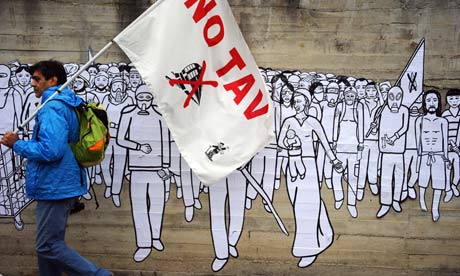
    After 20 years of protest against the tunnel, excavation for the TAV rail scheme is due to begin in the Susa valley near Turin

    • A No TAV demonstrator

      An Italy’s high-speed train (TAV) line at a protest in Chiomonte. Photograph: Olivier Morin/AFP/Getty Images

      It is a project of extravagant dimensions and it has been blocked for almost 20 years by a protest of epic tenacity and occasional violence.

      But this week, Italian plans for a 35-mile rail link under the Alps, four miles longer than the Channel tunnel and linking Turin to Lyons, will move into a new and possibly decisive phase.

      Officials are due to expropriate a stretch of sloping grassland near the Alpine village of Chiomonte, outside Turin, where work will begin on Italy‘s side of the border. The first planned excavation is of an access tunnel to allow geologists to test conditions.

      When the site was fenced off last summer, almost 400 people were injured in the resulting clashes between demonstrators and police. Twenty-six people accused of taking part in the violence have since been jailed.

      The authorities have declared the site of national strategic interest and made it subject to the same legislation that applies to army barracks. But part of the land has been bought by the protest movement, and Lele Rizzo, a prominent figure on its more radical wing, said that when the expropriations begin “we shall try to be there, on our property.”

      The first demonstration against the high-speed train (Treno Alta Velocità, TAV) route was in 1995. The resistance has continued ever since and, in February, almost claimed a life when an activist who climbed an electricity pylon fell after being severely burned.

      Taken aback by the intensity of the protests, successive governments in Rome have havered and dallied. But Mario Monti‘s non-party government appears determined. It came into office in November charged with reanimating Italy’s moribund economy and, said Mario Virano, special commissioner for the tunnel, “infrastructure is considered as a mechanism for the creation of economic growth”.

      Virano is charged with persuading local people and their representatives of TAV’s merits. Last month, he was summoned to Rome and was astonished to find on the other side of the table, in addition to Monti, no fewer than four members of his cabinet. According to Virano, at the end of a meeting lasting several hours, Monti declared: “We want to go ahead with [the TAV project], not because we inherited it but because we believe in it.”

      So why does the scheme arouse such passionate feelings? All Alpine landscapes have a certain grandeur. But while the Susa valley contains important historical monuments and archaeological remains, it is not the prettiest.

      Apart from the existing train line, it is dotted with quarries and factories. The land on which last year’s pitched battle was fought lies in the shadow of an array of monstrous concrete pillars that hold up part of the A32 motorway, built in the 1980s.

      “That is the real abomination. Yet it was put up without any resistance,” said Renzo Pinard, the mayor of Chiomonte and one of only two local authority chiefs along the proposed TAV route who back it.

      Environmentalists have said that the mountains through which the tunnel will be dug contain deposits of uranium and asbestos. Massimo Zucchetti, who lectures on nuclear engineering at the Polytechnic University of Turin, is an adviser to the Susa valley authority, whose president is a leading opponent of the scheme.

      But even he says: “I don’t think that the uranium, nor even the asbestos, represents the main reason for not carrying out this project.” The hazards of digging out the minerals could be eliminated by the use of powerful extractor fans.

      Nor is there a danger of lorries, heavy with rocks and dust, rumbling through the valley’s peaceful villages: it has been agreed the waste will be removed via the motorway. So what is the problem?

      This is an odd conflict, in which the normal roles are reversed: it is the proponents of the scheme who are the dreamers (or visionaries, depending on your point of view). And it is the opponents, including a fair share of anarchists and environmentalists, who argue for financial necessity and fiscal prudence.

      The two camps disagree over the project’s net, long-term balance of carbon emissions. But, said Rizzo: “While the No TAV movement began as an environmental protest, today – I have to say – it is the economic arguments that take priority. The tunnel would be an utter waste of public funds. The existing railway line could support any possible increase in traffic. The scheme continues to be based on projections made 20 years ago.”

      A document produced by the government in support of the project counters that it will slash the journey time between Paris and Milan from seven hours to four, bring about “a significant increase in the volume of freight transport” and halve the cost of transporting goods by rail. It could also bring about “a notable reduction in the number of lorries on the roads in the delicate Alpine environment”.

      But these and other assertions are impossible to test, because the Italian government has never published a cost-benefit analysis. Virano said his office had completed one, but was waiting for it to be formally unveiled in Rome by the appropriate minister.

      He said that the outcome, using the European Union’s central macro-economic scenario, was environmentally “very positive” and financially “slightly positive”. But, say the tunnel’s proponents, projections based solely on today’s facts and figures miss the point: that “Italy’s Channel tunnel” is intended to create its own, new reality.

      Virano points to the experience of Switzerland, which doubled its rail system traffic by excavating tunnels through the Alps. More importantly perhaps, TAV is fundamental to a vision of Europe conceived in Brussels, where Monti spent almost 10 years as an EU commissioner.

      The Susa valley lies on a proposed rail corridor which, before the Portuguese pulled out, was intended to run from the Atlantic to Ukraine’s border. By linking Turin to Lyon, moreover, it would connect the two biggest cities in a region the Eurocrats have dubbed AlpMed.

      Whether this region exists in any meaningful sense is debatable. On the Italian side, the A32 is all but deserted: a journey from the start to the last exit before the French border was shared with fewer than 20 vehicles.

      But put these objections to Virano and he hands over a map that appears to show the main rail links in today’s Italy. In fact, it was drawn in 1846 by the Count of Cavour, one of the architects of Italian unification. “If Cavour had taken into account commercial relations between the various cities then he would never have put in these lines,” said Virano. “Some were in countries that were at war at the time.”

      Engineering, in other words, can make dreams come true. And in this case, it may have to. Much of the work on the French side has already been done and, were Italy to pull out, say officials, it would face a huge bill for damages of at least €1bn (£820m).

  • North Sea gas leak” plug plan gets green light

    North Sea gas leak: plug plan gets green light

    Intervention given go-ahead after inspection of leak on Elgin platform, about 150 miles off Aberdeen

    • guardian.co.uk, Friday 6 April 2012 20.40 BST
    • Article history
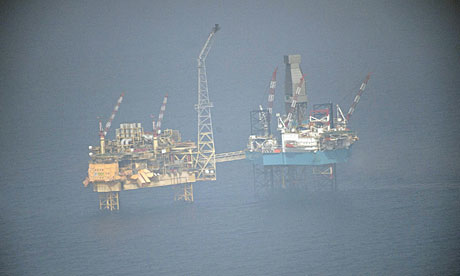
    • Total's Elgin platform in the North Sea

      Total’s Elgin platform in the North Sea, which was evacuated nearly two weeks ago. Photograph: Handout/Reuters

      Plans to “kill” a gas leak on an offshore platform by pumping mud into it can go ahead, experts said on Friday.

      A team inspected the leak on the Elgin platform about 150 miles off Aberdeen to decide how best to stop the leak. No one had been back to the platform since the leak forced its evacuation nearly two weeks ago.

      The inspection confirmed gas was leaking from the well head but not from underwater, so intervention could proceed as planned. A spokesman for Wild Well Control said: “Everything went as we would have hoped and the planned well intervention is achievable.

      The team of specialists flew out to the platform on Friday and spent four hours on the installation. They carried out a preliminary survey of the leak area, established zones which can be safely accessed and gathered data.

      Three Total employees and five specialists from Wild Well Control, a specialised well intervention company, took off from Aberdeen at 10.30am and landed on the platform before safely returning to Aberdeen shortly before 5pm.

      Plans are also still progressing for the drilling of a relief well, as well as a back-up relief well.

      Meanwhile, an environmental impact assessment of the gas leak has also got under way.

      The newly-established Environment Group, chaired by Marine Scotland, is to assess and monitor the impact of the leak. Marine Research Vessel Alba na Mara has begun work collecting and analysing environmental samples.

  • Researchers Base New Wind Turbine Control System on Human Memory

    Oil Price Daily News Update


    Researchers Base New Wind Turbine Control System on Human Memory

    Posted: 01 Apr 2012 08:45 AM PDT

    Prices of wind power have been constantly decreasing of late, and now electricity from wind is almost as cheap as that from conventional fossil fuel power stations. It does however still suffer from the same problem of inconsistency. The wind just won’t play by the rules and blow 24 hours a day at a constant speed.Turbines are designed to perform at an optimum wind speed. They then have complex control systems that can alter the magnetic torque of the turbine and tilt the angle of the blades in order to improve efficiency in low winds, or…

    Read more…

  • Gas could be just as dirty as coal, study reveals

    Gas could be just as dirty as coal, study reveals

    David Wroe

    March 28, 2012

    Not so clean ... fugitive emissions could make coal seam gas as dirty a fuel as black coal, report says.

    Not so clean … fugitive emissions could make coal seam gas as dirty a fuel as black coal, report says. Photo: Glenn Hunt

    COAL seam gas, widely touted as a greener fuel than coal, could have just as deep a carbon footprint unless world-class standards are used when extracting the gas from the ground, an expert report has found.

    A study into the life-cycle greenhouse emissions of Australia’s energy sources by consultancy WorleyParsons found conventional gas from large offshore wells typically produced 38 per cent less greenhouse emissions than black coal, largely because it burnt more cleanly.

    But the equation could shift dramatically for the fledgling coal seam gas industry – the subject of a fierce political battle in NSW and Queensland – if meticulous standards were not followed when the gas was extracted from the ground.

    So-called ”fugitive emissions”, particularly of methane, which is a much more powerful greenhouse gas than carbon dioxide, can tip the balance and make coal seam gas as dirty a fuel source as black coal burnt in ageing power plants, the report says.

    ”If methane leakage approaches the elevated levels recently reported in some US gas fields … the [greenhouse gas] intensity of CSG … generation is on a par with sub-critical coal-fired generation,” the report states.

    The lead author, Paul Hardisty, said in a statement: ”The implications for regulators and the emerging Australian CSG industry are that best practice applied to design, construction and operation of projects can significantly reduce emissions, lower financial liabilities under the carbon tax, and help make CSG a less GHG-intensive fuel option.”

    The report comes ahead of the introduction of the carbon tax on July 1, amid a battle between green groups and the energy sector over how to shift Australia to a cleaner energy mix. Many environmentalists argue that gas is little cleaner than coal and urge governments to encourage a quicker switch to renewables such as solar and wind energy.

    But many in the energy sector argue a swift transition to renewables is unrealistic and gas – including coal seam gas – is needed as a stepping stone.

    Alan Randall, professor of agricultural and resource economics at the University of Sydney, said the report showed Australia needed to tread carefully in the expansion of the gas industry.

    ”It seems like the more complete the research is, the more we tend to move away from the idea that the gas from CSG has big advantages over coal and may have a negative rather than a positive impact when all these things are considered,” Professor Randall said. ”That’s the big picture.”

    The Australian Petroleum Production and Exploration Association, the chief lobby group for CSG, said the looming price on carbon would ultimately prove whether CSG was green-friendly.

    ”In the end, whatever their relative greenhouse intensities, all energy sources will be required to pay for their emissions under the carbon pricing legislation,” a spokesman said.

    ”Over time, the pricing mechanism will naturally favour lower emissions technologies. That is its purpose.”

    The new paper, which was published yesterday in the journal Energies, stated that high losses of CSG through leaks and venting were ”considered unlikely”.

    But it said there were no Australian guidelines in place for estimating the natural gas fugitives.

    It urged the industry to ”improve monitoring of methane releases and to adopt best practice technology and systems to reduce leaks and venting emissions”.

    The Australian Coal Association chief executive, Nikki Williams, said the research highlighted the importance of carbon capture and storage to cut emissions.

    Read more: http://www.canberratimes.com.au/environment/conservation/gas-could-be-just-as-dirty-as-coal-study-reveals-20120327-1vwns.html#ixzz1qOF3NDhM