Subject: EV 208 Newsletter
5th March 2012
The twentieth century way of life has been made available, largely due to the miracle of cheap energy. The price of energy has been at record lows for the past century and a half.As oil becomes increasingly scarce, it is becoming obvious to everyone, that the rapid economic and industrial growth we have enjoyed for that time is not sustainable.Now, the hunt is on. For renewable sources of energy, for alternative sources of energy, for a way of life that is less dependent on cheap energy.Â
The newly evicted protesters against proposed nuclear power stations at Hinkley Point reject both the technology and the flaunting of democracy
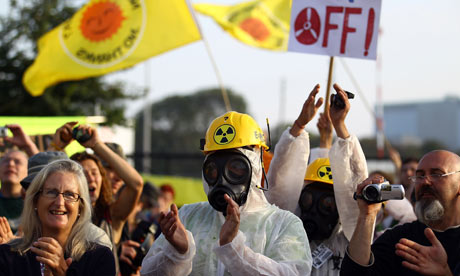
It’s been a busy week for the bailiffs. Even as one group was carting people off from the steps of St Paul’s in London on Monday night to remove Occupy protesters, so another was storming a Somerset farmhouse early on Wednesday to snuff out a small protest against the proposed two new Hinkley C nuclear power stations.
End of story? Not at all. Occupy will be back and anger in Someset is growing at the way that the nuclear steamroller is gearing up to build its stations. EDF, who went to the high court in London rather than Bristol, tried to get a blanket injunction on anyone going near the site but was thwarted by the court which could see no justification in granting anything so wideranging.
The Somerset protests are against nuclear power itself but also at the way the company appears to be flaunting democracy and the new planning laws even before it starts building. EDF has permission to spend £100m preparing the site for the two power stations on the basis that they will return many millions tonnes of earth and restore the land to exactly how it was, should a public inspector decline to give them planning permsssion in 2013.
This is clearly impossible, so the EDF must be 100% certain that it will get permission to build. In which case, say the protesters, the whole consultation exercise and planning process is a sham – a situation that looks likely to be subject to further court cases.
Half of all local residents are against the power station but everyone in the area is united in believing that the planning system has been corrupted by cash handouts and pressure from central government. It suggests that from now on that any company will be allowed to start work on any giant project and be allowed to trash any piece of land without any demcoratic accountability in the name of national interest, climate change or anything else that the government decrees. Yet again, nuclear power is cast as a corporate bully working as an accomplice of government.
What makes it worse, is that I am informed that some pro-nuclear greens have written to the protesters in Somerset urging them not to protest against EDF. If this is the case, then those pro-nuclear greens should be invited to write to the 3,000 “misguided” Indian protesters of the People’s Movement against Nuclear Energy who have been on hunger strike in Tamil Nadu in protest against two nuclear power stations being built there, as well as the many thousands of Chinese who are protesting nuclear plants in Anhui province. Both these nascent anti-nuclear protests are in the forefront of much wider democracy movements, demanding corporate and government accountability.
The point is that right across the world it is not just the nuclear technology which is so offensive to people, but the arrogance, callousness and ruthless steamrollering of any opposition that invariably accompanies nuclear projects. What the pro-nuclear folk here do not seem to understand is that the abuse of political power is as dangerous as the power source itself.
Posted
Trade unions are considering a High Court challenge to electoral funding laws passed by the New South Wales Parliament late last night.
The legislation passed the state’s Upper House just after midnight.
Under the laws only individuals will be permitted to make donations to political parties, with a cap of $5,000 a year.
Donations from trade unions, corporations and lobby groups will be banned.
Premier Barry O’Farrell says the changes will help clean up state politics.
“There’s now a level playing field for all parties, for all candidates. It’s a fair electoral system,” he said.
“Ultimately this is about putting power in the hands of individuals. That can’t be a bad thing.
“What I’m particularly pleased about is this has ended once and for all the donations for decisions culture that grew up under the former Labor government.
But Unions New South Wales secretary Mark Lennon says the changes are unfair and unworkable.
“We cannot let this legislation stand without having it challenged in the High Court,” Mr Lennon said.
“This is a real travesty for democracy in New South Wales.
“The Government talks about and the Premier talks about having a balanced political system. This is no way balanced.
“This is a system that will now favour the wealthy and ensure that working people can’t have an effective political voice.”
The Premier says he is not concerned by the legal threat, and the laws will come into force before the end of the month.
“The advice we have from the drafters of the legislation is that these laws will withstand legal challenge,” Mr O’Farrell said.
The Opposition has also condemned the changes, but much of Labor’s anger has been focused on the Greens for supporting the legislation in the Upper House.
Opposition spokesman Steve Whan says it is a blatant attack on Labor.
“It’s unprecedented to see a government in Australia which uses its majority in the Parliament to target and attempt to destroy its political opposition,” Mr Whan said.
“I think most people would be worried by a government that’s willing to do that and certainly be worried by the fact that the Greens have simply rolled over and agreed with the Government.”
Greens MP John Kaye has defended the party’s decision to support the legislation.
“The rivers of cash from corporations, from unions, from other organisations that have flowed in the past into political parties came to an end at about 10 past 12 this morning in the New South Wales Upper House. This is a big step forward for politics in New South Wales,” Dr Kaye said.
“The ability of unions to pool their money into a single campaign has been protected. They will not be able to give money to the Labor Party or any other political party, but that is part of cleaning up politics in New South Wales.”
Topics:states-and-territories, unions, activism-and-lobbying, state-parliament, sydney-2000
Source: AAP NewsWire
Browse the IndustrySearch directory: Mining Equipment & Machinery
Updated
The commander of United States naval forces in the Gulf says Iran has built up its naval forces in the region and prepared boats that could be used in suicide attacks.
Iran has made a series of threats in recent weeks to disrupt shipping in the Gulf or strike US forces in retaliation if its oil trade is shut down by sanctions, or if its disputed nuclear program comes under attack.
At a briefing in Bahrain, Vice Admiral Mark Fox told reporters the US Navy’s Fifth Fleet can prevent Iran from blocking the Strait of Hormuz.
He says Iran now has 10 small submarines.
“They have increased the number of submarines… they increased the number of fast attack craft,” said Vice Admiral Fox, who heads the fleet.
“Some of the small boats have been outfitted with a large warhead that could be used as a suicide explosive device. The Iranians have a large mine inventory.
“We have watched with interest their development of long-range rockets and short, medium and long-range ballistic missiles and of course … the development of their nuclear program.”
Military experts say the US Navy’s Fifth Fleet patrolling the Gulf – which always has at least one giant supercarrier accompanied by scores of jets and a fleet of frigates and destroyers – is overwhelmingly more powerful than Iran’s navy.
But ever since Al Qaeda suicide bombers in a small boat killed 17 sailors on board the destroyer USS Cole in a port in Yemen in 1996, Washington has been wary of the vulnerability of its huge battleships to bomb attacks by small enemy craft.
Asked whether the US Navy was prepared for an attack or other trouble in the Gulf, Vice Admiral Fox said: “We are very vigilant, we have built a wide range of options to give the president and we are ready… What if it happened tonight? We are ready today.”
Iranian officials have threatened to block the Strait of Hormuz, the outlet to the Gulf through which nearly all of the Middle East’s oil sails.
Asked if he took Iran’s threats seriously, Vice Admiral Fox said: “Could they make life extremely difficult for us? Yes they could. If we did nothing and they were able to operate without being inhibited, yeah, they could close it, but I can’t see that we would ever be in that position.”
He added that diplomacy should be given priority in resolving the tension.
“So when you hear discussion about all this overheated rhetoric from Iran we really believe that the best way to handle this is with diplomacy… I am absolutely convinced that is the way to go. It is our job to be prepared. We are vigilant.”
Contacts between the US Navy and Iranian craft in the Gulf region were routine, Vice Admiral Fox said, referring to cases where his sailors helped Iranian ships that were in distress or threatened by pirates.
Reuters
Topics:world-politics, iran-islamic-republic-of, united-states
Evidence of the threat came as the Government’s own National Water Commission raised fears of long-term impacts from the multiple projects planned for the Surat Basin.
A letter dated October 16 from Queensland Gas chief executive Catherine Tanna to Federal Environment Minister Tony Burke said the conditions placed on the company’s plans were too severe.
“We have indicated to your officers that we have significant concerns with the proposed conditions relating to coal seam gas water management, offsets and the timing of various approvals,” Ms Tanna said.
“In their proposed form, these matters present sufficient difficulty to prevent my recommending the project to the BG Group board for a final investment decision.”
Two weeks after the letter, the BG board approved the project, on which the Federal Government had placed 300 environmental conditions.
The company confirmed the Government changed its mind on some water issues after officials were shown how they had misinterpreted the plan.
Friends of the Earth activist Drew Hutton doubted all the conditions would be enforced.
“Queensland has a long history of non-enforcement of environmental regulation with regard to the mining industry which, basically, regulates itself,” he said. “This industry is too big and too powerful to be effectively regulated.”
Documents tabled in Federal Parliament last week show that at least one of the three projects approved had raised its own concerns about shallow groundwater contamination from salt ponds and chemical and fuel storage sites associated with processing plants.
There have also been warnings that underground acquifers would be so depleted by the projects that it could take centuries to replenish them.
The National Water Commission estimates the CSG industry would extract about 7500 gigalitres of water during the next 25 years – six times the capacity of Wivenhoe Dam.
“If not adequately managed and regulated, it risks having significant, long-term and adverse impacts on adjacent surface and groundwater systems,” the NWC said.
On the BG approval, Mr Bourke said all proponents were given a chance to comment on the proposed decision before the final ruling is made.
“It is common practice for changes to be made to proposed conditions, in response to such comments,” he said.


