Category: Energy Matters

The twentieth century way of life has been made available, largely due to the miracle of cheap energy. The price of energy has been at record lows for the past century and a half.As oil becomes increasingly scarce, it is becoming obvious to everyone, that the rapid economic and industrial growth we have enjoyed for that time is not sustainable.Now, the hunt is on. For renewable sources of energy, for alternative sources of energy, for a way of life that is less dependent on cheap energy. 

  • Tokyo to trial electric ‘filling stations’ to boost green transport.


    Tokyo to trial electric switching stations to boost green transport

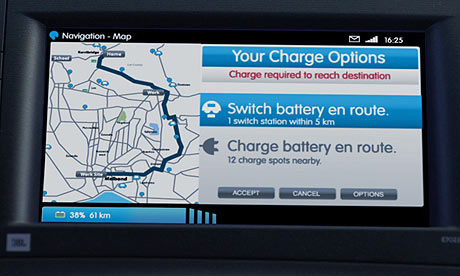
    A screenshot from Better Place in-car software showing charge options during route planning. Photograph: betterplace.com

    The first public trial of a system that “refills” electric cars in minutes will be launched this month. The Californian company Better Place will test its automated battery-swap stations in Tokyo.

    It is the latest element in the company’s ambitious plans to build the world’s first infrastructure networks for electric cars by the start of next year.

    Globally, road vehicles generate around a fifth of carbon dioxide emissions. The figure is the same for the UK. According to a study for the Department for Transport, widespread adoption of electric vehicles with a range of 30 miles or more could halve road transport emissions.

    One of the biggest challenges, however, to the large-scale implementation of electric cars is the problem of infrastructure for recharging.

    Better Place has come up with a model that involves building networks of charging points and battery-switch stations. At these a robotic mechanism will swap the empty battery in a car for a fully charged one. This means electric cars can be “refilled” in minutes, rather than taking several hours to charge their batteries.

    On 26 April in Tokyo Better Place will begin the first public trial of its battery-switching stations. “We’re applying the switch technology to taxis and working with Tokyo’s largest taxi operators, Nihon Kotsu,” said Better Place. The trial is expected to last for 90 days.

    The first part of Better Place’s technology, a network of 100 public charging points, is already being trialled in Copenhagen. Using data from the trials, Better Place will launch its first commercial network in Israel at the end of the year.

    “All of our components will be tested together with the Renault Fluence electric vehicles. There will be 10 cars this year, and as we work out the kinks in the system we’ll scale up by bringing in additional vehicles and deploying additional infrastructure,” the company said.

    Further cars will be introduced as the network is built up in size. Electric Renault Fluence cars will be available for consumers to buy by the end of next year and Better Place expects to be able to serve several other makes of car as long as their batteries are easily swappable by its robots.

    How consumers will pay for Better Place’s services is yet to be worked out but Jason Wolf, a business manager at the company, has said that users would probably pay a monthly subscription for unlimited access, or a one-off fee for casual users.

    Better Place has raised about £460m in investment in the past three years and has signed deals with Israel, Denmark, Australia and Hawaii and California to build trial networks of its electric vehicles and charging infrastructureWestminster has expressed interest in the Better Place model but has not committed to it, instead backing a more general £250m scheme including trials of a range of cars and charging infrastructures.


  • Lasers could create clean nuclear energy


    Emeritus Professor Heinrich Hora, of the Department of Theoretical Physics at the University of New South Wales, is leading the research effort, and says the process relies on a new generation of extremely powerful and very fast lasers being developed.

    “The key is a very carefully controlled extremely short laser pulse essential for ignition. The pulse would ignite a fuel made of ordinary hydrogen and boron-11,” Professor Hora said.

    “The idea of a hydrogen and boron fusion reaction is interesting because it wouldn’t cause neutron production. Neutrons are a problem because they generate radioactivity.”

    The team’s findings appear in the journal Energy and Environmental Science.

    Professor Hora says his team was originally developing computer models using next generation lasers to duplicate the work being done at the new $4.34 billion National Ignition Facility at the Lawrence Livermore National Laboratory in the United States.

    The US scientists are developing what is currently the world’s largest laser to ignite highly compressed spheres of deuterium-tritium fuel in a nuclear fusion reaction.


    Fast and furious


    The laser can produce a pulse of a few billionths of a second duration which produces 500 times more power than all US power stations combined.

    Professor Hora’s team originally rejected the idea of a hydrogen-boron fuel for their simulations “because the higher temperatures and compression needed made it 100,000 times more difficult than the Lawrence Livermore approach, making it just about impossible”.

    “But when we ran computer simulations using these next generation petawatt [quadrillion watt] strength lasers with a hydrogen-boron fuel, we were shocked to find that it’s only 10 times more difficult than deuterium-tritium,” he said.

    “It makes this all within the reach of current technology in a relatively short time. In fact these types of lasers are already in early testing at the Los Alamos National Laboratory.”

    Professor Hora says the key is to ensure the laser pulse is “extremely clean”, lasting no more than a millionth of a millionth of a second.

    “This allows conversion of optical energy to mechanical energy without heating,” he says.

    Professor Hora says the hydrogen-boron fuel has a numberof advantages over deuterium-tritium.

    “It would be largely free of radioactive emissions producing less radiation than that emitted by current power stations that burn coal, which contains trace amounts of uranium,” he says.

    According to Professor Hora, hydrogen and boron are plentiful and readily accessible, and the waste product of ignition would be clean helium gas.

    “The hydrogen-boron fuel would not have to be compressed. This means it needs far less energy to start the ignition,” he said.

    But Professor Hora warns the study only demonstrates the potential of the new process and much work needs to be done to demonstrate it in practice.

    Tags: science-and-technology, energy, engineering, physics, united-states, university-of-new-south-wales-2052

  • No stopping controversial dam in Ethiopia

    No stopping controversial dam in Ethiopia

    Ecologist

    26th March, 2010

    Controversial dam project on the Omo River in southern Ethiopia cannot be stopped says African Development Bank

    A soure within the African Development Bank has told the Ecologist that the building of a controversial dam in Ethiopia cannot be stopped and will go ahead with or without international assistance.

    At 240 meters high, the Gibe III dam would be the largest in Africa and would double the country’s electricity generation capacity.  

    Negative impacts

    But NGOs have said it will threaten the livelihoods of 500,000 tribal people and devastate fisheries in Kenya’s Lake Turkana, the world’s largest desert lake.  

    ‘Gibe III is the most destructive dam under construction in Africa. The project will condemn half a million of the region’s most vulnerable people to hunger and conflict,’ said Terri Hathaway, director of International River’s Africa Program.

    Construction on the dam began in 2006 and is now 35 per cent complete, but the Ethopian government is reportedly asking international banks for $1.4 billion to complete the project.

    Foriegn investment

    The African Development Bank (AfDB), the European Investment Bank (EIB) and the World Bank have been conducting their own assessments of the project but have so far not committed to providing finance.  

    However Azeb Asnake, project manager for Gibe III today said that the EIB and AfDB were backing the project.

    ‘When we meet with the EIB and the AfDB they are very supportive. I know that they are going to support this project, they are on board,’ said Asnake.

    Power supplies

    She also rejected claims that the project would adversely affect people downstream in Kenya.

    ‘Kenya is the major beneficiary of this project. We are going to supply them with power. They are working on the agreement to provide power right now.’

    She accused NGOs of ‘going against the spirit of Copenhagen’ by opposing the project and said they were ‘trying to deprive Africans of the right to electrification.’

    In a show of support for the project, the African Development Bank said the dam would improve the lives of people living downstream directly and indirectly.

    ‘It allows the flow of water to be controlled so as to prevent flooding and will actually lead to a greater flow of water into Lake Turkana,’ said a representative from the AfDB.  

    Open bidding

    They also rejected claims from NGOs that the Italian company building the dam had not bid competitively for the project.

    ‘Normally there should be an independent bidding process but Salini were already working in Ethiopia. It’s not unusual to give a company some additional work,’ they said.

    Useful Links
    International Rivers
    Stop Gibe III

  • Electric Vehicles Charge Ahead in US


    “You know, there’s a lot of excitement over this,” says Rich Feldman, a regional manager for eTec. “This is going to result in oil savings. There’s going to be jobs that come out of this project in terms of people installing the equipment. We’re obviously launching a whole new industry here. There’s going to be other spinoffs and economic opportunity.”

    Park, Plug in and Power Up

    Feldman is supervising the installation of more than 2,000 electric car chargers in the greater Seattle area in western Washington, and another 2,000 at homes and public places in four Oregon cities. They’ll be near shopping centers, fast food restaurants and movie theaters, “the variety of places that people think about when they’re able to park and leave the vehicle for an hour or two.”

    Feldman’s infrastructure company has partnered with Nissan. The car maker bought lots of ads during the Winter Olympics to promote its forthcoming all-electric model named the Leaf. Nissan is inviting drivers to sign up on its website to be among the first to buy one.

    Feldman says eTec hopes to convince a subset of Nissan Leaf buyers to participate in a study. It wants 900 drivers in each state to let researchers from the Idaho National Lab monitor their driving and charging behaviors. “In exchange, they get a free, home-based charging station,” he explains. Lessons learned about consumer preferences on placement, features and payment options could guide the eventual national rollout of charging infrastructure.

    The Nissan Leaf and the plug-in Chevy Volt are supposed to hit U.S. dealerships late this year. They’re the first wave of mass production electric cars. Mark Perry, who directs product planning for Nissan North America, says new owners will have no trouble finding a power station. “So the concern, ‘If I use this vehicle or purchase this vehicle, can I get charging?’ that’s going to be a very easy answer here.”

    The price of the fully electric Nissan is being announced at the end of March. Then the company will start taking deposits from consumers, who likely will pay a substantial premium over a comparable gasoline powered compact. The four-door, five-passenger Leaf has a range of about 160 kilometers.

    Perry says that Nissan will sell and lease the car and battery as a package. “There had been a lot of conversation about separation of car shell and battery and different approaches,” he said. “Nissan is still going to explore different business models in other parts of the world. But here in the U.S., definitely an entire transaction ? car and battery ? purchase or lease.”

    A World of Business Models for Electrics

    Other companies and countries are trying different business models to lure consumers into electric cars. Denmark is one nation on the cutting edge. A California-based company called Better Place is working with Denmark’s biggest utility to build the charging network there. It will offer battery swap-out stations, a feature not included initially in the United States.

    (Image, left: In Copenhagen, hotel owner Kirsten Brøchner gets behind the wheel of her leased Norwegian-made electric car. Credit: VOA – T. Banse)

    “We are building these switch stations here in Denmark ? a number of them ? so that when people want to cross the country, then they can very easily,” Utility CEO Anders Eldrup says. “If it works according to the plans ? we hope it will ? then you can, within three to four minutes, faster than you can put gasoline in your car, you can switch the battery for a brand new one, which is fully charged, and off you go.”

    When the system starts up next year, Danish electric vehicle drivers will pay a monthly subscription to access the battery charging network. They could also pay by the mile.

    But will consumers go for any of this? Vehicle researcher Valerie Karplus of the Massachusetts Institute of Technology says the car market is big enough to support numerous niches. But she adds, “It’s going to take consumers some time to sort out how they feel about going to a swap station, versus a gas station, versus charging at home. At the same time, today’s internal combustion engine cars are going to get more and more efficient. You may not have to go the gas station all that often with one of those cars.” She is looking forward to what she calls ‘an interesting technology race’.

    In Denmark, electric cars are exempt from the world’s highest car registration tax. That’s a big incentive, along with free parking on Copenhagen streets. 

    Washington State already exempts fully electric cars from its sales tax, and Nissan executives recently paid a call on legislators to talk up additional incentives. Free parking came up, along with access to carpool lanes. In Oregon, electric car enthusiasts want that state to increase the tax credit it offers to buyers of alternative fuel vehicles.

    Similar conversations are happening in government offices in Europe, East Asia and U.S. state capitals. Many policymakers, as well as drivers, find the prospect of a zero-emissions ride electrifying.

    Reprinted from Voice of America, a multimedia international broadcasting service funded by the U.S. government through the Broadcasting Board of Governors. VOA broadcasts more than 1,000 hours of news, information, educational, and cultural programming every week to an estimated worldwide audience of more than 115 million people.

  • How a 22-year-old student uncovered peak oil fraud

  • Power bills to rise by up to 64% in NSW


    They come on top of already significant increases last July.

    The Federal Government’s ETS, twice rejected by the Senate, is behind a big chunk of the latest increases, IPART said.

    Rising network costs have also contributed.

    IPART confirmed Energy Australia bills will rise 60 per cent, adding $754 to a typical household customer’s bill by 2013.

    Integral Energy and Country Energy bills will rise 46 per cent and 64 per cent respectively in the same period, adding $577 and $918 to typical customers’ bills.

    But all the increases will be lower if the ETS is scrapped, IPART said.

    Over the three years to June 2013, if the ETS is not introduced, average prices will increase by a cumulative total of 20 per cent for Integral Energy, 36 per cent for EnergyAustralia, and 42 per cent for Country Energy, IPART said.

    But whatever happens, average prices will increase by seven per cent from July this year for Integral Energy customers, 10 per cent for EnergyAustralia customers and 13 per cent for Country Energy customers.

    The increases will apply to everyone on standard tariffs – said to be about 67 per cent of NSW household customers