Category: Energy Matters

The twentieth century way of life has been made available, largely due to the miracle of cheap energy. The price of energy has been at record lows for the past century and a half.As oil becomes increasingly scarce, it is becoming obvious to everyone, that the rapid economic and industrial growth we have enjoyed for that time is not sustainable.Now, the hunt is on. For renewable sources of energy, for alternative sources of energy, for a way of life that is less dependent on cheap energy. 

  • Economic recovery unlikely given oil supply

    During May to September 2007 I had plenty of time for reflection and observation. In September 2007 I expressed concern to my family that we could be headed for something nasty and that it could be the big one. Like an idiot I prepared our house for sale when I should have just taken whatever I could get. By January 2008 when I put it on the market it was too late and I didn’t read it.

    In September 2007 I said we had a 50:50 chance that this could be the big one coming – the one that would change things forever. By January 2008 I had upgraded that to a 75% chance. I am still sticking with that, but the odds may be slightly higher.

    By the big one, I mean when the world hits the wall, when scarcity of natural resources governs, not scarcity of money. Growth will no longer be the status quo. It is physically impossible for this to be the case. That means decline is inevitable. It doesn’t mean the end of the world but it does mean a whole new paradigm, particularly in what one invests in.

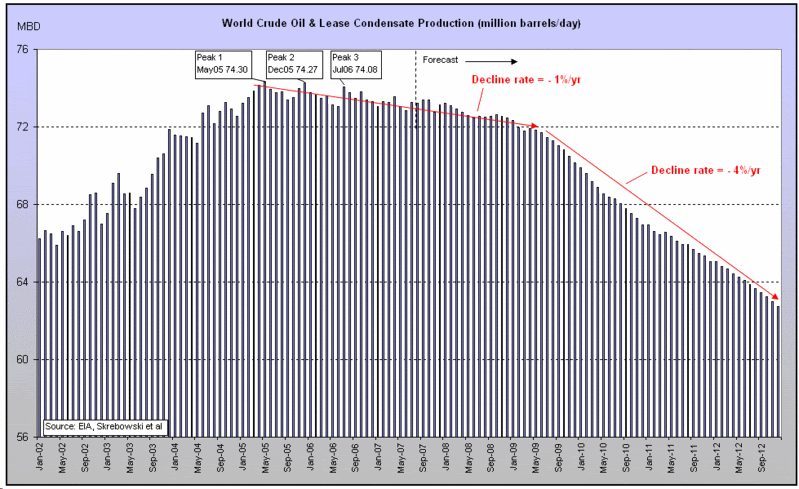
    Total productionIf the attached graph is correct and there is to be an oil slide of 2.9% pa that will probably translate to a decline in GDP of about 1.5% pa. Scary stuff if you are hoping to return to business as usual. Australia is particularly vulnerable because of where it currently competes to buy oil. Nearly all of those countries are already in decline (cf Vietnam, Indonesia). The projected deficit in what we want and what we can get is 55% by 2025.

    The way I see it, the recession could be long enough that it takes us into the next oil shortage which in turn will precipitate a tumbling oil price through catastrophic collapse of demand. A bumpy ride is ahead for sure. No conventional wisdom is going to cope with this. We may even see a change in government breakup. The dichotomy now is supposedly to share the scarce resource of monetary wealth. What if it breaks into how to share the scarce resource of the environment?


  • Domestic Hydro Power

    Domestic Hydro Power

    Renewable energy is a hot topic at the moment, however few people know about hydro power. This is especially true when looking at using hydro power in your own home, so what can you use it for?

    When people think about renewable sources of electricity people think about fairly new technology, however hydro power is without a doubt one of the oldest forms of renewable energy generation. Water wheels, the first form of hydro power were used for irrigation in the fareast over 2000 years ago. Waterwheels were then used for milling.

    During the 19th century water turbines were created, these turbines were much smaller, and more efficient.

    In England, water mills have been used for over 900 years, during the 19th century there were over 20,000 water mills just in England. Throughout the world, water wheels have been used to power numerous pieces of machinery.

    China has over 85,000 hydropower stations, all of which are small scale plants. Many other developing countries are realising the importance of using hydropower to generate electricity.

    If you have naturally falling water in or near your home then it will also be possible to harness the energy by using a domestic hydro power system. These are very small systems which can be used without damaging the environment.

    There are several different types of turbines which can be used, depending on the project in question. In each case the turbine spins a shaft which is used to generate electricity. There are two main categories of turbine.

    Impulse turbines are where pressurised jets hit shaped cups. This means that virtually all of the waters energy can be captured.

    Reaction turbines on the other hand are where the water is not pressurised into a jet, the water simply passes over the blades. This causes the blades to spin, and so creates movement which can be converted into electricity.

    Large scale hydro power schemes have been seen to be damaging to the environment, however these small scale plants do not cause as much disturbance. As long as they are managed correctly they shouldn’t create any environmental problems.

    Before you consider installing hydro power systems you check whether or not you need to apply for planning permission before building such a scheme.

    By using small scale systems there are actually environmental benefits, for a start it reduces the need to use fossil fuels, and other methods of energy production. Micro hydro power systems can also provide power for properties located in isolated areas who have no other options when it comes to electricity.

    Hydroelectric power stations account for 20% of the worlds electrical supply. Norway is very keen on hydro electrical power stations and produces most of its electricity from this method. Iceland and Austria are also keen, they produce in excess of 70% of their electricity using hydro power plants.

    There are three different types of hydroelectric system:-

    Diversion This is where a portion of a river is diverted through a manmade canal, this can be done without using a dam and so is not as damaging to the environment.

    Impoundment This is the most popular system for large scale systems, a dam is constructed across the river which creates a lake behind it. This creates a body of water which can be used to drive a turbine to create electricity.

    Pumped Storage If not much electricity is required water can be pumped from a lower reservoir to a higher reservoir. When more electricity is required the water can be used to turn a turbine and create electricity. In other words the water is being used to store the energy, like a battery.

    Domestic hydro power projects are encouraged by the Low Carbon Buildings programme and therefore may be eligible for grants.

    Hydro Power – The State of Play

  • Greg Combet facing reality check over coal jobs

    Greg Combet facing reality check over coal jobs


    Brad Norington and Greg Callaghan | May 06, 2009

    Article from:  The Australian

    THE pressure on the Rudd Government to get its emissions trading policy right is starkly obvious for Labor’s Greg Combet in his NSW Hunter Valley electorate.

    As Kevin Rudd’s Parliamentary Secretary for Climate Change, Mr Combet has the job of tackling coal industry demands for compensation when Labor goes ahead with its planned tax on carbon output.

    But he also faces the daily reality of miners such as Arthur Kent, whose job will be gone forever if a carbon tax forces the coal company that employs him out of business.

    Mr Kent, who lives at Lake Macquarie in the heart of Mr Combet’s Charlton electorate and has worked at the nearby Myuna colliery for 29 years, puts the choice bluntly: “Without us, the lights go out.”

    The Government’s decision to dump its election policy and accept a delayed start-up date for emissions trading will get a welcome response on Friday when Mr Combet sits down with coal industry representatives to restart negotiations on a workable carbon permit scheme.

    So far, compensation for the coal industry has been put in Labor’s too-hard basket.

    Collieries such as Myuna, owned by Centennial Coal, present the greatest difficulty for a viable scheme as mines that exclusively feed the coal-burning electricity industry. They are unlike others that are immune from the problem of carbon pollution, locally at least, because their coal goes to exports.

    Mr Kent, whose daily work regime involves a 180m descent to the coal seam, believes he is better placed than most to know the importance of the coal industry to the larger Australian economy, with or without emissions trading.

    Although he cherishes the days when coal was the soul of the Hunter Valley, and was not maligned as a dirty industry, he supports the planned shift to emissions trading and other environmental controls that have changed the face of his profession.

    “It’s about being a good corporate citizen, being socially responsible,” said the father of four. But Mr Kent’s double-barrelled position also highlights the difficulty facing Mr Combet, a seasoned hand at the bargaining table from his days as head of Australia’s union movement.

    “Coal remains the only really affordable way to supply electricity,” Mr Kent said.

    “Demand is now outstripping supply and the price is holding up well. We’re not going anywhere.”

    Mr Kent’s employer produces 47per cent of the electricity in NSW. “The two main polluters from coalmining are CO2 and methane, and we already have in place environmental strategies to control them,” Mr Kent said. “We can’t afford to breach those strategies otherwise they would close us.”

    The experienced coalminer believes the coal industry will never be “100 per cent clean” but says it can be cleaned up.

    Mr Kent wouldn’t be drawn on whether the coal industry had been unfairly treated by emissions trading, the threat of a new tax, or Mr Combet himself, who once worked in the industry. “It’s just important the Government gets it right,” he said.

    “Otherwise an entire, very healthy industry is at risk.”

    The Rudd Government is in negotiations with the coal industry and electricity generators about possible further changes to its emissions trading scheme.

    Katie Brassil, a spokeswoman for Centennial Coal, said the company welcomed the Government’s delay in implementing the scheme and a commitment to consult with the coal industry.

    “Otherwise the proposed scheme will merely export jobs and emissions overseas without any benefits whatever to the problem of climate change,” Ms Brassil said.

  • Rudd feels the heat over China syndrome

    Rudd feels the heat over China syndrome

    • May 3, 2009

    The Prime Minister knows the language but something is being lost in the translation, writes Michelle Grattan.

    Kevin Rudd might wonder at the irony. He prides himself on being such a China expert, the Mandarin speaker who’s studied the country since his youth and served there as a diplomat. You wouldn’t find too many leaders to match his knowledge. And yet things Chinese have been giving him grief.

    Moreover, he comes under fire every which way. He’s attacked for being too pro-China but sometimes the criticism comes from the other direction. His latest problem has been some arrows from Beijing before the release of the long-awaited Defence White Paper, which was launched yesterday and reflects a complex and wary view of China and the need for Australia’s defence planning to be prepared for all eventualities.

    The Chinese elephant has hung over Australia’s first Defence White Paper since 2000. Analyst Hugh White recently observed that the main concern isn’t about China as it becomes more powerful but how China’s growth is fracturing the old regional order, producing deep uncertainties about the implications for our security. White noted that Rudd in recent speeches had made it clear he saw China’s rise “as the single most important factor shaping Asia’s century and Australia’s long-term strategic risks”.

    Against a background of arguments within the defence and intelligence communities over whether China would evolve into a threat, Mike Pezzullo, a senior defence official and lead author of the white paper, went to Beijing to brief on the document.

    Beijing didn’t seem impressed. A Chinese diplomatic source was reported saying Rudd had been supposed to be a bridge between China and the US but “now it looks like he wants to act on behalf of America against China”.

    Malcolm Turnbull argues the Government is overplaying the China threat, while Rudd’s attempt to present himself “as some kind of intermediary between the United States and China is neither helpful nor convincing”.

    The risk, according to Turnbull, is Rudd “will be perceived by the Americans as being overly sympathetic to China and by the Chinese as a bearer of other people’s messages”.

    On his first round-the-world prime ministerial trip last year, Rudd made sure he visited China (which got him into trouble with Tokyo, because it wasn’t on the itinerary). But as soon as he touched down in Beijing, Rudd went to the university and delivered a firm message on Tibet and human rights.

    It’s certainly hard to accuse Rudd of being soft on China, whether the issue is human rights or defence. He’s a China admirer but a hard-headed realist, too, who has always been aware of its darker side. After all, his university honours thesis was about a leading dissident. In Nicholas Stuart’s biography of Rudd, his supervisor Pierre Ryckmans said Rudd wanted to understand “the duality of China”.

    An Opposition claim earlier this year that Rudd was acting like a “travelling advocate for China” when he argued for it to have greater representation on the International Monetary Fund was absurd. Nevertheless, the Prime Minister has raised eyebrows by some actions, notably his failure to announce at the time meetings he’d had with senior Chinese propaganda and security figures. He is clearly sensitive to how his China stances are seen. When in London for the G20 this year his staff asked for changes in the seating in a BBC studio when he found himself next to the Chinese ambassador, though he claimed he just wanted to be close to his mate, British Foreign Secretary David Miliband.

    After the Defence White Paper, the next testing point of the Australia-China relationship is the bid by the Chinese state-owned entity Chinalco for a bigger slice of the resource giant Rio Tinto.

    This raises important issues of resource security and Turnbull is increasing the pressure on the Government, arguing the bid, as it stands, should be rejected. His grounds are that Chinalco is effectively owned by the Chinese Communist Party, that there is a conflict of interest between a purchaser of a commodity having a large shareholding in the seller company and that no Australian company would be allowed to buy into a Chinese one.

    The judgment on the bid is an on-balance one. Whatever the decision, it will be controversial.

  • Generating energy from the deep

    Generating Energy From the Deep


    Jim Wilson/The New York Times

    By KATE GALBRAITH

    Published: April 29, 2009

    LOCKHEED MARTIN is best known for building stealth fighters, satellites and other military equipment. But since late 2006 the company has taken on a different kind of enterprise — generating renewable power from the ocean.

    The technology is still being developed in the laboratory, but if it succeeds on a large scale, it could eventually become an important tool in the nation’s battle against global warming and dependency on foreign oil.

    Lockheed and a few other companies are pursuing ocean thermal energy conversion, which uses the difference in temperature between the ocean’s warm surface and its chilly depths to generate electricity.

    Experts say that the balmy waters off Hawaii and Puerto Rico, as well as near United States military bases on islands like Diego Garcia in the Indian Ocean or Guam in the Pacific, would be good sites for developing this type of energy.

    Hawaii and many other islands rely on imported oil to generate most of their electricity, which is expensive, and last year’s spikes in oil prices have reinvigorated their search for homegrown alternatives.

    “The vagaries of petroleum impact Hawaii far more than any other state,” said Theodore Peck, an energy administrator in the state’s department of business, economic development and tourism. Generating energy from the ocean’s temperature variations, he added, is “a natural for Hawaii.”

    The Navy is also interested in the technology and in the next few months plans to award a contract to explore it, according to Whit DeLoach, a spokesman for the Naval Facilities Engineering Command. As of last year, he said, the Navy had spent slightly more than $1 million to research the technology for Diego Garcia.

    In the approach that Lockheed is pursuing (with another company, Makai Ocean Engineering), the water on the ocean’s surface is used to heat a pressurized liquid, usually ammonia, which boils at a temperature slightly below that of warm seawater. That liquid becomes gas, which powers a turbine generator. Cold water is then pumped from the ocean’s depths through a giant pipe to condense the gas back into a liquid, and the cycle is repeated.

    An important advantage of this method of producing energy is that it could run all the time, unlike solar plants, which cannot work at night, or wind turbines, which stop in calm conditions.

    But the technology is expensive and can work in only a limited number of places, like the tropics, where there is a large difference in temperature between the ocean’s layers. This excludes many major population centers, although proponents hope that Florida and the Gulf Coast could also be markets. (Other types of ocean energy being explored would harness the tides and waves.)

    Meanwhile, Lockheed is developing a test cold-water pipe — to be 13 feet in diameter and 40 feet long — in a laboratory in Sunnyvale, Calif.

    Last year, Gov. Linda Lingle of Hawaii announced a partnership between Lockheed and the Industrial Technology Research Institute in Taiwan to build a test plant in Hawaii.

    Lockheed says it hopes to obtain financing for the project from the Defense and Energy Departments, as well as from the private sector; if enough is available, the company says it would like to have the platform working by 2013. A Japanese engineering company, Xenesys, is also exploring ocean thermal energy for Cuba and Tahiti, among other countries.

    Lockheed and the federal government have worked on this type of energy before, after the 1970s oil crises. In 1979, a 50-kilowatt test project was briefly run off the coast of Hawaii’s Big Island. Financing for ocean-energy projects was slashed significantly by the Reagan administration, and Lockheed abandoned its pursuit of the technology in the mid-1980s.

    Proponents say that since the last attempt to develop it, the technology has improved enormously. Offshore oil platforms similar to the platforms needed for the ocean energy system have become more sophisticated, for example in their ability to withstand hurricanes and to moor in deeper water.

    In theory the technology could, among other uses, provide substantial amounts of power to Hawaii and other warm-water sites and also be used in floating power plants making industrial products like ammonia. However, such goals are distant.

    Skeptics say that the technology is highly inefficient because it requires large amounts of energy to pump the cold water through the system.

    Patricia Tummons, who edits the newsletter Environment Hawaii, said a major question about the technology was “just how economical it can be.”

    Robert Varley, who is helping to lead Lockheed’s efforts, estimated that just 3.5 percent of the potential energy from the warm water pumped might actually be used. “In reality that doesn’t matter — the fuel is free,” he said.

    But building and operating the platform will be costly. Harry Jackson, the president of Ocees International, an engineering firm based in Honolulu also working on the technology, estimated that a test plant of the size Hawaii is planning — which is still far smaller than commercial scale — would cost $150 million to $250 million.

    Some environmental groups are cautiously embracing the technology as one of many approaches that could help reduce fossil fuel consumption and thus combat climate change.

    “The environmental impacts associated with it would be probably a lot less than other sorts of power,” said Henry Curtis, executive director of Life of the Land, an environmental group in Hawaii.

    Still, the technology would not leave its surroundings unscathed. A huge amount of cold water would have to be pumped up from the depths. If that water, which is rich in nutrients, is discharged into a different part of the ocean, it could confuse fish and alter the balance of the ecosystem.

    Mr. Varley of Lockheed also said that the warm water must be siphoned in slowly enough so that fish could swim away.

    “We’ll have to put up screens, of course, on the intakes of the warm water so we don’t suck in marine mammals,” he said.

  • Cross your fingers and carry on

    Cross Your Fingers and Carry On

    Why does the government refuse to make contingency plans for peak oil?


    By George Monbiot. Published in the Guardian, 14th April 2009

    Here’s how the British government describes the risk of a smallpox outbreak. “We are currently at alert level 0. Smallpox remains eradicated. No credible threat of a smallpox release.”(1)

    So, in response to this non-existent threat, it has published 122 pages of central plans(2,3). Each of the nine English regions maintains a Smallpox Diagnosis and Response Group, which in turn supports five Smallpox Management and Response Teams, one of which is on duty at all times. There are smallpox centres all over the country, and lists of doctors, nurses and support staff prepared to run them, laboratories ready to multiply vaccines and planning committees involving scores of different agencies.

    The plans, in other words, must have cost millions. They use thousands of hours of specialist time every year. But step forward the man or woman who believes the government should abandon them.

    The chances that this extinct disease might break out here are extremely remote – one in a million perhaps – but they cannot be dismissed while the US and Russia disgracefully refuse to destroy their stockpiles. Stealing, weaponising and distributing the virus would require capabilities beyond those of any known terrorist group. The government’s plans are almost certainly a waste of time and money. But they are a waste of time and money that makes sense.

    This is what government is for: to prepare for the worst, however unlikely it may be. The UK, like all rich nations, maintains an elaborate network of agencies to defend us from unlikely events: the Ministerial Committee on Protective Security and Resilience, the Civil Contingencies Secretariat, the Domestic Horizon Scanning Committee, the National Risk Register, the Capabilities Programme Board, the National Recovery Working Group, the Regional Resilience and Emergency Response Division, the Centre for Emergency Preparedness and Response and endless departmental and regional bodies.

    But this great state safety net is full of holes. The government has a strangely unbalanced approach to risk, over-emphasising some contingencies – terrorism, anarchy, attacks by rogue states – while underplaying, even promoting, others. It was Gordon Brown, for example, who told the bankers of the City of London in his Mansion House speech of 2004 that “in budget after budget I want us to do even more to encourage the risk takers”(4).

    There is one respect in which the government’s approach seems utterly bonkers: a threat with a high likelihood of occurrence, for which it refuses to make any plans at all. I’ve been banging on about this for a while, with my usual absence of results. But now I’ve received a letter which makes its dismissive response look like outright lunacy.

    There is nothing certain about the hypothesis that global supplies of conventional petroleum might soon stop growing and then go into decline. There is a large body of expert opinion, marshalling impressive statistics, which is convinced that peak oil is imminent. There is also a large body of expert opinion, marshalling impressive statistics, which insists that it’s a long way off. I don’t know whom to believe. The key data – the true extent of reserves in the OPEC nations – are state secrets. Anyone who tells you that oil supplies will definitely peak by a certain date or definitely won’t peak ever is a fraud: the information required to make these assessments does not exist.

    In February 2008 I sent a freedom of information request to the Department for Business, asking what contingency plans the government has made for the eventuality that global supplies of crude oil might peak between now and 2020. The answer I received astonished me. “The Government does not feel the need to hold contingency plans specifically for the eventuality of crude oil supplies peaking between now and 2020.”(5)

    As it revealed in a parliamentary answer, the government relies primarily on the International Energy Agency for its assessment(6). When I made my first request, its cavalier attitude chimed with the IEA’s. But at the end of last year the agency suddenly changed tack. Its World Energy Outlook report upgraded the annual rate of decline in output from the world’s existing oilfields from 3.7% to 6.7%(7). Previously it had relied on guesswork. This time it had conducted the world’s first comprehensive study of decline rates, covering the 800 largest fields.

    The report also contained a word the agency had hitherto avoided: peak. It proposed that “although global oil production in total is not expected to peak before 2030, production of conventional oil … is projected to level off towards the end of the projection period.”(8) When I interviewed the IEA’s chief economist for the Guardian, he tightened this up: “in terms of non-OPEC, we are expecting that in three, four years’ time the production of conventional oil will come to a plateau, and start to decline. … In terms of the global picture, assuming that OPEC will invest in a timely manner, global conventional oil can still continue, but we still expect that it will come around 2020 to a plateau as well … I think time is not on our side here.”(9) He told me that we would need a “global energy revolution” to avert this prospect. Nothing of the kind is happening.

    So I sent the British government a new request: in the light of what the IEA has revealed, what contingency plans has the government made? The response has now arrived. “With sufficient investment, the Government does not believe that global oil production will peak between now and 2020 and consequently we do not have any contingency plans specific to a peak in oil production.”(10)

    I just don’t get it. Let’s assume that there is only a 10% chance that the International Energy Agency and everybody else predicting that global oil supplies will soon peak or plateau are right. That still makes peak oil about 100,000 times more likely than a smallpox outbreak in the United Kingdom.

    As the report by Robert L Hirsch, commissioned by the US Department of Energy, shows, the consequences of peak oil taking governments by surprise are at least as devastating as a smallpox epidemic. “Without timely mitigation, the economic, social and political costs will be unprecedented.”(11) Hirsch estimated that to avoid global economic collapse, we would need to begin “a mitigation crash program 20 years before peaking.” If he’s right and the IEA’s right, we’re already 10 years too late. But my conversations with government officials suggest to me that they wear the absence of plans almost as a badge of honour, like the Viking beserkers who went into battle without armour to show how mad they were.

    The only explanation I can suggest is that the concept of insufficient oil cannot be accommodated within the government’s worldview. Its response to a smallpox epidemic accords with its messianic tendencies: government as superman, defending us from nutters carrying vampire pathogens. The idea that we might be undone by an issue as mundane and unresponsive as resource depletion just doesn’t fit.

    But at least we know where we stand: we’ll have to make our own contingency plans. Does anyone have a spare AK47?

    www.monbiot.com

    References:

    1. http://www.dh.gov.uk/en/Publicationsandstatistics/Publications/PublicationsPolicyAndGuidance/DH_4070830

    2. Department of Health, 15th December 2003. Guidelines for smallpox response and management in the post-eradication era, Version 2. Downloadable at http://www.dh.gov.uk/en/Publicationsandstatistics/Publications/PublicationsPolicyAndGuidance/DH_4070830

    3. Department of Health, 15th December 2003. Appendices. Downloadable at http://www.dh.gov.uk/en/Publicationsandstatistics/Publications/PublicationsPolicyAndGuidance/DH_4070830

    4. Gordon Brown, 16th June 2004. Speech to Mansion House. http://www.hm-treasury.gov.uk/speech_chex_160604.htm

    5. BERR, 8th April 2008. Response to FoI request, Ref 08/0091.

    6. http://www.publications.parliament.uk/pa/cm200708/cmhansrd/cm080402/text/80402w0045.htm

    7. International Energy Agency, 2008. World Energy Outlook 2008, page 43. IEA, Paris.

    8. ibid, p103.

    9. http://www.guardian.co.uk/environment/video/2008/dec/15/fatih-birol-george-monbiot

    10. DECC, 23rd March 2009. Response to Freedom of Information request, Ref 09/0277.

    11. Robert L. Hirsch, Roger Bezdek and Robert Wendling, February 2005. Peaking of World Oil Production: Impacts, Mitigation, & Risk Management. US Department of Energy, page 4. http://www.netl.doe.gov/publications/others/pdf/Oil_Peaking_NETL.pdf