The Generator news service publishes articles on sustainable development, agriculture and energy as well as observations on current affairs. The news service is used on the weekly radio show, The Generator, as well as by a number of monthly and quarterly magazines. A podcast of the Generator news is also available.
As well as Giovanni’s articles it picks up the most pertinent articles from a range of other news services. You can publish the news feed on your website using RSS, free of charge.
• set national greenhouse gas emission targets for 2020 at 20 per cent below 1990 levels and 80 per cent below 1990 levels by 2050;
• introduce a greenhouse gas trigger into the EPBC Act to ensure that information about the greenhouse gas emissions resulting from major developments is adequately considered during the approval process. That trigger will be any action likely to result in greenhouse gas emissions of more than 100,000 tonnes of carbon dioxide equivalent in any 12-month period.
• introduce a national energy savings target, an energy efficiency target, to halt the growth in energy consumption by 2008, equivalent to business-as-usual growth in energy consumption.
• require large energy users to implement the findings of their energy efficiency audits. This would apply to 250 companies in Australia using 40 per cent of Australia’s energy.
• increase mandatory renewable energy targets so that renewable energy contributes at least 15 per cent to national demand by 2012 and 25 per cent by 2020
• establish renewable energy feed-in tariffs to provide a minimum price per unit of produced renewable electricity for a set period to provide investors security on income.
In many ways, Israel is similar to the medieval Crusader states in the Holy Land. It has a different religion and different institutions from all of its neighbours. It looks west for its military and economic support and if it were not for that support would be unlikely to survive for long.
Just as with those states, Israel is secure for as long as it can rely on its western lifeline. In the short term there is little danger of this being cut (the crusader states lasted about 200 years too). The US will probably be the dominant global power for the rest of my lifetime but it won’t be for ever. Think how one would have written about the long term future of the British Empire a hundred years ago. So, in the long term and in Israel’s own interests, it needs to come to an accomodation with its neighbours.
by Comment No. 478925 Posted March 16 11:15 on comment is free in response to Josh Freedman Berthoud’s (phew!) article Identity on parade: `In entering the Eurovision song contest, Israel is making a strong assertion about how it wishes to be viewed by the rest of the world.’
This is the reprint of an article from 2007. Statistics have not been updated and refer to 2007. Shockingly, most of these numbers are worse today than they were 11 years ago.
The business of waste
Our major metropolitan areas are running short of landfill and it is being transported increasing distances. Sydney ships around 400,000 tonnes of waste to Woodlawn, near Canberra, every year. Domestic waste makes up around 30 per cent of the total waste produced with more than 40 percent of that waste goes to land fill. The vast majority of domestic waste is still dumped.
Recycling of paper, plastic and metals not only reduces the cost of burying that waste in landfill it generates revenue. The separation of biomass from the waste stream to generate energy, via methane, and fertiliser, via compost, also produces revenue at the same time as reducing landfill.
Capturing methane from landfills reduces greenhouse gases as well. Currently Australian landfill sites produce around ten million tonnes of methane each year, of which two tonnes are curently captured and used to generate electricity. This is a tenfold increase over the previous decade.
Recycling of domestic waste is in its infancy but is well established in the construction sector. Building and demolition generates one third of Australia’s waste, but recycles steel, concrete and timber in significant quantities. Timber is mostly recovered and reused in renovations, concrete is crushed and used as aggregate in subsequent construction while steel is melted down and reincorporated into new steel products.
Recycled steel consumes 40 per cent less energy than making steel from raw materials, concrete recycling saves no energy (but involves less quarrying), timber is generally re-used rather than recycled.
In short, recycling is a significant, and growing, sector of the waste business. The waste business loves recycling because there is money in it.
Is recycling for real?
In Stupid White Men, Michael Moore writes,
I think recycling is like going to church — you show up once a week, it makes you feel good, and you’ve done your duty. Then you can get back to all the fun of sinning!
He argues that most recycling doesn’t actually happen: The waste companies simply dump the stuff in landfill and pocket the extra money they get paid for picking up two bins instead of one.
I have personally encountered recycling trucks at the waste transfer depot, quietly dumping paper, cans and PET bottles in with the old sofas, food scraps and building rubble headed for landfill. That was a decade ago, and one example is no proof of widespread abuse. However, Moore cites investigations carried out in Washington DC, that lead him to conclude that the practice is widespread.
Whatever transgressions might lead us to think that not all waste in our recycling bin gets recycled the overwhelming trend is toward greater use of recycling facilities as a more cost effective way of processing waste. The problem is that we are asking the wrong question. The question is not, ‘How can we better manage our waste?’, but ‘How can we waste less?’
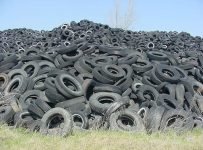
53 million tyres are thrown out in Australia every year
Waste in context
The danger to our grandchildren from polluted air, water and overburdened landfill is negligible compared to the danger that they will not have enough energy, food and water to enjoy any kind of lifestyle we might wish for them.
In 1798 Thomas Robert “Pop” Malthus famously predicted that the world would run out of food by 1850.
He predicted terrible wars, followed by “epidemics, pestilence and plague … [while] gigantic, inevitable famine stalks in the rear.” His simple analysis – that food production increases arithmetically, while unchecked population growth increases exponentially – failed to account for the wonders of the industrial revolution.
His basic premise was revived early in the twentieth century when, despite the carnage of two world wars, population figures were clearly on an exponential curve while food production was not. The “Green Revolution” of the 1950s saw a further increase in food production thanks to the wonder of fertilisers, pesticides and preservatives all made from fossil fuel. Malthusian gloom was discredited once more.
Now, we see a third major revival of the concept on a global scale.
In the green corner we have peak oilers, climate warriors and defenders of the environment. They point out that the world’s fisheries are in crisis, one quarter of the world’s population live in water catchments that cannot supply their demands, we have used half the available petroleum reserves in 150 years and will use the other half in less than forty, carbon dioxide levels are an order of magnitude higher than geologically normal, the world’s forests are disappearing before our eyes and we do not have sufficient arable land to feed the projected population in 2020 even if we manage to sustain current levels of production.
In the blue corner, the titans of capital point to technological solutions, clean coal, nuclear energy and algae as the miracles that will sustain us. Who needs forest, farms and fish when we can power economic growth using microscopic organisms and subatomic particles? Human history has proved our resilience as a species. We may well evolve a synthetic ecology and maintain our virtual lifestyle. It seems unlikely that we will solve world poverty on the way. Nor will we achieve consensus that this is the future we want to leave our descendants.
Looked at in terms of this debate, waste becomes a symptom rather than a cause. The waste mountain we produce each year is simply the difference between the resources we consume, and the resources we actually use to survive. Of course, the waste mountain itself is only one part of the resources we squander, we also pump our sewerage out to sea, our unused nutrients into our rivers, and our exhaust fumes into the atmosphere.
However undesirable the nature of civilisation’s residue, the bigger problem is the squandering of irreplaceable resources. We pump oil from the ground, convert it into plastic, use it once and then throw it away. That oil took millions of years to create and its energy – captured from the sun by prehistoric plants – will never be available again. Intercepting the waste stream to capture that plastic, then using more energy and toxic chemicals to turn that plastic into another bag, a plastic garden stake or a poly-fleece sweater which in turn gets thrown out or recycled again, may be slightly less wasteful than burying it, but it is still a significant waste of finite resources.
The only logical solution is to reduce our consumption. Unless we do, we face a future of increasing conflict as the world’s wealthy take more resources from the poor. The looming increase in grain prices to satisfy the demand for grain based ethanol fuels is a very real example that will make news headlines in mid-2008.
Waste management policy-makers talk about the four Rs: Reduce; re-use; recycle and remove. The first two of these go directly to conserving resources, but have almost nothing to do with waste management.
Reducing waste involves consumption patterns and is generally considered outside the scope of government influence. Resource taxes are considered from time to time, and howled down by industry concerned about the impact on profits. Incidentally, carbon trading is a form of resource tax now being demanded by industry, but only because it has become an integral part of the global economy.
Re-use of goods that would otherwise become waste is also outside the scope of the waste management industry. Trading of second-hand goods is the simplest form of re-use, but for effective resource management re-use has to be designed into a product before manufacture. An electric appliance made from plastic that is moulded together cannot be taken apart and repaired, or refitted for another purpose. A building that is constructed as cheaply as possible to meet the minimum building regulations becomes nothing but scrap, once the integral structure begins to weaken.
To reduce the amount of resources we waste, we have to manage our consumption rather than our rubbish.
You, the consumer
The only person that can reverse these dynamics, is you. In fact, the consumer is the most powerful person in the economic food chain. After all, we are the ones who buy the products that pay for everything else.
It is challenging to think that little old you and me can influence the patterns of waste production and resource consumption as we go about our daily lives. After all, our homes only produce about one quarter of the waste that trundles off to landfill every year, we use about one fifth of the water consumed across the country, one quarter of the energy and one sixth of the transport fuel. How on earth, you may ask, can we affect the other much larger chunk of society.
The fact is that although we only directly consume a small amount of the resources used by the society we live in, indirectly we are reponsible for one hundred percent. It is our insurance premiums, superannuation payments, bank interest, entertainment budget and the profits generated from every purchase we make, that keeps the wheels of industry turning. If we start to be careful exactly who we give our money to, we can make a real difference to the world, fast.
The first step in the right direction is to use eco-friendly alternatives where possible. These include recycled (post consumer waste, or PCW) paper, driving a Prius (if you can afford one) and buying goods made from natural materials like Zelfo rather than plastic and aluminium. Buying products that minimise the harm you do to the environment is a significant step you can take as a consumer. On its own though, this is as much a “feel good” approach as anything else. What is required is a framework that really gives some meaning to those purchasing decisions.
You can salvage the warm inner glow you once got from recycling by tackling the first two of those four Rs, reducing and reusing. You can achieve all that is needed with your wallet and a little ingenuity. Along the way, you can replace the thrill of acquisition with the power of community. You can enjoy life more, by taking less. All it requires is a simple adjustment of values.
There are three ways to do this.
1.Live more simply, that is actually have less stuff.
2.Buy things that last, that is keep things for longer so we do not throw stuff away.
3.Buy things that are made so that once they have served their initial purpose the components from which they are made can be re-used with minimal reprocessing.
By changing your lifestyle in accordance with earth friendly values, you can make an even greater difference. Consider the following four steps.
Shop locally
Become an active participant in your local community. Walk to the shops, buy goods made in your area. You will reduce the transport involved in shipping goods around the world and reverse globalisation by demanding goods made locally. Take holidays locally, socialise with the people in your neighbourhood. This builds a decentralised independent economy in which you are an active player. The best news is you become a part of a community and it feels good.
Do it yourself
Whether it is preparing your own food, repairing things that wear out, or picking up items that other people don’t need any more, you can significantly reduce the resources you consume. Yes, you need skills to do these things but acquiring those skills is satisfying, in a way that sitting down in front of the television can only emulate. Once you start looking at the items you own with DIY eyes, you’ll soon recognise that quality is cheaper in the long run. Well-made goods last longer and can be easily repaired when they begin to wear.
Generate value
Grow your own food, make things that other people want, offer your services to your friends, family and the community. The switch from consumer to supplier puts you in a completely different relationship with the community in which you live. You are rewarded by the payment and respect you receive. Instead of being envied because you have the largest TV screen, the most attractive swimming pool or most expensive car, you are loved because of what you do.
Share generously
In a world based on consumption, sharing is foolish. If you are always seeking more, the last thing you want to do is give things away. If you value happiness and community over wealth and acquisition, the situation is reversed. Sharing your time, resources, and the goods you create connects you with other people, makes them happy and in turn makes you happy.
Reality check
Agriculture uses 80 per cent of the water collected in Australia, industry and transport uses over 80 per cent of the energy generated. Less than one third of the waste generated in Australia comes from our homes. This article detailes how your consumption patterns can make a difference.
Someone has to buy the goods that industry create. Someone has to pay for the buildings that get knocked down and rebuilt. Someone has to eat the rice or wear the cotton that consumes the water taken from our rivers.
Your choices as a consumer drive the economy that consumes the resources that destroy the ecosystems that will sustain your grandchildren. Refuse to live in a cheap building that is only built to last for fifty years, refuse to buy water and energy intensive products, refuse to drive to work in peak hour traffic and park in a concrete parking lot. Value everything you do by the impact it has on the environment and live accordingly.
Not only that, the values of acquisition and consumerism drive economic growth, by learning to live well without consuming more we are turning the economic model on its head.
An Egyptian friend of mine used to say, “The best revenge is to live well.” I’m not sure who he was avenging, but I am avenging the destruction of the planet. It sure feels better than filling up the recycling bin every fortnight.
Giovanni Ebono is host of The Generator on Bay FM, community radio station of the year, and director of the Ebono Institute www.ebono.org
Long-term vision is the key: The new global carbon market – which Sir Nicholas believed had “made a good start” – needed an immediate signal from governments that there would be further cuts to carbon emissions after the first Kyoto period expired in 2012. “A lot of the working of carbon markets depends on long-term investments.” Deciding to build a cleaner power station, for example, required a long-term vision.
Taxation and regulation are critical: But while the market was important for drawing private finance into clean power investments, it was not the only way to drive change. Also critical were taxation and government regulation. Many countries taxed gasoline to reduce its use, for example.
The market is important but is not the only way to drive change for clean power investments, such as taxation and government regulation, reported The Age (18/11/2006, p. 7).
According to Christian Berthelsen and Tina Susman in Baghdad, reported in The Sydney Morning Herald (28/02/2007, p.9), the US had long wanted to capitalise on Iraq’s oil resources as a means of paying for the country’s reconstruction since the 2003 invasion. Oil’s importance was reiterated in the Iraq Study Group report released in December. The agreement not only would open up Iraq’s oil industry to international investment – a bonanza for foreign oil companies – but also produce revenue for a nation badly in need of cash to finance its reconstruction.
Inherent differences: Iraq’s oil riches predominantly lie in the Kurdish-controlled north and the Shiite-controlled south. Reaching an agreement required both parties to be willing to share their bounty with Sunnis in the middle – a particularly painful prospect as Sunnis under Saddam Hussein controlled the entire government. In addition, Kurds, who are pushing for a referendum on withdrawal from Iraq, wanted more control to strike contracts with foreign firms and spend profits as they see fit.
US works out a formula: The statement from the office of the US ambassador, Zalmay Khalilzad, who reportedly brokered the deal, said all revenues from oil sales would go into a single national account, but all regions and provinces would have a seat on an energy policy-making body, and provinces would receive shares of revenue and have control over how they spend it. It was unclear what concessions led to the compromise, and the precise terms of the deal were not immediately available.
Illegal Japanese whaling events in the Antarctic have hit Australian newspapers, televison and radio this week. No broadcaster in any medium has described the Japanese Government’s whaling activities as illegal. Click here to view the rules and treaties the Japanese Government is violating.
What are the mainstream newspapers saying?
Front page on The Sydney Morning Herald
Plea for help over blazing whaler
Andrew Darby
February 15, 2007 – 1:21PM
`The Japanese Government has called for international help with its stricken whaling ship Nisshin Maru as fire still burns through its factory deck in Antarctica. "I think this is a very urgent situation," said Hideki Moronuki, a deputy director at the Fisheries Agency of Japan. "I cordially ask the Australian and New Zealand governments to extend their kindest co-operation to the vessel." …
No comment was available from Australian government officials about any assistance they might provide, but the Ross Sea lies in New Zealand’s search and rescue zone.’
Under Breaking News on The Australian’s web site is the story
Whaling protesters could face charges
February 15, 2007 `ANTI-WHALING group Sea Shepherd could face questioning and even charges in Australia over its protest against Japanese whaling vessels, federal Justice Minister Chris Ellison has said. One of the group’s ships was involved in a dramatic collision with a Japanese whaling ship in Antarctic waters this week before its protest was formally called off due to a lack of fuel. Sea Shepherd footage of the incident has appeared on TV in Australia, and both sides have blamed each other for the collision…
"I would remind all those concerned that if they are to call into an Australian port they could well face the consequences of Australian law if they breached it," Senator Ellison said.’
Government gets whaling data from Japanese: Garrett
February 15, 2007 – 1:59PM
`Labor’s environment spokesman Peter Garrett says the only way the Federal Government monitors whaling by Japanese ships is by asking the Japanese what is happening. That was like asking a burglar to list what they’ve stolen, he said…
"Protecting whales and preserving our $300 million whale-watching industry require more than Howard Government platitudes." He said a Labor government would use the international courts to stop whaling for all time.’