|
|
We need renewable energy
|
Inbox
|
x |

|
1:52 PM (2 minutes ago)
 |
|
|||
 |
|
||||
Add your news
You can add news from your networks or groups through the website by becoming an author. Simply register as a member of the Generator, and then email Giovanni asking to become an author. He will then work with you to integrate your content into the site as effectively as possible.
Listen to the Generator News online
The Generator news service publishes articles on sustainable development, agriculture and energy as well as observations on current affairs. The news service is used on the weekly radio show, The Generator, as well as by a number of monthly and quarterly magazines. A podcast of the Generator news is also available.
As well as Giovanni’s articles it picks up the most pertinent articles from a range of other news services. You can publish the news feed on your website using RSS, free of charge.
|
|
|
Inbox
|
x |
|
1:52 PM (2 minutes ago)
|
|
|||
|
|
||||
|
Recycling Fact
Recycled cans can be made into airplanes, appliances, furniture and more.
|
|
Trash
|
x |

|
8:06 PM (1 hour ago)
|
|
|||
“Sydney, Melbourne, Brisbane, Perth, Adelaide, Canberra, Newcastle and the Gold Coast have been flattened overnight – the vast majority of their populations left homeless.”
NEVILLE,
Just imagine that headline. That’s pretty much what’s happened to Vanuatu, when category 5 Cyclone Pam bore down on the tiny island nation. It’s still chaotic, but early estimates say 70 per cent of their population has been left homeless overnight, and more than 24 people have lost their lives. How would Australia rebuild and recover from that? It’s impossible to even imagine – and it’s not just Vanuatu. Kiribati and Tuvalu have also been devastated.
It almost goes without saying that our immediate and first thoughts, priority and responses as Australians should be to reach out to our Pacific neighbours and help them rebuild and recover in whatever large and small ways we can. In fact, many Australians are already doing that, including our government. But on its own, it’s not enough – not for Vanuatu – or any other country at the frontline of the threats created by our changing climate.
If you would like to contribute, these organisations are doing great work on the ground: http://www.getup.org.au/help-vanuatu
But, we can’t stop there.
It may feel uncomfortable to talk about right now, and a great many people will want to deny it, but we need to have a serious talk about climate change.
Baldwin Lonsdale, the President of Vanuatu – who knows this all too well – has already started the conversation:
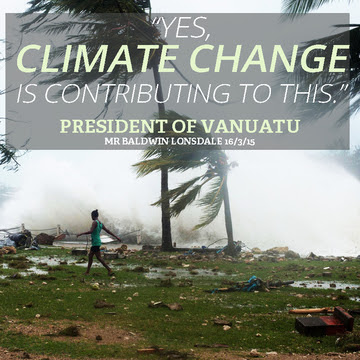
“We see the level of sea rise… The cyclone seasons, the warm, the rain, all this is affected.”
The UN Secretary General has also pointed out that climate change is making extreme weather events like Cyclone Pam far more damaging. That’s because sea levels have already risen – although not nearly as much as they will if we don’t act – meaning more water in cyclone storm surges, which is what causes most of the damage. Low-lying pacific islands, like our neighbouring countries, are particularly vulnerable, as this week shows.
For decades, Vanuatu and other countries argued their urgent need for international help to prepare for foreseeable climate events, like Cyclone Pam. Instead of answering this call for help, last year the Abbott Government drastically cut Australia’s foreign aid and scarapped legislation that was driving down our contrubtion to climate change. Not only are we contributing more to climate change, we’re simultaneously contributing less to help those most affected. And when disasters like this happen, no matter how generous we are personally, we will never make up for the $8 billion cuts this Government took from people who desperately needed it.
So pick up the phone, or get online, and donate to support the organisations working tirelessly on the ground in Vanuatu right now. But – and this is important – before you put the phone down or log off your computer, why not advocate for lasting change by calling your local MP? Tell them you’ve donated, and that you give a damn about our foreign aid, and our policies on climate change – the bigger picture.
No doubt, some may criticise anyone who dares to make the obvious link to climate change for “politicising” this disaster. We aren’t. To do everything we can to help those affected, we need to confront the elephant in the room and speak honestly. So why not start the conversation right now? Click here to contact your MP or Senator, or you could start the conversation at home as a warm up. Forward this email to your friends and family and use this as an opportunity to discuss how you intend to, personally, confront the greatest challenge of our time.
For years, every budget has seen Australian aid cut, because we don’t speak out loudly when it is. For years, climate action has been delayed or wound back, because our government is playing the short, easy game instead of the critical long game. We need to change that.
Climate change is here. It is affecting Australians and our neighbours. These are not easy conversations to have, but with each and every bushfire, heatwave, flood, drought and other climate excacerbated natural disasters it’s a conversation we’re going to need to get better and better at having.
Hopefully, one day soon, we’ll be so good at having it – and so many of us will be having it – that our government will finally put its money where our mouths are. Hopefully one day soon Australia can be a proud Pacific neighbour, joined in solidarity with our friends, as we all get on with the job of adapting to our new climate reality.
Yours in hope,
Sam and Erin for the GetUp team.
PS. In his most recent communication to 350 Pacific staff, Isso Nihmei, 350 Vanuatu Coordinator said: “Now that Cyclone Pam has left, it’s like a heat wave has hit us. Climate change is bringing new extremes to Vanuatu. It’s devastating us.” So while you’re considering what else you might do, why not consider joining a climate advocacy group in the region like 350 Pacific who work on the ground day-in and day-out with Pacific Islanders to bring awareness to the issue of climate change and its dramatic effects in the region? Click here to find out how: http://www.getup.org.au/cyclone-pam
PPS. Check out GetUp’s oped on this subject published in Fairfax media today, Cyclone Pam and Vanuatu: don’t just give cash, give a damn
GetUp is an independent, not-for-profit community campaigning group. We use new technology to empower Australians to have their say on important national issues. We receive no political party or government funding, and every campaign we run is entirely supported by voluntary donations. If you’d like to contribute to help fund GetUp’s work, please donate now! To unsubscribe from GetUp, please click here. Our team acknowledges that we meet and work on the land of the Gadigal people of the Eora Nation. We wish to pay respect to their Elders – past, present and future – and acknowledge the important role all Aboriginal and Torres Strait Islander people continue to play within Australia and the GetUp community.
Authorised by Sam Mclean, Level 2, 104 Commonwealth Street, Surry Hills NSW 2010.
|
Web Clip
Best Cruises Latest Specials – Seabourn Cruise Line – Dalmation Coast & Greek Isles
|
|
Inbox
|
x |

|
6:51 PM (0 minutes ago)
|
|
|||
|
|
||||

 |
 |
| March 12, 2015 |

|
|
|
China is the world’s largest contributor to annual growth in natural resource demandChina is the world’s largest contributor to annual growth in the demand for ecological resources and services, and has been for the last five years for which data is available, according to Global Footprint Network. The Ecological Footprint of the world – a measure of people’s demand on nature – has begun climbing again after experiencing a 2.1 percent decline in 2009 during the recession, according to Global Footprint Network’s 2015 Edition of the National Footprint Accounts, released today. The world’s Ecological Footprint increased nearly 4 percent in 2010 and nearly 1.7 percent in 2011 (the latest year data is available). However, excluding China, the world’s Ecological Footprint increased far less in 2011: 0.9 percent. The Ecological Footprint of China climbed 3.6% in 2010 and 5.2% in 2011. While the Ecological Footprints of many countries declined during the recession, including the United States and Germany, the Ecological Footprints of China and India, the world’s two most populous countries, continued to rise and now comprise about one quarter of the Ecological Footprint of the entire world. Still, the Ecological Footprints per person of both China and India remain far lower than that of many high-income countries. For example, the Ecological Footprint per person of the United States is more than seven times higher than that of India and nearly three times that of China.
In the past six months, both China and India have announced steps to reduce dependence on fossil fuels, which would decrease their Ecological Footprints. China, in particular, has invested substantially in renewable energy, and its decades-long focus on reducing fertility has also helped preserve its biocapacity per person. But more recent news that China’s annual GDP growth should remain at 7 percent for the years to come suggests its Ecological Footprint will continue on an upward trajectory. “In addition to recognizing the importance of indicators like GDP, unemployment or inflation, we look forward to the day when national decision-makers around the world also track their resource dependence. I hope they recognize that natural resources are a fundamental asset for any economy. They should be measured and managed wisely,” says Global Footprint Network President Mathis Wackernagel. “We believe it is not only critical but also possible to live within the means of nature.-It can be achieved without sacrificing current human well-being.” “This is a particularly important year for looking more closely at the planet’s resource budget, first in September with the new Sustainable Development Goals and then in December in Paris for the climate talks,” Wackernagel adds. “What is becoming clear is that living within nature’s budget is vital for each and every nation’s economic strength and the well-being of its citizens. Working with, rather than against, nature’s budget is not only important for our planet as a whole but also for the health and resilience of each individual nation.” Double Challenge: Low Income, Biocapacity Deficit The 2015 National Footprint Accounts compare what people demand against what nature can provide. The accounts simply add together all of the human demands that compete for our planet’s biologically productive surface (Ecological Footprint). This demand then can be compared to all of the planet’s productive surfaces (biocapacity), including cropland, forests, pastures and fishing grounds. Using United Nations data sets, these accounts are calculated for approximately 200 nations. Overall, approximately 71 percent of the world’s population lives in nations with a double challenge: They earn below world-average income (based on Gross National Income) and are running a biocapacity deficit. This means that by 2011, they were using more resources and services from nature than the ecosystems within their respective borders regenerated, based on calculations from the 2015 National Footprint Accounts. Global Footprint Network’s annual update of the National Footprint Accounts shows that each country’s performance varies year to year, but over the last decades, global ecological overshoot – humanity living beyond the budget of nature – has climbed substantially. Ecological overshoot now stands at 54 percent above the planet’s biocapacity. This means humanity demands biocapacity 54 percent faster than what our planet can renew in one year. By contrast, our planet had 30 percent more biocapacity than what humanity used in 1961, the first year for which consistent data sets are available.
Carbon Footprint The carbon Footprint continues to be the largest driver of today’s overall Ecological Footprint, and is also the leading driver of climate change. The world’s carbon Footprint increased almost 1.9 percent in 2011. That’s down slightly from an average annual growth of 2.5 percent from 1961 to 2011. When used in Ecological Footprint accounting, the carbon Footprint represents the land area required to sequester carbon dioxide emissions from fossil fuel use. This demand on nature competes for other land uses, including food, feed for animals, fiber for clothes and paper, and timber for construction. All those demands are tracked in the Footprint accounts. The 2015 National Footprint Accounts cover five decades of data. This year’s update is based on more than 6,000 data points per country per year, includes several methodological improvements and is being offered under a new, more open licensing program. More than 300 organizations and individuals around the world license Global Footprint Network’s National Footprint Accounts each year, including universities and financial institutions. “Notenstein’s methodology for rating sovereign bonds from a sustainability perspective makes heavy use of the National Footprint Accounts,” says Balazs Magyar, a sustainability analyst with Notenstein Privatbank AG in Switzerland. “During turmoils in the bond markets, especially the European sovereign debt crisis, our analysis using the National Footprint Accounts proved to be a valuable tool for selecting sovereign bonds.” This year, Global Footprint Network is offering the National Footprint Accounts under a more open licensing structure, with a new, improved “Public Data Package” available as a free download from our website. This free download includes the latest results for all countries, country graphics and the number of Earths required if the world’s population lived like the average citizen of each country. The free download also offers many new ways to sort data—by region, quality score, GDP, Human Development Index score, and other categories – and data quality scores for the results. Ecological Footprint and the Recession Since hitting a peak in 2004, the Ecological Footprint per person in the United States has dropped to nearly the same level it was in 1961 (the earliest year data is available). The recent Footprint contraction coincides with the recession. Similarly, several European countries, still struggling to pull out of the recession, continued to see a downward trend in their Ecological Footprints in 2011. That included the United Kingdom, France and Spain. Germany, widely viewed as the strongest economy in Europe, saw its per person Ecological Footprint remain virtually flat in 2011, in continuation of the last decade, which may be attributed in part to its investment in renewable energy. Sweden was an outlier, with its Ecological Footprint starting to creep up again to about 6.5 global hectares per person, though that was still substantially lower than its all-time high of more than 8 global hectares in 2004. “With more nations now moving closer toward economic recovery, Ecological Footprints will most likely begin creeping upward,” notes Susan Burns, CEO of Global Footprint Network. “However, these recoveries will be fragile and unsustainable in the long run unless we take a more proactive approach to managing our natural resource dependence.”
Additional Resources Ecological Footprint and Biocapacity Data by Nation: See if your country is running a biocapacity reserve or deficit. Licensing Information for Commercial Data Use Case Stories on Footprint Applications: United Arab Emirates, Philippines, Calgary |
||
|
1 of 18
|
Web Clip
Funny Quote of the Day – Peter O’Toole – “When did I realize I was God? Well, I was praying and I suddenly realized I was talking to m…
|
|
Inbox
|
x |
|
3:39 PM (17 minutes ago)
|
|
|||
|
|
Web Clip
|
|
Inbox
|
x |

|
11:51 AM (56 minutes ago)
|
|
|||
When it comes to the relationship between power companies and consumers, we’ve known for a while that things are out of whack. Power prices are through the roof and almost every solar owner I speak to has a story about connection delays, hidden costs and unfair fixed fees.
But there’s a rule change on the horizon that could help all Australian energy consumers regain control of our power bills. It’s called the Demand Management Incentive Scheme Rule Change and it works by rewarding power companies for encouraging consumers to save energy. This provides incentives for power companies to support the installation of more solar with storage, helping to lower energy bills.
According to research from the Australian Energy Market Commission (AEMC), the body who makes the rules which govern power companies, this rule change would reduce household bills by an estimated $120 to $500 a year*.
The fact is, the way our energy market operates currently goes against every notion of common sense. Why are companies investing in more and more network infrastructure – that’s the grid that delivers us power – even though electricity demand is falling? The same reason power prices have doubled since 2007. It’s in the rules. As things stand, the AEMC rules reward companies for investing in unnecessary infrastructure, and consumers are left to foot the bill.
If accepted, this rule change will see common sense restored. It would mean that when consumers reduce their energy usage by going solar or using efficiency measures, their power bills would actually go down accordingly.
We’re at a turning point. If this rule change is accepted, our energy sector could finally be ready to embrace a sun-powered future. If it’s rejected, there will be fewer and fewer reasons for Australians to go solar; current solar owners will continue to be hit with discriminatory charges and all Australian energy consumers will face rising fixed costs.
Right now we have an opportunity to win power back for energy consumers. Click here to to make a submission to the AEMC, urging them to accept this rule change. It will take you no longer than 10 minutes and -considering the time and money this rule change could save you in the long run – I’d say it’s worth it.
Here’s to a fairer energy system,
Claire O’Rourke, National Director

P.S.Submissions to the AEMC close on Thursday, so make sure you get yours in ASAP using our quick and easy form. Click here to make your submission today.