Category: News

Add your news
You can add news from your networks or groups through the website by becoming an author. Simply register as a member of the Generator, and then email Giovanni asking to become an author. He will then work with you to integrate your content into the site as effectively as possible.
Listen to the Generator News online

 
The Generator news service publishes articles on sustainable development, agriculture and energy as well as observations on current affairs. The news service is used on the weekly radio show, The Generator, as well as by a number of monthly and quarterly magazines. A podcast of the Generator news is also available.
As well as Giovanni’s articles it picks up the most pertinent articles from a range of other news services. You can publish the news feed on your website using RSS, free of charge.
 

  • They’re Trying to Shut Us Down Lock the Gate Alliance

    1 of 4
    Web Clip

    They’re Trying to Shut Us Down

    Inbox
    x

    Phil Laird for Lock the Gate Alliance <info@lockthegate.org.au>

    3:41 PM (10 minutes ago)

    to me
    Lock the Gate Alliance

    Double your donation! Ethical Jobs will match every dollar that you give us to help save the magnificent icons of Arnhem Land and Kings Canyon.

    Hi Neville,This week the mining industry launched an unprecedented attack on Lock the Gate Alliance, trying to have our status as a charitable institution removed.

    But we will not be bullied by multi-national billionaires trying to shut down our democratic rights to defend land, water and communities.

    EJ_Email4.jpgSo today, we’re asking you to join us to show that you will not be intimidated, and to chip in $20 to our latest appeal to fight fracking in the Northern Territory.

    Every dollar that you give will be matched by Ethical Jobs, who have partnered with us to raise much needed funds to protect our most precious natural and cultural icons.

    They’re supporting us in our campaign to raise funds to save iconic regions of the Northern Territory that are under immediate threat from dangerous fracking.  

    From the tropical wetlands of Arnhem Land to the iconic deserts and gorges of Central Australia, the gas companies want it all!  Even the magnificent Watarrka (Kings Canyon) National Park has a fracking application covering it! 

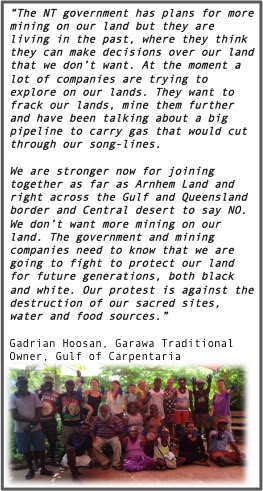
    Indigenous Traditional Custodians, like Gadrian Hoosan, are telling us ‘No, we don’t want more mining on our land’. 

    Will you support remote communities across the Northern Territory, like Gadrian’s, who are joining together to protect country and culture?

    All we’re asking is for you to click on this link and kick off our campaign by donating $20.

    It’s simple – for every dollar donated to this campaign, EthicalJobs.com.au will match that every day until the end of March– or until we hit $10,000.

    Lock the Gate has been selected as the first organisation for this fantastic initiative and this is where we need your help.

    Can you chip in and double your impact?

    Together we stand,

    Phil Laird – National Coordinator
    Lock the Gate Alliance
    http://www.lockthegate.org.au/

  • It’s never been done before LAND AND WATER FUTURE ORG AU

    Click here to enable desktop notifications for Gmail.   Learn more  Hide
    More

    1 of 10
    Web Clip

    It’s never been done before

    Inbox
    x

    Holly, Land Water Future <campaign@landwaterfuture.org.au>

    1:42 PM (10 minutes ago)

    to me
    - -

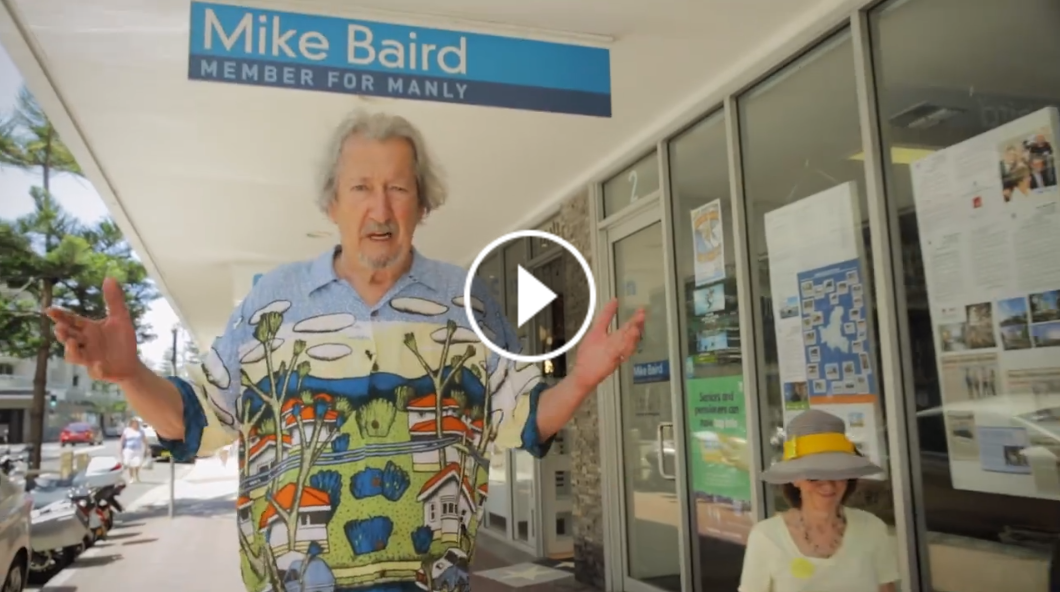
    Want to be part of an event Premier Baird can’t ignore? Watch this clip with actor Michael Caton here!

    Neville —

    I need your help to make something incredible happen. Something our Premier can’t ignore.

    On Sunday March 1 hundreds of people like you will take to the streets of Manly to knock on every single house in the Premier’s electorate with a survey about coal mining and coal seam gas fracking.

    Aussie actor Michael Caton made this great video to give you a taste of what to expect.

    Watch and share on Facebook | Watch and share on Youtube

    Manly Stands Up!

    On Wednesday night at a packed community forum in Manly, over 100 people signed up to take part – so we’re off to a great start.

    Don’t worry if you haven’t doorknocked before: the survey has five simple questions, we will provide a training on the day, and you’ll be joined by hundreds of great people.

    After the survey, we will deliver the results to Premier Baird’s office, to show him just how much people from Manly and across NSW want to protect our best farmland, forests and water from coal mining and coal seam gas fracking.

    Can you join other volunteers on March 1 to take part in the giant community survey in Manly? RSVP now.

    When: 11-4pm Sunday, 1 March, with a celebratory BBQ afterwards.
    Where: Meet at The Great Hall – International College of Management Sydney (ICMS), 151 Darley Rd, Manly. Map here.
    What to bring: Hat, sunscreen, water bottle, a bag for carrying materials, lunch, shoes for walking.
    We will provide: Training, a campaign t-shirt, maps, a free BBQ to celebrate at the end of the day.

    RSVP is essential, please let us know you’re coming here: manlystandsup.org/survey

    Holly and the Land, Water, Future team.

    P.S. Premier Baird can’t ignore hundreds of people surveying every house in his state electorate. It’s also Prime Minister Abbott’s electorate – so we can double our impact. Watch and share the video today: On Facebook | On Youtube

  • Meet the Reef warriors, NEVILLE

    1 of 4

    Meet the Reef warriors, NEVILLE

    Inbox
    x

    Dermot O’Gorman, WWF-Australia noreply@act.wwf.org.au via server8839.e-activist.com 

    11:39 AM (4 minutes ago)

    to me
    Connected By Water

    Dear NEVILLE,

    You’ve been with us, every step of the way, fighting to protect our iconic Great Barrier Reef from rapid industrialisation. Like anything worth fighting for, it hasn’t always been easy – there have been ups and downs.

    So today we share a story to inspire; a story of hope.

    This story comes from an unlikely group of Australians, quietly working to help save the Reef.

    Who are these Reef warriors?

    Over 75 cane farmers from Queensland, decided it was time to step up and do their bit for the Reef. They joined Project Catalyst and partnered with WWF-Australia, the Coca Cola Foundation, Catchment Solutions, NQ Dry Tropics and Terrain NRM.

    This unlikely alliance wasn’t easy, but we all had a common goal – to help save the Reef. To leave something better for the next generation.

    Don’t just take our word for it – watch the video and hear straight from the farmers, in their own words.

    Connected By Water Video
    What these farmers have achieved for the land and our Reef is truly inspirational.

    Let’s make sure the actions of these farmers don’t go unnoticed. Help us spread the word with the hope that other farmers and businesses will be encouraged to do the same.

    Help spread hope for the Reef and thank a farmer by sharing the video.

    As cane farmer Tony Bugeja puts it best:

     “As a farmer I feel we should all be doing our bit for this planet. I think if everyone does their bit it will make a difference”. 

    This is an inspiring story, one that should be shared so that hope for the Reef spreads.

    Best,

    Dermot O’Gorman
    CEO, WWF-Australia

    P.S.  I think you’ll especially like the bit at 4.31 – Tony’s smile says it all.

    P.P.S If you’re not on Facebook it’s no problem, you can watch the video on YouTube here.

  • Our latest report making headlines CLIMATE COUNCIL

    The conversation has been marked as not important.
    More

    Web Clip
    ESPN.comUFC to drug test year-round as part of PED plan31 minutes ago

    Our latest report making headlines

    Inbox
    x

    Tim Flannery – Climate Council via sendgrid.info 

    11:15 AM (6 minutes ago)

    to me

    Dear Inga

    Just a quick update on our latest report explaining breakthrough scientific research demonstrating the strong influence of climate change on individual extreme heat events.

    It seems every time there’s another record-breaking heatwave we first must endure the swelter; then the “debate” over whether it has anything to do with climate change (‘Australia! It’s always been hot!’)… and if climate change is influencing individual weather events, by how much?

    Well, new ground-breaking research is changing this conversation, to be more decisive and well-informed.

    Scientists can now pinpoint exactly how much climate change is contributing to individual extreme heat events, and it won’t surprise you to learn that, yes: hot days are happening more often while heatwaves are becoming hotter, longer and more frequent thanks to greenhouse gas emissions.

    The research reveals that:

    • Our record hot year of 2013 in Australia was virtually impossible without climate change.
    • Climate change tripled the odds that the heat waves of the 2012/2013 Australian summer would occur as frequently as they did.
    • Climate change doubled the odds that the 2012/2013 heat waves would be as intense as they were.

    We were pleased with the media coverage the report received. Five TV channels ran the story on their national bulletin, while newspapers gave us colourful headlines like the Courier-Mail’s, “It’s hot…damn hot”, and it was picked up internationally in the US, Canada and the UK.

    We’ve been focused for the last year on getting out as much information as possible on the link between extreme weather and climate change. Extreme weather helps us explain that climate change is not just a future problem affecting polar bears, but a tangible issue affecting Australians today.  

    It’s working. Public opinion polling by Essential Media Communications in November showed that 76% of people thought that climate change and extreme weather were linked, compared to 52% in January 2014. Now journalists say to me, ‘of course Tim, don’t we already know this?’ Whereas 18 months ago it was a very different conversation.

    Reports like this are helping to keep climate change at the top of the national agenda. There is much more to do, but thank you for your support which makes it possible.

    You can read a copy of the report for yourself here[idea: Even better, email a copy to your MP with a polite but not altogether unalarmed note urging them to act.]

    Again, thank you for all that you do to share, support and make our work possible.

    Yours,

    Tim Flannery

  • Tassie forests again? They can’t be serious

    Click here to enable desktop notifications for Gmail.   Learn more  Hide
    1 of 6
    Web Clip

    Tassie forests again? They can’t be serious

    Inbox
    x

    Jess Abrahams, ACF Unsubscribe

    10:19 AM (23 minutes ago)

    to me

    Hi NEVILLE

    Last year, I celebrated with hundreds of thousands of Australians like you, who helped stop the Abbott government’s attempt to strip some of Tassie’s magnificent forests of World Heritage status.
    It’s hard to believe that any government would try it again. But right now, the Tasmanian government has a disturbing new plan to allow logging and large-scale tourism in the heart of the Wilderness World Heritage area.
    This is disappointing news but there is hope.
    Our federal environment minister, Greg Hunt, vowed to “fully and completely” protect Tasmania’s Wilderness World Heritage Area in a strong response to the plans.

    I WILL!

    I first experienced Tassie’s Wilderness World Heritage Area as a teenager on a tough two-week bushwalk in the south-west. It was a brutal, yet beautiful induction. Tasmania’s wild places are full of contrasts, both rugged and subtle, physically intimidating and spiritually uplifting.
    I’ve ventured back many times since – as a ranger, a campaigner, and for personal adventure. I’ve wandered on and off track, camped out on sun-drenched beaches and freezing mountain tops, and swum flooded rivers and cold calm lakes.
    There is something deeply moving about being immersed in the last places on Earth untouched by industrialisation. It puts our lives into context and reminds us that we are part of nature – not its master.

    TELL HIM!

    Our natural heritage – the places we love – are not commodities. They are special places, of great natural and cultural significance, that deserve the highest level of protection.
    Don’t get me wrong – responsible tourism is vital for Tasmania. But commercial tourism in the heart of a World Heritage protected wilderness cannot respect the natural and cultural values of the area.
    Hundreds of thousands of us have come together before to protect Tassie forests – and won. It’s time to harness that energy again.
    Jess
    Jess Abrahams
    Healthy ecosystems campaigner
    Australian Conservation Foundation

    PS – You can can read Greg Hunt’s vow to protect Tassie’s World Heritage forests in The Australian.

  • [New post] NSW 2015 – where will the preferences flow?

    1 of 15
    Web Clip
    CNN.com Recently Published/UpdatedSpeech analysis could help ID executioner in new ISIS video1 hour ago

    [New post] NSW 2015 – where will the preferences flow?

    Inbox
    x

    The Tally Room <donotreply@wordpress.com>

    10:15 AM (24 minutes ago)

    to me

    New post on The Tally Room

    NSW 2015 – where will the preferences flow?

    by Ben Raue

    One of the biggest stories of the recent Queensland state election was the huge shift in preference flows towards Labor, with a big drop in the exhaustion rate across the state.

    Opinion polling was quite accurate in predicting primary votes, but the method of distributing preferences according to the real flow of preferences at the previous election significantly overstated the two-party-preferred vote for the Liberal National Party.

    It shouldn’t have been as much of a surprise as it was – the largest proportion of minor party votes in Queensland in 2012 came from Katter’s Australian Party, who had since dropped in the polls and were only running in a small number of seats.

    I blogged about the preference issue shortly after the election, and Antony Green posted about the final vote figures on Tuesday.

    There are two major jurisdictions in Australia that use optional preferential voting in single-member electorates, and the other one will be voting in just over a month, in New South Wales.

    Like in Queensland, the last New South Wales election saw a big drop in the Labor vote and a majority of Labor’s seats being lost to the Coalition. We also saw a big decline in the number of seats where the Greens opted to preference Labor (as opposed to issuing a ‘just vote 1’ how-to-vote).

    So I was curious whether there had been a significant drop in preference flows to Labor in 2011, that could possibly revert to form in 2015.

    The following table shows the proportion of minor party preferences flowing to Labor, the Coalition or exhausting.

    Election ALP preferences LNP preferences Exhausted
    2003 26.92% 16.37% 56.70%
    2007 26.87% 18.57% 54.56%
    2011 24.13% 20.66% 55.21%

    Unlike Queensland, there was only a minor shift in preferences – LNP preferences increased by just over 2%, and Labor preferences dropped by just under 3%, with the remainder resulting in an increase in exhausted preferences.

    This isn’t surprising, considering that there was no party playing a similar role to KAP in the 2011 election.

    The above table brings together all preferences for all minor parties, but there is some analysis giving indications of how preferences flow for each minor party.

    Antony Green produced a report for the NSW Parliamentary Library after the 2007 election which re-examined ballot papers for minor parties to precisely identify how each minor party’s primary votes flowed as preferences. The normal distribution of preferences doesn’t allow for this process, as votes can flow from one minor party to another. This process of post-election study is conducted after every federal election by the AEC, but is not regularly performed for state elections. It doesn’t appear that a similar study was conducted in 2011.

    In the 2007 study (on page 59 of the PDF at the above link), Green breaks down preference flows based on each party, and how they preferenced in that seat. In the 73 seats studied, the Greens preferenced Labor in 43 seats and exhausted in the remaining thirty. There was a significant difference in preference flows in these two groups of seats – 46.2% of Greens votes flowed to Labor in seats where the Greens directed preferences, and only 33.2% flowed to Labor where they didn’t.

    In 2011, the Greens only preferenced Labor in five out of 93 seats. Presumably that number will increase in 2015, but the previous evidence suggests that the decline in Greens preferences to Labor only produced a small shift in actual preference flows in 2011.