Home
Coal
Gas
Nuclear
Renewables
Smart Grid
Business
O&M
Register Now to participate in this webinar: The role of mobile water treatment to offset emergency or scheduled plant shutdowns
Home /
Coal/
New Carbon Targets, Other Measures Proclaimed at UN Climate Summit
New Carbon Targets, Other Measures Proclaimed at UN Climate Summit
09/25/2014 | Sonal Patel
Print Mode : OFF
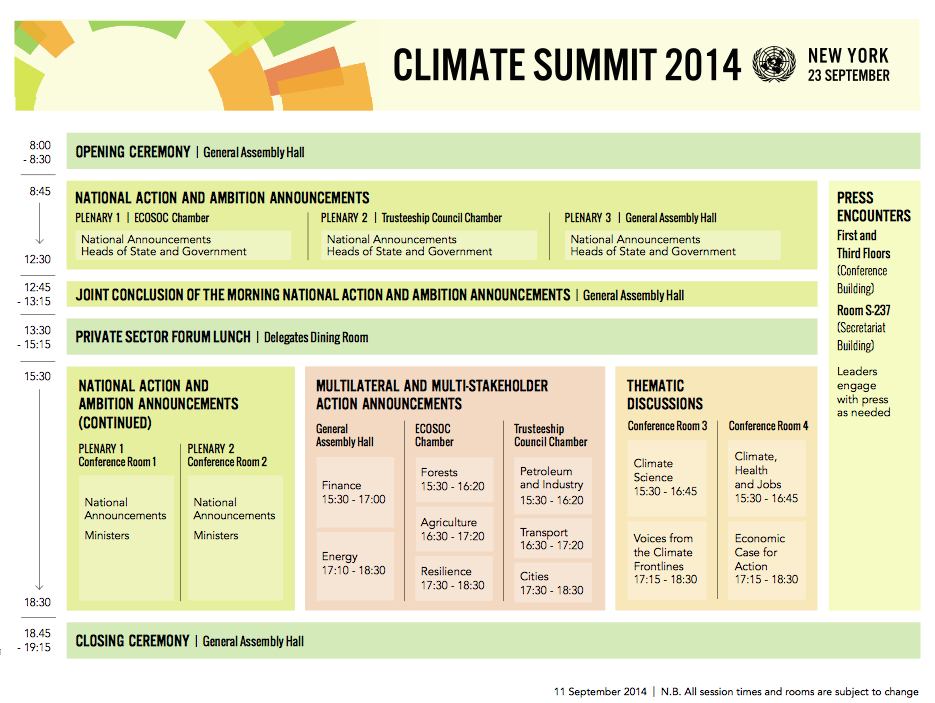
Several countries and companies at the United Nations (UN) Climate Summit 2014 in New York City pledged action to address climate change by slashing carbon emissions, mobilizing funding, or putting a price on carbon.
The one-day event on Tuesday was designed to raise political momentum and spur transformative action ahead of COP 21, the December 2015 summit in Paris where the UN hopes all countries will agree to a plan under the United Nations Framework Convention on Climate Change (UNFCCC) to cut their greenhouse gas (GHG) emissions enough to stay within the 2-degree-Celsius target.
About 100 government heads reportedly attended the New York City summit, as along with 800 other leaders from business, finance, and society. According to the World Resources Institute (WRI), leaders widely agreed that “bold action is needed today to reduce emissions.” All were committed to finalizing a universal new agreement under the UNFCCC, agreeing to arrive at the first draft of that agreement by December 2014 in Lima, Peru.
Here are some notable announcements from the New York City summit:
China will adopt a national climate change plan to reduce the country’s carbon dioxide emission intensity (CO2 emissions per unit of gross domestic product) by between 40% and 45% by 2020, compared with the 2005 level. The plan approved by the State Council of China will also raise the share of non–fossil fuels to 15% of total primary energy consumption. The announcement is significant, even though the country’s National Development and Reform Commission estimates that China’s carbon intensity has already fallen by about 29% between 2005 and 2013, and non–fossil fuels already made up about 9.8% of primary consumption at the end of 2013.
Hong Kong will seek to slash its GHG emissions by at least 50% by 2020 from 2005 levels, the city’s secretary for the environment said.
The European Commission (EC) will formally recommend that the 28-country European Union (EU) should adopt a target of reducing carbon emissions to 40% below 1990 levels by 2030. No surprise here: the bloc is soon expected to vote on the measure.
UK Prime Minister David Cameron said his nation has invested $1 billion in carbon capture and storage (CCS) systems and prohibited construction of new coal power plants without CCS. Yet, he called on the world to eliminate fossil fuel subsidies and invest in renewable energy.
New York City committed to an 80% cut in GHG emissions by 2050, compared to 2005 levels. The city plans to retrofit about 150 to 200 public and private buildings per year over the next decade to increase their efficiency and dramatically reduce the city’s contribution to climate change.
France pledged $1 billion to the 2010-founded Green Climate Fund, which helps developing countries both reduce emissions and adapt to climate change impacts. Switzerland, Denmark, Norway, Luxembourg, and the Czech Republic also made pledges. But despite pledges by Germany and Sweden last year, the fund only has about $2.3 billion in total, well below the $15 billion target.
U.S. President Obama announced an executive order requiring federal agencies to factor climate resilience into the design of their international development programs and investments.
South Africa’s Minister of Environment Edna Molewa noted that the country had in 2009 pledged to cut GHG emissions 34% by 2020 and 42% by 2025 below business as usual levels. South Africa would submit national targets in time for COP 21 in Paris, she said.
Sweden said it would reduce emissions by 40% by 1990 levels and have no net emissions by 2050.
Denmark’s Prime Minister Helle Thorning-Schmidt reiterated that country’s commitment to be fossil-fuel free by 2050.
Mexico’s President Enrique Pena Nieto pledged an emissions reduction of 30% by 2030 and 50% by 2050 compared to 2000. By 2020, Mexico will also produce 34.6% of its power with renewables, he said, and have instituted a carbon tax.
Brazil’s President Dilma Rousseff announced no new commitments, but revealed the country had reduced its deforestation by 79%.
Seventy-four national governments, 23 regional governments, and numerous businesses pledged their support for policy signals that will put a price on carbon. The summit also saw some countries join the World Bank’s newly formed Carbon Pricing Leadership Coalition. While countries like the U.S., Canada, and India haven’t signed on to the coalition, members so far include China, South Africa, Russia, and the EU countries.
At least 40 countries, 30 cities, and several companies pledged to double the rate of energy efficiency by 2030 through fuel efficiency, lighting, appliances, and district energy.
Norway’s Statoil, the UK’s BG Group, Italy’s ENI, Mexico’s Pemex, Thailand’s PTT, and Houston-based Southwestern Energy agreed to work with more than a dozen countries to help reduce their emissions of methane.
Bank of America predicts that the global green bond market—securities meant to raise capital to finance low-carbon investments—will grow to $300 billion by 2020 (up from $40 billion in green bonds to be in 2014 and $11 billion issued in 2013).
—Sonal Patel, associate editor (@POWERmagazine, @sonalcpatel)
Home
Coal
Gas
Nuclear
Renewables
Smart Grid
Business
O&M
Register Now to participate in this webinar: The role of mobile water treatment to offset emergency or scheduled plant shutdowns
Home /
Coal/
New Carbon Targets, Other Measures Proclaimed at UN Climate Summit
New Carbon Targets, Other Measures Proclaimed at UN Climate Summit
09/25/2014 | Sonal Patel
Print Mode : OFF
Several countries and companies at the United Nations (UN) Climate Summit 2014 in New York City pledged action to address climate change by slashing carbon emissions, mobilizing funding, or putting a price on carbon.
The one-day event on Tuesday was designed to raise political momentum and spur transformative action ahead of COP 21, the December 2015 summit in Paris where the UN hopes all countries will agree to a plan under the United Nations Framework Convention on Climate Change (UNFCCC) to cut their greenhouse gas (GHG) emissions enough to stay within the 2-degree-Celsius target.
About 100 government heads reportedly attended the New York City summit, as along with 800 other leaders from business, finance, and society. According to the World Resources Institute (WRI), leaders widely agreed that “bold action is needed today to reduce emissions.” All were committed to finalizing a universal new agreement under the UNFCCC, agreeing to arrive at the first draft of that agreement by December 2014 in Lima, Peru.
Here are some notable announcements from the New York City summit:
China will adopt a national climate change plan to reduce the country’s carbon dioxide emission intensity (CO2 emissions per unit of gross domestic product) by between 40% and 45% by 2020, compared with the 2005 level. The plan approved by the State Council of China will also raise the share of non–fossil fuels to 15% of total primary energy consumption. The announcement is significant, even though the country’s National Development and Reform Commission estimates that China’s carbon intensity has already fallen by about 29% between 2005 and 2013, and non–fossil fuels already made up about 9.8% of primary consumption at the end of 2013.
Hong Kong will seek to slash its GHG emissions by at least 50% by 2020 from 2005 levels, the city’s secretary for the environment said.
The European Commission (EC) will formally recommend that the 28-country European Union (EU) should adopt a target of reducing carbon emissions to 40% below 1990 levels by 2030. No surprise here: the bloc is soon expected to vote on the measure.
UK Prime Minister David Cameron said his nation has invested $1 billion in carbon capture and storage (CCS) systems and prohibited construction of new coal power plants without CCS. Yet, he called on the world to eliminate fossil fuel subsidies and invest in renewable energy.
New York City committed to an 80% cut in GHG emissions by 2050, compared to 2005 levels. The city plans to retrofit about 150 to 200 public and private buildings per year over the next decade to increase their efficiency and dramatically reduce the city’s contribution to climate change.
France pledged $1 billion to the 2010-founded Green Climate Fund, which helps developing countries both reduce emissions and adapt to climate change impacts. Switzerland, Denmark, Norway, Luxembourg, and the Czech Republic also made pledges. But despite pledges by Germany and Sweden last year, the fund only has about $2.3 billion in total, well below the $15 billion target.
U.S. President Obama announced an executive order requiring federal agencies to factor climate resilience into the design of their international development programs and investments.
South Africa’s Minister of Environment Edna Molewa noted that the country had in 2009 pledged to cut GHG emissions 34% by 2020 and 42% by 2025 below business as usual levels. South Africa would submit national targets in time for COP 21 in Paris, she said.
Sweden said it would reduce emissions by 40% by 1990 levels and have no net emissions by 2050.
Denmark’s Prime Minister Helle Thorning-Schmidt reiterated that country’s commitment to be fossil-fuel free by 2050.
Mexico’s President Enrique Pena Nieto pledged an emissions reduction of 30% by 2030 and 50% by 2050 compared to 2000. By 2020, Mexico will also produce 34.6% of its power with renewables, he said, and have instituted a carbon tax.
Brazil’s President Dilma Rousseff announced no new commitments, but revealed the country had reduced its deforestation by 79%.
Seventy-four national governments, 23 regional governments, and numerous businesses pledged their support for policy signals that will put a price on carbon. The summit also saw some countries join the World Bank’s newly formed Carbon Pricing Leadership Coalition. While countries like the U.S., Canada, and India haven’t signed on to the coalition, members so far include China, South Africa, Russia, and the EU countries.
At least 40 countries, 30 cities, and several companies pledged to double the rate of energy efficiency by 2030 through fuel efficiency, lighting, appliances, and district energy.
Norway’s Statoil, the UK’s BG Group, Italy’s ENI, Mexico’s Pemex, Thailand’s PTT, and Houston-based Southwestern Energy agreed to work with more than a dozen countries to help reduce their emissions of methane.
Bank of America predicts that the global green bond market—securities meant to raise capital to finance low-carbon investments—will grow to $300 billion by 2020 (up from $40 billion in green bonds to be in 2014 and $11 billion issued in 2013).
—Sonal Patel, associate editor (@POWERmagazine, @sonalcpatel)
Home
Coal
Gas
Nuclear
Renewables
Smart Grid
Business
O&M
Register Now to participate in this webinar: The role of mobile water treatment to offset emergency or scheduled plant shutdowns
Home /
Coal/
New Carbon Targets, Other Measures Proclaimed at UN Climate Summit
New Carbon Targets, Other Measures Proclaimed at UN Climate Summit
09/25/2014 | Sonal Patel
Print Mode : OFF
Several countries and companies at the United Nations (UN) Climate Summit 2014 in New York City pledged action to address climate change by slashing carbon emissions, mobilizing funding, or putting a price on carbon.
The one-day event on Tuesday was designed to raise political momentum and spur transformative action ahead of COP 21, the December 2015 summit in Paris where the UN hopes all countries will agree to a plan under the United Nations Framework Convention on Climate Change (UNFCCC) to cut their greenhouse gas (GHG) emissions enough to stay within the 2-degree-Celsius target.
About 100 government heads reportedly attended the New York City summit, as along with 800 other leaders from business, finance, and society. According to the World Resources Institute (WRI), leaders widely agreed that “bold action is needed today to reduce emissions.” All were committed to finalizing a universal new agreement under the UNFCCC, agreeing to arrive at the first draft of that agreement by December 2014 in Lima, Peru.
Here are some notable announcements from the New York City summit:
China will adopt a national climate change plan to reduce the country’s carbon dioxide emission intensity (CO2 emissions per unit of gross domestic product) by between 40% and 45% by 2020, compared with the 2005 level. The plan approved by the State Council of China will also raise the share of non–fossil fuels to 15% of total primary energy consumption. The announcement is significant, even though the country’s National Development and Reform Commission estimates that China’s carbon intensity has already fallen by about 29% between 2005 and 2013, and non–fossil fuels already made up about 9.8% of primary consumption at the end of 2013.
Hong Kong will seek to slash its GHG emissions by at least 50% by 2020 from 2005 levels, the city’s secretary for the environment said.
The European Commission (EC) will formally recommend that the 28-country European Union (EU) should adopt a target of reducing carbon emissions to 40% below 1990 levels by 2030. No surprise here: the bloc is soon expected to vote on the measure.
UK Prime Minister David Cameron said his nation has invested $1 billion in carbon capture and storage (CCS) systems and prohibited construction of new coal power plants without CCS. Yet, he called on the world to eliminate fossil fuel subsidies and invest in renewable energy.
New York City committed to an 80% cut in GHG emissions by 2050, compared to 2005 levels. The city plans to retrofit about 150 to 200 public and private buildings per year over the next decade to increase their efficiency and dramatically reduce the city’s contribution to climate change.
France pledged $1 billion to the 2010-founded Green Climate Fund, which helps developing countries both reduce emissions and adapt to climate change impacts. Switzerland, Denmark, Norway, Luxembourg, and the Czech Republic also made pledges. But despite pledges by Germany and Sweden last year, the fund only has about $2.3 billion in total, well below the $15 billion target.
U.S. President Obama announced an executive order requiring federal agencies to factor climate resilience into the design of their international development programs and investments.
South Africa’s Minister of Environment Edna Molewa noted that the country had in 2009 pledged to cut GHG emissions 34% by 2020 and 42% by 2025 below business as usual levels. South Africa would submit national targets in time for COP 21 in Paris, she said.
Sweden said it would reduce emissions by 40% by 1990 levels and have no net emissions by 2050.
Denmark’s Prime Minister Helle Thorning-Schmidt reiterated that country’s commitment to be fossil-fuel free by 2050.
Mexico’s President Enrique Pena Nieto pledged an emissions reduction of 30% by 2030 and 50% by 2050 compared to 2000. By 2020, Mexico will also produce 34.6% of its power with renewables, he said, and have instituted a carbon tax.
Brazil’s President Dilma Rousseff announced no new commitments, but revealed the country had reduced its deforestation by 79%.
Seventy-four national governments, 23 regional governments, and numerous businesses pledged their support for policy signals that will put a price on carbon. The summit also saw some countries join the World Bank’s newly formed Carbon Pricing Leadership Coalition. While countries like the U.S., Canada, and India haven’t signed on to the coalition, members so far include China, South Africa, Russia, and the EU countries.
At least 40 countries, 30 cities, and several companies pledged to double the rate of energy efficiency by 2030 through fuel efficiency, lighting, appliances, and district energy.
Norway’s Statoil, the UK’s BG Group, Italy’s ENI, Mexico’s Pemex, Thailand’s PTT, and Houston-based Southwestern Energy agreed to work with more than a dozen countries to help reduce their emissions of methane.
Bank of America predicts that the global green bond market—securities meant to raise capital to finance low-carbon investments—will grow to $300 billion by 2020 (up from $40 billion in green bonds to be in 2014 and $11 billion issued in 2013).
—Sonal Patel, associate editor (@POWERmagazine, @sonalcpatel)
Home
Coal
Gas
Nuclear
Renewables
Smart Grid
Business
O&M
Register Now to participate in this webinar: The role of mobile water treatment to offset emergency or scheduled plant shutdowns
Home /
Coal/
New Carbon Targets, Other Measures Proclaimed at UN Climate Summit
New Carbon Targets, Other Measures Proclaimed at UN Climate Summit
09/25/2014 | Sonal Patel
Print Mode : OFF
Several countries and companies at the United Nations (UN) Climate Summit 2014 in New York City pledged action to address climate change by slashing carbon emissions, mobilizing funding, or putting a price on carbon.
The one-day event on Tuesday was designed to raise political momentum and spur transformative action ahead of COP 21, the December 2015 summit in Paris where the UN hopes all countries will agree to a plan under the United Nations Framework Convention on Climate Change (UNFCCC) to cut their greenhouse gas (GHG) emissions enough to stay within the 2-degree-Celsius target.
About 100 government heads reportedly attended the New York City summit, as along with 800 other leaders from business, finance, and society. According to the World Resources Institute (WRI), leaders widely agreed that “bold action is needed today to reduce emissions.” All were committed to finalizing a universal new agreement under the UNFCCC, agreeing to arrive at the first draft of that agreement by December 2014 in Lima, Peru.
Here are some notable announcements from the New York City summit:
China will adopt a national climate change plan to reduce the country’s carbon dioxide emission intensity (CO2 emissions per unit of gross domestic product) by between 40% and 45% by 2020, compared with the 2005 level. The plan approved by the State Council of China will also raise the share of non–fossil fuels to 15% of total primary energy consumption. The announcement is significant, even though the country’s National Development and Reform Commission estimates that China’s carbon intensity has already fallen by about 29% between 2005 and 2013, and non–fossil fuels already made up about 9.8% of primary consumption at the end of 2013.
Hong Kong will seek to slash its GHG emissions by at least 50% by 2020 from 2005 levels, the city’s secretary for the environment said.
The European Commission (EC) will formally recommend that the 28-country European Union (EU) should adopt a target of reducing carbon emissions to 40% below 1990 levels by 2030. No surprise here: the bloc is soon expected to vote on the measure.
UK Prime Minister David Cameron said his nation has invested $1 billion in carbon capture and storage (CCS) systems and prohibited construction of new coal power plants without CCS. Yet, he called on the world to eliminate fossil fuel subsidies and invest in renewable energy.
New York City committed to an 80% cut in GHG emissions by 2050, compared to 2005 levels. The city plans to retrofit about 150 to 200 public and private buildings per year over the next decade to increase their efficiency and dramatically reduce the city’s contribution to climate change.
France pledged $1 billion to the 2010-founded Green Climate Fund, which helps developing countries both reduce emissions and adapt to climate change impacts. Switzerland, Denmark, Norway, Luxembourg, and the Czech Republic also made pledges. But despite pledges by Germany and Sweden last year, the fund only has about $2.3 billion in total, well below the $15 billion target.
U.S. President Obama announced an executive order requiring federal agencies to factor climate resilience into the design of their international development programs and investments.
South Africa’s Minister of Environment Edna Molewa noted that the country had in 2009 pledged to cut GHG emissions 34% by 2020 and 42% by 2025 below business as usual levels. South Africa would submit national targets in time for COP 21 in Paris, she said.
Sweden said it would reduce emissions by 40% by 1990 levels and have no net emissions by 2050.
Denmark’s Prime Minister Helle Thorning-Schmidt reiterated that country’s commitment to be fossil-fuel free by 2050.
Mexico’s President Enrique Pena Nieto pledged an emissions reduction of 30% by 2030 and 50% by 2050 compared to 2000. By 2020, Mexico will also produce 34.6% of its power with renewables, he said, and have instituted a carbon tax.
Brazil’s President Dilma Rousseff announced no new commitments, but revealed the country had reduced its deforestation by 79%.
Seventy-four national governments, 23 regional governments, and numerous businesses pledged their support for policy signals that will put a price on carbon. The summit also saw some countries join the World Bank’s newly formed Carbon Pricing Leadership Coalition. While countries like the U.S., Canada, and India haven’t signed on to the coalition, members so far include China, South Africa, Russia, and the EU countries.
At least 40 countries, 30 cities, and several companies pledged to double the rate of energy efficiency by 2030 through fuel efficiency, lighting, appliances, and district energy.
Norway’s Statoil, the UK’s BG Group, Italy’s ENI, Mexico’s Pemex, Thailand’s PTT, and Houston-based Southwestern Energy agreed to work with more than a dozen countries to help reduce their emissions of methane.
Bank of America predicts that the global green bond market—securities meant to raise capital to finance low-carbon investments—will grow to $300 billion by 2020 (up from $40 billion in green bonds to be in 2014 and $11 billion issued in 2013).
—Sonal Patel, associate editor (@POWERmagazine, @sonalcpatel)
Home
Coal
Gas
Nuclear
Renewables
Smart Grid
Business
O&M
Register Now to participate in this webinar: The role of mobile water treatment to offset emergency or scheduled plant shutdowns
Home /
Coal/
New Carbon Targets, Other Measures Proclaimed at UN Climate Summit
New Carbon Targets, Other Measures Proclaimed at UN Climate Summit
09/25/2014 | Sonal Patel
Print Mode : OFF
Several countries and companies at the United Nations (UN) Climate Summit 2014 in New York City pledged action to address climate change by slashing carbon emissions, mobilizing funding, or putting a price on carbon.
The one-day event on Tuesday was designed to raise political momentum and spur transformative action ahead of COP 21, the December 2015 summit in Paris where the UN hopes all countries will agree to a plan under the United Nations Framework Convention on Climate Change (UNFCCC) to cut their greenhouse gas (GHG) emissions enough to stay within the 2-degree-Celsius target.
About 100 government heads reportedly attended the New York City summit, as along with 800 other leaders from business, finance, and society. According to the World Resources Institute (WRI), leaders widely agreed that “bold action is needed today to reduce emissions.” All were committed to finalizing a universal new agreement under the UNFCCC, agreeing to arrive at the first draft of that agreement by December 2014 in Lima, Peru.
Here are some notable announcements from the New York City summit:
China will adopt a national climate change plan to reduce the country’s carbon dioxide emission intensity (CO2 emissions per unit of gross domestic product) by between 40% and 45% by 2020, compared with the 2005 level. The plan approved by the State Council of China will also raise the share of non–fossil fuels to 15% of total primary energy consumption. The announcement is significant, even though the country’s National Development and Reform Commission estimates that China’s carbon intensity has already fallen by about 29% between 2005 and 2013, and non–fossil fuels already made up about 9.8% of primary consumption at the end of 2013.
Hong Kong will seek to slash its GHG emissions by at least 50% by 2020 from 2005 levels, the city’s secretary for the environment said.
The European Commission (EC) will formally recommend that the 28-country European Union (EU) should adopt a target of reducing carbon emissions to 40% below 1990 levels by 2030. No surprise here: the bloc is soon expected to vote on the measure.
UK Prime Minister David Cameron said his nation has invested $1 billion in carbon capture and storage (CCS) systems and prohibited construction of new coal power plants without CCS. Yet, he called on the world to eliminate fossil fuel subsidies and invest in renewable energy.
New York City committed to an 80% cut in GHG emissions by 2050, compared to 2005 levels. The city plans to retrofit about 150 to 200 public and private buildings per year over the next decade to increase their efficiency and dramatically reduce the city’s contribution to climate change.
France pledged $1 billion to the 2010-founded Green Climate Fund, which helps developing countries both reduce emissions and adapt to climate change impacts. Switzerland, Denmark, Norway, Luxembourg, and the Czech Republic also made pledges. But despite pledges by Germany and Sweden last year, the fund only has about $2.3 billion in total, well below the $15 billion target.
U.S. President Obama announced an executive order requiring federal agencies to factor climate resilience into the design of their international development programs and investments.
South Africa’s Minister of Environment Edna Molewa noted that the country had in 2009 pledged to cut GHG emissions 34% by 2020 and 42% by 2025 below business as usual levels. South Africa would submit national targets in time for COP 21 in Paris, she said.
Sweden said it would reduce emissions by 40% by 1990 levels and have no net emissions by 2050.
Denmark’s Prime Minister Helle Thorning-Schmidt reiterated that country’s commitment to be fossil-fuel free by 2050.
Mexico’s President Enrique Pena Nieto pledged an emissions reduction of 30% by 2030 and 50% by 2050 compared to 2000. By 2020, Mexico will also produce 34.6% of its power with renewables, he said, and have instituted a carbon tax.
Brazil’s President Dilma Rousseff announced no new commitments, but revealed the country had reduced its deforestation by 79%.
Seventy-four national governments, 23 regional governments, and numerous businesses pledged their support for policy signals that will put a price on carbon. The summit also saw some countries join the World Bank’s newly formed Carbon Pricing Leadership Coalition. While countries like the U.S., Canada, and India haven’t signed on to the coalition, members so far include China, South Africa, Russia, and the EU countries.
At least 40 countries, 30 cities, and several companies pledged to double the rate of energy efficiency by 2030 through fuel efficiency, lighting, appliances, and district energy.
Norway’s Statoil, the UK’s BG Group, Italy’s ENI, Mexico’s Pemex, Thailand’s PTT, and Houston-based Southwestern Energy agreed to work with more than a dozen countries to help reduce their emissions of methane.
Bank of America predicts that the global green bond market—securities meant to raise capital to finance low-carbon investments—will grow to $300 billion by 2020 (up from $40 billion in green bonds to be in 2014 and $11 billion issued in 2013).
—Sonal Patel, associate editor (@POWERmagazine, @sonalcpatel)
Home
Coal
Gas
Nuclear
Renewables
Smart Grid
Business
O&M
Register Now to participate in this webinar: The role of mobile water treatment to offset emergency or scheduled plant shutdowns
Home /
Coal/
New Carbon Targets, Other Measures Proclaimed at UN Climate Summit
New Carbon Targets, Other Measures Proclaimed at UN Climate Summit
09/25/2014 | Sonal Patel
Print Mode : OFF
Several countries and companies at the United Nations (UN) Climate Summit 2014 in New York City pledged action to address climate change by slashing carbon emissions, mobilizing funding, or putting a price on carbon.
The one-day event on Tuesday was designed to raise political momentum and spur transformative action ahead of COP 21, the December 2015 summit in Paris where the UN hopes all countries will agree to a plan under the United Nations Framework Convention on Climate Change (UNFCCC) to cut their greenhouse gas (GHG) emissions enough to stay within the 2-degree-Celsius target.
About 100 government heads reportedly attended the New York City summit, as along with 800 other leaders from business, finance, and society. According to the World Resources Institute (WRI), leaders widely agreed that “bold action is needed today to reduce emissions.” All were committed to finalizing a universal new agreement under the UNFCCC, agreeing to arrive at the first draft of that agreement by December 2014 in Lima, Peru.
Here are some notable announcements from the New York City summit:
China will adopt a national climate change plan to reduce the country’s carbon dioxide emission intensity (CO2 emissions per unit of gross domestic product) by between 40% and 45% by 2020, compared with the 2005 level. The plan approved by the State Council of China will also raise the share of non–fossil fuels to 15% of total primary energy consumption. The announcement is significant, even though the country’s National Development and Reform Commission estimates that China’s carbon intensity has already fallen by about 29% between 2005 and 2013, and non–fossil fuels already made up about 9.8% of primary consumption at the end of 2013.
Hong Kong will seek to slash its GHG emissions by at least 50% by 2020 from 2005 levels, the city’s secretary for the environment said.
The European Commission (EC) will formally recommend that the 28-country European Union (EU) should adopt a target of reducing carbon emissions to 40% below 1990 levels by 2030. No surprise here: the bloc is soon expected to vote on the measure.
UK Prime Minister David Cameron said his nation has invested $1 billion in carbon capture and storage (CCS) systems and prohibited construction of new coal power plants without CCS. Yet, he called on the world to eliminate fossil fuel subsidies and invest in renewable energy.
New York City committed to an 80% cut in GHG emissions by 2050, compared to 2005 levels. The city plans to retrofit about 150 to 200 public and private buildings per year over the next decade to increase their efficiency and dramatically reduce the city’s contribution to climate change.
France pledged $1 billion to the 2010-founded Green Climate Fund, which helps developing countries both reduce emissions and adapt to climate change impacts. Switzerland, Denmark, Norway, Luxembourg, and the Czech Republic also made pledges. But despite pledges by Germany and Sweden last year, the fund only has about $2.3 billion in total, well below the $15 billion target.
U.S. President Obama announced an executive order requiring federal agencies to factor climate resilience into the design of their international development programs and investments.
South Africa’s Minister of Environment Edna Molewa noted that the country had in 2009 pledged to cut GHG emissions 34% by 2020 and 42% by 2025 below business as usual levels. South Africa would submit national targets in time for COP 21 in Paris, she said.
Sweden said it would reduce emissions by 40% by 1990 levels and have no net emissions by 2050.
Denmark’s Prime Minister Helle Thorning-Schmidt reiterated that country’s commitment to be fossil-fuel free by 2050.
Mexico’s President Enrique Pena Nieto pledged an emissions reduction of 30% by 2030 and 50% by 2050 compared to 2000. By 2020, Mexico will also produce 34.6% of its power with renewables, he said, and have instituted a carbon tax.
Brazil’s President Dilma Rousseff announced no new commitments, but revealed the country had reduced its deforestation by 79%.
Seventy-four national governments, 23 regional governments, and numerous businesses pledged their support for policy signals that will put a price on carbon. The summit also saw some countries join the World Bank’s newly formed Carbon Pricing Leadership Coalition. While countries like the U.S., Canada, and India haven’t signed on to the coalition, members so far include China, South Africa, Russia, and the EU countries.
At least 40 countries, 30 cities, and several companies pledged to double the rate of energy efficiency by 2030 through fuel efficiency, lighting, appliances, and district energy.
Norway’s Statoil, the UK’s BG Group, Italy’s ENI, Mexico’s Pemex, Thailand’s PTT, and Houston-based Southwestern Energy agreed to work with more than a dozen countries to help reduce their emissions of methane.
Bank of America predicts that the global green bond market—securities meant to raise capital to finance low-carbon investments—will grow to $300 billion by 2020 (up from $40 billion in green bonds to be in 2014 and $11 billion issued in 2013).
—Sonal Patel, associate editor (@POWERmagazine, @sonalcpatel)
Home
Coal
Gas
Nuclear
Renewables
Smart Grid
Business
O&M
Register Now to participate in this webinar: The role of mobile water treatment to offset emergency or scheduled plant shutdowns
Home /
Coal/
New Carbon Targets, Other Measures Proclaimed at UN Climate Summit
New Carbon Targets, Other Measures Proclaimed at UN Climate Summit
09/25/2014 | Sonal Patel
Print Mode : OFF
Several countries and companies at the United Nations (UN) Climate Summit 2014 in New York City pledged action to address climate change by slashing carbon emissions, mobilizing funding, or putting a price on carbon.
The one-day event on Tuesday was designed to raise political momentum and spur transformative action ahead of COP 21, the December 2015 summit in Paris where the UN hopes all countries will agree to a plan under the United Nations Framework Convention on Climate Change (UNFCCC) to cut their greenhouse gas (GHG) emissions enough to stay within the 2-degree-Celsius target.
About 100 government heads reportedly attended the New York City summit, as along with 800 other leaders from business, finance, and society. According to the World Resources Institute (WRI), leaders widely agreed that “bold action is needed today to reduce emissions.” All were committed to finalizing a universal new agreement under the UNFCCC, agreeing to arrive at the first draft of that agreement by December 2014 in Lima, Peru.
Here are some notable announcements from the New York City summit:
China will adopt a national climate change plan to reduce the country’s carbon dioxide emission intensity (CO2 emissions per unit of gross domestic product) by between 40% and 45% by 2020, compared with the 2005 level. The plan approved by the State Council of China will also raise the share of non–fossil fuels to 15% of total primary energy consumption. The announcement is significant, even though the country’s National Development and Reform Commission estimates that China’s carbon intensity has already fallen by about 29% between 2005 and 2013, and non–fossil fuels already made up about 9.8% of primary consumption at the end of 2013.
Hong Kong will seek to slash its GHG emissions by at least 50% by 2020 from 2005 levels, the city’s secretary for the environment said.
The European Commission (EC) will formally recommend that the 28-country European Union (EU) should adopt a target of reducing carbon emissions to 40% below 1990 levels by 2030. No surprise here: the bloc is soon expected to vote on the measure.
UK Prime Minister David Cameron said his nation has invested $1 billion in carbon capture and storage (CCS) systems and prohibited construction of new coal power plants without CCS. Yet, he called on the world to eliminate fossil fuel subsidies and invest in renewable energy.
New York City committed to an 80% cut in GHG emissions by 2050, compared to 2005 levels. The city plans to retrofit about 150 to 200 public and private buildings per year over the next decade to increase their efficiency and dramatically reduce the city’s contribution to climate change.
France pledged $1 billion to the 2010-founded Green Climate Fund, which helps developing countries both reduce emissions and adapt to climate change impacts. Switzerland, Denmark, Norway, Luxembourg, and the Czech Republic also made pledges. But despite pledges by Germany and Sweden last year, the fund only has about $2.3 billion in total, well below the $15 billion target.
U.S. President Obama announced an executive order requiring federal agencies to factor climate resilience into the design of their international development programs and investments.
South Africa’s Minister of Environment Edna Molewa noted that the country had in 2009 pledged to cut GHG emissions 34% by 2020 and 42% by 2025 below business as usual levels. South Africa would submit national targets in time for COP 21 in Paris, she said.
Sweden said it would reduce emissions by 40% by 1990 levels and have no net emissions by 2050.
Denmark’s Prime Minister Helle Thorning-Schmidt reiterated that country’s commitment to be fossil-fuel free by 2050.
Mexico’s President Enrique Pena Nieto pledged an emissions reduction of 30% by 2030 and 50% by 2050 compared to 2000. By 2020, Mexico will also produce 34.6% of its power with renewables, he said, and have instituted a carbon tax.
Brazil’s President Dilma Rousseff announced no new commitments, but revealed the country had reduced its deforestation by 79%.
Seventy-four national governments, 23 regional governments, and numerous businesses pledged their support for policy signals that will put a price on carbon. The summit also saw some countries join the World Bank’s newly formed Carbon Pricing Leadership Coalition. While countries like the U.S., Canada, and India haven’t signed on to the coalition, members so far include China, South Africa, Russia, and the EU countries.
At least 40 countries, 30 cities, and several companies pledged to double the rate of energy efficiency by 2030 through fuel efficiency, lighting, appliances, and district energy.
Norway’s Statoil, the UK’s BG Group, Italy’s ENI, Mexico’s Pemex, Thailand’s PTT, and Houston-based Southwestern Energy agreed to work with more than a dozen countries to help reduce their emissions of methane.
Bank of America predicts that the global green bond market—securities meant to raise capital to finance low-carbon investments—will grow to $300 billion by 2020 (up from $40 billion in green bonds to be in 2014 and $11 billion issued in 2013).
—Sonal Patel, associate editor (@POWERmagazine, @sonalcpatel)
Home
Coal
Gas
Nuclear
Renewables
Smart Grid
Business
O&M
Register Now to participate in this webinar: The role of mobile water treatment to offset emergency or scheduled plant shutdowns
Home /
Coal/
New Carbon Targets, Other Measures Proclaimed at UN Climate Summit
New Carbon Targets, Other Measures Proclaimed at UN Climate Summit
09/25/2014 | Sonal Patel
Print Mode : OFF
Several countries and companies at the United Nations (UN) Climate Summit 2014 in New York City pledged action to address climate change by slashing carbon emissions, mobilizing funding, or putting a price on carbon.
The one-day event on Tuesday was designed to raise political momentum and spur transformative action ahead of COP 21, the December 2015 summit in Paris where the UN hopes all countries will agree to a plan under the United Nations Framework Convention on Climate Change (UNFCCC) to cut their greenhouse gas (GHG) emissions enough to stay within the 2-degree-Celsius target.
About 100 government heads reportedly attended the New York City summit, as along with 800 other leaders from business, finance, and society. According to the World Resources Institute (WRI), leaders widely agreed that “bold action is needed today to reduce emissions.” All were committed to finalizing a universal new agreement under the UNFCCC, agreeing to arrive at the first draft of that agreement by December 2014 in Lima, Peru.
Here are some notable announcements from the New York City summit:
China will adopt a national climate change plan to reduce the country’s carbon dioxide emission intensity (CO2 emissions per unit of gross domestic product) by between 40% and 45% by 2020, compared with the 2005 level. The plan approved by the State Council of China will also raise the share of non–fossil fuels to 15% of total primary energy consumption. The announcement is significant, even though the country’s National Development and Reform Commission estimates that China’s carbon intensity has already fallen by about 29% between 2005 and 2013, and non–fossil fuels already made up about 9.8% of primary consumption at the end of 2013.
Hong Kong will seek to slash its GHG emissions by at least 50% by 2020 from 2005 levels, the city’s secretary for the environment said.
The European Commission (EC) will formally recommend that the 28-country European Union (EU) should adopt a target of reducing carbon emissions to 40% below 1990 levels by 2030. No surprise here: the bloc is soon expected to vote on the measure.
UK Prime Minister David Cameron said his nation has invested $1 billion in carbon capture and storage (CCS) systems and prohibited construction of new coal power plants without CCS. Yet, he called on the world to eliminate fossil fuel subsidies and invest in renewable energy.
New York City committed to an 80% cut in GHG emissions by 2050, compared to 2005 levels. The city plans to retrofit about 150 to 200 public and private buildings per year over the next decade to increase their efficiency and dramatically reduce the city’s contribution to climate change.
France pledged $1 billion to the 2010-founded Green Climate Fund, which helps developing countries both reduce emissions and adapt to climate change impacts. Switzerland, Denmark, Norway, Luxembourg, and the Czech Republic also made pledges. But despite pledges by Germany and Sweden last year, the fund only has about $2.3 billion in total, well below the $15 billion target.
U.S. President Obama announced an executive order requiring federal agencies to factor climate resilience into the design of their international development programs and investments.
South Africa’s Minister of Environment Edna Molewa noted that the country had in 2009 pledged to cut GHG emissions 34% by 2020 and 42% by 2025 below business as usual levels. South Africa would submit national targets in time for COP 21 in Paris, she said.
Sweden said it would reduce emissions by 40% by 1990 levels and have no net emissions by 2050.
Denmark’s Prime Minister Helle Thorning-Schmidt reiterated that country’s commitment to be fossil-fuel free by 2050.
Mexico’s President Enrique Pena Nieto pledged an emissions reduction of 30% by 2030 and 50% by 2050 compared to 2000. By 2020, Mexico will also produce 34.6% of its power with renewables, he said, and have instituted a carbon tax.
Brazil’s President Dilma Rousseff announced no new commitments, but revealed the country had reduced its deforestation by 79%.
Seventy-four national governments, 23 regional governments, and numerous businesses pledged their support for policy signals that will put a price on carbon. The summit also saw some countries join the World Bank’s newly formed Carbon Pricing Leadership Coalition. While countries like the U.S., Canada, and India haven’t signed on to the coalition, members so far include China, South Africa, Russia, and the EU countries.
At least 40 countries, 30 cities, and several companies pledged to double the rate of energy efficiency by 2030 through fuel efficiency, lighting, appliances, and district energy.
Norway’s Statoil, the UK’s BG Group, Italy’s ENI, Mexico’s Pemex, Thailand’s PTT, and Houston-based Southwestern Energy agreed to work with more than a dozen countries to help reduce their emissions of methane.
Bank of America predicts that the global green bond market—securities meant to raise capital to finance low-carbon investments—will grow to $300 billion by 2020 (up from $40 billion in green bonds to be in 2014 and $11 billion issued in 2013).
—Sonal Patel, associate editor (@POWERmagazine, @sonalcpatel)