1 of 1
 AdSolar Panel Installation – www.bradfordsolar.com.au – Solar Panel Installation Company Backed By CSR. Get Your Free Quote.
|
Daily update: Can energy utilities keep their customers, or will they flee the grid?

|
||||||||||||||||||||||||||||||||||||||||||
Add your news
You can add news from your networks or groups through the website by becoming an author. Simply register as a member of the Generator, and then email Giovanni asking to become an author. He will then work with you to integrate your content into the site as effectively as possible.
Listen to the Generator News online
The Generator news service publishes articles on sustainable development, agriculture and energy as well as observations on current affairs. The news service is used on the weekly radio show, The Generator, as well as by a number of monthly and quarterly magazines. A podcast of the Generator news is also available.
As well as Giovanni’s articles it picks up the most pertinent articles from a range of other news services. You can publish the news feed on your website using RSS, free of charge.
|
AdSolar Panel Installation – www.bradfordsolar.com.au – Solar Panel Installation Company Backed By CSR. Get Your Free Quote.
|
Daily update: Can energy utilities keep their customers, or will they flee the grid?
|
||||||||||||||||||||||||||||||||||||||||||
The eight lowest measurements of Arctic summer sea-ice extent occurred in the last eight years, scientists confirmed today.
The findings were presented by Professor Julienne Stroeve from the National Snow & Ice Data Centre (NSIDC) at a Royal Society conference on Arctic sea ice reduction.
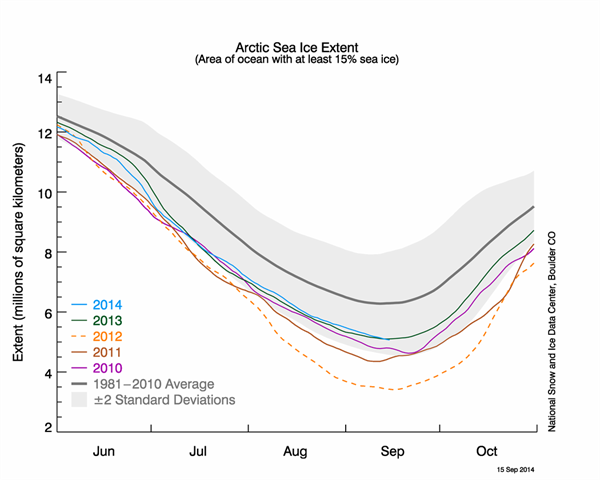
On the 17th September satellites recorded the Arctic summer minimum extent at 5.01 million square kilometers (sq km). Stroeve confirmed that this year’s summer sea-ice extent is the sixth lowest on record, in a series of satellite measurments stretching back over thirty years.
Sea-ice minimum
Mid to late September marks the end of the Arctic summer, and the point when Arctic ice is at it’s smallest extent, before it freezes up again as temperatures fall in the autumn.
Measurements of sea ice taken over the past decades suggest the rate of sea-ice loss is accelerating.
Between 1979 and 1996 Arctic sea ice declined at around 36,000 sq km a year, on average. Since 1997, the rate of loss has accelerated to dramatically, to 130,000 sq km per year.
The two trends are statistically different from each other, which means there is less than five per cent chance the change has happened by chance. “We can argue that in the last several years there is an accelerated rate of decline,” Stroeve says.
She also says there’s a clear link to rising temperatures. While sea ice conditions vary a lot from one year to the next, the summers with the warmest summer temperatures have seen the lowest sea ice extents:
“If you look at the last two minimum [Arctic sea-ice] low years – 2007 and 2012 – especially 2007 it was very warm… 2007 is the warmest summer we’ve had.”
Thick ice
Scientists have also found that the amount of older, thicker ice is diminishing. Stroeve’s research finds a reduction in the amount of ice at least five years old.
Usually around 90 per cent of old ice persists through the summer melt season and into the winter. In recent years this has dropped to around 70 percent, she says.
This is important because old ice will be replaced by new, thinner ice as the sea refreezes in winter. Thin ice is more susceptible to being broken up by storms and will melt more easily the following year, say scientists. Only around 30 per cent of first-year ice survives the average summer.
During the 1980s or 1990s, in an average year, around 54 to 58 per cent of ice in the Arctic would be first-year ice. Last year it was 77 per cent.
Melt season
Another important factor in monitoring changes in the Arctic is the length of the melt season. Ice melt is starting earlier and lasting longer, says Stroeve.
In particular, scientists have found a delay in when the sea-ice starts to freeze again after the summer. For example, in some areas of the Beaufort Sea north of Canada and Alaska, the sea isn’t freezing again until almost two months later than usual.
Stroeve points to warmer sea surface temperatures as the likely cause. While this might not come as a surprise, this could suggest a link between the sea surface temperature at an earlier point in the year and the length of the meltwater season.
This could allow scientists to predict when the melt season is going to end and when the ice would start to freeze again.
A later session at the conference examined the current state of Antarctic sea ice, that we’ll be covering tomorrow.
|
AdGovernment finance help – environment.nsw.gov.au/busprogram – New energy finance, energy training on conservation of electricity
|
Daily update: Australia’s economic and political strategy – deny climate change
|
||||||||||||||||||||||||||||||||||||||||||
The increasing frequency and severity of extreme weather events could cost the world 328 billion euros ($421 billion) per year by 2030, the Red Cross and the European Commission warned on Monday.
“Disasters take lives and ruin prospects, often making the situation of already impoverished people even worse,” said European Union Commissioner for International Cooperation, Humanitarian Aid and Crisis Response Kristalina Georgieva in a news release from the Red Cross on Monday.

The warning came as the Red Cross—a global humanitarian aid charity—and the European Commission—the executive body of the European Union—launched a joint communications campaign on the importance of preparing for disasters.
In the last 20 years, the impact of extreme weather has affected 4.4 billion people worldwide, killing 1.3 million people and causing 1.5 trillion euros in economic losses, according to the Red Cross. It calculates that every 0.77 euros spent on disaster risk reduction saves 11.47 euros in return.
This year, several European countries have suffered severe flooding. In May, floods hit entire regions of Bosnia and Herzegovina and Serbia, resulting in several dozens of casualties in both countries. Damages and economic losses amount to around 2 billion euros in Bosnia and 1.5 billion euros in Serbia.
Read MoreSerbia comes in from the cold with EU ambitions
Earlier in the year, heavy storms flooded around 6,000 homes in the U.K. The country experienced the wettest January on record and widespread flooding continued into February.
The Red Cross/European Commission warning came one day ahead of the United Nations’ Climate Summit in New York.
Although the Red Cross drew no direct link between extreme weather events and climate change in its news release, it forecast that around 375 million people would be hit by climate-related disasters each year by 2015.

Last week, a report by the Global Commission on the Economy and Climate concluded that action against climate change need not sacrifice economic growth—despite widely held views to the contrary.
“The low-carbon growth path can lead to as much prosperity as the high-carbon one, especially when account is taken of its multiple other benefits: from greater energy security to cleaner air and improved health,” concluded the 70-page Better Growth Better Climate report, which was published last Tuesday.
Read MoreIs climate change key to the spread of Ebola?
World energy demand will grow by a third by 2030, according to Felipe Calderon, the former president of Mexico who chairs the global; climate commission. During that time, some $90 trillion is seen being invested in infrastructure affecting the world’s cities, land use and energy systems.
For climate change activists like Calderon, this represents an opportunity to move away from reliance on high-carbon pollutants.
At present, carbon usage varies widely across developed world cities. According to Calderon, carbon emissions per person from public and private transportation in Atlanta, Georgia, are 10 times higher than in Barcelona, Spain. The U.S. city is marked by urban sprawl and spotty public transport, while Spain’s second-biggest city is more compact and has invested heavily in mass transit.

“We are not suggesting decoupling economic growth from energy demands; but decoupling from carbon emissions,” said Calderon.
“Although many jobs will be created, and there will be larger markets and profits for many businesses, some jobs will also be lost, particularly in high-carbon sectors,” said the authors of the report.
|
AdMaster of Public Health – tua.edu.au/Master_of_Public_Health – Study Online at Torrens University. Request Information Right Now!
|
climate code red
|
||||||||||||||||
|
AdGovernment finance help – environment.nsw.gov.au/busprogram – New energy finance, energy training on conservation of electricity
|
Daily update: Australia urged to set 50% renewables target by 2030
|
||||||||||||||||||||||||||||||||||||||||||||