Category: News

Add your news
You can add news from your networks or groups through the website by becoming an author. Simply register as a member of the Generator, and then email Giovanni asking to become an author. He will then work with you to integrate your content into the site as effectively as possible.
Listen to the Generator News online

 
The Generator news service publishes articles on sustainable development, agriculture and energy as well as observations on current affairs. The news service is used on the weekly radio show, The Generator, as well as by a number of monthly and quarterly magazines. A podcast of the Generator news is also available.
As well as Giovanni’s articles it picks up the most pertinent articles from a range of other news services. You can publish the news feed on your website using RSS, free of charge.
 

  • Global Cafe adds to alternative G20 summits in Brisbane

    Lord Mayor Quirk squires Lin Lei through King George Square
    Quirk says the Global Cafe will help position Brisbane on the world’s radar and attract more talent

    Brisbane has attracted a rich array of technology pioneers, scientists, entrepreneurs, researchers, inventors and new-world thinkers to its major curtain-raiser event ahead of the G20 Leaders Summit in November.

    Lord Mayor Graham Quirk said the Brisbane Global Cafe would boost’s the city’s status as the “capital of the world” during the G20 week in November.

    Speaking at the official launch of the Brisbane Global Cafe, Cr Quirk said the event at Brisbane City Hall on 12-13 November was attracting some of the world’s most exceptional and influential thinkers as well as support from global media organisations and corporations.

    “It’s a bold concept and a first for a G20 host city,” he said.

    “With the leaders of the world’s major nations and their support teams, the international media and the Global Cafe in Brisbane, we have an unprecedented opportunity.

    “I have repeatedly emphasised that, to attract investment, students, skills and talent, business meetings and tourists, Brisbane has to be on the radar around the globe.

    “The Global Cafe will help us extend ‘Team Brisbane’ to a broader audience of influencers and advocates and give our local business, government and academic community access to progressive thinking from around the world.

    “The event will also attract hundreds of participants and help drive business for local hotels, restaurants and retail businesses.”

    At today’s launch, Cr Quirk announced the first group of speakers for the Global Cafe. More high-profile speaker names will be announced in coming weeks.

    “The G20 will be the largest gathering of world leaders Australia has ever hosted and it’s a once-in-a-generation chance for Brisbane to step up and take its place among the emerging new world cities of the 21st century,” he said.

    “The Global Cafe, led by economic development board Brisbane Marketing, has attracted phenomenal interest from both world-leading speakers and corporate partners including global media organisations BBC World News and Bloomberg.

    “While the program is still being finalised, I can reveal confirmed international speakers will include: Chinese business leader Xu Weiping; renowned biochemist Prof Christopher Leaver from University of Oxford; US demographer Alan Berube; Chinese digital media mogul Liu Shengyi from Tencent; Israeli Digital entrepreneurGadi Mazor and Thai retail developer Chadatip Chutrakul of Siam Piwat.

    “Locally, the line-up includes cochlear implant pioneer Professor Robert Shepherd who is leading the development of a bionic eye; Chairman of Lirrwi Yolngu Tourism Djawa Burarrwanga; intensive care medicine director at RBWH Professor Jeffrey Lipman; antibiotic-resistant bacteria researcher Professor David Paterson and Young Australian of the Year 2012 and founder 2Mar Robotics Marita Cheng.”

    Cr Quirk said the program would boast about 70 speakers – many of whom will also be engaging with local businesses while here – with up to 1000 people in the audience, including a large media contingent.

    “I am also pleased to announce that the event will be live-streamed online and broadcast in King George Square as well as covered by local and global media outlets,” he said.

    The event would explore important issues around improving human life, developing cities that match future needs, powering the future economy, unlocking the opportunities of the digital age and exploring the emerging frontiers of tourism.

    “The November event will be the highlight but the Global Cafe also includes a website rich with thought-provoking content aimed at generating discussion (www.globalcafe.com.au) as well as a series of events between August and November and an online information and discussion forum,” he said.

    “Anyone interested in participating or attending the Brisbane Global Cafe event can register their interest on the global cafe website.”

    Cr Quirk last week announced five high-profile identities had been appointed as Brisbane Global Cafe Chairs to steer the conversations:

    • Brisbane cervical cancer vaccine pioneer Professor Ian Frazer
    • national tourism identity Christopher Brown AM
    • UK-based advisor for cities and business Greg Clark
    • CSIRO executive Dr Alex Wonhas
    • international entrepreneurial leadership and business growth expert Dr Jana Matthews.

    “I’d also like to recognise the contribution of the co-chairs: CEO of QIMR Berghofer Professor Frank Gannon, Regional Director Pacific for the Pacific Asia Travel Association (PATA) Chris Flynn and CEO of the International Energy Centre Tim McLennan,” he said.

    “While the official Brisbane G20 summit will focus on achieving stronger economic and employment growth and dealing with future economic shocks, the global cafe will add a new dimension to the G20 summit.

    “It’s a first for a G20 host city and I hope the concept will be adopted by other G20 host cities in the future.

    Brisbane Marketing CEO, John Aitken, said international and Australian media, industry thought-leaders, business leaders, academia, and individuals with a particular interest in one or more of the themes would be encouraged to take part.

    “This program has been a specifically-targeted global outreach of people we’d like to include in the Brisbane story going forward,” Mr Aitken said.

    “We will be seeking to continue to work collaboratively with them to create investment opportunities that build Brisbane’s future as an emerging global city and a major player in the Asia Pacific.”

  • The ‘will of the people’? It’s the bastardisation of democracy

    Australia
    8 September 2014, 1.01pm AEST

    The ‘will of the people’? It’s the bastardisation of democracy

    The Abbott government, when faced with opposition over the past year, has commonly resorted to two lifeline statements. The first is that it’s carrying out the “will of the people”. And the second is that…

    Treasurer Joe Hockey and his Coalition colleagues continue to demand that their opponents ‘respect the mandate of the new government and the will of the people and vote with the government’. AAP/Gary Schafer

    The Abbott government, when faced with opposition over the past year, has commonly resorted to two lifeline statements. The first is that it’s carrying out the “will of the people”. And the second is that “the people have spoken”. These are words taken from the vocabularies of demagogues, not democrats.

    Frontbenchers like Joe Hockey, Tony Abbott, Malcolm Turnbull and Greg Hunt use these phrases to delegitimise their opponents both within parliament and more broadly. In effect, they’re saying if you disagree with government policy you are at odds with the “will of the people”. This is a serious claim.

    Turnbull, for example, claimed the mandate to govern in 2013 when facing opposition over changes to the National Broadband Network (NBN). Last March, Hunt argued that the Senate was blocking the will of the people by not passing the carbon tax repeal. Hockey and Abbott have repeatedly claimed the same in reference to the Senate blocking tax repeals.

    How did ‘the people’ vote?

    The problem when politicians do this is that they are claiming untruths. Let’s look at some 2013 election data to partly justify our claim that at best the government can only claim to be representing the “will of a minority”.

    According to the Australian Bureau of Statistics, the population of Australia was over 23.2 million at the time of the 2013 national election. Of that 23.2 million, 14.7 million were registered to vote. And of that 14.7 million, the Liberals in their own right picked up 4.1 million first-preference votes (the Liberals gained 2.8 million votes in support through the other Coalition parties and also through the transferable vote).

    Just 40% of enrolled voters chose Coalition parties first, so is their vote the ‘will of the people’? AAP/Tony McDonough

    In sum, the Abbott-led government can at most claim to be representing the will of about 6.9 million Australians out of 23.4 million. But, if we look at the composition of the cabinet (these ministers are typically the “decision-makers” or executives), 16 come from the Liberals, two from the Nationals and one from the Country Liberals. This means that the cabinet is essentially making decisions as representatives of fewer than 5.9 million Australians.

    That’s about 25% of Australians or 40% of enrolled voters. The government thus cannot logically make a claim to be carrying out the “will of the people”. It’s not even carrying out the will of a majority of voters.

    The most the government can say is that it is carrying out what it presumes to be the will of a substantial minority. We say presume because how many of the 5.9 million voters who gave their first-preference vote to Coalition parties fully understood and endorsed everything they were voting for? And how many have since changed their minds on policies the Abbott government revealed only after the election?

    Reform needed to express democratic will

    If the government is serious about acting on the “will of the people”, as dubious as that ambition might be, then reforming Australia’s electoral system should be on the agenda. The reason for this is it’s because of the voting system we have that 25% of Australians were empowered to bring to bear a majority government. This problem doesn’t exist in New Zealand and Germany, which use a mixed member proportional representation system, which Australians should consider adopting.

    But in focusing on these numbers we’ve skirted the main flaw in the government’s heavy-hitting lines. The objection comes in part from political philosophy and in part from electoral studies.

    Political philosophers have a long history of debating whether the will of the people can be determined or whether we can ever know if the people have spoken. Popular references to “the people” and their will tend to be oversimplified. More often than not, it’s used as a political weapon to shut down debate.

    Who are the people? Is it enough to “speak” once every three or four or five years (depending on the nation or state in question) – or even six years in the case of individual senators – until the next election is held?

    The field of electoral studies makes a more concrete point. Elections are heavily mediated and controlled procedures – there is actually very little “speaking” going on by “the people” when citizens vote.

    Voters that successfully vote are already by definition a small majority of Australians. The government, and indeed Australians, have to confront the fact that democracy means more than 14.7 million people being allowed to vote every once in a while.

    Voters participate in a system that determines, numerically, which representative will win what seat. This shows who the people will be working with over the coming government’s term. The substance of democracy comes after the election.

    Democracy is not a winner-takes-all scenario where those who win the election become the rulers with a sacred mandate to govern as they see fit. Democracy is an ongoing process of deliberation, monitoring, inclusion and resistance. To work properly, it requires voters and their representatives to work together to achieve the most palatable ends for Australians.

    “The will of the people” and “the people have spoken” are false constructions that are used to delegitimise opponents and shut down debate. It’s a bastardisation of democracy.

  • G20 and the First Nations people of Brisbane

    tentembassyBRISBANE ABORIGINAL SOVEREIGN EMBASSY RESPONSE TO G20 SUMMIT

    The 12th to the 16th of November will see Brisbane playing host to the G20 Summit. Leaders from the world’s richest economies will be meeting on Jaggera country to discuss how best to control the world and destroy indigenous lands and resources for profit. Australia is among the 20, taking its place as one of the most economically rich countries in the world while the living conditions and quality of life for its First Nations people rank among the lowest in the world.

    These are desperate and critical times for us as First Nations people. Our life expectancy is only 45 years, deaths in custody have almost doubled since the Royal Commission into Aboriginal Deaths in Custody, the stolen generations continue with almost 14000 of our children in out of home care, youth suicide rates are at an all time high, the NT Intervention has been extended for another 10 years and the land that was won back during the land rights movement is being taken again by a government that is refusing to build community housing and infrastructure unless 99 year leases are signed.

    The 40th Anniversary of the Aboriginal Tent Embassy represented a coming together of several generations of aboriginal activists with non-aboriginal solidarity. The anniversary connected people in a way not seen since the 1982 Commonwealth Games protest. The G20 Summit is another chance for a week of Aboriginal unity. It is time for us to come together as a network of strong Aboriginal nations sharing ideas, perspectives and solutions to the myriad of struggles we face under colonisation.

    “In 1972 the tent embassy really highlighted to me what sort of strength aboriginal people have got when we all come together in unity” Billy Craigie Jan 27 1992 

    Colonisation is not a thing of the past; the colonial power structure exists today. The majority of the people living in Australia are from the dominant colonialist culture and, whether consciously or unconsciously, exploit and benefit from our land and culture while conditions continue to deteriorate for our people. Decolonisation is the first step towards liberation, recognition of our sovereignty, and self determination.

    The Brisbane Aboriginal Sovereign Embassy will be boycotting the G20 Summit, which will be taking place on stolen aboriginal land. We want decolonisation to be recognised as a priority and added to the agenda as a political reality.

    Decolonisation is a process for all Australians and provides a chance for all who live on this land to build a new society based on Aboriginal culture and values; a society ruled by social need and environmental sustainability, not one of greed and discrimination. A unique society with a definitive system of laws and customs to govern it, based on the world’s oldest living culture.

    Musgrave Park has been declared a zone for peaceful protest during the G20 Summit. Prior to invasion, Musgrave was home to the Kalperum-Jaggin people and is a part of Kurilpa ‘place of the water rats’. The park has been an important meeting place for First Nations people since time began as it still is today. We ask all attendees to respect Jaggera Law in this historically significant meeting place and the Brisbane Aboriginal Sovereign Embassy sacred fire.

    There will be a second media release outlining appropriate protocols for all wishing to visit or camp in the park during G20. Respecting traditional protocols allows everyone an opportunity to actively practice decolonisation and have a better understanding of the relevance our laws have in the struggle of all peoples against oppression.

    “If you have come here to help me, you are wasting our time. But if you have come because your liberation is bound up with mine, then let us work together” Attributed to The Collective Aboriginal Voice

    We welcome cooperation from the general community, activist groups, unions and elsewhere. We aspire to develop a united community front which fully recognises the need to decolonise.

    For more information contact Wayne Wharton on 0408 064 900, Paul Spearim 0416 069 788 or Debbie Jones 0422 569 325

  • Daily update: Australia’s real energy problem: Too many useless coal generators

    Click here to enable desktop notifications for Gmail.   Learn more  Hide
    1 of 2
    AdCompare Electricity Plansiselect.com.au/Electricity – Find a Range of Plans to Match Your Needs. You Could Save at iSelect.

    Daily update: Australia’s real energy problem: Too many useless coal generators

    Inbox
    x

    Renew Economy editor@reneweconomy.com.au via mail141.us4.mcsv.net Unsubscribe

    3:38 PM (6 minutes ago)

    to me
    Australia’s real energy problem; Global shift to renewables inevitable; Graph of the Day; Repaying the emissions debt; Save Solar campaign hits regional TV screens; EV battery use trumps hybrid battery use; Could plug-in hybrid EVs make a difference?; U.S solar industry nears 16GW of installed capacity; and water risks to global shale development.
    Is this email not displaying correctly?
    View it in your browser.
    RenewEconomy Daily News
    The Parkinson Report
    It’s not renewables that are causing Australia’s electricity over-capacity, its old and dirty coal-fired generators. AGL Energy says three quarters of the country’s coal plants are past their used-by date and should be retired.
    IRENA calls on govts to adapt and invest as world makes inevitable – and climate driven –  shift to renewable energy and decentralised grids.
    IRENA graph illustrates that renewables have more power to generate short, medium and long-term employment than fossil fuels.
    Absent the carbon price, we need to mitigate the temptation to repay borrowings of future emissions with the dirtiest energy generation on the market.
    ASC-led Save Solar campaign launches television ad targeting regional voters in Queensland and Victoria in lead up to state elections.
    With plug-in car sales growing in leaps and bounds, their annual battery use already trumps the annual battery use of hybrids, but what about all time use?
    Plug-in Hybrid Electric Vehicles like the Holden Volt could cut transport emissions and help smooth electricity demand. But is Australia ready for them?
    U.S. solar market hit a major milestone in the second quarter of this year, with more than a half-million homes and businesses now generating solar energy.
    Unlocking shale gas comes with a significant environmental risk: access to freshwater for drinking, agriculture, and industrial use.

    Click here to enable desktop notifications for Gmail.   Learn more  Hide
    1 of 2
    AdCompare Electricity Plansiselect.com.au/Electricity – Find a Range of Plans to Match Your Needs. You Could Save at iSelect.

    Daily update: Australia’s real energy problem: Too many useless coal generators

    Inbox
    x

    Renew Economy editor@reneweconomy.com.au via mail141.us4.mcsv.net Unsubscribe

    3:38 PM (6 minutes ago)

    to me
    Australia’s real energy problem; Global shift to renewables inevitable; Graph of the Day; Repaying the emissions debt; Save Solar campaign hits regional TV screens; EV battery use trumps hybrid battery use; Could plug-in hybrid EVs make a difference?; U.S solar industry nears 16GW of installed capacity; and water risks to global shale development.
    Is this email not displaying correctly?
    View it in your browser.
    RenewEconomy Daily News
    The Parkinson Report
    It’s not renewables that are causing Australia’s electricity over-capacity, its old and dirty coal-fired generators. AGL Energy says three quarters of the country’s coal plants are past their used-by date and should be retired.
    IRENA calls on govts to adapt and invest as world makes inevitable – and climate driven –  shift to renewable energy and decentralised grids.
    IRENA graph illustrates that renewables have more power to generate short, medium and long-term employment than fossil fuels.
    Absent the carbon price, we need to mitigate the temptation to repay borrowings of future emissions with the dirtiest energy generation on the market.
    ASC-led Save Solar campaign launches television ad targeting regional voters in Queensland and Victoria in lead up to state elections.
    With plug-in car sales growing in leaps and bounds, their annual battery use already trumps the annual battery use of hybrids, but what about all time use?
    Plug-in Hybrid Electric Vehicles like the Holden Volt could cut transport emissions and help smooth electricity demand. But is Australia ready for them?
    U.S. solar market hit a major milestone in the second quarter of this year, with more than a half-million homes and businesses now generating solar energy.
    Unlocking shale gas comes with a significant environmental risk: access to freshwater for drinking, agriculture, and industrial use.
  • California drought: Solar desalination plant shows promise

    Leave Beta TestFeedback

    Welcome to the new SFGate.com

    We have re-imagined our design in a bold new way. Before we roll it out for everyone, we are giving select readers an opportunity to try out the new design. We welcome your feedback.

    57°F San Francisco

    California drought: Solar desalination plant shows promise

    Solar desalination system appears to be cost-effective
    Kevin Fagan
    Updated 7:45 am, Tuesday, March 18, 2014
    • 115
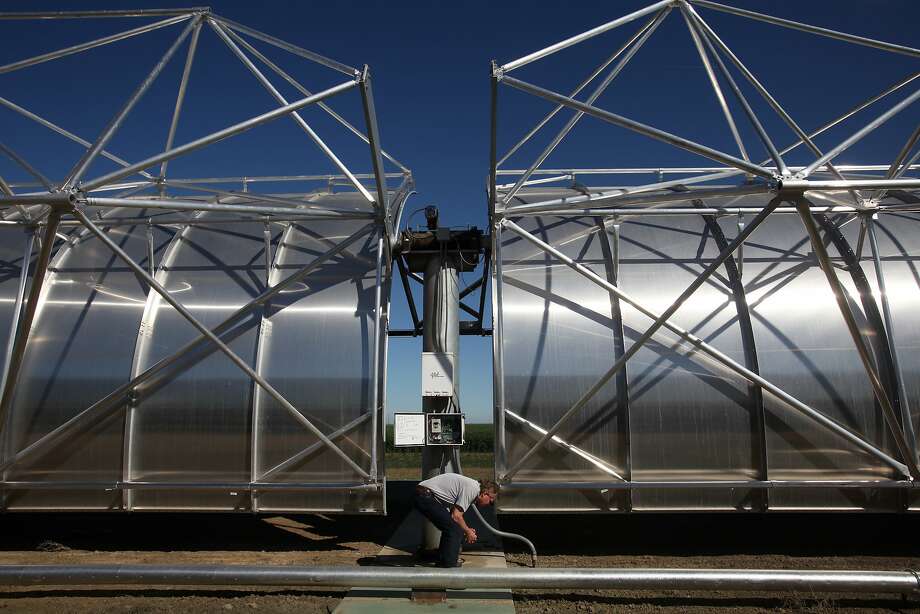
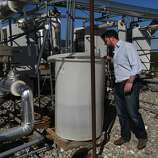
    • Consultant Bruce Marlow demonstrates a feature at the solar-powered WaterFX desalination plant in Fresno County. Photo: Leah Millis, The Chronicle

    Photo: Leah Millis, The Chronicle
    Image 1 of 12

    Consultant Bruce Marlow demonstrates a feature at the solar-powered WaterFX desalination plant in Fresno County.

    Image 5 of 12

    Brian Hicks, 29, checks the water level at one of a few existing wells on his family’s land March 15, 2014 at the Hammonds Ranch, Inc. in Firebaugh, Calif. The family have not had to use the wells in years. Now that they will be using them, instead of checking the levels once a month, Hicks will be checking them once every other week. The Hammonds Ranch is allowing over 4,000 acres of approximately 5,000 acres of farm land to fallow this year because of the drought. This year they will be keeping their grapes and some pistachios alive using well water they haven’t had to tap in years and some supplemental water. Hicks, who lives on the ranch with his wife and young daughter, is a 4th generation Hammonds rancher. He is currently back in school to get his certification in special studies of enology, so he can get into wine making. Hicks says he’s wanted to be part of the family business since he was a child. Despite the uncertainty that the drought brings, he’s still pursuing his dream, “I believe in it, it’s something that everybody needs,” he said. “Food is a necessity of life.”

    Firebaugh, Fresno County

    Quietly whirring away in a dusty field in the Central Valley is a shiny solar energy machine that may someday solve many of California’s water problems.

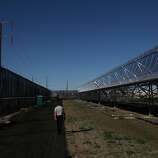
    It’s called the WaterFX solar thermal desalination plant, and it has been turning salty, contaminated irrigation runoff into ultra-pure liquid for nearly a year for the Panoche Water and Drainage District. It’s the only solar-driven desalination plant of its kind in the country.

    Right now its efforts produce just 14,000 gallons a day. But within a year, WaterFX intends to begin expanding that one small startup plant into a sprawling collection of 36 machines that together can pump out 2 million gallons of purified water daily.

    Within about five years, WaterFX company co-founder Aaron Mandell hopes to be processing 10 times that amount throughout the San Joaquin Valley. And here’s the part that gets the farmers who buy his water most excited: His solar desalination plant produces water that costs about a quarter of what more conventionally desalinated water costs: $450 an acre-foot versus $2,000 an acre-foot.

    An acre-foot is equivalent to an acre covered by water 1 foot deep, enough to supply two families of four for a year.

    Competitive price

    That brings Mandell’s water cost close to what farmers are paying, in wet years, for water from the Panoche and other valley districts – about $300 an acre-foot. And that makes it a more economically attractive option than any of the 17 conventional desalination plants planned throughout California.

    If Mandell can pull it off, the tiny farming town where he is starting his enterprise could be known as ground zero for one of the most revolutionary water innovations in the state’s history.

    “Eventually, if this all goes where I think it can, California could wind up with so much water it’s able to export it instead of having to deal with shortages,” Mandell said, standing alongside the 525-foot-long solar reflector that is the heart of his machine. “What we are doing here is sustainable, scalable and affordable.”

    Dennis Falaschi, manager of the Panoche district, and many of the 60 farmers that constitute his customer base say the sooner WaterFX expands, the better.

    Saving water

    Panoche expects to deliver about 45,000 acre-feet of water this year to its growers. That total is half of what the growers get in wetter years – but because drought and environmentally driven water mandates are not unique to 2014, the district’s farmers are already ahead of the curve on water preservation techniques.

    Most use drip irrigation instead of water-intensive sprinklers and are hooked up to an unusual drainage system that captures used irrigation water and directs it into fields of wheatgrass, a salt-tolerant crop sold for cattle feed. But that drainage system is little more than a creative way to get rid of irrigation water that’s too salty for most uses once it leaches through farm soil.

    Finding a way to make it suitable for people to drink and use on the crops they eat would be a breakthrough, Falaschi said.

    “It appears this solar system will be cost-effective, and if Aaron can perform as we think he can, it can make a huge difference – be a great supplement at the very least,” he said. “We’re talking about basically unusable drainage water that is in everybody’s interest to mine.

    “This solar plant could be a very important part of where we want to be in terms of being self-sufficient in the valley.”

    Nothing from feds

    Panoche, like many districts in the Central Valley – the nation’s most productive agricultural zone – has traditionally bought most of its water from the federally run Central Valley Project. But in this drought year, farmers are likely to get zero allocation from the project.

    If that happens, Panoche will have to draw from leftover supply, the expensive spot water market and wells. All of that is pricier than usual, with the spot market alone charging as much as $3,500 an acre-foot.

    “This situation right now is a killer, and anything that adds to a potential water supply is good,” said Mike Stearns, a fourth-generation farmer in the Panoche district who is fallowing most of his tomato, onion and other fields this year because of the drought. He’s concentrating on his wine grapes, which are thirsty but promise a good profit even in a drought year.

    “And keep in mind that this water shortage doesn’t just affect farmers,” Stearns said. “Think about the jobs that are lost when we have to fallow our fields. Or the taxes that the government won’t get because we aren’t growing and selling. It’s bad. We need to do everything we can about this.”

    Simple process

    The way the solar plant works is simple, which is why the water it produces is cheap.

    Water that dribbles down from nearby hills, and through the soil in the Central Valley after being used for irrigation, collects so much salt, selenium, boron and other minerals that it’s not fit for human consumption. The solar plant captures the foothill runoff and sucks in used irrigation water from a French drain-style system 6 to 8 feet under the crops, and sends that tainted water through a series of pipes and tanks that heat it.

    The heat comes from the plant’s huge, parabolic-shaped solar reflector, which focuses the sun on a long tube containing mineral oil. That heated tube in turn creates steam, which condenses the brackish water into usable liquid, separating out the minerals.

    The water then goes back out for irrigation. Mandell says that because his condensation method distills the minerals more efficiently than other desalination methods, he is installing a system that will process them for use. Selenium and boron can be vitamin supplements, for example, and gypsum can be used for drywall.

    More conventional desalination plants – such as a $1 billion operation being built near San Diego – use a reverse osmosis process, in which brackish water is forced through screens to filter out the contaminants. That requires a lot of energy, which is why it is more expensive.

    Raising money

    WaterFX’s pilot plant cost $1 million in state grants to build last summer. The expansion of the 36-plant complex would cost as much as $30 million, which Mandell is working on raising.

    “It does seem like this system is in a great location,” said Daniel Choi, an analyst with Lux Research, which researches emerging technology. “It’s where it should be – an area with a lot of sunlight, where reverse osmosis doesn’t make the most sense large-scale. It does seem like it’s viable.

    “I wouldn’t be surprised if WaterFX expanded to other markets.”

    Mandell’s expanded solar plant would be able to deliver 2,200 acre-feet of water next year – and if that performs as hoped, within a few years his ambition is to scale it up to 20,000 acre-feet. That would meet nearly half of the current demand from Panoche district farmers.

    “Eventually we could process not just drainage water, but industrial and residential wastewater as well as groundwater that now is too salty to use,” Mandell said. Such desalination already happens on a large scale in other parts of the world, particularly the Middle East, he pointed out.

    Sinking land

    Drawing groundwater, however – even groundwater that’s now too salty to drink – could prove problematic in the Central Valley. Years of tapping usable groundwater have so depleted aquifers that in some places the land has sunk 30 feet since the 1920s.

    There are trillions of gallons of brackish groundwater available in California, said Claudia Faunt, a U.S. Geological Survey hydrologist, and much of that has not been tapped because it is closer to the surface than the purer liquid deeper down. However, “to say there wouldn’t be subsidence (if it were tapped) is an unknown,” she said.

    For now, Mandell said, he and his partners are focusing on drainage water – and that alone is a major issue.

    “Look, there are 200 million tons of salt on the land in the Central Valley, and billions of gallons of drainage water, and cleaning up that drainage water is a huge issue,” said WaterFX’s chief consultant, Bruce Marlow. “I’d say if we can control the saline in the valley, in 10 years we might not have to rely on the federal water system here at all.”

    Online extra: For more on California’s water issues, go to SFGate.com/drought.

    Leave Beta TestFeedback

    Welcome to the new SFGate.com

    We have re-imagined our design in a bold new way. Before we roll it out for everyone, we are giving select readers an opportunity to try out the new design. We welcome your feedback.

    57°F San Francisco

    California drought: Solar desalination plant shows promise

    Solar desalination system appears to be cost-effective
    Kevin Fagan
    Updated 7:45 am, Tuesday, March 18, 2014
    • 115
    • Consultant Bruce Marlow demonstrates a feature at the solar-powered WaterFX desalination plant in Fresno County. Photo: Leah Millis, The Chronicle

    Photo: Leah Millis, The Chronicle
    Image 1 of 12

    Consultant Bruce Marlow demonstrates a feature at the solar-powered WaterFX desalination plant in Fresno County.

    Image 5 of 12

    Brian Hicks, 29, checks the water level at one of a few existing wells on his family’s land March 15, 2014 at the Hammonds Ranch, Inc. in Firebaugh, Calif. The family have not had to use the wells in years. Now that they will be using them, instead of checking the levels once a month, Hicks will be checking them once every other week. The Hammonds Ranch is allowing over 4,000 acres of approximately 5,000 acres of farm land to fallow this year because of the drought. This year they will be keeping their grapes and some pistachios alive using well water they haven’t had to tap in years and some supplemental water. Hicks, who lives on the ranch with his wife and young daughter, is a 4th generation Hammonds rancher. He is currently back in school to get his certification in special studies of enology, so he can get into wine making. Hicks says he’s wanted to be part of the family business since he was a child. Despite the uncertainty that the drought brings, he’s still pursuing his dream, “I believe in it, it’s something that everybody needs,” he said. “Food is a necessity of life.”

    Firebaugh, Fresno County

    Quietly whirring away in a dusty field in the Central Valley is a shiny solar energy machine that may someday solve many of California’s water problems.

    It’s called the WaterFX solar thermal desalination plant, and it has been turning salty, contaminated irrigation runoff into ultra-pure liquid for nearly a year for the Panoche Water and Drainage District. It’s the only solar-driven desalination plant of its kind in the country.

    Right now its efforts produce just 14,000 gallons a day. But within a year, WaterFX intends to begin expanding that one small startup plant into a sprawling collection of 36 machines that together can pump out 2 million gallons of purified water daily.

    Within about five years, WaterFX company co-founder Aaron Mandell hopes to be processing 10 times that amount throughout the San Joaquin Valley. And here’s the part that gets the farmers who buy his water most excited: His solar desalination plant produces water that costs about a quarter of what more conventionally desalinated water costs: $450 an acre-foot versus $2,000 an acre-foot.

    An acre-foot is equivalent to an acre covered by water 1 foot deep, enough to supply two families of four for a year.

    Competitive price

    That brings Mandell’s water cost close to what farmers are paying, in wet years, for water from the Panoche and other valley districts – about $300 an acre-foot. And that makes it a more economically attractive option than any of the 17 conventional desalination plants planned throughout California.

    If Mandell can pull it off, the tiny farming town where he is starting his enterprise could be known as ground zero for one of the most revolutionary water innovations in the state’s history.

    “Eventually, if this all goes where I think it can, California could wind up with so much water it’s able to export it instead of having to deal with shortages,” Mandell said, standing alongside the 525-foot-long solar reflector that is the heart of his machine. “What we are doing here is sustainable, scalable and affordable.”

    Dennis Falaschi, manager of the Panoche district, and many of the 60 farmers that constitute his customer base say the sooner WaterFX expands, the better.

    Saving water

    Panoche expects to deliver about 45,000 acre-feet of water this year to its growers. That total is half of what the growers get in wetter years – but because drought and environmentally driven water mandates are not unique to 2014, the district’s farmers are already ahead of the curve on water preservation techniques.

    Most use drip irrigation instead of water-intensive sprinklers and are hooked up to an unusual drainage system that captures used irrigation water and directs it into fields of wheatgrass, a salt-tolerant crop sold for cattle feed. But that drainage system is little more than a creative way to get rid of irrigation water that’s too salty for most uses once it leaches through farm soil.

    Finding a way to make it suitable for people to drink and use on the crops they eat would be a breakthrough, Falaschi said.

    “It appears this solar system will be cost-effective, and if Aaron can perform as we think he can, it can make a huge difference – be a great supplement at the very least,” he said. “We’re talking about basically unusable drainage water that is in everybody’s interest to mine.

    “This solar plant could be a very important part of where we want to be in terms of being self-sufficient in the valley.”

    Nothing from feds

    Panoche, like many districts in the Central Valley – the nation’s most productive agricultural zone – has traditionally bought most of its water from the federally run Central Valley Project. But in this drought year, farmers are likely to get zero allocation from the project.

    If that happens, Panoche will have to draw from leftover supply, the expensive spot water market and wells. All of that is pricier than usual, with the spot market alone charging as much as $3,500 an acre-foot.

    “This situation right now is a killer, and anything that adds to a potential water supply is good,” said Mike Stearns, a fourth-generation farmer in the Panoche district who is fallowing most of his tomato, onion and other fields this year because of the drought. He’s concentrating on his wine grapes, which are thirsty but promise a good profit even in a drought year.

    “And keep in mind that this water shortage doesn’t just affect farmers,” Stearns said. “Think about the jobs that are lost when we have to fallow our fields. Or the taxes that the government won’t get because we aren’t growing and selling. It’s bad. We need to do everything we can about this.”

    Simple process

    The way the solar plant works is simple, which is why the water it produces is cheap.

    Water that dribbles down from nearby hills, and through the soil in the Central Valley after being used for irrigation, collects so much salt, selenium, boron and other minerals that it’s not fit for human consumption. The solar plant captures the foothill runoff and sucks in used irrigation water from a French drain-style system 6 to 8 feet under the crops, and sends that tainted water through a series of pipes and tanks that heat it.

    The heat comes from the plant’s huge, parabolic-shaped solar reflector, which focuses the sun on a long tube containing mineral oil. That heated tube in turn creates steam, which condenses the brackish water into usable liquid, separating out the minerals.

    The water then goes back out for irrigation. Mandell says that because his condensation method distills the minerals more efficiently than other desalination methods, he is installing a system that will process them for use. Selenium and boron can be vitamin supplements, for example, and gypsum can be used for drywall.

    More conventional desalination plants – such as a $1 billion operation being built near San Diego – use a reverse osmosis process, in which brackish water is forced through screens to filter out the contaminants. That requires a lot of energy, which is why it is more expensive.

    Raising money

    WaterFX’s pilot plant cost $1 million in state grants to build last summer. The expansion of the 36-plant complex would cost as much as $30 million, which Mandell is working on raising.

    “It does seem like this system is in a great location,” said Daniel Choi, an analyst with Lux Research, which researches emerging technology. “It’s where it should be – an area with a lot of sunlight, where reverse osmosis doesn’t make the most sense large-scale. It does seem like it’s viable.

    “I wouldn’t be surprised if WaterFX expanded to other markets.”

    Mandell’s expanded solar plant would be able to deliver 2,200 acre-feet of water next year – and if that performs as hoped, within a few years his ambition is to scale it up to 20,000 acre-feet. That would meet nearly half of the current demand from Panoche district farmers.

    “Eventually we could process not just drainage water, but industrial and residential wastewater as well as groundwater that now is too salty to use,” Mandell said. Such desalination already happens on a large scale in other parts of the world, particularly the Middle East, he pointed out.

    Sinking land

    Drawing groundwater, however – even groundwater that’s now too salty to drink – could prove problematic in the Central Valley. Years of tapping usable groundwater have so depleted aquifers that in some places the land has sunk 30 feet since the 1920s.

    There are trillions of gallons of brackish groundwater available in California, said Claudia Faunt, a U.S. Geological Survey hydrologist, and much of that has not been tapped because it is closer to the surface than the purer liquid deeper down. However, “to say there wouldn’t be subsidence (if it were tapped) is an unknown,” she said.

    For now, Mandell said, he and his partners are focusing on drainage water – and that alone is a major issue.

    “Look, there are 200 million tons of salt on the land in the Central Valley, and billions of gallons of drainage water, and cleaning up that drainage water is a huge issue,” said WaterFX’s chief consultant, Bruce Marlow. “I’d say if we can control the saline in the valley, in 10 years we might not have to rely on the federal water system here at all.”

    Online extra: For more on California’s water issues, go to SFGate.com/drought.

  • Climate scientists address urgent priorities for research

    world map

    Media centre

    News

    8 September 2014

    Climate scientists address urgent priorities for research

    Leading climate scientists from around the world gather this week  in Bern, Switzerland to refine their priorities for up-coming research in light of the Intergovernmental Panel on Climate Change (IPCC) Fifth Assessment Report, focusing on areas of science where many of the fastest climate system changes emerge, focusing on areas of science where many of the fastest climate system changes emerge or areas where better understanding is essential to improve projections of future climate change.

    Two long-standing partners – the World Climate Research Programme (WCRP) and Working Group I of the IPCC Intergovernmental Panel on Climate Change, are organizing the meeting 8-10 September, less than one year after the IPCC Working Group I assessment on the Climate Change 2013: The Physical Science Basis.

    WCRP has advanced six ‘Grand Challenges’ covering sea level change, water availability, disappearing snow and ice, changing atmospheric circulations, climate extremes, and regional climate.

    In Bern approximately 80 scientists, many of them authors of the IPCC Working Group I chapters or leaders of the WCRP grand challenges, will discuss lessons learned from the Working Group 1 assessment , as well as new research since the IPCC report. The meeting will refine the focus and future priorities and directions for climate research.

    “With new results about the climate system emerging every day, we need to continually assess where we stand and where we need to go next,” said Prof Thomas Stocker of the University of Bern and Co-Chair of IPCC WGI. “We deeply appreciate support from the Swiss government for this meeting; it represents exactly the next steps needed for climate research,” said Prof. Stocker, who leads the meeting from the IPCC side..

     “The climate research community doesn’t sit still,” said Dr David Carlson, Director of the WCRP.  “We need to press forward but in the best directions as guided by the Working Group I report.”

     WCRP is an international programme jointly sponsored by the World Meteorological Organisation, the International Council for Science and the Intergovernmental Oceanographic Commission of UNESCO.

    The conference is hosted by the International Space Science Institute on the campus of the University of Bern, and is receiving support from WCRP, the IPCC and the Oeschger Centre for Climate Change Research of the University of Bern.