Category: News

Add your news
You can add news from your networks or groups through the website by becoming an author. Simply register as a member of the Generator, and then email Giovanni asking to become an author. He will then work with you to integrate your content into the site as effectively as possible.
Listen to the Generator News online

 
The Generator news service publishes articles on sustainable development, agriculture and energy as well as observations on current affairs. The news service is used on the weekly radio show, The Generator, as well as by a number of monthly and quarterly magazines. A podcast of the Generator news is also available.
As well as Giovanni’s articles it picks up the most pertinent articles from a range of other news services. You can publish the news feed on your website using RSS, free of charge.
 

  • Consumer protection by guerilla disconnection

    Biosolar Installers

    Local business owner, Leigh Storr, says that companies and individuals will start cutting themselves off from the electricity supply in what he calls guerilla disconnection.

    The challenge for the electricity industry, recently exposed by Four Corners and The Monthly, is that the cost of the infrastructure for fossil fuel generated electricity is increasing as fewer customers need it.

    As a result, the service charges on your electricity bill have increased much faster than the charges for the electricity itself.

    Not content with printing false statements blaming these costs on environmental regulation in large red letters on their bills, electricity companies are now lobbying governments to further penalise owners of solar panels with higher connection charges. The price paid for solar generated electricity is already a ridiculously low 4 cents per kilowatt and the amount of electricity that can be supplied to the grid has been capped by export limiters.

    The best protection for consumers, according to BioSolar owner and CEO, Leigh Storr, is to disconnect from the grid altogether.

    He said that consumers can achieve this, by simply notifying their provider of an imminent disconnection date, online. On that date, the consumer throws the switch on the export limiter and the utility records no further use.

    “What are they going to do? Drive around and issue fines for people who have the lights on without being registered to a fossil-fuel-powered generator?”

    He thinks the crunch will come in 2017 when the cost of being connected to the grid will exceed the cost becoming self-sufficient.


  • Extreme weather becoming more common, study says

    Extreme weather becoming more common, study says

    Rise in blocking-patterns – hot or wet weather remaining stuck over regions for weeks – causing frequent heatwaves or floods

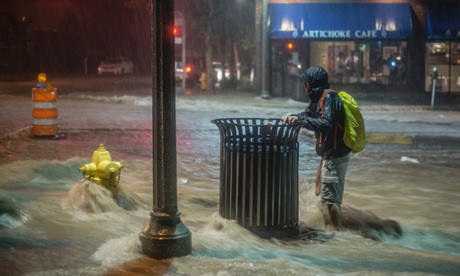
    A pedestrian hangs on to a trash can along Central Avenue as rainwater flows towards downtown Albuquerque, N.M.,  August 1, 2014.  Heavy rains late Friday night caused the flash flooding and road closures in parts of downtown and in other areas.
    A man hangs on to a trash can as rainwater gushes towards Albuquerque in New Mexico, US. Heavy rains caused flash flooding and road closures in the city earlier this month. Photograph: Roberto E. Rosales/AP

    Extreme weather like the drought currently scorching the western US and the devastating floods in Pakistan in 2010 is becoming much more common, according to new scientific research.

    The work shows so-called “blocking patterns”, where hot or wet weather remains stuck over a region for weeks causing heatwaves or floods, have more than doubled in summers over the last decade. The new study may also demonstrate a link between the UK’s recent flood-drenched winter and climate change.

    Climate scientists in Germany noticed that since 2000 there have been an “exceptional number of summer weather extremes, some causing massive damage to society”. So they examined the huge meanders in the high-level jet stream winds that dominate the weather at mid-latitudes, by analysing 35 years of wind data amassed from satellites, ships, weather stations and meteorological balloons. They found that blocking patterns, which occur when these meanders slow down, have happened far more frequently.

    “Since 2000, we have seen a cluster of these events. When these high-altitude waves become quasi-stationary, then we see more extreme weather at the surface,” said Dr Dim Coumou, at the Potsdam Institute for Climate Impact Research. “It is especially noticeable for heat extremes.” The intense heatwaves in Russia in 2010, which saw 50,000 people die and the wheat harvest hit hard, and in western Europe in 2003, which saw 30,000 deaths, were both the result of blocking patterns. The Intergovernmental Panel on Climate Change concluded in 2011 that extreme weather would become more common as global warming heats the planet, causing both heatwaves and increasingly severe rain storms.

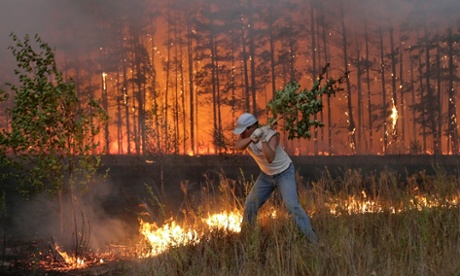
    A Russian man tries to stop fire near village Dolginino on August 4, 2010. Russia's worst heatwave for decades shows no sign of relenting, officials warned as firefighters battled hundreds of wildfires in a national disaster that has claimed at least 40 lives.
    In 2010, heatwaves caused hundreds of wildfires across Russia. Above, a man tries to stop a fire near Dolginino village. Photograph: Artyom Korotayev/AFP/Getty Images

    The rise in blocking patterns correlates closely with the extra heating being delivered to the Arctic by climate change, according to the research which is published in the journal Proceedings of the National Academies of Science (PNAS). Coumou and his colleagues argue there are good physical reasons to think there is a causal link, because the jet streams are driven by the difference in temperature between the poles and the equator. As the Arctic is warming more quickly than lower latitudes, that temperature difference is declining, providing less energy for the jet stream and its meanders, which are called Rossby waves.

    Prof Ted Shepherd, a climate scientist at the University of Reading, UK, but not involved in the work, said the link between blocking patterns and extreme weather was very well established. He added that the increasing frequency shown in the new work indicated climate change could bring rapid and dramatic changes to weather, on top of a gradual heating of the planet. “Circulation changes can have much more non-linear effects. They may do nothing for a while, then there might be some kind of regime change.”

    Shepherd said linking the rise in blocking events to Arctic warming remained “a bit speculative” at this stage, in particular because the difference between temperatures at the poles and equator is most pronounced in winter, not summer. But he noted that the succession of storms that caused England’s wettest winter in 250 years was a “very good example” of blocking patterns causing extreme weather during the coldest season. “The jet stream was stuck in one position for a long period, so a whole series of storms passed over England,” he said.

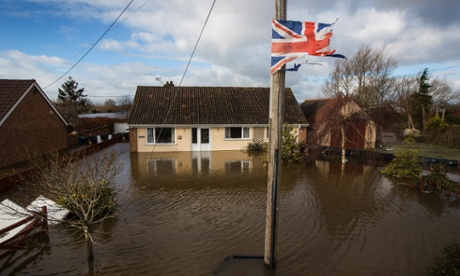
    Flooding in the town of Northmoor Green (Moorland), where almost all residents have now been evacuated, Somerset, 10 February 2014
    Flooding in Northmoor Green (Moorland) in Somerset, UK, in February this year. Photograph: David Levene for The Guardian

    Coumou acknowledges his study shows a correlation – not causation – between more frequent summer blocking patterns and Arctic warming. “To show causality, computer modelling studies are needed, but it is questionable how well current climate models can capture these effects,” he said.

    Prof Tim Palmer, at the University of Oxford, wrote in a PNAS article in 2013 that understanding changes to blocking patterns may well be the key to understanding changes in extreme weather, and therefore to understanding the worst impacts of climate change on society. But he said climate models might have to run down to scales of 1km to do so. “Currently, national climate institutes do not have the high-performance computing capability to simulate climate with 20km resolution, let alone 1km,” he wrote. “[I] look forward to the day when governments make the same investment in climate prediction as they have made in finding the Higgs boson.”

  • Solar panels and batteries to be cheaper than the grid

    Solar panels and batteries to be cheaper than the grid

    Biosolar's Leigh Storr
    Leigh Storr predicts rooftop solar will undercut grid connections in 2017

    Young Entrepreneur of the year, Leigh Storr, is pleased to be in the fastest growing sector of the fastest growing industry.

    “The only constraint on our growth, right now, is a lack of investment capital,” he told Westender.

    “In America investors would be throwing money at a company like BioSolar, in Australia, the financial institutions see rapid growth and call it risk.”

    According to Storr, the secret to his growth is high-quality panels, components and installations and a focus on affordability. He achieves that by providing customers with a payment plan to keep up-front costs down, and rigorous attention to cashflow in his business.

    “Many solar companies are selling incentives and are vulnerable to the whims of government policy. As governments slash incentives, our business has soared.”

    He explains that customers have simply done the numbers on their power bill.

    “If power prices continue to rise at 12.5% p.a. over the next ten years, the average Australian will spend an entire year of their work life, just paying for electricity.”

    BioSolar now employs over 400 people and has invested in a workplace culture that has earned it the nickname ‘Google of the Gabba’. It has a vegan cafe, cinema and gym on premises and an independent yoga studio on-site. The company has a major operational centre in Darra and offices in NSW and Victoria.

    Storr believes the current focus on propping up the fossil fuel industry will cost the Australian economy dearly as other countries shift to cheap, distributed energy and unleash innovation.

    Before the end of the year, BioSolar will be selling low cost battery technology and generators that will allow homes and businesses to be independent of the grid (see sidebar on Guerilla Disconnection).

    He points to companies like Google in the USA who are independent of the grid, precisely because they need to guarantee their electricity supply and control their electricity costs.

  • Staffie could save Straddie

    QYAC press releaseBy Richard Carew

    The Stafford by-election swing of over 18% against the LNP conveyed a dramatic message.  The public has had enough of the extreme decisions of the Newman government. This brings sharper focus to Campbell Newman’s “cash for legislation” deal with North Stradbroke sand miner Sibelco.

    Following the deal, the Newman government spread misinformation to the media over its November 2013 amendments to North Stradbroke Island sand mining legislation.

    An absence of fact checking by the media led to false reports that sand mining  had already been extended to 2035. In the public interest, these require correction. Some media outlets have begun to make corrections.

    If the Newman amendments are not repealed, the financial benefit to Sibelco,the privately owned Belgian mining company, could be $1.5 Billionby its own reckoning – see Jackie Trad.com.au – stop sandmining Straddie.  But contrary to media reporting, an extension of mining at the Enterprise sand mine to 2035 (or 2027, as Sibelco previously sought) is not scheduled to occur until 2019. This is because relevant mining leases do not expire until 31 December, 2019.

    In a revised article titled “Clive Palmer, Jeff Seeney and Campbell Newman’s Straddie donation”, published by the online newspaper Independent Australia.net, highly respected barrister Stephen Keim SC recently agreed that Sibelco cannot apply to extend the time frame for sand mining until 2019.

    Parliament can repeal the Newman amendments at any time before 2019. That is likely to occur without a change of government, if the native title owners win their High Court action for a declaration that he Newman amendments are invalid under the Australian constitution.

    The Newman government has misled the media and the public into believing that sand mining has already been extended to 2035 to quell dissent from  the many who want to see the Queensland icon protected. If people think the extension has already occurred, maybe they will think it’s a waste of time talking about repealing the Newman amendments?

    The reality is that even if the native title challenge to the validity of the amendments fails, if the LNP is voted out before 2019, the Newman amendments can be repealed by a future parliament. No compensation would be payable to Sibelco. Section 6 of the North Stradbroke Island Protection and Sustainability Act specifically rules out compensation.

    This would not be an unjust result. Sibelco purchased the mine in 2009 knowing that a key mining lease had expired in 2007 and had not been renewed. It was also aware that under the State’s expired lease laws there were legal obstacles to renewal of expired North Stradbroke mining leases. It also knew that there was significant opposition from indigenous owners, environment groups and others.

    The Fraser Island Inquiry in 1976 concluded that sand mining causes “major, permanent and irreversible environmental harm.” The Federal government accepted the findings and ended sand mining on Fraser almost immediately. The Bjelkie-Petersen government’s request for a two year transition was rejected.

    Stradbroke’s future clearly depends upon its natural environment being protected. It is remarkable that Campbell Newman, with a straight face, can talk about a so called ‘transition’ away from mining of 22 years when 40 years ago Joh Bjelkie Petersen would have settled for 2 years for Fraser Island !

    Richard Carew is a city-based lawyer and active member of Friends of Stradbroke Island

  • Coal bed methane: sorting the information from misinformation

    Join us on Linkedin

    Coal bed methane: sorting the information from misinformation

    Sam Dodson looks to sieve through the reams of misrepresented facts and misinformation in the hunt for accurate data on the benefits – or otherwise – of coalbed methane.


    A recently published report in the Proceedings of the National Academy of Sciences (PNAS) in the US has extolled some of the benefits of coalbed methane (CBM) and other unconventional resources, while also noting the need for further study to determine both the benefits and risks associated with developing such fuel sources.

    The report has been held up by industry lobbyists as a sign of the potential benefits of CBM: for example, the report noted that CBM would release “half the CO2 of coal”.  Meanwhile, activists pitted against the development of unconventionals have either refuted the report or drawn attention to its stance that further study into the industry is needed.

    Both groups would look to sway public opinion to their own way of thinking and, as such, choose to grasp at and support any report or news development that would appear to back up their claims, regardless of how accurate any such thing may be.

    Indeed, there is a growing body of research showing that, when a person’s worldview is threatened by scientific evidence, they interpret the science in a biased manner. People choose the data that supports their views, or views of those closest to them, and place greater weight on evidence that confirms those beliefs, while ignoring or resisting conflicting evidence.

    Mass communication and social media

    With the advent of mass communication, activists and lobbyists are able to spread the evidence that supports their views with ease. Both groups will also respond to each other’s actions in kind: an industry lobby group posts an article extolling the benefits of CBM, and attacking those that refute such benefits; activists post information that claims the opposite is true.

    As Michael Roche, CEO of Queensland Resources Council (QRC), at last year’s Coaltrans World Coal Conference in Berlin explained: “with so much of the world now connected and active on social media platforms,” it is easy to “hi-jack the good will of social media users and exploit this in order to spread a false message to serve [a group’s] own purpose.”

    In a classic example of the way groups can spread disinformation, a number of activist “eco groups” spread false or doctored images that claim to show the negative effects of dredging and seaborne coal transport. Roche said that to believe this was in any way the case was entirely false, explaining that the coal and shipping industries have worked alongside reef authorities and their interaction with the Great Barrier Reef has been under close scrutiny for many years with no evidence that the industry does any damage. Roche also said it would not make sense for any industry professional to claim otherwise or do anything that in anyway endangered the reef: “We all have a vested interest in ensuring the reef continues to survive,” Roche said.

    Roche, of course, has his own vested interest in supporting the coal industry – evidence indicates that the QRC receives AU$ 103 million from the coal industry to press the case for the state’s coal miners. Attacking the source of this income does not necessarily pay such rich dividends.

    Another example, is the recent spat between the Australian Petroleum Production & Exploration Association (APPEA) and the Australian Medical Association (AMA). The AMA had recently suggested that natural gas from coal seams poses a risk to human health, a claim the APPEA accused of having more political overtones than scientific foundation. The AMA, in turn, argued that the opposite was the case.

    Trying to find true, real and accurate information among all the misinformation can therefore be a significant challenge.

    Fact and fiction

    Alex Wonhas, from the Gas Industry Social and Environmental Research Alliance (GISERA), explains that: “deciding whether CBM is good or bad is wholly dependent on the individual’s definition of the words ‘good’ or ‘bad’.”

    “It is in the interests of the industry to make you believe that CBM is good, while the opposite is true for other groups. The role of scientists and organisations such as the Commonwealth Scientific and Industrial Research Organisation (CSIRO) is to act as an honest broker and try to bring some clarity to the debate,” Wonhas adds.

    CSIRO is currently set to investigate whether CBM activity is causing methane seeps in Queensland’s Surat Basin. The study will give authorities baseline data to compare over the life of the CBM industry. “We’ll be able to follow the eventual impacts on methane seeps to the atmosphere from these sources,” Dr Damian Barrett, Spokesman for Australia’s national science agency, said.

    The project will be funded through a partnership between CSIRO and CBM companies operating in Australia.

    It is through scientific research, such as that conducted by the CSIRO, as well as by gathering information in reports, such as the one released in the PNAS, that the information needed to ground our opinions in fact will be provided; rather than selectively choosing the misinformation generated by activists on both sides of the argument.

    One thing else is clear: the world needs energy, yet the fact that human activity (including the creation of energy) effects climate change is almost universally accepted. A balance between these two pressing matters must therefore be struck – and struck quickly. As demand for power and electricity around the globe grows, energy production must increase. All sources of energy – from CBM and other unconventionals to mainstays like coal and gas, as well as renewables – must be considered as viable options in meeting energy needs until scientific fact proves otherwise. To spend time trying to win battles – be they with activists or lobbyists – to conjecture and form biased opinions over a subject as crucial to global development as energy resources is to only ever be on the losing side of an entirely bigger struggle.


  • Daily update: Abbott praises coal, gas, dog-whistles to nuclear

    to enable desktop notifications for Gmail.   Learn more  Hide

    1 of 1
    Why this ad?
    Learn about coal seam gasyoursayagl.com.au – Ask us a question about our natural coal seam gas projects

    Daily update: Abbott praises coal, gas, dog-whistles to nuclear lobby

    Inbox
    x

    Renew Economy editor@reneweconomy.com.au via mail67.atl51.rsgsv.net

    3:16 PM (10 minutes ago)

    to me
    Abbott praises coal, gas, dog-whistles to nuclear lobby; Why “experts” get it wrong on wind and solar; Carnergie receives first ARENA payment for CETO 6 project; Tritium partners with James Cameron for deep-sea dive; Community calls on Alcoa to shut down coal plant; A climate of terror?Keystone XL will spike oil demand and c02, study says; Increase in flights will outweigh carbon cuts; and EV-Lite project reduces battery weight 41%.
    Is this email not displaying correctly?
    View it in your browser.
    RenewEconomy Daily News
    The Parkinson Report
    Australian wave energy developer, Carnegie Energy, have received its first payment from ARENA as part of an $11 million grant for the CETO 6 Project.
    So who has got it right on predicting the growth of wind and solar – green NGOs or the traditional “experts”.
    Australian wave energy developer, Carnegie Energy, have received its first payment from ARENA as part of an $11 million grant for the CETO 6 Project.
    Australian electric vehicle charging company and solar racing car Brisbane business, Tritium, have helped support James Cameron’s deep-sea expedition.
    A 700-people-strong community march in Anglesea has called for Alcoa to shut down its polluting coal power plant.
    Replacing divisive changes to the Racial Discrimination Act with an equally divisive ramping up of counter-terrorism laws suggests the government is using up the last reserves of its political capital.
    A new study says the State Department may have underestimated the Keystone XL pipeline’s CO2 emissions by as much as four times.
    Whatever the industry’s efforts to reduce its carbon emissions, they will be outweighed by the growth in air traffic
    UK-based Cenex has just completed a two-year project to reduce both the weight and cost of EV batteries.