The Generator news service publishes articles on sustainable development, agriculture and energy as well as observations on current affairs. The news service is used on the weekly radio show, The Generator, as well as by a number of monthly and quarterly magazines. A podcast of the Generator news is also available.
As well as Giovanni’s articles it picks up the most pertinent articles from a range of other news services. You can publish the news feed on your website using RSS, free of charge.
Glaciers in Central Asia are melting fast as temperatures rise at double the speed to those at sea level.
The rapid melting of glaciers in the so-called Third Pole located in the Himalayas and Central Asian mountains threatens the long term survival of billions of people across Central and Southern Asia.
The melting is due to a 1.5 degree increase in surface temperature and will increase flows in the Mekong, Yellow, Yangtse, Ganges and Indus rivers over the next decade after which it will begin to slow again. The area is known as the Third Pole because it contains as much frozen water as the North and South pole.
Glaciers on the Western side of the mountains appear to be unaffected to due increased precipitation being blown East from Europe.
Local herdsmen in Western China are already being re-located as climate refugees due to the changes in the landsape caused by the increased volume of water, warmer weather and lack of snowfall.
Crisis at the Third Pole
At the top of the world a climate disaster is unfolding that will impact the lives of more than 1 billion people. The real worry is the melt will set off a chain of climate disasters like the recent epic floods in Pakistan and China, or unprecedented heatwaves in India, or increasing desertification across the region. And the deeper concern is that while scientists know the changes in the Third Pole will affect global weather patterns such as monsoons and the El Nino, they don’t know by how much. And in a region where tension between countries over shared water resources is becoming increasingly common, the environmental threat is likely to spark a political one.
Activists arrested for protesting at the Piliga Push by “locking on” to the gates and preventing mining trucks from entering the forest have had demerit points deducted from their license and been fined for failing to follow police directions. At least three individuals have had three demerit points deducted and have been fined $350 or more under the NSW Road Transport Act 2013.
The Pilliga Push is protecting forests from mining
The particular offence being used is Rule 304(1) “Failing to follow directions of a police officer”. While the definition of Rule 304(1) does not specifically defined the scope of police powers, Section 32.1 of the NSW Road Transport Act 2013 identifies that offences for which demerit points are incurred are those (relating to the driving or use of motor vehicles).
The full wording of that clause is,
“(1)  The statutory rules may prescribe:

(a)  the offences (relating to the driving or use of motor vehicles), and the number of demerit points incurred for each offence, that comprise the national schedule of demerit points, and

(b)  additional offences (relating to the driving or use of motor vehicles) created under a law of this jurisdiction for which demerit points may be incurred and the number of demerit points incurred for each offence.”
Thus it is clear that the intent of the act is to restrict the use of demerit points to offences that reduce the safety of the roads or the citizenry due to activity on the roads.
Rule 304(1) is an offence under Section 32.1(a) as it is part of the Australian Road Rules, agreed to by all states to establish a national framework of regulation for traffic offences.
Under the Commonwealth Road Traffic Act 1961, Part 2, Division 1, Clause 11 “Australian Road Rules apply to vehicles and users on roads and road related areas.”
The question is likely then to come down to one of whether the arrest by NSW Police of protestors who “lock on” to protect the Pillaga from mining is
a road traffic and safety activity carried out on behalf of the citizens of NSW OR
a security operation carried out to protect the commercial interests of international mining companies who wish to destroy farmland and forest in the interests of profit.
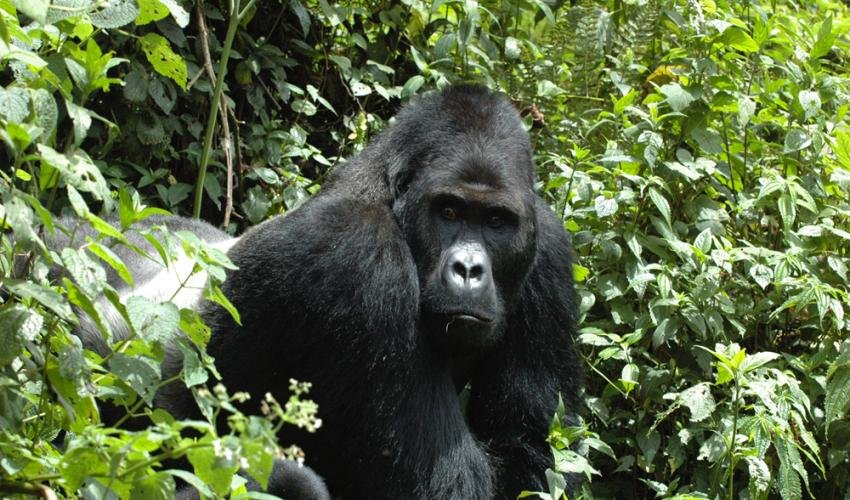
The Eastern Gorilla is one of four great apes added to the Critically Endangered list this week.
The world’s largest primate is now critically endangered due to illegal hunting. The Eastern Gorilla is the latest victim of a phenomena known as extinction investment where the market for endangered animals spikes in anticipation of their disappearance, thereby accelerating the process. Ironically, efforts by national governments to protect an endangered species, serve to heighten the value in this speculative market.
Great Apes Face Extinction
The Eastern Gorilla – the largest living primate – has been listed as Critically Endangered due to illegal hunting, as are four out of six great ape species – only one step away from going extinct – with the remaining two also under considerable threat of extinction. The Red List now includes 82,954 species of which 23,928 are threatened with extinction.
Aquion battery packs will power a nano-grid at the Illinois Institute of Technology.
A new salt based battery from US based Aquion will allow mass storage of solar generated power more cheaply than lithium iron or lead acid batteries.
The approach uses a bath of salts to store the charge without the chemical deterioration and inefficiencies found in most existing batteries. Batteries using highly reactive chemicals gradually wear out as the chemicals become polluted with constant re-use.
Similar technology was developed at the University of New South Wales thirty years ago using Vanadium salts, but was not successfully commercialized.
Solar and salt water battery storage used to create “nanogrid” of future
The unique solar and storage system designed for IIT will use alternating and direct current loads while charging batteries at the same time, allowing the nanogrid to run independent of the rest of the campus, as an islanded off-grid system.
Monsanto’s aggressive use of seed patents to attack organic farmers has food growers and activists agitated
The proposed merger of German pharmaceutical manufacturer Bayer and American pesticide and seed corporation Monsanto has raised global concerns among activists concerned about monopoly power over food security and human health.
US Senators representing mid-western farmers have promised to scrutinize the deal which some financial commentators have said will fail, netting a windfall for Monsanto.
There is little overlap in the companies’ products and so it is unlikely to be stopped by anti-monopoly laws.
Bayer-Monsanto Merger Is ‘a Disaster for Global Food System
This is extremely bad news for farmers and consumers across the globe. “We already know that these agri-businesses use aggressive techniques to further their market share and increase profit margins and do not act in the best interests of small-scale farmers, public health or the environment.” The merger will create a company that will command more than a quarter of the combined world market for seeds and pesticides.
People aren’t thinking straight about Monsanto – Bloomberg
Critics who dislike Monsanto for its leading role in developing genetically modified organisms and agricultural chemicals shouldn’t also be citing monopoly concerns as a reason to oppose the merger — that combination of views doesn’t make sense. Let’s say for instance that the deal raised the price of GMOs due to monopoly power. Farmers would respond by using those seeds less, and presumably that should be welcome news to GMO opponents.
Bayer-Monsanto Merger Is ‘a Disaster for Global Food System
This is extremely bad news for farmers and consumers across the globe. “We already know that these agri-businesses use aggressive techniques to further their market share and increase profit margins and do not act in the best interests of small-scale farmers, public health or the environment.” The merger will create a company that will command more than a quarter of the combined world market for seeds and pesticides.
People aren’t thinking straight about Monsanto – Bloomberg
Critics who dislike Monsanto for its leading role in developing genetically modified organisms and agricultural chemicals shouldn’t also be citing monopoly concerns as a reason to oppose the merger — that combination of views doesn’t make sense. Let’s say for instance that the deal raised the price of GMOs due to monopoly power. Farmers would respond by using those seeds less, and presumably that should be welcome news to GMO opponents.
The Senate is taking a closer look at a proposed $66 billion merger of American seed and weed-killer company Monsanto and German medicine and farm chemical maker Bayer.
The deal combines two of the six U.S. and European companies that dominate the agrochemical market, and would create a global agricultural and chemical giant with a broad array of products. The Senate Judiciary Committee chairman, Republican Sen. Charles Grassley of Iowa, has said he’s concerned that the consolidation could hurt American farmers who are already worried about rising costs.
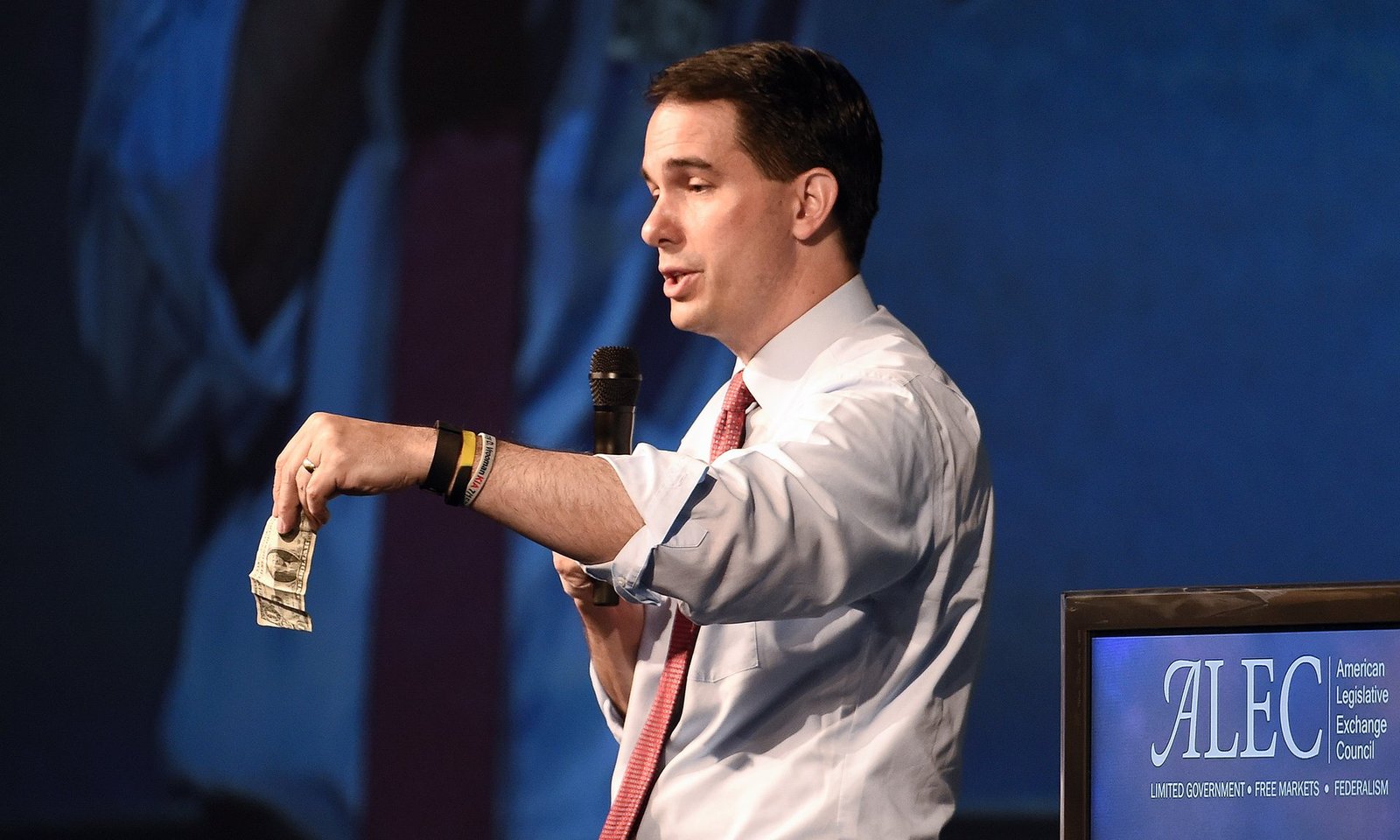
Wisconsin governor, Scott Walker, waves a dollar in defiance of a corporate donations scandal
The company Walmart is wealthier than Australia. Of the hundred wealthiest entities in the world, 69 are corporations and only 31 are countries.
The top ten largest countries are worth 2.9 trillion US dollars, more than the size of China’s economy. Coorporate wealth is increasing rapidly. while that of nations is declining.
The impact is apparent in situations such as the recent investigation in corruption in Wisconson that has controversially been shut down by the Wisonsin Supreme Court which ordered that all the evidence be destroyed.
A small parcel of evidence was recently released revealing revealed huge donations of more than $750,000 to directly influence policy.
Donald Trump has widely criticised donations but the Wisconson investigation revealed that he had donated $15,000 to governor Scott Walker’s campaign.
Largest Corporations Wealthier Than Most Countries
‘The power of corporations is so great within our society that they have undermined the idea that there is any other way to run society. Of the 100 wealthiest economic entities in the world, 69 are now corporations and only 31 countries, The figures were 63 to 37 just one year ago. The top ten largest companies have a combined value of $2.9 trillion, which is larger than China’s economy. Walmart is larger than our Australian economy.
Leaked documents reveal secretive influence of corporate cash on politics
Wisconsin court documents from Scott Walker investigation expose extent of corporate influence on democratic process rarely seen by the public in which millions of dollars are secretly donated in an attempt to sway elections. They speak to the distortion of American democracy by big business that has been slammed by both Donald Trump and Bernie Sanders.