Category: News

Add your news
You can add news from your networks or groups through the website by becoming an author. Simply register as a member of the Generator, and then email Giovanni asking to become an author. He will then work with you to integrate your content into the site as effectively as possible.
Listen to the Generator News online

 
The Generator news service publishes articles on sustainable development, agriculture and energy as well as observations on current affairs. The news service is used on the weekly radio show, The Generator, as well as by a number of monthly and quarterly magazines. A podcast of the Generator news is also available.
As well as Giovanni’s articles it picks up the most pertinent articles from a range of other news services. You can publish the news feed on your website using RSS, free of charge.
 

  • 700,000 Australian buildings at risk from Sea Level Rise

    Friday, March 16, 2007

    700,000 Australian buildings at risk from Sea Level Rise
    An Insurance industry study in Australia has identified 700,000 buildings at risk nationwide from rising sea levels caused by human induced climate change. The study was done in 2006.

    Karl Sullivan from the Insurance Council of Australia said “We’re working closely with government to try to map and understand what those risks are as climate change starts, or what the exact details of climate change may be and how it may manifest.” according to the ABC 7.30 Report.

    According to 7.30 Report journalist Matt Peacock the Insurance report specifies that Sea Level Rise associated with King tides and storm surges may effect more than 700,000 buildings on the Australian coast. “In the Northern Territory nearly 900 coastal buildings, mainly in Darwin, are at risk. Along the Tasmanian coastline, more than 17,000 addresses are considered vulnerable. More than 60,000 in South Australia, mostly around Adelaide, and along the Victorian coast over 80,000, mainly around Melbourne. In Western Australia, 94,000 buildings have been identified around Perth, but the biggest concern is along the eastern seaboard; more than 200,000 buildings are considered vulnerable on the NSW coast, including Sydney. Queensland faces the largest risk, with almost 250,000 buildings under threat, stretching from the Gold Coast to the Sunshine Coast.”

    Barrie Pittock, former head of the CSIRO and a contributor to the IPCC report, said on the 7.30 Report: “We have an increase in the outflow of glaciers from Greenland and parts of Antarctica already that have been observed. The latest papers suggest a rise by 2100 between about 50 centimetres and 1.5 metres, which is quite a lot more than the IPCC report.”

    Barrie Pittock said that there is a crude rule of thumb effect of sea level rise which applies theoretically just to straight sandy beach, which suggests for every metre rise in sea level the coastline will retreat or go inland by 100m.

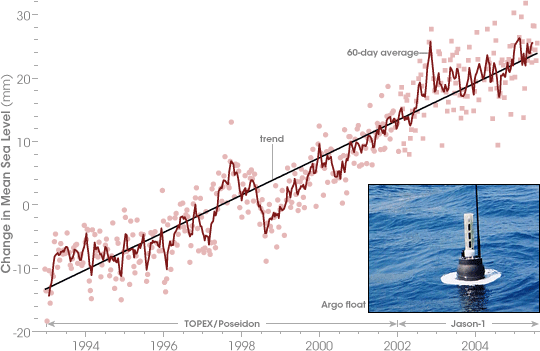
    In Hobart this week (March 12-15) a conference of about 200 scientists met to discuss oceanography, including Sea Level Rise and ongoing monitoring of the earth’s oceans. Much of the accurate measurment data is collected from the Jason 1 satellite. Satellite measurements suggest that global warming is doubling the number of intense storms and coastal flooding on the West and East Australian coasts, and the rate of sea level rise is being severely underestimated by the IPCC recent report.

    David Griffin from the CSIRO said that available data indicates that sea levels are rising faster than expected, and the main reason is climate change. His comments indicate a more accurate model is required to explain the rapid rate in sea level rise. “Well that underpins the importance to understand why the observed rate of sea-level rise is greater than the models can explain,” he said. “We’re relying on those models to make projections for the next 100 years. If they can’t actually explain the last 10 years, then we know that we’ve got more work to do.”

    The head of NASA Oceanography, Eric Lindstrom, attending the conference, was reported by the ABC as saying that a lot of scientists are wondering when society will wake up to the seriousness of climate change. “I’d say the major force involved in these changes is human-induced climate change, global warming,” he said. “I consider this data very serious and that there is climate change happening and that we need to be concerned about it.”

    ======================================

    So how bad could sea level rise be? The rule of thumb, according to Barrie Pittock is that for every 1 metre rise in sea level, the coast moves about 100 metres. If the Greenland and West Antarctic Ice sheets disintegrate rapidly, then sea levels may change at the rate of up to 1 metre per 20 years.

    Outspoken NASA climate scientist, Jim Hansen, was interviewed by Kerry Obrien on the ABC TV current affairs program, The 7.30 Report. He gives a very graphic and detailed view of what we are facing with climate change and sea level rise. Interview Reproduced in full.

    Australian Broadcasting Corporation
    TV PROGRAM TRANSCRIPT
    LOCATION: http://www.abc.net.au/7.30/content/2007/s1870955.htm
    Broadcast: 13/03/2007
    Scientist predicts disastrous sea level rise

    Reporter: Kerry O’Brien

    KERRY O’BRIEN: Welcome to the program and first, as the world continues to absorb the import of the recent UN intergovernmental report on climate change, with its projections for increased temperatures, violent storms and rising sea levels, one of America’s pioneering climate change scientists has raised a much more frightening scenario. Dr James Hansen, a prominent and controversial NASA scientist, has written a paper predicting catastrophic sea level rises from the disintegration of polar ice sheets if the globe heats up by two to three degrees Celsius this century. The IPCC report, written by hundreds of the world’s top scientists, has predicted temperature rises of from two to six degrees Celsius if greenhouse emissions aren’t reduced. Dr Hansen, who had a much publicised run-in with the Bush White House after accusing the administration of trying to gag him, has told this program that he expected both west Antarctica and parts of Greenland to collapse if temperatures reached 2 or more per cent, which could cause sea levels to rise at a rate of a metre every 20 years. Last night’s program showed how up to 700,000 homes around the Australian coastline have been identified as being at risk from much lower sea level rises. The Hansen scenario would potentially displace hundreds of millions of people around the world. I spoke with Dr Hansen from London earlier today.

    KERRY O’BRIEN: Jim Hansen, now we’ve had the IPCC report, do you believe the world has an accurate picture of the risks ahead for global warming?

    DR JAMES HANSEN, NASA CLIMATOLOGIST: There is quite a large gap between what is understood about global warming by the relevant scientific community and what is known by the public. The one thing that I’ve become particularly concerned about is sea level rise, where the current IPCC report is going to suggest smaller numbers than the last report, although all of the information that we’re getting in the last year or two points in a very much different direction. Now, in defence of IPCC, their procedure required that they stop getting new inputs more than a year ago and a lot of the data on ice sheet stability has come up in just the last year or two.

    KERRY O’BRIEN: What are your particular fears with regard to the melting of the polar ice caps?

    JAMES HANSEN: Well, the problem is that the climate system in general has a lot of inertia and that means that it takes time for the changes to begin to occur but then, once they do get under way, it becomes very difficult to stop them and that is true in spades for the ice sheets. If we once begin to disintegrate it will become very difficult, if not impossible, to stop them and we are beginning to see now on both Greenland and west Antarctica disintegration of those ice sheets. They’re both losing ice at a rate of about 150 cubic kilometres per year and that’s still not a huge sea level rise. Sea level rise is now going up about 3.5 centimetres per decade. So that’s more than double what it was 50 years ago. But it’s still not disastrous; it’s a problem, but it’s not disastrous. But the potential is for a much larger sea level rise. If we get warming of two or three degrees Celsius, then I would expect that both West Antarctica and parts of Greenland would end up in the ocean, and the last time we had an ice sheet disintegrate, sea level went up at a rate of 5 metres in a century, or one metre every 20 years. That is a real disaster, and that’s what we have to avoid.

    KERRY O’BRIEN: What is the most recent evidence of what’s really going on with the ice caps, the Arctic and the Antarctic?

    JAMES HANSEN: There are two things that are cause of concern. First of all, if we look at the history of the Earth, we know that at the warmest interglacial periods, which were probably less than 1 degree Celsius warmer than today, it was still basically the same planet. Sea level was perhaps a few metres higher. But if we go back to the time when the Earth was two or three degrees Celsius warmer, that’s about three million years ago, sea level was about 25 metres higher, so that tells us we had better keep additional warming less than about one degree. And the other piece of evidence is not from the history of the Earth but from looking at the ice sheets themselves, and what we see is that the disintegration of ice sheets is a wet process and it can proceed quite rapidly. We see that the ice streams have doubled in their speed on Greenland in the last few years and even more concern is west Antarctica because it’s now losing mass at about the same rate as Greenland, and west Antarctica, the ice sheet is sitting on rock that is below sea level. So it is potentially much more in danger of collapsing and so we have both the evidence on the ice sheets and from the history of the Earth and it tells us that we’re pretty close to a tipping point, so we’ve got to be very concerned about the ice sheets.

    KERRY O’BRIEN: How good are the models on which world science is basing its climate change predictions?

    JAMES HANSEN: Temperature we can, we now have that calibrated quite well, both in terms of how fast the Earth is now warming, which is about two-tenths of a degree Celsius per decade, and the climate models reproduce that, and the climate models can also reproduce the magnitude of the climate change from glacial to interglacial periods. So we’re pretty confident of climate sensitivity, and what that sensitivity tells us is that if we want to keep warming less than one degree Celsius additional above that of today, we had better keep CO2 less than 450 parts per million, and perhaps even less than that. So we’re really getting close to the tipping point, because CO2 is now 380 parts per million. It started out, 100 years ago, at 280, it’s now 380 and it’s going up 2 PPM per year. So if we stay on as business as usual, within about 30 years we will be past this level that, I think, is a very dangerous level.

    KERRY O’BRIEN: You said a year ago that in your 30 years working in government you’d never seen such constraints on communication between scientists and the public. What’s the evidence of that?

    JAMES HANSEN: Well, it worries me a lot because in our country the government science agencies have public affairs offices which are now staffed with political appointees and those political appointees have a big impact on what science gets reported and how it’s reported. And I’m very disturbed about that. I think that public affairs officials should be helping scientists speak in a language that the public can understand but they shouldn’t be massaging the information. And the other example is reporting, testifying to Congress. I don’t understand why a scientist’s testimony has to be approved by the White House. Government scientists are paid by the public, paid by taxes and I think we’re working for the public and for Congress, as well as for the executive branch, and I don’t think that our testimony should be filtered.

    KERRY O’BRIEN: You said just a couple of weeks ago that there should be a moratorium on building coal fired power plants until the technology to capture and sequester carbon dioxide emissions is available. But you must know that that’s politically unacceptable in many countries China, America, Australia for that matter, because of coal industry jobs and impact on the economy.

    JAMES HANSEN: Well, it’s going to be realised within the next 10 years or so that we have no choice. We’re going to have to bulldoze the old style coal fired power plants. We can burn coal, provided we capture the CO2 and sequester it, and we’re working on technology that would allow us to do that and we should have been working a little harder but, nevertheless, we will have, within five to 10 years, we will have that technology. In the meantime, we should be emphasising energy efficiency so that we don’t need new old style coal fired power plants. We’re just not doing that. Buildings could be 50 per cent more efficient. The architects and engineers will tell you they have the technology to do that, but if it’s not required it’s not likely to happen.

    KERRY O’BRIEN: After your 20 years as a scientist of trying to raise awareness of the dangers of global warming, are you ultimately optimistic or pessimistic about the future?

    JAMES HANSEN: I think that we’re likely to pass the 450 parts per million, which is probably the dangerous level. However, I think there is a lot of encouraging evidence in the last year or two that people are starting to get it, and so – if we can keep it close to that level, and take some additional actions. You know, there are other climate forces besides carbon dioxide, and some of those – it would be very useful to reduce those. And so if we begin to address carbon dioxide and methane and black carbon and tropospheric ozone then I think we can avoid the dangerous climate change but we’ll have to get going very soon.

    KERRY O’BRIEN: Jim Hansen, thanks for talking with us.

    JAMES HANSEN: Thank you.

    =========================================================

    Sources:
    West Australian 6 March, 2007 – Scientists to discuss global sea rise
    http://www.thewest.com.au/aapstory.aspx?StoryName=361931

    ABC News 12 March, 2007 – The CSIRO says sea levels are rising faster than expected
    http://www.abc.net.au/news/newsitems/200703/s1869919.htm

    ABC News 12 March, 2007 – NASA official ‘surprised’ climate change still debated
    http://www.abc.net.au/news/newsitems/200703/s1869676.htm

    The 7.30 Report – ABC TV – 12 March 2007 – Coastal areas face environmental threats
    http://www.abc.net.au/7.30/content/2007/s1869888.htm

    PM – ABC Radio – 13 March 2007 – Global warming doubling number of intense storms
    http://www.abc.net.au/pm/content/2007/s1870888.htm

    The 7.30 Report – ABC TV – 13 March 2007 – Scientist predicts disastrous sea level rise
    http://www.abc.net.au/7.30/content/2007/s1870955.htm

    NASA – The Earth Observatory = June 2006 – The Rising Sea Level
    http://earthobservatory.nasa.gov/Newsroom/NewImages/images.php3?img_id=17300

  • Misleading UN report confuses Paris climate talks outcome of 3.5C by 2100 climate code red

    More

    3 of 13

    climate code red

    Inbox
    x

    Climate Code Red <noreply+feedproxy@google.com> Unsubscribe

    8:45 PM (11 hours ago)

    to me

    climate code red


    Misleading UN report confuses Paris climate talks outcome of 3.5C by 2100

    Posted: 07 Nov 2015 10:29 PM PST

    by Joe Romm, Climate Progress

    Memo to media: If countries go no further than their current global climate pledges, the earth will warm a total of 3.5°C by 2100.

    A very misleading news release from the U.N. Framework Convention on Climate Change (UNFCCC) — coupled with an opaque UNFCCC report on those pledges, which are called intended nationally determined contributions (INDCs) — has, understandably, left the global media thinking the climate talks in Paris get us much closer to 2°C than they actually do.

    Indeed, the news release contains this too-cleverly worded paragraph quoting UNFCCC Christiana Figueres, Executive Secretary:

    The INDCs have the capability of limiting the forecast temperature rise to around 2.7 degrees Celsius by 2100, by no means enough but a lot lower than the estimated four, five, or more degrees of warming projected by many prior to the INDCs,” said Ms. Figueres.

    I’m a fan of Figueres and all that she has accomplished in the lead-up to Paris. Indeed, as I’ve written, “the INDCs have bought us another five to 10 years of staying close to the 2°C path,” which is the defense line against very dangerous-to-catastrophic global warming.

    But, to repeat, assuming countries meet their current global climate pledges — but go no further — the earth will warm a total of 3.5°C by 2100 (but see note at the end). Climate Interactive has added up the latest commitments and here is where they lead:

    CI-INDC-3.5c

    Significantly, while China has agreed to peak CO2 emissions by 2030, “total GHG emissions are likely to continue increasing until 2030, as China has not yet implemented sufficient policies addressing non-CO2 GHG emissions (methane, nitrous oxide, HFCs etc.),” as the analytical team at Climate Action Tracker explains. Also, India has specifically not committed to peak its CO2 emissions yet (nor have some other developing countries that are not yet at India’s stage of economic growth).

    I have no doubt that countries will make stronger pledges in the future — indeed, China just announced with France that it wants every country to have five-year check-ins to assess progress on the climate commitments. But those pledges have not been made yet, we do not know what they might be, and we certainly should not count them in any analysis of what Paris will achieve.

    So why does Figueres say the Paris pledges will limit warming to 2.7°C by 2100? In fact, she doesn’t say that. She says they “have the capability of limiting the forecast temperature rise to around 2.7 degrees Celsius by 2100.” What does that mean?

    It means that the overwhelming majority of the pledges end by 2030 — but most of them imply a rate of reduction in CO2 emissions between now and 2030. So, if you assume countries will commit in the future to keep reducing emissions after 2030 at the rate they did before 2030 — and make a bunch of other optimistic assumptions — you can limit warming to 2.7°C in 2100.

    Here’s a quick analogy. You weigh 400 pounds with many weight-related health problems, and a team of doctors say you need to cut your weight sharply. You agree to go on a supervised weight loss regime for two years that will take you down to 300. Should you start telling all of your friends that you’ll weigh 200 pounds in 4 years?

    Of course not. You’ve got a long way to go. Heck, you’re not even at 300 yet.

    Actually, it is worse than that because the 2.7°C scenario requires a whole other level of effort. Here’s one possible 2.7°C pathway:

    CI-2c post-2030 v2

    As you can see, India would have to plateau around 2030 (as would other developing countries). India has has not made such a commitment yet. One of the country’s leading politicians says it can do it. Indeed, I believe the combination of ever worsening climate impacts and rapidly dropping costs for clean energy make it all but inevitable that India will ultimately do so — and that the vast majority of other countries will also make stronger pledges in the years to come.

    But India has not made a pledge to peak yet, nor have other major developing countries, nor has China agreed to start slashing emissions in 2030, nor has our country agreed to steady reductions in CO2 emissions post-2025.

    Here’s another analogy. You weigh 400 pounds with weight-related health problems, and a team of doctors say you have to lose weight sharply. But you are still gaining 10 pounds a month. You agree to go on a supervised diet and exercise regime that will stop your weight from rising beyond 450 pounds in twelve months. Should you tell everyone that you’ll weigh 300 pounds in 3 years?

    Of course not.

    And the UNFCCC understands all this, which is why, immediately after Figueres’ quote in the news release, the very next paragraph is: 

    The secretariat report does not directly assess implications for temperature change by the end of the century under the INDCs because information on emissions beyond 2030 is required. However, other independent analyses have, based on a range of assumptions, methodologies and data sources, attempted to estimate the impact of the INDCs on temperature leading to a range of average estimates below, at or above 3 degrees C.

    That means the UK Guardian had the story wrong when they wrote:

    “Pledges by most of the world’s countries on climate change are likely to lead to less than 3C of global warming over the century, analysis of the data by the United Nations suggests.”

    The UNFCCC never made any such analysis or claim. And the only way to make such a claim is to go far beyond the current pledges. But, again, the mistake is understandable since the news release was very misleading on this point.

    The best we can say right now is that, if we consider the Paris climate pledges and nothing further, the earth will warm a total of 3.5°C by 2100. Of course, we can continue to say that keeping total warming to 2°C is super cheap because we know that is also true.

    Note to nerdtastic readers: Yes, the 3.5°C calculation does assume that no unmodeled carbon cycle feedbacks kick in — such as the permafrost melting. I’ll cover issue that in a later post.

  • Our plan to kick the big polluters out Sam LR – GetUp!

    1 of 10

    Our plan to kick the big polluters out

    Inbox
    x

    Sam LR – GetUp! Unsubscribe

    10:18 AM (5 minutes ago)

    to me

    Recently you took a survey to help determine GetUp’s priorities on climate change. We’ve taken your feedback and turned it into an ambitious plan to give the big polluters a run for their money. Can you chip in to make it a reality?

    This is absurd, NEVILLE.

    French mining company Engie (previously known as GDF-Suez) owns Australia’s dirtiest coal plant Hazelwood, and guess what? They’re sponsoring the UN climate talks!1

    The UN conference at the end of this month will be crawling with big coal and their mates trying to block action on the climate disaster they’ve created. For the past two decades, the coal lobby has funded think tanks for dodgy sceptics like Bjorn Lomborg, bankrolled lobbyists to pollute our politics behind closed doors and devised misinformation campaigns straight from the big tobacco playbook.2

    So while they’re on the inside trying to hold us back – we need to be on the outside pushing forward. Forward to a safer climate and a better life free from polluting energy. That’s why we’re mobilising en masse for People’s Climate Marches across Australia to show the world we’re ready to play our part in tackling global warming.

    To take on the big polluters in the lead up to the Paris climate talks, right through to the next federal election, we need resources, which is why we’re asking you to step up and become a GetUp core climate member. Can you make a small weekly donation?

    We’ve already hit the ground running. Your money will provide organisers on the ground, phones for phone bankers, t-shirts for volunteers, clipboards for doorknockers, and the promotional materials we need to make these marches the biggest we’ve ever seen.

    Big coal might have a lot of money, but we’ve got something much more powerful: YOU, NEVILLE, and a million more GetUp members ready to kick polluters out of politics.

    As a core member, you’ll join hundreds of Australians to fund:

      1. The biggest, coordinated doorknock for climate action the country has ever seen.
      1. The massive People’s Climate March for 2015, which last year was used as real-time evidence of the world’s demand for climate action by leaders like Ban Ki Moon and President Obama.
      1. A people’s policy platform led by researchers, policy experts, economists and movement partners to show politicians the pathway to a 100% renewable powered future.
    1. All the hard-hitting ads, high-profile actions, and electoral organising we need to turn climate change into a major issue at the next federal election.

    If fossil fuel lobbyists are running the show on the inside, whispering nonsense in the ear of our Prime Minister, let’s raise an alarm on the outside that they can’t ignore.3,4 Our plan is designed to get global media taking our actions here at home all the way to Paris.

    But to change everything, we’ll need everyone. Click here to fund our fight for a cleaner, safer future.

    If big polluters are going to keep trying to hold us back then we need to step up and show the way forward.

    Are you in? www.getup.org.au/power

    In hope,
    Sam and Adam, for the GetUp team

    PS – There’s never been a more important time to fire up our movement and demand action with a strong, united voice. Last week we saw what happens when big coal writes the PM’s political propaganda – a whopping 72% of Liberal Party supporters still don’t realise human activity causes climate change.5 Thanks Tony Abbott. But now is the time for Malcolm Turnbull to do better. Chip in now to support our plan to tackle the big polluters.


    References
    [1] France defends ‘imperfect’ fossil fuel sponsors for Paris climate summit, The Guardian, 30 May 2015
    [2] Fossil fuel firms are still bankrolling climate denial lobby groups, The Guardian, 26 March 2015
    [3] Coal industry lobbying Government ahead of climate change talks, ABC Online, 27 October 2015
    [4] How the Minerals Council of Australia has government’s ear on coal, The Saturday Paper, 24 October 2015
    [5] Most Coalition voters do not believe in human-induced climate change – CSIRO, The Guardian, 4 November 2015

  • The John James Newsletter 89

    1 of 57

    The John James Newsletter 89

    Inbox
    x

    John James

    10:16 AM (3 minutes ago)

    to John
    The John James Newsletter 89
    7 November 2015
    The ultimate measure of a man is not where he stands in moments of comfort, but where he stands at times of challenge and controversy
    Martin Luther King
    Though no one can go back and make a brand new start, anyone can start from now and make a brand new ending.
    Carl Bard
    Do you want the latest research? This is it
    Climate-Change Summary and Update
    “No matter how cynical you become, it’s never enough to keep up.” In climate science, my own efforts to stay abreast are blown away every week by new data, models, and assessments. It seems no matter how dire the situation becomes, it only gets worse when I check the latest reports.
    Climate, Fire and Human evolution
    Andrew Glikson outlines the principle milestones in the evolution of the atmosphere, oceans and biosphere during the last 4 million years and how we uniquely mastered the ignition and transfer of fire.
    World’s biggest floating wind farm approved in Scotland
    The turbines will be attached to the seabed by a three-point mooring spread and anchoring system, that makes them easier and cheaper to install in deep water than other traditional offshore wind turbines, which are rigidly attached to the seabed.
    Why South Africa’s born-free generation is not happy
    A new black consciousness movement is emerging in South Africa 21 years after its first democratic elections – most recently seen in nationwide student protests.
    Climate Court Battle, Youth Refuse ‘To Watch Government Do Nothing’
    The trial is over the refusal by the Department of Ecology to set a cap on carbon emissions. Eight young teens are the plaintiffs. “We’re the ones who have to live with it if the oceans are acidic and the planet is 5 degrees warmer. Everything that can go wrong is going wrong, and we need to fix it.”
    The TPP agreement may now be read by anyone
    Israel Is Occupation Addicted
    Gideon Levy, Respected Israeli journalist, explains why Israel is like an addict living off the financial aid from the US to keep feeding it’s “occupation addition”
    Earth Is An Oil-Producing Machine — We’re Not Running Out
    The data imply that hydrocarbons are produced chemically from carbon found in Earth’s mantle. Nature magazine calls the product of this process an “unexpected bounty ” of “natural gas and the building blocks of oil products.”
    40 packages of drugs, weighing 2 tons in total, were confiscated from Saudi prince. 
    The prince was arrested for attempting to smuggle pills of captagon, an amphetamine widely used among fighters in the Middle East.
    Nepal’s First Woman President is a Feminist, Communist
    Bhandari, 54, was the vice president of the country’s Communist Party. During the recent debates over the country’s new Republican constitution in September, she fiercely struggled for the inclusion of women’s rights.
    Indonesia May Declare National Emergency over Forest Fires
    The peat fires, which have spread across vast parts of the country including South Sumatra, are  deliberately lit to clear forests for large plantations of palm oil and rubber.
    Peat is full of methane.
    Strong evidence of genocide in Myanmar
    The government has been triggering communal violence for political gain by inciting anti-Muslim riots, using hate speech to stoke fear among the Myanmarese about Muslims, and offering money to hardline Buddhist groups.
    Australians can be sustainable without sacrificing lifestyle or economy
    We found that collective policy choices are crucial, and that Australia could make great progress to sustainability without any changes in social values.
    Putin’s long-term motives in Syria remain misunderstood by many in Washington. 
    He does not seek to transform the country or make Russia’s involvement a dangerous quagmire. He simply seeks to ensure that the regime in Syria’s capital is acceptable. If the rest of the country roils and sends refugees into Europe, shoring up nationalists and weakening support for the EU, all the better for Putin. In fact, it would be a win-win.
    New U.S.-Backed Alliance to Counter ISIS in Syria Falters:
    10 days of interviews and front-line visits across northern Syria with many of the forces in the alliance made clear that so far it exists in name only, and that the political and logistical challenges it faces are daunting.
    Small atoll islands may grow, not sink, as sea levels rise
    After poring over more than a century’s worth of data, they conclude that 18 out of 29 islands have actually grown by more than 18 hectares.
    This is the Earth! This is where we live
    It’s almost impossible to wrap your mind around this information. Amazing!
    Rosetta’s Comet Compared to Los Angeles
    Deadly 9.4 sieverts detected outside Fukushima reactor 2 
    Radiation has been detected. Exposure for 45 minutes would result in death.
    Are Resource Wars Our Future? 
    A failure to cap carbon emissions guarantees not just climate shocks, but worldwide instability, insurrection, and warfare.  COP-21 should be considered the most significant peace conference in history.
    What happens when you’re about to die? Chemists explain exactly how death feels
    How fear and pain trigger different parts of the brain, the brain’s chemistry places body in a state of hyper-alertness and activity and experiences an extra jolt of life before it dies
    Cholera Is Coming
    An outbreak is sweeping across Iraq. But El Niño, climate change, and Middle Eastern instability could make the crisis much bigger.
    Melting ice in west Antarctica 
    Computer models project the effects of 60 more years of melting at the current rate would drive the west Antarctic ice sheet past a critical threshold beyond which a complete, long-term disintegration would occur.
    Are You Confused By The Middle East? Here Are Some Things You Should Know. 
    (But You’ll Probably Still Be Confused) The media never mentions the proposed Qatar natural-gas pipelines – whose path to Europe Syria has stood in the way of for years – as a reason for much of the hostility toward Syria. The pipelines could dethrone Russia as Europe’s dominant source of energy.
    Indonesia Signs The Historic Bali Declaration Targeting The Looming TB Diabetes Co-Epidemic
    Diabetes weakens the immune system, and triples a person’s risk of getting TB—which killed 1.5 million people in 2014. 387 million people are affected by diabetes, with 77% in low- and middle-income countries where TB is prevalent.
    Since the end of World War 2, the US has:
        >> Attempted to overthrow more than 50 foreign governments, most of which were democratically-elected.
        >> Dropped bombs on the people of more than 30 countries.
        >> Attempted to assassinate more than 50 foreign leaders.
        >> Attempted to suppress a populist or nationalist movement in 20 countries.
        >> Grossly interfered in democratic elections in at least 30 countries.
        >> More involved in torture than any other country in the world, not just in performing the actual torture, but teaching it, providing the manuals, and furnishing the equipment.
  • Let’s change the world for the better Victoria McKenzie-McHarg, ACF

    More

    1 of 11

    Let’s change the world for the better

    Inbox
    x

    Victoria McKenzie-McHarg, ACF Unsubscribe

    5:08 PM (1 hour ago)

    to me

    Hi INGA

    Not so long ago, people who cared came together and won the right for women to vote. They ended apartheid and abolished slavery. They saved the Franklin River from a dam and stopped oil rigs in the Great Barrier Reef.

    History shows us again and again, when people come together, we can change the world for the better.

    This November, right across the world, people from all walks of life are standing together to ask our leaders to cut pollution and set us on the path to a brighter future. There’s so much happening, it’s incredible!

    24 hours of reality

    Wherever you are, tune in on November 13 for 24 hours of Reality, as influencers and artists join Al Gore to spotlight stories around the globe of people working together to solve climate change.  

    Tune in between 4 and 7pm AEST for the Australian segment with inspiring interviews and short docos from people in Australia, New Zealand and Oceania, beamed live from Sydney. Put it in your calendar now!

    If you’re in Melbourne, join us for a viewing party on Saturday 14 November from 3.30–5pm, at ACF in Carlton.

    Last year 17 million people tuned in to watch 24 Hours of Reality and 88.5 million people connected with the #ClimateHope message on social media. This year you can help spread the word using #24Hours and #WhyImWatching.

    The biggest climate doorknock ever

    That same weekend, to get the word out and build some serious community buzz, we’re also extraordinarily excited to invite you to Australia’s biggest ever climate doorknock day!

    On Saturday November 14, people like you will knock on doors all across the country and invite their neighbours to the People’s Climate March. 

    By knocking on someone’s door, having a friendly conversation and personally inviting them to the People’s Climate March, you are empowering them to get involved. By going beyond your close circles, you are making the movement bigger and more diverse.

    Never doorknocked before? That’s ok! No expertise required, just a big smile 🙂 We’ll give you plenty of training, tips and a team. Bring your friends and enjoy the sense of community that comes with getting to know your neighbours.

    Sign up now to go doorknocking near you: www.peoplesclimate.org.au/doorknocks/#ACF

    And if you haven’t already, make sure you RSVP for the People’s Climate March in a town or city near you!

    Together, let’s grow a movement that’s so strong we can change our world for the better.

    Thanks for all that you do,

    Victoria

    Victoria McKenzie-McHarg
    Climate campaign manager
    Australian Conservation Foundation

  • Shorten commits to dangerous, dirty coal Adam Bandt

    2 of 11

    Shorten commits to dangerous, dirty coal

    Inbox
    x

    Adam Bandt

    11:47 AM (2 hours ago)

    to me


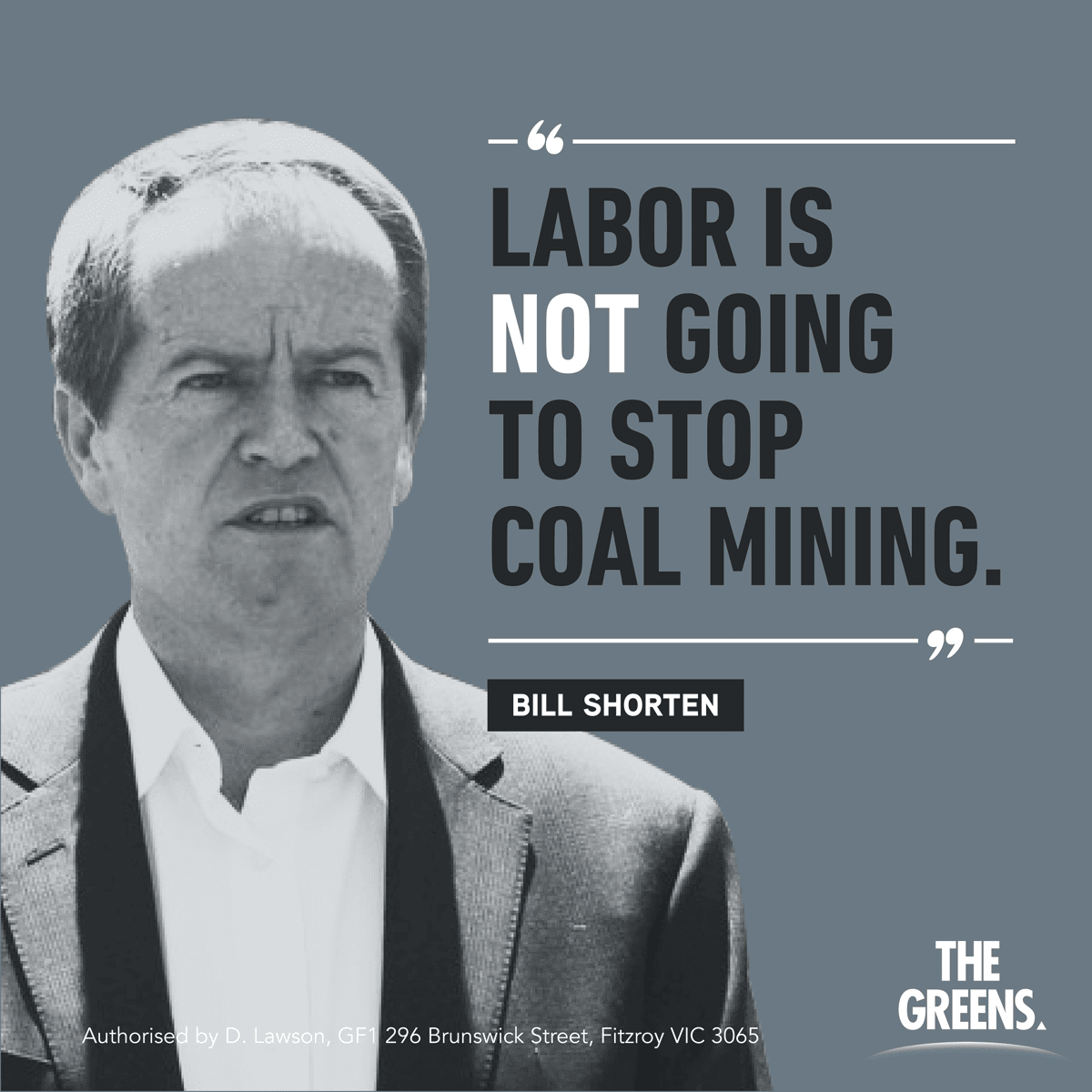
    “Labor is not going to stop coal mining.” Bill Shorten, November 2015.

    Dear Neville,

    Standing among the people of the Pacific Islands whose homes are most at risk from rising sea levels, Bill Shorten had the gall to declare “Labor is not going to stop coal mining”.By doing his part to condemn low lying island nations across the Pacific, Bill Shorten has shown that the old parties are in lockstep when it comes to taking real action on climate change. Click here to share this news with your friends and family on Facebook.

    A recent EMC poll has shown that almost twice as many Australians support a ban on all new coal mines as those opposed. This is a stark reminder of just how out of touch Bill Shorten is in refusing to support the Pacific Islands’ call for a moratorium on new coal mines. 

    Shorten: Labor is not going to stop coal mining

    Any credible plan to tackle climate change and keep global warming below 2 degrees must bring the age of coal and fossil fuels to an end.

    As the Paris climate talks approach, anything short of a commitment to ban all new coal mines would be devastating for the safety of our climate. Instead of depending on this dirty and outdated source of energy, we need to rapidly replace it with clean, renewable energy like wind and solar. The world is already moving away from coal and yet the old parties are refusing to acknowledge this reality.

    It’s clear — the old parties will not take real and meaningful action on climate change unless we force them. The Greens will continue to work to drastically cut pollution and invest in renewable energy for a safe future for people and our environment. It’s time that Labor and the Liberals listen to the vast majority of Australians who believe that climate change is happening, not their mates in the coal industry.

    Share this news with your friends on Facebook now. 

    Thanks for standing with us,

    Adam

    PS. Not on Facebook? Can you forward these email onto 5 of your friends to help us make sure people know where Bill Shorten and Labor stand when it comes to bringing the age of coal and fossil fuels to an end?