Category: News

Add your news
You can add news from your networks or groups through the website by becoming an author. Simply register as a member of the Generator, and then email Giovanni asking to become an author. He will then work with you to integrate your content into the site as effectively as possible.
Listen to the Generator News online

 
The Generator news service publishes articles on sustainable development, agriculture and energy as well as observations on current affairs. The news service is used on the weekly radio show, The Generator, as well as by a number of monthly and quarterly magazines. A podcast of the Generator news is also available.
As well as Giovanni’s articles it picks up the most pertinent articles from a range of other news services. You can publish the news feed on your website using RSS, free of charge.
 

  • US nuclear plan problem worse than thought: report


    US nuclear plant problem worse than thought: report

    LOS ANGELES — US nuclear regulators published an update on California’s troubled San Onofre power plant Thursday, sparking an expert warning that the problem is more serious than first thought.

    A reactor at the nuclear power plant near San Diego was shut down in January after a radiation leak, although the Nuclear Regulatory Commission (NRC) said there was no danger to the public.

    Investigations found unexpected erosion on tubes that carry radioactive water, and the entire plant was shut down, forcing Californian authorities to fire up alternative power generation facilities.

    On Thursday, an update on the tube erosion, posted on an obscure part of the NRC’s website, showed the situation had worsened.

    “This reveals a far greater problem than has been previously disclosed, and raises serious questions about whether it is safe to restart either unit,” said Daniel Hirsch, a nuclear expert at the University of California, Santa Cruz.

    The new data shows that more than 3,400 steam generator tubes in the new steam generators at San Onofre have been found to be damaged — about 1,800 in Unit 3 and 1,600 in Unit 2 — he said.

    “Edison had been talking about trying to get Unit 2 back on line at end of summer; now we know to do so they would have to run with a large number of damaged tubes,” Hirsch told AFP.

    A spokeswoman for operator Southern California Edison did not immediately respond to a request for comment on the new figures. The NRC did not comment on the figures, which were presented as tables.

    San Onofre produces enough energy to power 1.4 million homes, according to SCE. California’s only other nuclear reactor, at Diablo Canyon between Los Angeles and San Francisco, is run by Pacific Gas and Electric Company.

    Related articles

    AFP


    California’s troubled San Onofre power plant (AFP/File, Mark Ralston)


    Map


  • Global fight for natural resources ‘has only just begun’

    Global fight for natural resources ‘has only just begun’

    Academics and business figures gave a grim warning at the Resource 2012 conference, but defended the Rio+20 outcomes

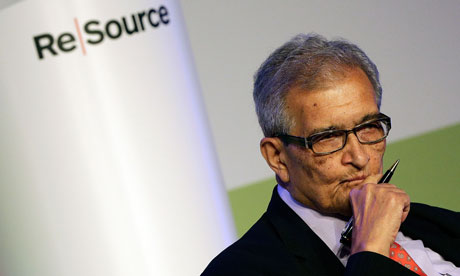
    Nobel prize-winning economist Amartya Sen at the Resource 2012 conference in Oxford

    Nobel prize-winning economist Amartya Sen told the conference that governments would need to step in, to ensure resources were best distributed. Photograph: Matthew Lloyd/Getty Images for ReSource 2012

    The global battle for natural resources – from food and water to energy and precious metals – is only beginning, and will intensify to proportions that could mean enormous upheavals for every country, leading academics and business figures told a conference in Oxford on Thursday.


    Sir David King, former chief scientific adviser to the UK government, who convened the two-day Resource 2012 conference, told the Guardian: “We are nowhere near realising the full impact of this yet. We have seen the first indications – rising food prices, pressure on water supplies, a land grab by some countries for mining rights and fertile agricultural land, and rising prices for energy and for key resources [such as] metals. But we need to do far more to deal with these problems before they become even more acute, and we are not doing enough yet.”


    Countries that are not prepared for this rapid change will soon – perhaps irrevocably – lose out, with serious damage to their economies and way of life, the conference was told.


    Amartya Sen, a Nobel prize-winning economist, said that the free market would not necessarily provide the best solution to sharing out the world’s resources. Governments would need to step in, he said, to ensure that people had access to the basics of life, and that the interests of businesses and the financial markets did not win out over more fundamental human needs.


    Sen has played a key role as an academic in showing how the way resources are distributed can impact famine and surplus more than the actual amount of resources, that are available, particularly food.


    David Nabarro, special representative for food security and nutrition at the United Nations Special, defended the outcomes of last month’s Rio+20 conference – a global summit that was intended to address resource issues and other environmental problems, including pollution, climate change and the loss of biodiversity, all of which are likely to have knock-on effects that will exacerbate resource shortages.


    Many observers criticised the governments represented at Rio+20 for failing to adopt any clear targets and initiatives on key environmental problems, saying it was a wasted opportunity.


    But Nabarro said there had been important successes – that governments had agreed to strive for the elimination of hunger and more sustainable agriculture, including an emphasis on small farmers, improvements in nutrition (in both developed and developing countries), and cutting the harmful waste of resources that is currently plaguing economies.


    Several speakers joined him in highlighting the problems of waste and inefficiency – the developed world tends to be profligate in its use of natural resources, because most western companies have in the last century experienced few limits on their ability to access raw materials in peacetime, thanks to the opening up of global trade.


    But this is rapidly changing. One of the first indications has been the soaring price of fossil fuel energy in the past decade, which has had severe economic impacts but which could easily be lessened if countries and companies took simple measures to be more energy-efficient. The failure of businesses, individuals and governments to improve their efficiency, even by relatively small amounts, has been one of the conundrums for resource economists in recent years. According to standard economic thinking, rising prices should prompt more efficiency, but this has happened at a much slower rate than should have been the case.


    If price signals are not enough to change behaviour, then other methods such as government intervention may be needed.


    Paul Kagame, the president of Rwanda, urged rich countries to work together with poor developing nations to ensure that the best was made of the natural resources, and to remedy situations where scarcity leads to human suffering.


    Businesses also joined in to discuss their efforts to use resources more sustainably. Peter Brabeck-Letmathe, the chairman of Nestlé, outlined his company’s programme to use water more efficiently. He said water was often overlooked, and considered as a free resource, but that this was a mistake – he reminded listeners that the increasing availability of clean drinking water, accompanied by better sanitation and hygiene, had been the biggest single factor behind the enormous increases in longevity of people in developed countries in the past 150 years, and the GDP growth that followed.


    Camilla Toulmin, of the International Institute for Economy and Development, said the conference should act as a primer to policymakers and politicians who have been insufficiently aware of the real issues surrounding resource constraints and the economics of waste and distribution. “This is like an Open University course that is educating people on the problems here. I hope the financiers and businesspeople go home with a clearer understanding of how important this is, and of the role they can play.”

  • Deadly storm lashes southern Japan

    Deadly storm lashes southern Japan

    Posted July 12, 2012 17:07:09

    Loading…

    Map DataMap data ©2012 AutoNavi, GIS Innovatsia, Google, Kingway, MapKing, SK M&C, Tele Atlas, ZENRINTerms of Use
    Map Data
    Map data ©2012 AutoNavi, GIS Innovatsia, Google, Kingway, MapKing, SK M&C, Tele Atlas, ZENRIN
    Map data ©2012 AutoNavi, GIS Innovatsia, Google, Kingway, MapKing, SK M&C, Tele Atlas, ZENRIN
    Map
    Map
    Satellite

    Map: Japan

    A storm has dumped 500 millimetres of rain in just eight hours in southern Japan, killing several people and forcing thousands to evacuate their homes.

    The rain pounded the island of Kyushu in Japan’s south-west, with some parts of Kumamoto prefecture copping the full brunt of the deluge.

    In the city of Aso, an 80-year-old woman was killed after being washed away, and officials say two other people have been confirmed dead in the city.

    Two women were killed after floodwaters destroyed their homes in the village of Minamiaso.

    At least five people are believed to be missing, and emergency workers say there are multiple reports of mudslides swallowing homes.

    In the city of Kikuchi, a home was swept way with a man and a woman still inside. They were later rescued.

    Fearing more landslides, officials have ordered 50,000 people to evacuate their houses.

    The heavy rains have also caused blackouts and wreaked havoc on railway services and motor traffic.

    Prime minister Yoshihiko Noda says he has received a report on the unprecedented rainfall and will take sufficient anti-disaster measures.

    The government has set up a liaison office within the crisis management centre at the prime minister’s office.

    ABC/Kyodo

    Topics:storm-disaster, storm-event, disasters-and-accidents, landslide, japan

  • Climate change scepticism could wipe out rural towns

    Climate change scepticism could wipe out rural towns

    Posted July 12, 2012 14:56:47

    A new report is warning hundreds of inland Australian towns could cease to exist by 2050 if locals do not adapt to climate change.

    The report studied 1,600 bush towns and found the ones with low education rates are least likely to make the decisions needed to adapt to a hotter future.
    But in many regional areas there is resistance to change because of lingering scepticism about climate change.
    The same scepticism means the research may not have much impact on the areas it targets.
    The report was commissioned by the Federal Government’s National Climate Change Adaptation Research Facility.
    Author Professor Andrew Beer says climate change and market forces will de-populate entire towns.
    “It’s impossible to predict because between now and 2050 is a very long time,” he told The World Today.
    “But you could easily see the loss of 10 per cent. So 160 country towns across Australia could be gone within 20 years and a further 10 per cent by 2050 – simply because of climate change and the failure to adapt to it.
    “So, many people living in a small place right now will discover that their town won’t be there in 40 years’ time.”
    Mount Gambier resident Leon Ashby disagrees.
    Mr Ashby is a spokesman for the No Carbon Tax Climate Sceptics Party, which believes that while the climate is changing, it is only minor and not due to humans.


    He says the party has 800 paid-up members, but represents an opinion that is much more widely held in rural areas.
    “I lean over the fence post, and talk to a lot of farmers and that, and I would say 80, 90 per cent would scoff at what’s happening politically when you are talking about climate change,” he said.
    “We all say ‘look, we’d love some global warming when it’s a cold day or whatever it is’.
    “All those sorts of attitudes, they’re constant right through the rural community.”
    Robert Gordon, a sheep farmer at Guyra in northern New South Wales, agrees.
    “I take on board that the experts are saying that we having a significant effect but I also take on board that there are some scientists who don’t believe that,” he said.
    “I think you’ll find that the majority of farmers are already factoring in climate change in their plans for the future.”
    Professor Beer says people in remote and Indigenous communities are particularly at risk of not adapting.
    “You need both education and you need resources to adapt to any major change, including climate change,” he said.
    “But the good news is if they begin to plan and adapt now, they can actually have a very prosperous future, and perhaps be more prosperous than they are now.”

    Topics:climate-change, rural, environment, research, australia, sa,mount-gambier-5290, guyra-2365, nsw, vic, nt, qld, wa

  • Trigger for past rapid sea level rise discovered

    Trigger for past rapid sea level rise discovered

    Posted: 11 Jul 2012 10:47 AM PDT

    The cause of rapid sea level rise in the past has been found by scientists using climate and ice sheet models. The process, named ‘saddle-collapse’, was found to be the cause of two rapid sea level rise events: The Meltwater pulse 1a (MWP1a) around 14,600 years ago and the ‘8,200 year’ event.
  • Bankers behind bars AVAAZ

    This message contains blocked images.

    Show ImagesOptions

    Dear friends,

    Big banks have been rigging the interest rates on our mortgages and student loans! They’ve finally gone too far. The EU finance regulator is bringing new laws to put bankers behind bars for these crimes but needs popular support to face down the banking lobby and bring global change — let’s get 1 million people to stand with him in the next 3 days: 

    Sign the petition

    Big banks have been caught in a massive scam to rig global interest rates, ripping off millions of people on their mortgages, student loans and more! We’d go to jail for this, but Barclays bank has only been fined, and just a fraction of their profits! Outrage is mounting — this is our chance to finally turn the tide of the banks’ reign over our democracies. 

    The EU finance regulator, Michel Barnier is standing up to the powerful bank lobbyand championing reform that would put bankers behind bars for fraud like this. If the EU goes first, accountability could quickly spread across the globe. But the banks are lobbying hard against it, and we need a massive surge of people power to drive these reforms through. 

    If we can get 1 million people to stand with Barnier in the next 3 days, it will give him momentum to face down the banking lobby and push governments to bring reform. Click below to sign, and our growing numbers will be represented by adding mock bankers to a jail right in front of the EU Parliament:

    http://www.avaaz.org/en/bankers_behind_bars_f/?bBYMjdb&v=15946

    The full scale of the scandal is still unknown, but what we know is breathtaking:“Several” unnamed major banks were involved, and the rigging of the LIBOR interest rate, the rate on which many of the world’s interest rates are based, affected the value of literally hundreds of trillions of dollars in investments. Barclays alone has admitted to committing this fraud “hundreds” of times. 

    For too long, our governments have been cowed by powerful banks who threatened to move elsewhere if challenged. For too long, banks have manipulated our market economies, tilting the playing field in their favour, and engaging in reckless risk-taking, secure in the knowledge that they could force governments to hand them our taxpayer money when they got into trouble. 

    The system is rigged, and that’s a crime. It’s time to put the criminals behind bars for it. It starts in Europe — let’s make it happen: 

    http://www.avaaz.org/en/bankers_behind_bars_f/?bBYMjdb&v=15946

    There may never have been a time in modern history when the big banks didn’t have excessive and extraordinary power that they regularly abused. But democracy is on the march — we’ve seen this march overcome tyrants across the world, and together, we’ll help end the reign of the banks as well.

    With hope,

    Ricken, Iain, Alex, Antonia, Giulia, Luis, and the entire Avaaz team

    P.S. — Last week 94,000 people joined Avaaz member David R.’s campaign against foul-play in the Mexican elections which he launched on the new Avaaz Community Petitions platform. Get support for the things you care strongly about by starting your campaign here:http://www.avaaz.org/en/petition/start_a_petition

    More information:

    FSA’s Turner Says Banks Culture One of ‘Cynical Entitlement’ (Bloomberg) 
    http://www.bloomberg.com/news/2012-07-03/fsa-s-turner-says-banks-have-culture-of-cynical-entitlement-1-.html

    Barclays Libor scandal: how can we change banking culture? (The Guardian) 
    http://www.guardian.co.uk/business/2012/jul/02/barclays-libor-scandal-change-banking-culture

    Barclays just the tip of the iceberg as banking braced for more scandals (The Guardian)
    http://www.guardian.co.uk/business/2012/jul/08/banking-scandals-barclays?intcmp=239

    The rotten heart of finance: A scandal over key interest rates is about to go global (Economist)
    http://www.economist.com/node/21558281

    Banking Reforms after the Libor scandal (Financial Times) 
    http://blogs.ft.com/martin-wolf-exchange/2012/07/02/banking-reforms-after-the-libor-scandal/#axzz1zY8LnZHS

    EU’s Barnier pushes for criminal sanctions for Libor abuse (Reuters)
    http://in.reuters.com/article/2012/07/09/idINL6E8I91PR20120709

    Barnier Seeks to Widen EU Rules to Bar Libor Manipulation (Business Week)
    http://www.businessweek.com/news/2012-07-08/barnier-seeks-to-widen-eu-market-abuse-rules-to-include-libor

    Support the Avaaz Community!
    We’re entirely funded by donations and receive no money from governments or corporations. Our dedicated team ensures even the smallest contributions go a long way.


    Avaaz.org is a 14-million-person global campaign network
    that works to ensure that the views and values of the world’s people shape global decision-making. (“Avaaz” means “voice” or “song” in many languages.) Avaaz members live in every nation of the world; our team is spread across 19 countries on 6 continents and operates in 14 languages. Learn about some of Avaaz’s biggest campaigns here, or follow us on Facebook or Twitter.

    You are getting this message because you signed “Join Avaaz!” on 2012-06-22 using the email address ngarthurslea@yahoo.com.au.
    To ensure that Avaaz messages reach your inbox, please add avaaz@avaaz.org to your address book. To change your email address, language settings, or other personal information, https://secure.avaaz.org/act/index.php?r=profile&user=8cf8652c11a852bcc536a7c1ddc00e27&lang=en, or simply go here to unsubscribe.

    To contact Avaaz, please do not reply to this email. Instead, write to us at www.avaaz.org/en/contact or call us at +1-888-922-8229 (US).