Category: News

Add your news
You can add news from your networks or groups through the website by becoming an author. Simply register as a member of the Generator, and then email Giovanni asking to become an author. He will then work with you to integrate your content into the site as effectively as possible.
Listen to the Generator News online

 
The Generator news service publishes articles on sustainable development, agriculture and energy as well as observations on current affairs. The news service is used on the weekly radio show, The Generator, as well as by a number of monthly and quarterly magazines. A podcast of the Generator news is also available.
As well as Giovanni’s articles it picks up the most pertinent articles from a range of other news services. You can publish the news feed on your website using RSS, free of charge.
 

  • Sierra Nevada 200-year megadroughts confirmed

    Sierra Nevada 200-year megadroughts confirmed

    Posted: 01 Jun 2012 09:06 AM PDT

    The culmination of a comprehensive high-tech assessment of Fallen Leaf Lake — a small moraine-bound lake at the south end of the Lake Tahoe Basin — shows that stands of pre-Medieval trees in the lake suggest the region experienced severe drought at least every 650 to 1,150 years during the mid- and late-Holocene period.
    You are subscribed to email updates from ScienceDaily: Severe Weather News
    To stop receiving these emails, you may unsubscribe now.
    Email delivery powered
  • Unmanned NASA storm sentinels set for hurricane study

    ScienceDaily: Earth Science News


    Unmanned NASA storm sentinels set for hurricane study

    Posted: 01 Jun 2012 09:34 AM PDT

    Ah, June. It marks the end of school, the start of summer … and the official start of the 2012 Atlantic hurricane season, which got off to an early start in May with the formation of Tropical Storms Alberto and Beryl. National Oceanic and Atmospheric Administration forecasters are calling for a near-normal hurricane season this year. But whether the season turns out to be wild or wimpy, understanding what makes these ferocious storms form and rapidly intensify is a continuing area of scientific research, and is the focus of the NASA-led Hurricane and Severe Storm Sentinel (HS3) airborne mission that kicks off this summer.

    Plate tectonics cannot explain dynamics of Earth and crust formation more than three billion years ago

    Posted: 01 Jun 2012 09:06 AM PDT

    The current theory of continental drift provides a good model for understanding terrestrial processes through history. However, while plate tectonics is able to successfully shed light on processes up to three billion years ago, the theory isn’t sufficient in explaining the dynamics of Earth and crust formation before that point and through to the earliest formation of planet, some 4.6 billion years ago.
    You are subscribed to email updates from ScienceDaily: Earth Science News
    To stop receiving these emails, you may unsubscribe now.
    Email delivery powered by Google
    Google Inc., 20 West Kinzie, Chicago IL USA 60610
  • Study Suggests Super-Volcano Formation to Be Faster Than Thought

    Study Suggests Super-Volcano Formation to Be Faster Than Thought
    French Tribune
    Findings of a new study have claimed that formation of super-volcanoes will not take more than 10000 years, rather it is being expected that they might be formed within the next 500 years. Previously, it was estimated that these volcanoes will take
    See all stories on this topic »

  • Scathing reef report doesn’t impress govts (Great Barrier Reef)

    Scathing reef report doesn’t impress govts

    By Patrick Caruana, AAPUpdated June 2, 2012, 4:25 pm

    A scathing UNESCO report into Australia’s management of the Great Barrier Reef has failed to prompt a strong response from either the federal or Queensland governments.

    The report, released on Saturday, warns the reef could be listed as a World Heritage site in danger unless Australia makes substantial changes to its supervision of the area.

    It says the adverse listing could go ahead if the federal government does not convince the international body it has improved its performance before February next year.

    The report urges Australia not to permit the creation of ports separate to those which already exist near the reef and asks for a strategic assessment of the entire area, implying that new developments should be held up until that report is complete.

    Queensland Premier Campbell Newman said his government was aware of the issues raised in the report but could not accommodate some of its chief recommendations.

    “We will protect the environment but we are not going to see the economic future of Queensland shut down,” Mr Newman said.

    ” … We are in the coal business. If you want decent hospitals, schools and police on the beat we all need to understand that.”

    Federal Environment Minister Tony Burke said there was not much he could do to prevent development applications already in progress.

    “I can’t take away the rights at law that applicants have when they’ve already started their approval process,” he told reporters in Sydney.

    “(But) certainly for the areas that the World Heritage Committee would be most concerned about, we’re not expecting any of those decisions to come to me before the strategic assessment work is concluded anyway.”

    Greens Senator Larissa Waters said Mr Burke’s response was inadequate.

    “The laws are clear – the minister has the power to act. He has the power to press pause while the strategic assessment is undertaken,” Senator Waters told AAP.

    “Unfortunately he lacks the will … I have been very disappointed with the lack of interest he has shown in the Great Barrier Reef.”

    Australian Conservation Foundation CEO Don Henry said the report should be a wake-up call for the federal government.

    “To have a potential `in danger’ listing hanging over the reef is a national disgrace,” he said.

    The report calls for an internationally-recognised review of the management of Gladstone Harbour, saying there are a “range of unaddressed concerns” around the approval of major liquefied natural gas (LNG) plants at nearby Curtis Island.

    Environmentalists and fishermen blame dredging in Gladstone Harbour for the area’s poor water quality and a skin disease affecting marine life.

  • Greenhouse gas levels pass symbolic 400ppm CO2 milestone

    Greenhouse gas levels pass symbolic 400ppm CO2 milestone

    Monitoring stations in the Arctic detect record levels of carbon dioxide, higher than ever above ‘safe’ 350ppm mark

    • guardian.co.uk, Friday 1 June 2012 12.50 BST
    • Big picture : Arctic ocean methane emissions

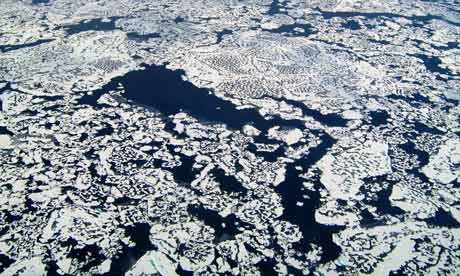
      The Arctic Ocean with leads and cracks in the ice cover of north of Alaska. Photograph: Courtesy Eric Kort/Jet Propulsion Laboratory/NASA

      The world’s air has reached what scientists call a troubling new milestone for carbon dioxide, the main global warming pollutant.

      Monitoring stations across the Arctic this spring are measuring more than 400 parts per million of the heat-trapping gas in the atmosphere. The number isn’t quite a surprise, because it’s been rising at an accelerating pace.

      Years ago, it passed the 350ppm mark that many scientists say is the highest safe level for carbon dioxide. It now stands globally at 395.

      So far, only the Arctic has reached that 400 level, but the rest of the world will follow soon.

      “The fact that it’s 400 is significant,” said Jim Butler, the global monitoring director at the National Oceanic and Atmospheric Administration’s Earth System Research Lab. “It’s just a reminder to everybody that we haven’t fixed this, and we’re still in trouble.”

      “The news today, that some stations have measured concentrations above 400ppm in the atmosphere, is further evidence that the world’s political leaders – with a few honourable exceptions – are failing catastrophically to address the climate crisis,” former vice president Al Gore, the highest-profile campaigner against global warming, said in an email. “History will not understand or forgive them.”

      Carbon dioxide is the chief greenhouse gas and stays in the atmosphere for 100 years. Some carbon dioxide is natural, mainly from decomposing dead plants and animals. Before the industrial age, levels were around 275 parts per million.

      For more than 60 years, readings have been in the 300s, except in urban areas, where levels are skewed. The burning of fossil fuels, such as coal for electricity and oil for gasoline, has caused the overwhelming bulk of the man-made increase in carbon in the air, scientists say.

      It’s been at least 800,000 years – probably more – since Earth saw carbon dioxide levels in the 400s, Butler and other climate scientists said.

      Readings are coming in at 400 and higher all over the Arctic. They’ve been recorded in Alaska, Greenland, Norway, Iceland and even Mongolia. But levels change with the seasons and will drop a bit in the summer, when plants suck up carbon dioxide, NOAA scientists said.

      So the yearly average for those northern stations likely will be lower and so will the global number.

      “It’s an important threshold,” said the Carnegie Institution ecologist Chris Field, a scientist who helps lead the Nobel Prize-winning Intergovernmental Panel on Climate Change. “It is an indication that we’re in a different world.”

      Ronald Prinn, an atmospheric sciences professor at the Massachusetts Institute of Technology, said 400 is more a psychological milestone than a scientific one. We think in hundreds, and “we’re poking our heads above 400,” he said.

      Tans said the readings show how much the Earth’s atmosphere and its climate are being affected by humans. Global carbon dioxide emissions from fossil fuels hit a record high of 34.8 billion tonnes in 2011, up 3.2%, the International Energy Agency announced last week.

      The agency said it’s becoming unlikely that the world can achieve the European goal of limiting global warming to just 2 degrees based on increasing pollution and greenhouse gas levels.

  • Bizarre scenes and shifting mood in Parliament

    Bizarre scenes and shifting mood in Parliament

    Posted June 01, 2012 07:07:51

    It could have been worse. Imagine if the actors in the bizarre scenes in the federal Parliament this week were switched; if it had been the Prime Minister running to avoid a vote and not Opposition Leader Tony Abbott.

    Imagine if Julia Gillard had taken off behind Anthony Albanese and bumped Dick Adams out of the way to get to the doors and avoid a “tainted” vote.

    That, for her, would have been the ultimate humiliation and almost certainly the end of a rocky career.

    But that’s the difference between government and opposition. Expectations on governments are higher, as they should be. Government is a serious business. Opposition, on the other hand, by definition, is more political. When judgments are flawed or tactics go wrong, nobody gets hurt.

    Not so when governments stuff up. That’s why the poor handling of the overseas workers issue matters more than a comical scene from the Parliament that seemed to fit a familiar pattern in the minds of the public anyway.

    As Geoff Kitney put it in the Financial Review, Tony Abbott was determined to have the upper hand on a principle and was prepared to look a bit “unhinged” in the process. Australians have known for years that he can be a bit whacky. It’s a character trait that was on display even during the last election campaign, and it did him no real harm.

    For a prime minister, on the other hand, a lack of judgment matters far more.

    After much internal wrangling and hand wringing, the Government has finally landed in a good place on the enterprise migration agreements. There will be oversight to ensure that the mining companies genuinely make jobs available first to qualified Australians, and that workers from overseas are not used as a source of cheap labour.

    But once again, getting there was a struggle, and the Prime Minister wasn’t able to properly articulate and argue a volatile policy issue because of poor implementation and internal politics.

    Yet despite all that, opinion polls show that the Government is doing quite well on key issues like the NBN, aged care, private health insurance and the mining tax. Even with the carbon tax, there is some encouragement for the Government depending on how the issue is presented to the voter.

    As polling expert Andrew Catsaras put it on Insiders this week, the worst thing that can happen for the Coalition is to believe it can’t lose the next election, and the worst thing that can happen for the Government is to believe it can’t win.

    And the “edge” that the Government has in those key policy areas does sustain many of the government MPs, for now.

    That and the surprising improvement in Newspoll in the past month.

    Politicians say parrot-like that an election is the only poll that counts, but this week we saw how one opinion poll can have a significant impact on the political atmospherics, in the media as well as in the parliamentary chambers. The new mood was so transparent you could photograph it.

    The mood change happened because a month ago, according to Newspoll, the primary vote gap between the two major parties was 24 points (51 per cent to 27 per cent.) Now it’s 14 points (46 per cent to 32 per cent.) Likewise with the two party preferred vote; a month ago the gap was 18 points (59 per cent to 41 per cent), now it’s 8 points (54 per cent to 46 per cent).

    The new figures immediately took some of the pressure off Julia Gillard and caused some introspection on the part of the Coalition about their aggressiveness.

    Tony Abbott uncharacteristically at a doorstop interview even tried to deflect attention from Newspoll, a poll that has served him so well, by referring the media to other polls out this week that were not as encouraging for Labor.

    The situation, nevertheless, is still grim for Labor. The figures defy political history. Traditionally, governments – the incumbents – have an advantage, particularly when the economy is strong, and sometimes even when it is not. Right now, it is apparently anything but the economy, in the minds of the electorate.

    Even with the three key indicators – unemployment, official interest rates and inflation – all below 5 per cent (and that hasn’t happened for 40 years) Labor still trails badly.

    Worse for Labor, they face an 8 per cent deficit in the polls even though Tony Abbott has a disapproval rating of 60 per cent and threatens to be the most unpopular opposition leader ever to be elevated to the prime ministership.

    But as Abbott warned his party room this week, Gillard will not give up without a fight, in spite of all the difficulties inherent in a minority government.

    The election could be 15 to 18 months away, and the Government is at 46 per cent two-party preferred.

    In 1993, Paul Keating’s government was at 46.5 per cent just five weeks out from an election and won. In 2001, John Howard’s government was at 56.5 per cent five weeks out and polled just 51 per cent at the election. In 2004, the Howard government was at 47.5 per cent three weeks out and won. In 2010, Julia Gillard’s government was at 52 per cent three weeks out and just fell in on the day.

    Big late swings can and have happened, and the electorate has never been more volatile and less rusted on to the major parties as it is now.

    The Coalition has a big lead and for all we know the electorate may have stopped listening to Julia Gillard and her government.

    But on the other hand, despite the hubris at some levels in the Coalition, and the constant references to state elections in NSW and Queensland, Tony Abbott is no Campbell Newman. The entire state of Queensland was interested in Newman and ultimately ready to embrace him. That is true of Abbott in only parts of Australia.

    There is a long way to go and lots of issues and events yet to be traversed. Both sides would be well served heeding Andrew Catsaras’ advice. The Coalition should avoid over confidence, and the Labor Party, despondency.

    Barrie Cassidy is the presenter of ABC programs Insiders and Offsiders. View his full profile here.

    Topics:federal-parliament, federal-government