| Vicious Volcanoes Around the World CTV.ca Whether they’re erupting lava, exploding or throwing ash sky high, volcanoes are a sight to be seen. CTVNews.ca looks at 10 of the world’s most violent volcanoes of the past two decades. AP Photos / CTVNews.ca Popocatepetl is one of Mexico’s most … See all stories on this topic » |
||
| USGS opens volcano observatory The Almanac Online The US Geological Survey, however, also thinks “volcanoes.” CalVO, their new volcano observatory, opened Feb. 9 at the Menlo Park branch of the USGS. The list of volcanoes currently on CalVO’s watch list includes Mount Shasta, Medicine Lake Volcano, … See all stories on this topic » |
||
| Terrible Noise — Volcano as imagery is apt Yakima Herald-Republic One I am drawn to is songs about volcanoes. And books. And movies, though I will say right here that in my experience, the only good film ever made about a volcano is “Return of the King,” and that’s going a little off-message. See all stories on this topic » |
||
|
||
|
||
| UW geologist becomes National Geographic Explorer Casper Star-Tribune Online He walks into smoldering volcanoes, through war zones and takes samples from Earth’s most remote freezing places. Sims is equal parts scientist and explorer. He doesn’t go into the field simply for the adventure. He also doesn’t propose a project … See all stories on this topic » |
||
| Scientists discover reason Mt. Hood tends to be quiet Albany Democrat Herald CORVALLIS — For a half-million years, Mount Hood has towered over the landscape, but unlike some of its cousins in Oregon’s Cascade Mountains and many other volcanoes around the Pacific “Rim of Fire,” it doesn’t have a history of large, … See all stories on this topic » |
Category: News
Add your news
You can add news from your networks or groups through the website by becoming an author. Simply register as a member of the Generator, and then email Giovanni asking to become an author. He will then work with you to integrate your content into the site as effectively as possible.
Listen to the Generator News online
The Generator news service publishes articles on sustainable development, agriculture and energy as well as observations on current affairs. The news service is used on the weekly radio show, The Generator, as well as by a number of monthly and quarterly magazines. A podcast of the Generator news is also available.
As well as Giovanni’s articles it picks up the most pertinent articles from a range of other news services. You can publish the news feed on your website using RSS, free of charge.
-
More on Volcanoes
-
Catastrophic flood could sink Sydney suburbs
Catastrophic flood could sink Sydney suburbs
Updated
As Queensland carries out an inquiry into deadly flooding in that state, the spotlight has turned to other parts of Australia and how well they would be prepared for a catastrophic flood.
The Hawkesbury Nepean Valley in Sydney’s outer suburbs has a history of massive floods, and while there has not been a big one for more than a century, plans are in place for such an event.
The suburbs of Penrith and Emu Plains straddle the high banks of the Nepean River in what is a typical picture of Australian suburbia – lots of brick houses, probably built around the 1960s and ’70s.
But up to 70,000 people would have to be evacuated if a major flood was to hit the area.
The suburbs sit in a flood plain, and if a flood like the one which hit in 1867 was to occur, the whole area could go under.
Newspaper reports from the time describe an inland sea that destroyed houses, farms and crops and killed at least 13 people. The town of Windsor, downstream from Emu Plains, was submerged.
The enormous body of water rushing down with relentless force on its way to the sea could not be easily described, nor its effects conceived.
About the neighbourhood of Windsor, now that the waters are fast subsiding, the scene is most dreary, and the destruction caused becomes every day more apparent.
The feeling of bitter anguish expressed not in words but in the blank look of utter despair would move the most hardened.
John Thomas Smith, Sydney Morning Herald, July 2, 1867Steven Molino is principal of Molino Stewart, an environment and natural hazards consultancy that has been working on flood plain management for 20 years.
“The 1867 flood was around 19.5 metres here. So all of these houses would be flooded at least to the eaves, if not higher, in a repeat of the 1867 flood,” he said.
He says a major flood today would probably destroy many houses in Emu Plains.
‘Hard to comprehend’
Steve Opper, director of community safety with the State Emergency Service, says the Hawkesbury Nepean Valley has a unique shape that can lead to catastrophic flooding.
“The Hawkesbury Nepean Valley is throttled down by a narrow gorge down near what’s called Sackville, which is just upstream of Wiseman’s Ferry,” he said.
“The result of that is that the water can flow into the top of the system very, very rapidly, can’t get out, and so you get very dramatic rises in the level of the river.
“So normal river level might be two metres; if you’re at the town of Windsor and in the most extreme thought possible, that could rise up to 26 metres, which is a number that’s quite hard to comprehend.”
That is seven metres higher than the 1867 flood which submerged the valley.
Even if the 1867 flood was repeated, tens of thousands of people would have to be moved.
Mr Opper has designed the evacuation plan for the valley.
“Our contingency planning for evacuation for that valley indicates that we would have to evacuate between 40,000 and 70,000 people just depending on the level of flooding that we’re expecting,” he said.
“It’s a very large number; it would no doubt be probably the largest evacuation of its kind in New South Wales.”
Fatal depths
Alan Ashworth’s house in Emu Plains overlooks the Nepean River and is in the firing line. It is a double-storey house set high on his block and seems way above the level of the river below.
But the historic record shows his house could be flooded.
Mr Ashworth says he does not have a detailed flood plan.
“Basically anything downstairs you’d move upstairs. By the time we get water on this section of the road, basically you’ve lost Richmond, Windsor and all that,” he said.
Even so, Mr Opper says moving everything upstairs may not be good enough.
“The difference with this valley is that if people stay there, then the depths the water could get to are almost certainly fatal,” he said.
“And so you can’t even take an option of saying well, maybe if people don’t get out it’ll be OK because they’ll be able to survive in their house; that’s just not an option in this valley.”
Because of this, a spillway has been built on the Warragamba Dam upstream from the river and roads have been built and upgraded to help with the evacuation.
These measures will help, but when a big flood comes – and the odds say it will – it will not be stopped.
Mr Molino says the 1867 flood had about a one-in-200 chance of occurrence.
“It can happen. And we have sedimentary evidence from the gorge upstream of Penrith that there’s been at least one, if not more floods as large as or larger than a one-in-500 flood in this valley,” he said.
“Elsewhere in the country we’ve had floods of that probability.
“These things do happen. They don’t always happen where there’s people or houses, but when they do we have a major catastrophe.”
This report is the first of a two-part look at Australia’s flood planning.
On ABC Radio’s PM on Thursday, David Mark will look more broadly at how well Australia is prepared for flooding and the battle between development and nature.
Topics:disasters-and-accidents, floods, emu-plains-2750, nsw, penrith-2750
First posted
-
WORLD OCEAN CURRENTS
WITH ICEMELT AND SEA-LEVEL RISE THESE CURRENTS WILL LIKELY ALTER AND SEA- LEVEL RISES MAY NOT BE UNIFORM. OCEANOGRAPHY IS FASCINATING. NOTE THE CURRENTS OFF THE QUEENSLAND COAST, WHICH WILL AFFECT OUR EASTERN COASTLINE AS SEA-LEVEL RISES
Ocean current
From Wikipedia, the free encyclopediaThis article is about ocean currents. For other uses, see Current (disambiguation).

The ocean currents

Distinctive white lines trace the flow of surface currents around the world
An ocean current is a continuous, directed movement of ocean water generated by the forces acting upon this mean flow, such as breaking waves, wind, Coriolis effect, cabbeling, temperature and salinity differences and tides caused by the gravitational pull of the Moon and the Sun. Depth contours, shoreline configurations and interaction with other currents influence a current’s direction and strength.
Ocean currents can flow for great distances, and together they create the great flow of the global conveyor belt which plays a dominant part in determining the climate of many of the Earth’s regions. Perhaps the most striking example is the Gulf Stream, which makes northwest Europe much more temperate than any other region at the same latitude. Another example is the Hawaiian Islands, where the climate is cooler (sub-tropical) than the tropical latitudes in which they are located, due to the effect of the California Current.
Contents
[hide]
[edit] Function
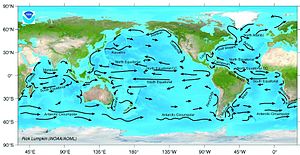
Major ocean surface currents, (Source: NOAA)

Device to record ocean currents
Surface ocean currents are generally wind-driven and develop their typical clockwise spirals in the northern hemisphere and counter-clockwise rotation in the southern hemisphere because of the imposed wind stresses. In wind-driven currents, the Ekman spiral effect results in the currents flowing at an angle to the driving winds. The areas of surface ocean currents move somewhat with the seasons; this is most notable in equatorial currents.
Ocean basins generally have a non-symmetric surface current, in that the eastern equatorward-flowing branch is broad and diffuse whereas the western poleward-flowing branch is very narrow. These western boundary currents (of which the gulf stream is an example) are a consequence of basic fluid dynamics.
Deep ocean currents are driven by density and temperature gradients. Thermohaline circulation, also known as the ocean’s conveyor belt, refers to the deep ocean density-driven ocean basin currents. These currents, which flow under the surface of the ocean and are thus hidden from immediate detection, are called submarine rivers. These are currently being researched using a fleet of underwater robots called Argo. Upwelling and downwelling areas in the oceans are areas where significant vertical movement of ocean water is observed.
Surface currents make up about 10% of all the water in the ocean. Surface currents are generally restricted to the upper 400 m (1,300 ft) of the ocean. The movement of deep water in the ocean basins is by density driven forces and gravity. The density difference is a function of different temperatures and salinity. Deep waters sink into the deep ocean basins at high latitudes where the temperatures are cold enough to cause the density to increase.
Ocean currents are measured in Sverdrup (Sv), where 1Sv is equivalent to a volume flow rate of 1,000,000 m3 (35,000,000 cu ft) per second.
[edit] Importance

A 1943 map of the world’s ocean currents.
Knowledge of surface ocean currents is essential in reducing costs of shipping, since they reduce fuel costs. In the sail-ship era knowledge was even more essential. A good example of this is the Agulhas current, which long prevented Portuguese sailors from reaching India. Even today, the round-the-world sailing competitors employ surface currents to their benefit. Ocean currents are also very important in the dispersal of many life forms. An example is the life-cycle of the European Eel.
Ocean currents are important in the study of marine debris, and vice versa. These currents also affect temperatures throughout the world. For example, the current that brings warm water up the north Atlantic to northwest Europe stops ice from forming by the shores, which would block ships from entering and exiting ports.
[edit] OSCAR: Near-realtime global ocean surface current data set
The OSCAR near-realtime global ocean circulation data set is based on NOAA and NASA satellite data (sea level altimetry, surface vector winds, and SST). The data set extends from 1993–present and is available at 1-degree and 1/3-degree resolution. The OSCAR data are continuously updated on an interactive website from which users can create customized graphics and download the data. A section of the website provides validation studies in the form of graphics comparing OSCAR data with moored buoys and global drifters.
OSCAR data are used extensively in climate studies. Monthly maps and anomalies have been published in the monthly Climate Diagnostic Bulletin since 2001, and are used routinely to monitor ENSO and to test prediction models. OSCAR currents are routinely used to evaluate the surface currents in Global Circulation Models (GCMs), for example in NCEP Global Ocean Data Assimilation System (GODAS) and European Centre for Medium-Range Weather Forecasts (ECMWF). Data and relevant publications and references are available on the OSCAR website.
[edit] See also
-
Donations shake-up passes NSW Parliament
This is long overdue.
Donations shake-up passes NSW Parliament
Posted
Trade unions are considering a High Court challenge to electoral funding laws passed by the New South Wales Parliament late last night.
The legislation passed the state’s Upper House just after midnight.
Under the laws only individuals will be permitted to make donations to political parties, with a cap of $5,000 a year.
Donations from trade unions, corporations and lobby groups will be banned.
Premier Barry O’Farrell says the changes will help clean up state politics.
“There’s now a level playing field for all parties, for all candidates. It’s a fair electoral system,” he said.
“Ultimately this is about putting power in the hands of individuals. That can’t be a bad thing.
“What I’m particularly pleased about is this has ended once and for all the donations for decisions culture that grew up under the former Labor government.
But Unions New South Wales secretary Mark Lennon says the changes are unfair and unworkable.
“We cannot let this legislation stand without having it challenged in the High Court,” Mr Lennon said.
“This is a real travesty for democracy in New South Wales.
“The Government talks about and the Premier talks about having a balanced political system. This is no way balanced.
“This is a system that will now favour the wealthy and ensure that working people can’t have an effective political voice.”
The Premier says he is not concerned by the legal threat, and the laws will come into force before the end of the month.
“The advice we have from the drafters of the legislation is that these laws will withstand legal challenge,” Mr O’Farrell said.
The Opposition has also condemned the changes, but much of Labor’s anger has been focused on the Greens for supporting the legislation in the Upper House.
Opposition spokesman Steve Whan says it is a blatant attack on Labor.
“It’s unprecedented to see a government in Australia which uses its majority in the Parliament to target and attempt to destroy its political opposition,” Mr Whan said.
“I think most people would be worried by a government that’s willing to do that and certainly be worried by the fact that the Greens have simply rolled over and agreed with the Government.”
Greens MP John Kaye has defended the party’s decision to support the legislation.
“The rivers of cash from corporations, from unions, from other organisations that have flowed in the past into political parties came to an end at about 10 past 12 this morning in the New South Wales Upper House. This is a big step forward for politics in New South Wales,” Dr Kaye said.
“The ability of unions to pool their money into a single campaign has been protected. They will not be able to give money to the Labor Party or any other political party, but that is part of cleaning up politics in New South Wales.”
Topics:states-and-territories, unions, activism-and-lobbying, state-parliament, sydney-2000
-
Research on Volcanoes
Exploring Eruptions: Research on Volcanoes Could One Day Help Save Lives
Michigan Tech News
By Dana Yates John Lyons near a microseismicity station located below Antisana volcano, in Ecuador. Cara Shonsey photo Geology takes the long view. It is a field, after all, in which the pace of change spans billions of years.
See all stories on this topic »
Michigan Tech NewsMount Hood eruption ‘style’ studied
UPI.com
Studies show the volcano has never experienced an explosive eruption exhibited by other volcanoes in Oregon, Washington and across the Pacific “ring of fire” despite having similar chemical magma composition and gas content, a university release said …
See all stories on this topic »Dr. Shanaka de Silva Answers Your Questions About Supervolcanoes, Uturuncu and …
Wired News
Are so called ‘supervolcanoes’ regular strato/shield volcanoes before their first major eruption? Dr. de Silva: These are great questions that deal with something very close to my heart which is the critical importance of heat delivery to a volcanic …
See all stories on this topic »Weatherman Sean Batty finds out more about the Icelandic climate
stv.tv
The STV weatherman travelled to Iceland to find out how Icelandic volcanoes affect the climate and weather. Scotland is well known for being a cold, wet and windy country, with an unpredictable climate that can go from being sunny one minute to pouring …
See all stories on this topic »
stv.tvUnknown volcanes caused the Little Ice Age
Canada Free Press
Now, a new computer “study” announced that volcanoes caused the Little Ice Age! A research team led by Gifford Miller of the University of Colorado says eruptions of four volcanoes just before AD 1300 spewed huge amounts of sulphates into the air, …
See all stories on this topic »Hawaii’s volcanic gases spur renewed disaster declaration for the agriculture …
Live Insurance News
The state is well known for its many volcanoes, which have become an attraction for tourists around the world. While the volcanoes are famously beautiful and awe inspiring, they are also the source of dangerous emissions that can kill plant life and …
See all stories on this topic »
Live Insurance NewsExploring the myths of the Yellowstone supervolcano
High Country News (blog)
Nor did the earthquake swarm indicate a potential volcano eruption. In fact, earthquake swarms are common in the park. They have occurred as recently as January 2010, when the northwestern edge of the Yellowstone Caldera started to experience what …
See all stories on this topic »
This once a day Google Alert is brought to you by Google.
-
Scientists say global warming changes currents
Scientists say global warming changes currents
Posted
A team of scientists has found a trend in ocean currents moving either north or south around the world. The scientists say the water in the currents is warming at a faster rate than the rest of the oceans, and they believe global warming is to blame. Their work is being published in the journal Nature Climate Change.
Source: The World Today | Duration: 3min 26sec


3.png)


