Category: News

Add your news
You can add news from your networks or groups through the website by becoming an author. Simply register as a member of the Generator, and then email Giovanni asking to become an author. He will then work with you to integrate your content into the site as effectively as possible.
Listen to the Generator News online

 
The Generator news service publishes articles on sustainable development, agriculture and energy as well as observations on current affairs. The news service is used on the weekly radio show, The Generator, as well as by a number of monthly and quarterly magazines. A podcast of the Generator news is also available.
As well as Giovanni’s articles it picks up the most pertinent articles from a range of other news services. You can publish the news feed on your website using RSS, free of charge.
 

  • Climate deal loopholes ‘Make farce’ of rich nations’ pledges


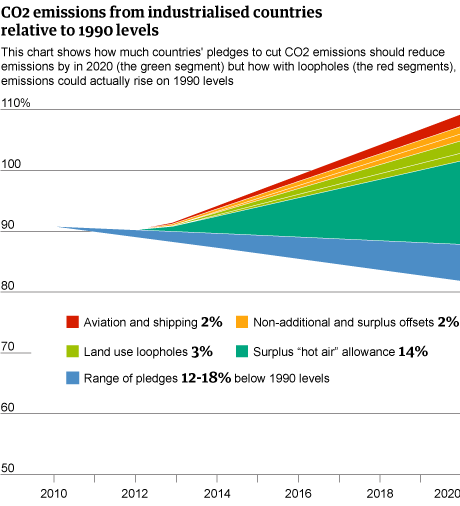
    The research factored in four separate loopholes that are known to exist, but which countries have so far failed to address in the negotiations. These include land use and forestry credits, carbon offset credits gained from UN Clean Development Mechanism schemes, surplus carbon allowances accumulated by former Soviet countries and international aviation and shipping emissions, which are not currently included in emission reduction schemes proposed by countries.

    “Industrialised countries pledged a modest reduction in their emissions at the Copenhagen talks last year, but the these loopholes would actually allow them to grow them substantially well into the future,” said Sivan Kartha, senior scientist at the Stockholm Institute.

    “This means they [rich nations] need not do anything to hold emissions. They could accumulate huge amounts of credits to continue business as usual,” he said.

    “The more we look into the loopholes the worse it gets. The whole thing begins to look like a farce”, said Lim Li Lin, a legal specialist with TWN.

    In a separate submission to governments, Pablo Solon, Bolivia’s ambassador to the UN, claimed that industrialised countries were filling all the available atmosphere with carbon pollution, and preventing poor countries from developing. Solon quoted peer-reviewed research by leading Nasa scientist Jim Hansen and the German government’s Advisory Council on Global Change which, he said, showed that the world had a “budget” of 750 gigatonnes of CO2 over the next 40 years if it sought a 66% chance of holding temperature rises to under 2C. The world had a smaller budget of just 420GT of CO2 if it wanted to stay below 1.5C, as more than 100 countries have so far demanded.

    “With the current pledges on the table, we have calculated that the Annex 1 (industrialised) nations are going to spend the whole [carbon] budget of the next 40 years in the next 10 years,” Solon said. “What is on the table has no relation to any target that [rich countries] have established. It is like a salary. If you spend it all in the first week then you have nothing left for the rest of the month.”

    “Copenhagen demonstrated disastrously low levels of ambition and rich countries are trying shamelessly to wriggle out of even the weak commitments they have made,” said Asad Rehman, international climate change campaigner at Friends of the Earth. “The science is clear. Developed countries must stop trying to hide behind technicalities hidden in the negotiations,” he said.

    CO2CHART.gif


  • Abbott to mobilise older workers


    “We have already got a series of targeted measures out there to assist older workers, including in our last budget a very substantial work bonus for many elderly people who are on the pension and want to go to work,” he said.

    “When it comes to the pension we put in that very significant increase in the base rate of the pension last year to support senior Australians.”

    Last night Mr Swan told Lateline that the Government was proud of its economic record and was in a position to implement reform if re-elected because of its stewardship throughout the economic crisis.

    But Opposition finance spokesmen Andrew Robb told ABC News 24 that Australia only emerged from the global financial crisis unscathed because of the economic conditions engineered by the Howard government.

    Both party leaders will be campaigning in the battleground state of Queensland today.

    Mr Abbott will be in Brisbane while Ms Gillard heads north to Cairns.

    Tags: community-and-society, government-and-politics, elections, federal-government, older-people, work, abbott-tony, federal-elections, australia, qld, brisbane-4000

    First posted 5 hours 48 minutes ago

  • Gillard to fast-track baby bonus


    “Families know what it’s like to come up against an unexpected problem,” Ms Gillard said as she announced the details of the plan during a campaign press stop in the northern Queensland city of Cairns.

    “Families know what it’s like to have these costs come into the family budget.”

    Ms Gillard said the initiative would cost $54 million over four years, to be offset by savings in other areas.

    Opposition Leader Tony Abbott is also campaigning in Queensland today and will use an appearance in Brisbane to announce plans to pay companies incentives to take on older workers.

    Tags: community-and-society, family-and-children, government-and-politics, elections, federal-government, federal-elections, australia, qld, cairns-4870

    First posted 52 minutes ago

  • Polls show Labor is struggling- but read them with care.


    The Nielsen poll, taken last week, was the strongest for the Coalition on the two-party vote at 52-48. On a weighted average, Labor was on a primary vote of 37.5 per cent in the four polls. In normal circumstances, it needs a higher primary vote than this to win. The Coalition vote was 43.8 per cent, while the Greens were on 12 per cent.

    Since Julia Gillard announced her proposal for a citizens’ assembly on climate change on July 23, Labor’s two-party vote has dropped 5 points in Newspoll (55 per cent to 50 per cent over two polls) and 6 points in Nielsen (54 per cent to 48 per cent in one poll). Galaxy went up 2 points, and then down 2 points, to end at 50-50. Morgan dropped 2.5 points to 53 per cent two-party for Labor.

    The polls tell us Labor is in trouble, as does Ms Gillard’s reaction. They don’t tell us Labor will lose. They must be read with two big qualifications. First, they give us a snapshot of people’s opinions when the pollsters ask the question. Up to 20 per cent of voters aren’t strongly committed to their current voting intention – some will shift before they actually get to vote.

    Second, and very important, the swing in these polls is a national average. It conceals big differences between different parts of the country, and even between different seats within the same area. These varied swings determine where seats fall or hold. It is possible (as in 1998) for a government to survive on a minority popular vote.

    Source: The Age

  • Obama must take a lead on climate change and soon


    Changing the world’s energy and agricultural systems is no small matter. It is not enough to just wave our hands and declare that climate change is an emergency. We need a practical strategy for overhauling two economic sectors that stand at the centre of the global economy and involve the entire world’s population.


    The second major challenge in addressing climate change is the complexity of the science itself. Today’s understanding of earth’s climate and the human-induced component of climate change is the result of extremely difficult scientific work involving many thousands of scientists in all parts of the world. This scientific understanding is incomplete, and there remain significant uncertainties about the precise magnitudes, timing, and dangers of climate change.


    The general public naturally has a hard time grappling with this complexity and uncertainty, especially since the changes in climate are occurring over a timetable of decades and centuries, rather than months and years. Moreover, year-to-year and even decade-to-decade natural variations in climate are intermixed with human-induced climate change, making it even more difficult to target damaging behaviour.


    This has given rise to a third problem in addressing climate change, which stems from a combination of the economic implications of the issue and the uncertainty that surrounds it. This is reflected in the brutal, destructive campaign against climate science by powerful vested interests and ideologues, apparently aimed at creating an atmosphere of ignorance and confusion.


    The Wall Street Journal, for example, America’s leading business newspaper, has run an aggressive editorial campaign against climate science for decades. The individuals involved in this campaign are not only scientifically uninformed, but show absolutely no interest in becoming better informed. They have turned down repeated offers by climate scientists to meet and conduct serious discussions about the issues.


    Major oil companies and other big corporate interests are also playing this game, and have financed disreputable PR campaigns against climate science. Their general approach is to exaggerate the uncertainties of climate science and to leave the impression that climate scientists are engaged in some kind of conspiracy to frighten the public. It is an absurd charge, but absurd charges can gather public support if presented in a slick, well-funded format.


    If we add up these three factors – the enormous economic challenge of reducing greenhouse gases, the complexity of climate science, and deliberate campaigns to confuse the public and discredit the science – we arrive at the fourth and overarching problem: US politicians’ unwillingness or inability to formulate a sensible climate-change policy.


    The US bears disproportionate responsibility for inaction on climate change, because it was long the world’s largest emitter of greenhouse gases, until last year, when China overtook it. Even today, per capita US emissions are more than four times higher than China’s. Yet, despite America’s central role in global emissions, the US Senate has done nothing about climate change since ratifying the UN climate change treaty 16 years ago.


    When Barack Obama was elected US president, there was hope for progress. Yet, while it is clear that Obama would like to move forward on the issue, so far he has pursued a failed strategy of negotiating with senators and key industries to try to forge an agreement. Yet the special interest groups have dominated the process, and Obama has failed to make any headway.


    The Obama administration should have tried – and should still try – an alternative approach. Instead of negotiating with vested interests in the back rooms of the White House and Congress, the president should present a coherent plan to the American people. He should propose a sound strategy over the next 20 years for reducing America’s dependence on fossil fuels, converting to electric vehicles, and expanding non-carbon energy sources such as solar and wind power. He could then present an estimated price tag for phasing in these changes over time, and demonstrate that the costs would be modest compared to the enormous benefits.


    Strangely, despite being a candidate of change, Obama has not taken the approach of presenting real plans of action for change. His administration is trapped more and more in the paralysing grip of special-interest groups. Whether this is an intended outcome, so that Obama and his party can continue to mobilise large campaign contributions, or the result of poor decision-making is difficult to determine – and may reflect a bit of both.


    What is clear is that we are courting disaster as a result. Nature doesn’t care about our political machinations. And nature is telling us that our current economic model is dangerous and self-defeating. Unless we find some real global leadership in the next few years, we will learn that lesson in the hardest ways possible.


    • Jeffrey D. Sachs is professor of economics and director of the Earth Institute at Columbia university. He is also pecial adviser to UN secretary-general on the millennium development goals. There is a podcast of this commentary.


    Copyright: Project Syndicate, 2010.
  • Gillard questioned on citizens’ assembly leak


    When questioned on the AFR report on the campaign trail in western Sydney today, Ms Gillard did not directly answer the claim.

    “I am proud to say that I have been working with my Cabinet colleagues in the lead-up to the election campaign,” she said.

    “We have had extensive discussions in Cabinet about climate change, about getting a deep and lasting community consensus for change.”

    Ms Gillard also faced questions over whether she breached Cabinet rules by allowing an adviser to take notes in the National Security Committee of Cabinet in her absence.

    She said all documents were dealt with appropriately.

    Earlier, Ms Gillard vowed to take control of Labor’s faltering election campaign, declaring she would “throw out the rule book” and show Australians who she really is.

    The Prime Minister’s change in campaign tactics came as today’s Newspoll in The Australian newspaper put Labor and the Coalition neck and neck at 50 per cent on a two-party preferred basis.

    Opposition Leader Tony Abbott seized on Ms Gillard’s words as evidence that the “faceless” factions are running Labor.

    Speaking from Cairns, where he announced a $90m package for the tourism industry, Mr Abbott demanded the “real Julia” stand up.

    “What have we been seeing for the last five weeks if it’s not the real Julia Gillard?” he said.

    “It was the faceless men that put the Prime Minister into office. It was the faceless men who were running her campaign.”

    Tags: climate-change, government-and-politics, elections, federal-government, gillard-julia, abbott-tony, federal-elections, australia