She didn’t, of course, but such is Bernarditas’s reputation as a “dragon woman” in the epic UN climate talks which should conclude next month in Copenhagen that if she had, no one (least of all the US and British governments who seem to fear and loathe her) would have been too surprised.
In the outwardly polite yet vicious world of UN climate change diplomacy, where negotiators use every trick to further national interests and where battles rage over commas, colons and semi-colons, Bernarditas is seen by most poor countries as a heroic defender of their rights. But most rich countries paint her as a machiavellian, Soviet-style hardliner holding back an agreement to save the world.
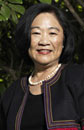 Bernarditas de Castro Muller. Photograph: Gian Paul Lozza
Bernarditas is officially an environment adviser to the Filipino government, and lead negotiator and co-ordinator of the 130 developing countries in the umbrella group known as the G77 plus China. She negotiates in what is called “the ad hoc working group on long-term co-operative action (AWG-LCA) process under the Bali action plan”. In short, she represents the interests of nearly two-thirds of the poorest people of the world in the climate talks.
It’s her job – along with a few other G77 negotiators – to keep together the traditionally squabbling poor nations at least until the major power blocks like the US and EU inevitably split and outmanoeuvre them. She must wrest the best possible financial deal for them by insisting that the rich countries commit to deep CO2 cuts. She is a pivotal figure in the talks, a lightning rod for western distrust and for southern hopes.
But this sweaty Bangkok morning has started badly. Manila, the capital of the Philippines, 1,000 miles east, is literally under water following back-to-back typhoons and floods, and in the last few days there have also been a tsunami in Samoa and an earthquake claiming over 1,000 lives in Sumatra. Moreover, the climate talks on which UN secretary general Ban Ki-moon has said “the future of this entire humanity” depends are deadlocked.
Environmentalists say the series of disasters should concentrate minds, but with just six full negotiating days before world leaders join the final conference of the parties in Copenhagen, the diplomats of 181 countries present in Bangkok have failed to agree on the big issues: what carbon cuts rich countries should make, how much money the poor should get to help them adapt to climate change, and where that money should come from. A draft text has been hacked down by negotiators from 250-odd pages to half that, leaving the UN bureaucracy optimistic – but everyone knows it has been painfully slow.
In these talks nobody moves until everybody moves, so most of the big issues will now only be resolved by politicians in late-night horse-trading sessions at very end of next month’s talks in Copenhagen. But right now in Bangkok another matter is brewing that threatens to derail the negotiations and which illustrates the immense gulf that exists between rich and poor countries.
The UN’s Kyoto protocol, which has been signed by 184 countries and commits all the word’s rich nations except the US to cut emissions, is the base of the present talks, but it has just come under massive attack. The US negotiating team, led by the bearded former climate thinktank scientist Jonathan Pershing, is playing traditional hardball diplomacy, stating categorically that it will not join Kyoto. There’s nothing new in US intransigence on climate change, but in a dramatic development, Europe and Australia have just sided for the first time publicly with the US, arguing that the Kyoto treaty should now be ditched in favour of a new one to get the Americans on board.
The poor, represented mostly by the G77 and China, are outraged. Why should the whole world change, they ask, just to accommodate the US? This Bangkok meeting should have been spent negotiating how far rich countries were prepared to cut emissions after 2012; instead countries like India and China have been told they, too, must all come up with quantifiable plans to cut their emissions – something not agreed before – and the rich seem to be ducking their commitments.
If the climate talks are a game of diplomatic chess, the rich countries have just moved their white queen into the back row of the developing countries’ territory. But have they underestimated the reaction this will get? Can the G77 and China now gain diplomatic advantage? Are the industrialised countries threatening the talks by wanting it all their own way? Or will their bold move lead to a genuinely global agreement?
Bernarditas, who insists she does not represent the views of the G77, is appalled. For her, the US and EU are not just illegally abandoning an international treaty but they are now jeopardising the credibility of international law and the UN system itself. She is contemptuous. “Do the rich countries have any sense of life in the least-developed countries?” she asks. “I doubt it.”
“I say, aren’t we all in this world together? Didn’t we all sign this?” she says to a small audience in the UN coffee bar that morning, brandishing a well-thumbed copy of the 20-page Kyoto treaty.
She turns to page 7 where she has underlined paragraphs: “Look!” she says, jabbing the text with her index finger. “Article 4. It says ‘shall’. That is legally binding. There are obligations here. The words are not there by chance. And there’s the word ‘fully’. We spent hours on that word. We agreed on it. Are they saying it no longer applies? These are very serious negotiations. The Kyoto protocol is not a statement from a high-level meeting when they [politicians] go ‘blah blah’. They are not bound by that. Here they are bound. It’s law! Why do they now want to kill Kyoto? A new agreement means we will have to go through ratification all over again. How long will that take? What if you do not ratify? What are we left with? If you throw this away…? Every word in it means something important because it binds us to legal obligations.”
To negotiate successfully at this level means you must understand your opponents and are able to argue all night. Bernarditas does that, but friend and foe say she has a special advantage because she is not only a stickler for detail but she knows the UN climate change convention and the Kyoto protocol word for word. And because her negotiating days go back to the Rio Earth summit in 1992 when the first climate change treaty was signed, woe betide any young pup of a rich country negotiator who strays from the precise words.
“She is the protector of the convention,” says a colleague (in the world of diplomacy no one wants to be identified). “I’d hate to negotiate against her. She reminds me of Humpty Dumpty when he said to Alice, ‘When I use a word it means just what I choose it to mean – neither more nor less.’ “
A western friend, who also asks not to be named, says: “She is used by the G77 and China as the bad cop, the experienced negotiator past whom the inexperienced, naive and unsuspecting cannot pass. She has an old style of Soviet negotiating. She can go on for 45 minutes easily. It’s a method. It’s attrition. Her start is from a stance of noncooperation. Success is seen as how much the opposition gives in, and how much you can extract. You have to start with something unbelievable and make concessions. Even the Americans quake in fear of her. She terrifies them.”
Bernaditas herself says: “Few people have dealt with the talks since the beginning [like me] and can still remember what we wrote. The majority don’t see what we fought so hard for. [They say] this or that sounds reasonable. But I say that the words matter. They don’t mean the same thing to everyone but they determine the levels of the relationship. There are words that do not appear that we talk about for hours.
“I use their [the rich countries’] language. I spell it better. I don’t make grammatical mistakes like they do. It angers them. I never get angry, I’m not subservient, nor impressed. They say, ‘She cannot be right, she’s only a woman and must be weak.’ “
“Clearly she is successful,” says a European observer. “They would not employ her otherwise. But it would please the annex 1 [industrialised] countries a lot if she were not there. She is very dangerous to their interests. She doesn’t hesitate to remind them all the time that they are in breach of their obligations. They roll their eyes and say, ‘There she goes again.’ “
“Actually, she’s really like my mum,” says a young Malaysian barrister. “She is sweet but very authoritative.”
Bernarditas de Castro Muller is a grandmother who lives in Geneva with her Swiss economist husband and is known among her colleagues for her sense of humour and babysitting skills. She has a house in Manila, and travels there regularly to see family, has lived in Kenya and worked as a full-time diplomat on just about every major global agreement on the environment of the last 20 years. Now, when she is not negotiating climate, she travels the world teaching diplomats from other developing countries how to negotiate.
“I am only a housewife, actually,” she says. “My husband doesn’t even trust me with the household budget. My education was totally western and I have spent most of my life in Europe. I am living in two worlds but I am at home in both. I see poverty and how people must live in developing countries but I am fortunately not poor.”
Climate change is the most complex and satisfying of all the diplomacy she has done because it is science-based, it is about development, but mainly because there is so much at stake. Get it right, she says, and the world has the chance to both halt catastrophic climate change and find a better path to develop. Get it wrong and all the injustices and disadvantages that developing countries now face will be magnified 1,000 times in the coming years.
“Climate change is making the poor even more vulnerable and threatening to destroy their health and their homes,” she says.
She was persuaded to fight for climate justice when she went back to live in Manila after the downfall of President Marcos in the late 1980s. “We happened to be chair of the G77. I listened to developing countries. I saw so much disadvantage there. The fact is they are very open and vulnerable. [It became clear] that the rich countries are freely exploiting, stealing practically, their resources. These countries do not have resources because they were so exploited in the past.
“I now see developing countries who have so little… they get peanuts. They think if someone gives them anything they should be grateful. [But] developed countries have taken on obligations to provide money. This is not voluntary bilateral aid, or charity that we are negotiating from the annex 1 countries. This is a commitment.
“When we were negotiating in the 1990s, all of us were caught up in environment and development. We were full of ideals. We said, ‘Yes, we have to do something, because the world is getting lost.’ Now I tell the developing countries that I am not working for them but for their children’s children and what we will leave the world.”
Even seasoned diplomats find the talks surreal, with an arcane language, logic and a pace of their own. In three years, they have gone well beyond being just about emission cuts and now embrace development, trade, finance, carbon markets, forestry, science and technology. Because they are so complex, most nations belong to one or another of the negotiating blocs, like the G77, the EU, the Alliance of small island states, or the African group.
Negotiators are mainly anonymous civil servants who have some freedom to set positions but can hide from their public, which is mostly denied access to the talks. They admit to personal duels and tactical manoeuvres. Phrases that might protect the world’s forests or condemn nuclear power may be there one day, but be removed the next, and no one can say why or who is responsible.
But as the talks have progressed, so the negotiators admit to becoming lost in their own verbiage. There have been long debates over whether a comma, a colon or a semicolon should be used in the text; arguments have raged about the meaning of “sustainable forest management” as opposed to “sustainable management of forests”; and hours have been spent by nations debating the differences between “economic development” and “sustainable development”.
Now the talks have invented their own language. There are Bingos (business and industry non-governmental groups) who discuss Mrvs (measurable, reportable and verifiable), Namas (nationally appropriate mitigation actions) and Napas (national adaptation programmes of action). One important section is known as Redd (reducing emissions from deforestation and degradation); another is called Lulucf (land-use, land-use change and forestry) which probably only 50 people in the world half-understand. Meanwhile, more than 100 “non-papers” have been issued which reflect nations’ points of view without being formal positions.
“It is easily the most complex piece of diplomacy ever devised,” says one British diplomat. “A set of interlocking negotiations taking place on parallel tracks, ranging from aviation to trade and forests to adaptation, finance and science. It’s quite possible it will all collapse under its own weight.
“There are many people who try to keep the language incomprehensible. There’s a relationship between power and transparency – it’s about keeping people out. The only people who really understand the lingo are the people who wrote it. It needs another industry of people to translate the words so they can be understood. I remember my first experience in the negotiations. I concluded after 25 minutes that I was in a madhouse. It was one of the most professionally disconcerting experiences of my life,” he says.
He recalls seeing Bernarditas in action for the first time: “There was what was called the Gang of Four – Bernarditas, a Chinese negotiator we called Professor No because he said no to everything, an Indian and a Saudi. They acted as the ‘they shall not pass’ group. Bernarditas was scary. You could imagine her as one of the Gang of Four in the Chinese upheavals. She and Professor No were fighting a 1960s ideological war in which the rich were trying to screw the poor and vice versa.”
Several weeks later, this point was put to Bernarditas. “What do they mean by ideological war?” she thundered. “What are they saying? They should specify. What do they not like? What do they mean by 1960s ideology? Fidel [Castro]? The opening up of traditions? Opposition to the colonial mentality? They have to specify what! No, I don’t live up to their prejudices of what is a third-world woman, that’s what they don’t like about me.
“But if they mean 1960s ideology in the sense of keeping economic gains, yes. They just do not accept they have historical responsibility. It’s like I burn down your house and you become rich but now they say you can pay for it yourself. Well, you might be rich, but your brothers and sisters also lost their houses. Are you free from responsibility because one member of your family becomes rich?”
She says the dice are loaded against the poor. Africa is experiencing climate change faster and deeper than almost anywhere else, and could be devastated within 30 years, yet its 55 countries have been offered no money by the rich to adapt and can afford to bring only 145 official delegates between them to Bangkok – just 8% of the total.
Europe, however, has more than 450 delegates, with the UK, Denmark and US numbering 142 between them. At least 50 countries have only one or two, but the WWF, a western conservation group, has a team of 50 to lobby, observe and advise delegations, as well as to brief the press. In comparison with the EU or the US, the G77 has no offices, no permanent staff and no budget to meet in advance of conferences. Moreover, while delegates from poor countries must grasp highly complex technical issues in their second or even third languages, big country delegations may bring legal advisers, interpreters and business consultants for each area of the talks, with many more experts held in reserve.
The US or Japan may fly in people to advise them on the precise wording of a single paragraph, and as the talks reach their climax, rich countries will have whole teams of people to take it in turns to be on the frontline of the negotiations, staying fresh while their less well resourced opponents are exhausted.
“Most developing countries don’t have enough people, they don’t even understand the text. They are exhausted after a few days and cannot even get to the meetings,” says Meena Rahman from Third World Network, an NGO based in Geneva which has followed the talks for years. “They complain that they are marginalised, but there is nothing they can do. All the negotiations are in English and some just do not understand what is going on. It’s accepted as a fact of life in the negotiations.”
From a poor country’s perspective, it is easy to suspect institutional bias. The executive secretary of the talks is Yvo de Boer, a Dutch diplomat, who himself has succeeded another Dutchman. His deputy is Canadian, and many of the senior secretariat and core groups are staffed by middle-aged white men. The media at the talks is mostly western and the language throughout is English.
“Of course we complain all the time,” says an African diplomat. “If you control the process, you control the discussion and the texts. That’s how you manipulate the outcome. It’s very easy really.”
Is this a sensible or fair way to go about re-ordering the world’s economies to counter something as important as climate change? “No,” says an exhausted Swedish diplomat in Bangkok. “It’s quite mad.”
As the talks conclude, the tactics get dirtier and the road to Copenhagen becomes increasingly ugly. Earlier this year, says Bernarditas, word was dropped by a British diplomat in a meeting with non-government groups that she was appearing overfriendly with the Saudi Arabian delegation because she had possibly accepted a house from them. The veiled accusation of bribery sped along the diplomatic grapevine. “It was outrageous,” says Bernarditas. “I could not believe this.”
But while she suspected a crude attempt to smear her, she was unable to prove anything and last week the head of the UK negotiations, Jan Thompson, said categorically that no official complaint had been received.
“It’s quite inconceivable. Bernarditas does not even need the money. She is incorruptible. That’s why they hate her,” says one of her colleagues. “But she and the Saudis no longer sit near each other for fear that the rumours are restarted.”
“It’s an idiot putting that about. It will backfire. God, how stupid can you get!” said a British observer. “It’s below the belt… we should not think the Brits are immune [from these tactics].”
Bernarditas herself stays aloof. “Each one is looking for the weakness of the other. It’s very vicious. But there are big commercial interests at stake. They exploit the weaknesses of people and exacerbate the differences between countries. It’s part of the game,” she says.
So, too, is the rhetoric now being employed by leaders of rich countries in the last crucial weeks before Copenhagen. In meeting after meeting, presidents and prime ministers have used apocalyptic language to insist that the future of the world is at stake and everyone must play their part. It plays well in the north, but in many developing countries it rings hollow, where it is seen as a precursor to blaming the poor if no deal is struck.
The rhetoric is reciprocated with the poor: “Developed countries have overconsumed their share of the atmospheric space – they ate the pizza and left us the crumbs,” said ambassador Anjelica Navarro of Bolivia. “They have a historical debt – a historical responsibility. We want our atmosphere back, how you do that, developed countries, is your problem.”
In a few weeks’ time the talks will reconvene possibly for the last time in Copenhagen under the glare of the world’s media and with the extra ingredient of high emotion brought by thousands of environment, human rights and development groups from around the world. But in diplomatic terms, the real talks are nearly over, having taken place behind closed doors between fewer and fewer countries. In the last month, there have been high-level meetings in London, Beijing, Delhi and Washington, with the US, Europe, Japan and the EU all trying to work out their position and agree what offer they are prepared to make.
“They are now working together to split the developing countries, in order to weaken their political positions and isolate them before they make them offers and get their way,” says Rahman.
The way this is being done, she says, is via those countries who are most vulnerable to climate change. The British in particular have worked with the Maldives to form a new grouping, known as the “group of vulnerable countries”, a set of small island states and least developed countries who stand to disappear beneath the waves or be most affected by drought and flood. Next week, Bangladesh, Kenya and others will meet with British financial help in the Maldives, with rich countries invited to attend.
“They can expect tempting sweeteners to break away from the G77, and threats if they do not play ball,” says Meena Rahman, who is also a former chair of Friends Of The Earth International. “It looks brilliant in PR terms. It looks like the British are helping the weakest but they are really peeling off the poorest and weakening Kyoto and the treaty.”
Robin Gwynn, UK special envoy for vulnerable countries, insists this is far too cynical a view, saying no country has done more than Britain to give the poor a real voice in the talks. “The effort has been very genuine. The moral case must be made to ensure a global deal.”
But another diplomat sees the tactical advantage in working with the poorest. “If you can convince the most vulnerable countries that there is a serious funding offer on the table, then you can open up another front which helps a lot of third-party things. Tactics? It’s never thought out before, it’s always [negotiations] by the seat of the pants. There are too many events to react to. It’s always chaotic. It’s a weird game.”
In the end, exhausted ministers from the three great power blocks, the US, the EU and China, will probably make a deal of sorts between themselves in the small hours of 17 December in Copenhagen. By then, the world’s really poor countries will have long been diplomatically blown away from the negotiations with promises of cash soon and greater reward later. The G77 and its negotiators like Bernarditas will congratulate themselves for obtaining the best possible deal in the circumstances and the rich countries will insist the world is on a new, cleaner, greener development path.
There will be something for everyone because everyone wants something, and the politicians will be able to go home waving a communiqué that commits countries and industries to taking action to reduce emissions. Whether it is anywhere like enough, fast enough, to prevent a climate catastrophe, or is just or equitable, is another matter.
Because in western diplomatic terms, if there is not complete failure, then there can be one of only two outcomes to these climate talks. Copenhagen must be either a success or a great success. It may clearly be a fudge, or even a cop-out, but for the politicians who must sell it back home, nothing else in the world can be countenanced.
• Join the 10:10 climate change campaign, which the Guardian is supporting, at 1010uk.org
